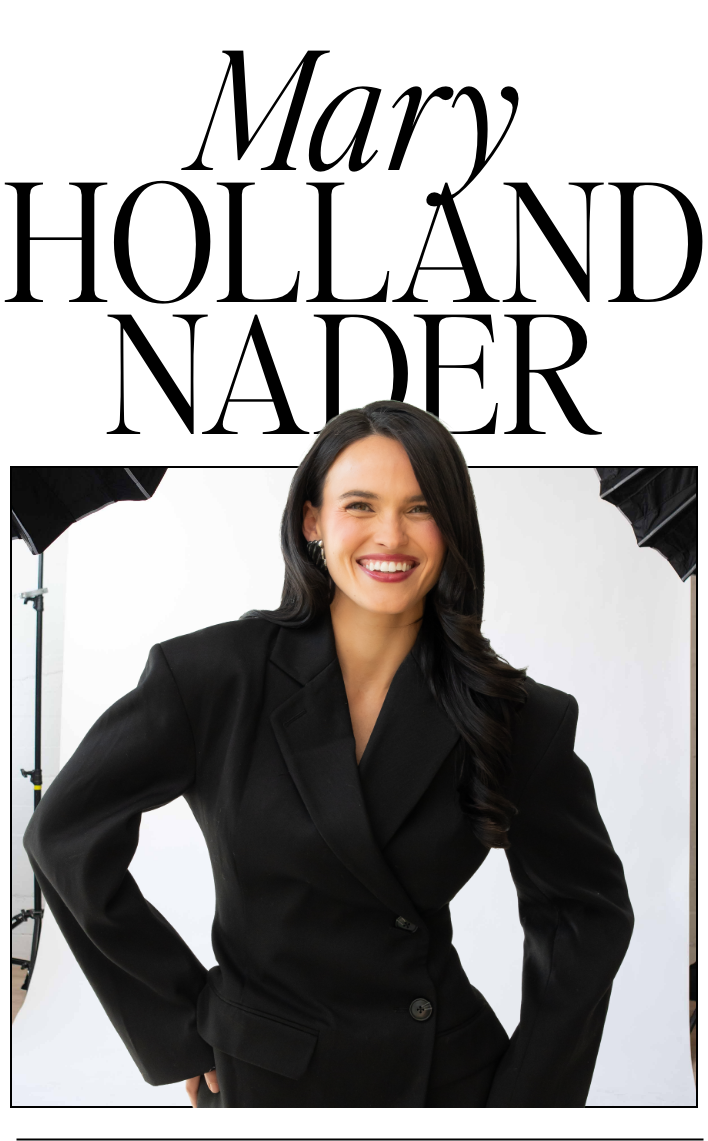
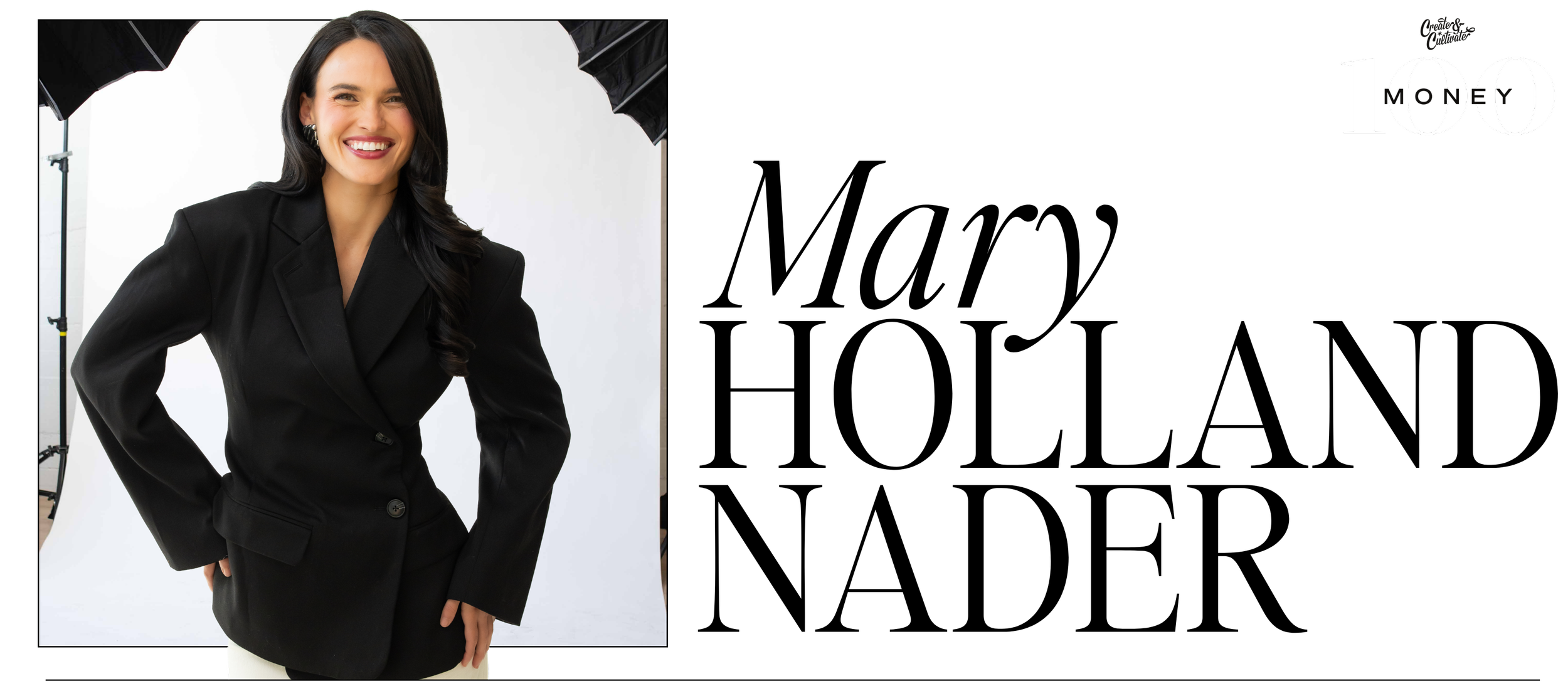
AFTER YEARS SPENT WORKING ON WALL STREET, Mary Holland Nader REALIZED THAT financial expertise ALONE DOESN’T GUARANTEE peace of mind.
Despite building a career in wealth management, she found herself grappling with the same money anxiety and avoidance that affects so many women—especially after leaving the security of a steady paycheck to freelance and join a reality TV show with her sisters.
That personal turning point inspired her to create Mary & Pip, an upcoming financial platform designed to help people navigate the practical and the emotional side of money. Over time, she’s learned that negotiating is non-negotiable, and a simple weekly money ritual has since transformed her relationship with finances for good. Read more about Mary Holland Nader’s journey in the C&C 100 interview below.
Growing up, what were some of the earliest lessons you were taught about money? Was money something that was openly discussed at home?
Money was talked about through a lens of caution at home. Save everything, don't get into debt. I remember my parents budgeting with envelopes labeled "groceries" and "gas." It gave me this low hum of anxiety around money, even when things were okay. And honestly, that's part of what pushed me into finance. I thought if I worked in the industry, I'd never have to worry about it. What I've learned since is that understanding money and feeling at peace with it are two very different things.
You’ve built your career as a financial expert—what initially drew you to this space, and what has kept you in it?
We didn't have much growing up, and I associated finance jobs with stability. I also knew I was a people person, and my dad worked in wealth management, so 21-year-old me decided it was the safest field to enter! I enjoyed helping people but wanted to serve someone other than ultra-high-net-worth clients. I wanted to help people who didn't typically have access to that kind of guidance.
The real turning point was when I left wall street to film Love Thy Nader and freelance full-time. Even I, someone who worked on Wall Street, was feeling anxious, scattered, and avoidant with my money. If it could happen to me, it could happen to anyone. I realized everyone felt stressed, anxious and isolated with their money because the system is set up to make us feel that way! So I knew what I built needed to not only provide solutions for managing money as a freelancer, but also for managing the emotions and anxiety that come with it. That's what Mary & Pip is all about.
What pep talk would you give a friend who’s struggling to negotiate confidently—whether it’s a job offer or raising capital for a business?
Girl, the worst they can do is say no. The person on the other side expects a conversation. If you don’t advocate for yourself, they’ll assume you’re fine with less. And honestly, confidence comes from preparation. Know your numbers before you walk in and it feels a lot less scary.
What’s something you wish more people understood about building wealth over time?
People think it’s about one big decision, but it’s really small, consistent habits that compound quietly over time. The boring approach is usually the one that actually works. The earlier you start, the more time your money has to do its thing. And if you don’t understand something, look it up. Wall Street loves big words, but once you peek behind the curtain, it’s a lot more approachable than it seems. Or just follow Mary & Pip and we will teach you!
How should women think about money in their 20s vs. their 40s?
In your 20s, your biggest asset is time. The earlier you invest, the better. Pay off your credit card in full (statement balance), and hustle. Get competitive with yourself. You have so much energy and curiosity in that phase, so focus on building income, skills, and confidence. Your ability to earn and your time in the market are everything.
In your 40s, the question I get asked most is whether it's too late. It's not. The best time to start investing was yesterday. The second best time is today!
At every stage, the goal is the same. Awareness of what is going on. You can't change what you can't see.
How has your relationship with money evolved as you’ve advanced in your career?
I used to avoid money completely. Checking my accounts, conversations about it, everything. I assumed everything would work itself out. After I pivoted to freelance, when i no longer had a bi-weekly paycheck hitting my account, I realized I had to face it and actually stay on top of it.
Now I treat my finances the same way I treat my skincare or workout routine. Even when I don't feel like checking in, I know my overall health (including my stress level) depends on it. I do a weekly money ritual where I light a candle, set a vibe and do 5 simple steps. Over time, that consistency has made it a lot less scary.
What does financial freedom look like to you these days?
Financial freedom looks like being free from the anxiety and avoidance I used to have around money. When I had a steady job, I avoided checking my spending and accounts because I knew a check was hitting every two weeks. But when your income isn't consistent, you don't have that luxury. You have to stay on top of it.
My weekly money ritual completely changed my relationship with money. As that relationship improved, so did my confidence. I feel so much more independent and comfortable knowing my worth, which has impacted how I save, invest, and negotiate.
That's actually the foundation of what I'm building with Mary & Pip, a behavioral finance app launching later this year. For anyone who has ever felt overwhelmed or avoidant about money. We meet you exactly where you are. Sign up for our waitlist and stay tuned on socials for more!
If someone wanted to start building wealth today but felt overwhelmed or intimidated, what’s the first mindset shift you’d encourage?
Our nervous system sometimes doesn’t know the difference between a lion chasing us and opening our bank account. So remind yourself, out loud if you have to, your body will be okay if you check in. That fear usually comes from repeated avoidance. That’s why my weekly money ritual starts with the smallest thing: just open your accounts. If that’s all you do that week, that’s something! Everything starts with awareness. And if you’re feeling overwhelmed, write down why. What do you not understand? It gives your brain some relief and helps you break things down into something you can actually handle.
What’s the most important financial or career lesson you’ve learned the hard way so other women won’t have to?
Not negotiating early on. I thought if I worked hard enough, the right people would notice. They don’t. You have to advocate for yourself, because no one is tracking your value as closely as you are.
Rapid fire POP QUIZ:
The first thing I do when I wake up in the morning is:
Open my windows for sunlight
A song that describes the era I’m in right now is…
Wickedest by Tems
My current obsession is…
Learning about Behavioral Psychology
If I had one more hour in the day, I would…
It would be a bright hour and I would go for a long walk (guilty of being stuck at my desk)
If I had one more hour in the day, I would…
Calm. Confident. Supported