

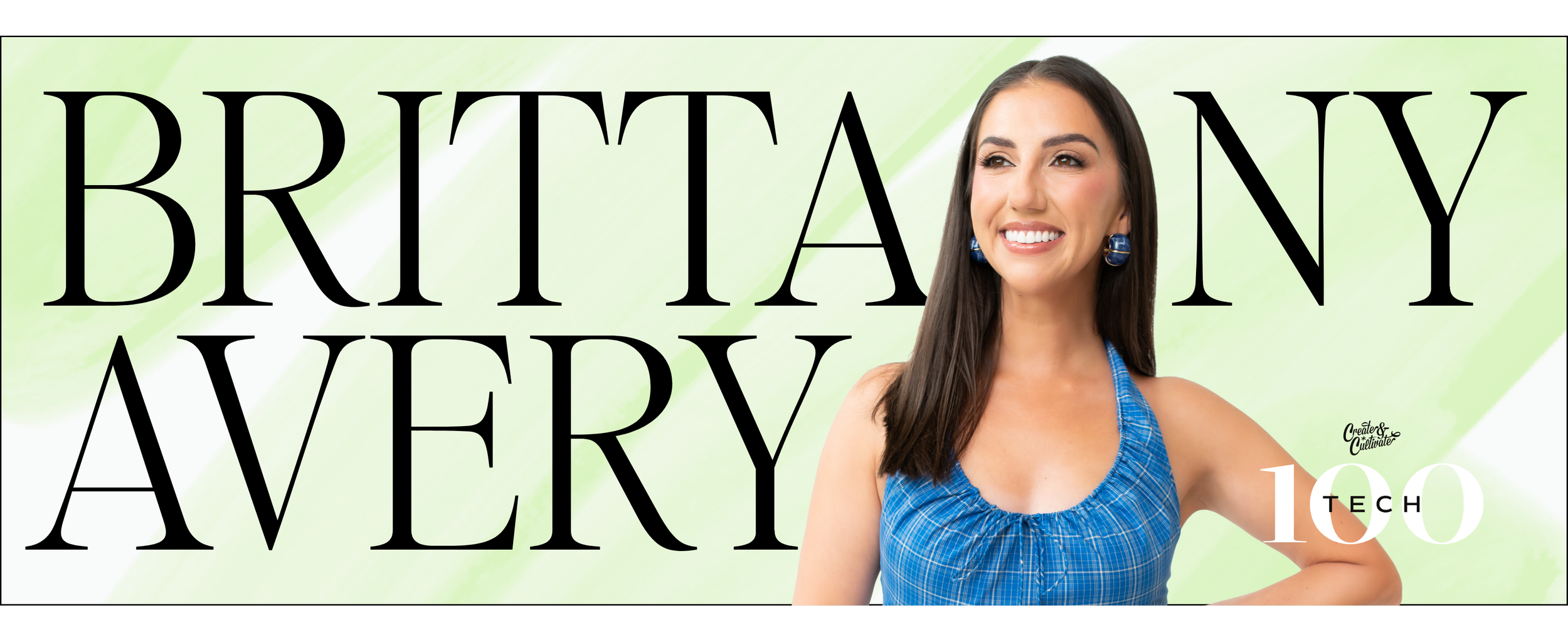
Brittany Avery HAS SPENT NEARLY A DECADE PROVING THAT confidence DOESN’T REQUIRE YOU TO spend big.
As the founder of FashionPass, Avery turned a college-era obsession with stretching every dollar for the sake of a better wardrobe into a business success story. She wondered why women are only able to rent gowns for special occasions. That question led her to build a profitable, bootstrapped business that helps members access designer pieces for everything from first dates to work meetings.
Equal parts fashion visionary and operational powerhouse, Avery has built a vertically integrated company that obsesses over every detail, from proprietary technology to custom-made laundry detergent. At the heart of it all is a bigger mission: to democratize access to confidence and prove that feeling like your best self should never depend on what you own. Read about Brittany Avery's journey in her C&C 100 interview below.
Describe the moment you realized there was a problem in the fashion space that wasn't being solved, and that your idea could be the new solution?
The idea came to me in college, right around the time I'd convinced my dad to pay me my meal plan directly so I could "eat healthy," and instead I lived on $1 oatmeal so I could spend the rest funding my closet. At the time, the only rental options were for big events like gowns, black-tie, and weddings. But I wanted to rent for my actual day-to-day life. First dates, music festivals, Monday meetings. Years later, I was racking up a pretty hefty credit card bill on impulse purchases and finally thought, someone has to fix this, and it might as well be me.
From your standpoint, how does FashionPass stand out from other online clothing subscriptions out there?
We're maniacal about quality control and member satisfaction. We treat every order as if it's our first impression with that member. We've built around our member since day one, and we treat her the way we'd treat our best friend. Everything we do, perfecting fits, obsessing over condition, the way we communicate, all comes back to one thing: delivering confidence. When she opens her box on a Tuesday before a big meeting or a Friday before a first date, she knows exactly what she's getting, and she can rely on the quality, condition, and timeliness of delivery. We're there for her in those moments. We go to insane lengths so our members always show up looking and feeling like the best version of themselves.
What do you care more about right now: perfecting the product or building the right team? And why?
Team, always. One person cannot perfect a product, and in any case product perfection is a moving target, not static. We've spent the last couple of years putting the right people in the right seats, and now I have a group that's obsessed with the problem we're solving and takes more ownership than I ever could have asked for. I've worked hard to build a company that doesn't depend on any one person, including me, and that's exactly the kind of organization I want to keep building. Our team is absolutely relentless, and because of them, I never have to choose.
What's been harder than you anticipated while building your brand?
That I only have one speed. When I do something, I'm 100% all in, and FashionPass and my family get all of me. Everything else has taken a back seat: hobbies, friends and activities, and a lot of the version of me that existed before kids and the company. Having Ella and Cody ironically made prioritization easier as they forced me to get ruthlessly clear about what matters. The non-negotiables are my husband (who thank goodness is my co-founder), my kids, and this company. My circle is small, and the people closest to me get it.
Did you raise capital for your business—and if so, what surprised you most about the process?
No, we've been bootstrapped from day one, and profitable, in large part because of it. What surprises people most is that we chose this path. The assumption is that capital is the goal, and often entrepreneurs celebrate a financing round as if that is the end goal when really it is just the start. For us, the constraint of self-funding was a feature, not a bug. Because every dollar was ours, we had to think critically about every decision instead of throwing money at problems. That's why we're one of the only fully vertically integrated players in the category. We built every piece of the operation ourselves, from the technology to fulfillment. We even make our own laundry detergent.
AI is undeniably the biggest thing in tech right now, and it's changing everything around us. How should women entrepreneurs be leveraging it to level the playing field? How are you using it in your business?
AI is only as helpful as the data you give it. We're fortunate to have millions of data points across virtually every sector of our business, so we're using AI to do analysis in minutes that used to take us hours, days, sometimes weeks. We're also building in-house software at a pace that would've taken a product manager and a dev team months. Now it's days. The best part: individual team members are becoming their own product managers and deploying their own tools. My advice for women entrepreneurs is twofold. First, if you're not already, stop using AI to just draft emails and start using it to build the team you can't afford to hire yet. Second, AI properly leveraged is both a cost saver and a productivity enhancer. Don't forget the second piece of that.
What's your most common AI prompt?
Some version of “What am I missing? Be brutally honest” or “Apply Charlie Munger’s inversion principle to this set of facts.” The best thing AI does for me is pressure-test my thinking.
What does your current tech stack look like—and how has it changed your daily output?
Our tech stack is roughly 95% proprietary, by design. On day one, Joel told me, "if you can dream it, I can build it," and we've taken that literally. Every piece of technology we've built solves a specific problem we've lived through, with one of three goals: (1) drive efficiency, (2) tighter quality control, and/or (3) enhance member experience. Often, those goals are mutually reinforcing. We don't run on anyone else's software, and that's deliberate.
Claude and Antigravity have more recently turned every team member into a Product Manager within their respective business. Our operations, customer service, buying, and marketing teams are independently designing tools, writing code, and shipping new features daily. Work that used to require our full dev team and months of runway.
The pace of AI in early 2026 has fundamentally changed what a 200-person company can do. We're operating with the speed and autonomy of a team three times our size.
What do you want to build beyond just the FashionPass brand itself?
What I'm building is bigger than a rental company, I'm democratizing access to confidence for women. Fashion has been one of the last categories where confidence is tied to what you own. Women aren't buying clothes, they're seeking confidence and clothes are how they express it. Confidence is the product, clothes are the medium. She doesn't have to own the clothes to feel confident.
Rapid fire POP QUIZ:
The first thing I do when I wake up in the morning is:
head downstairs for pilates at 5:45 AM, then wake up my two toddlers.
If I had one more hour in the day, I would:
spend it with my kids - or go on a date with my husband.
A song that describes the era I’m in right now is:
Life of a Showgirl.
My current obsession is:
Claude + the boho revival
Three words to describe the legacy I want to leave behind:
Reimagined the closet.