

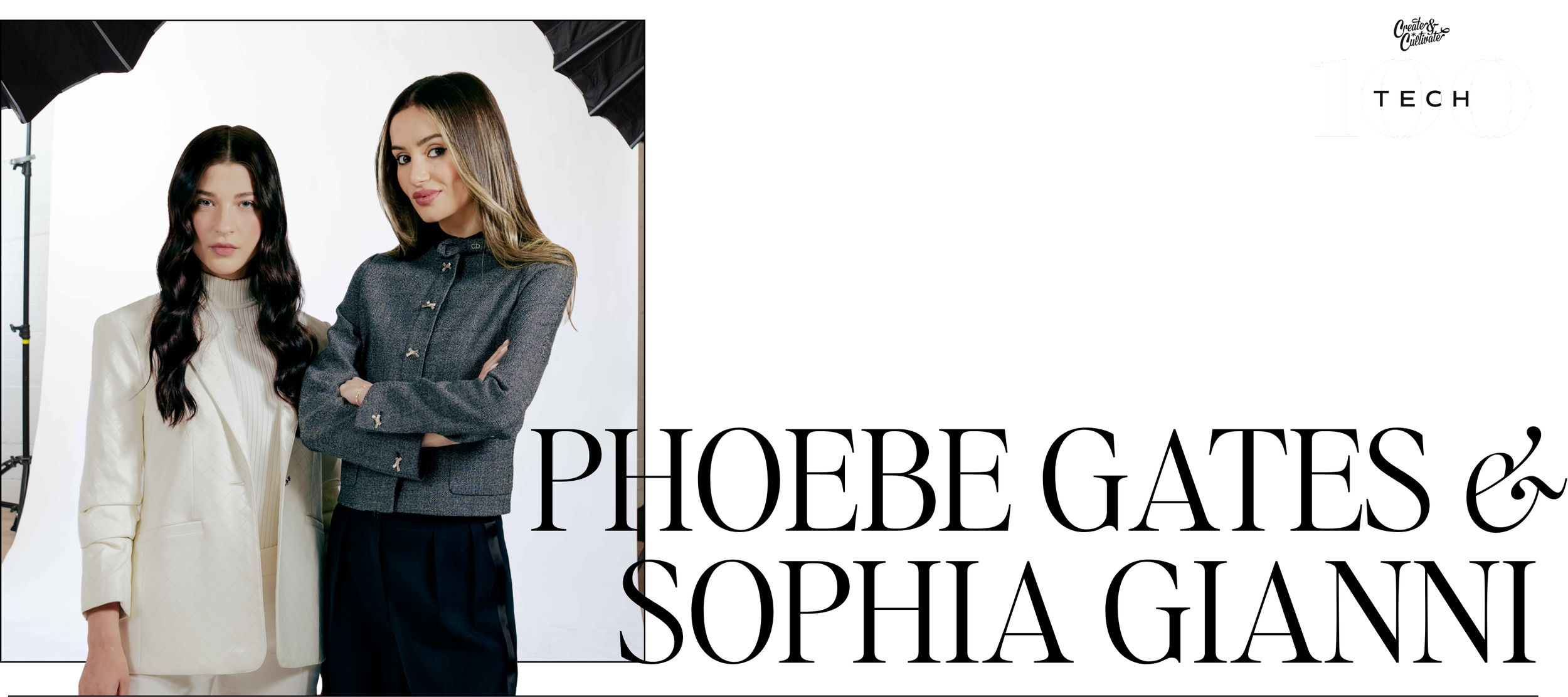
PHOEBE GATES AND SOPHIA KIANNI WANT TO change HOW PEOPLE shop online.
While students at Stanford University, the pair saw a disconnect between the rapid advances in AI and the fragmented experience of shopping for fashion in the resale market. Their answer was Phia, an AI-powered platform where you can search secondhand sites, compare options, and make smarter purchasing decisions.
Since launching, Gates and Kianni have raised significant venture backing and built a fast-growing community of shoppers who value both style and sustainability. Their mission is to prove that a new generation of women founders can and should be building the next wave of transformative tech. Through Phia and their podcast, The Burnouts, they are opening up the entrepreneurial journey and inspiring others to turn ambitious ideas into reality. Read about Phoebe and Sophie’s journey their C&C 100 interview below.
Describe the moment you realized there was a problem in the fashion industry that tech wasn’t addressing, and that your idea could be the new solution?
SOPHIA: At Stanford, we were watching AI reshape how people interact with information across industries, and it became obvious that commerce was next. But my own shopping experience still felt incredibly outdated, especially as someone who loved secondhand fashion. Finding the best resale options meant searching site by site with no easy way to see everything in one place, which is what sparked the original idea for our Chrome extension.
PHOEBE: Change was happening across consumer AI, and yet even as CACs multiplied for brands we saw no adaptation to the consumer online experience. It remains unpersonalized, unsocial, and users are left staring at a static product pages across 20 different tabs that have no understanding of their sizes, preferences, and how this item will actually fit into their closet
We both appreciate fashion: we were the girls in our dorm room scrolling for hours, trying to find the best dress on secondhand platforms for a spring formal, or hunting for a designer bag secondhand. Yet, the research was inefficient and completely fragmented. We knew someone had to transform commerce and we were ready to take on that challenge
What risk have you taken as a founder that’s changed the trajectory of your business?
PHOEBE: Launching before we felt fully ready, and doing it publicly. If we'd waited until Phia was perfect, it might never have launched. The reality Sophia and I live every day is that building a company is a stacking of lessons in rejection - a user hates a feature, an investor doesn't get the pitch. You have to be bullish enough to keep going. Not letting perfection be the enemy of progress is genuinely how we got here. You learn much faster when real people are using what you've built.
SOPHIA: For me, it was leaving Stanford after my junior year and moving to New York to work on Phia full time. It was a real leap of faith, because I was stepping away from a path where I had already built years of momentum and into something far less certain. That decision changed the trajectory of the business because it meant fully committing, moving faster, and building Phia with the intensity it needed.
“The product has to be strong enough that people actually want it, but the only way it gets there is with the right team.”
What do you care more about right now: perfecting the product or building the right team? And why?
PHOEBE: They're completely tied. The product has to be strong enough that people actually want it, but the only way it gets there is with the right team. When Sophia and I first started, we were doing everything — taxes, marketing, all of it. Being able to bring on A star high agency talent is what takes the product to the next level. That's where we are now, growing the team while driving the product forward, fueled by the voices of our community of over 1 million shoppers.
SOPHIA: It’s both, because you cannot build the perfect product without the right team behind it. Early on, we were doing everything ourselves, but what matters now is building a team of exceptional people who can push the product further than we ever could alone. The right team is what makes a great product possible.
What’s been harder than you anticipated while building your brand?
PHOEBE: The pace. There isn’t really a moment where it slows down or feels figured out. Every stage introduces a new set of problems, but I wouldn’t have it any other way.
SOPHIA: Probably the constant evolution. Every stage brings a new challenge, so you have to get comfortable learning quickly, staying resilient, and treating hard things as part of the job.
Did you raise capital for your business—and if so, what surprised you most about the process?
Both: Yes, we’ve raised $43 million to date, most recently a $35 million Series A. Fundraising is about choosing a long-term partner, not just taking capital. You want people who really understand the vision, choose you back, and genuinely resonate with the use case, whether that was our Stanford professor backing us early or investors like Kris Jenner and Hailey Bieber who immediately understood the consumer.
AI is undeniably the biggest thing in tech right now, and it’s changing everything around us. How should women entrepreneurs be leveraging it to level the playing field? How are you using it in your business?
PHOEBE: Everyone should be learning how to use AI to make their workflow more efficient. Only 2% of VC funding goes to female founders which means entire categories of women's problems aren't getting solved. AI changes that equation. It lowers the barrier to building, compresses the time from idea to proof, and means you don't need to wait for anyone to give you permission or a seat at the table.
SOPHIA: I think the next step is using AI to actually audit how you work, identify repetitive patterns, and figure out what can be streamlined. We all now have access to something that can function like a personal assistant, and the people who use that well are going to have a huge advantage.
What do you want to build beyond just the brand itself?
PHOEBE: I am proud of a generation of women who are deciding not to wait for permission. With that mindset, we want to build a real community around Phia where people help each other shop smarter and feel more confident in and conscious about what we are consuming.
SOPHIA: We also started The Burnouts to chronicle the journey publicly and hopefully inspire more entrepreneurs to build alongside us. For us, it is bigger than a company, it is about bringing people into the process and showing what building really looks like.
What does your current tech stack look like—and how has it changed your daily output?
BOTH: Our stack is intentionally lean: Notion, Slack, Google Suite, Figma, Linear, Mixpanel, plus our own internal AI systems.
The expectation across the team is high ownership. If something can be improved, we don’t wait, we build. AI isn’t just supporting productivity, it’s embedded in how we operate. That’s what allows a small team to move with a lot of speed and clarity.
Rapid fire POP QUIZ:
The first thing I do when I wake up in the morning is:
PHOEBE: Check my phone. I'm working on that bit.
SOPHIA: Check my Slack, text, and email notifications.
If I had one more hour in the day, I would:
PHOEBE: Get to inbox 0
SOPHIA: Keep working.
One thing most people would be surprised to know about me is…
PHOEBE: I have a miniature dachshund who is certified nuts.
SOPHIA: I love being alone and reading. I do my best work at 2 am in dark corners of solitude.
A risk I took in my career that paid off was…
PHOEBE: Rebuilding Phia entirely for mobile after initially building for desktop.
SOPHIA: Walking away from a path I'd spent years building to go all in on Phia.