Delegation Isn’t a Skill Issue, It’s a Control Issue
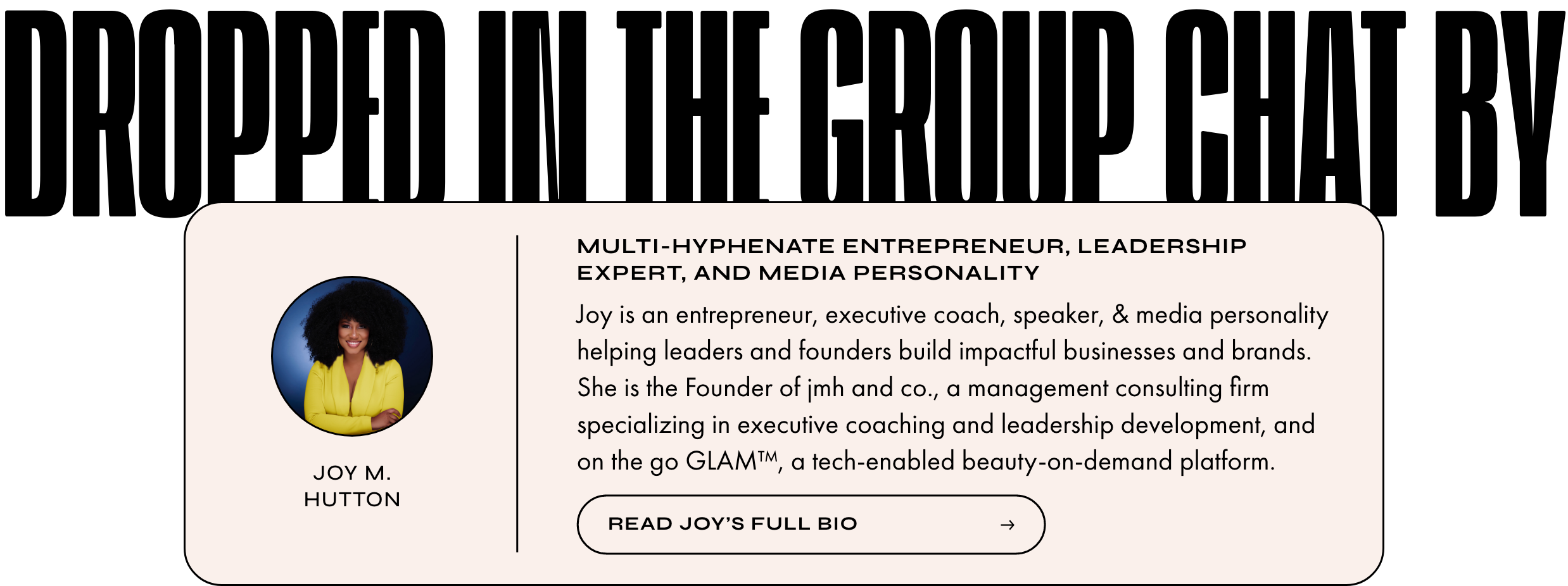
🗓️ Joy M. Hutton POSTED TO THE GROUP CHAT July 23, 2026
Most high-achieving women don't struggle with delegation because they don't know how. They struggle because, on some level, they don't want to let go.
Especially women who are used to being the one who figures it out, gets it done, and makes sure everything runs smoothly. And that makes complete sense. You built this. You figured it out when no one else could. You carried it when it was heavy and messy and unclear. Your name and your reputation are attached to the outcome. So handing something off doesn't just feel uncomfortable; it feels risky.
And what if they don't do it the way it needs to be done? What if it reflects poorly on you? What if it creates more work than it saves?
So you keep it. You tell yourself it's faster to just do it. And maybe it is, this time.
But over time, "I'll just handle it" becomes "I have to do everything." And what started as efficiency has turned into a ceiling. So the idea of handing something off feels… again, uncomfortable. And this comes at a cost.
What the cost actually looks like:
It's not just stress or a packed calendar. It shows up as slower business growth because your bandwidth is maxed out on tasks that don't require your level of thinking. It's limited capacity to take on higher-value opportunities because you're buried in work that someone else could do. It's the constant exhaustion of being the person everything flows through, the approver, the fixer, the backstop on every single thing.
You've made yourself the bottleneck in your own empire. And the longer it goes on, the harder it becomes to imagine it working any other way.
This is where the 3Ds come in:
Do: Make a list of the things you have to do day-to-day, from admin to the delivery of your products and/or services. These are the things that require your thinking, your leadership, your decision-making.
Dump: Look at your “Do” list and cross out the things you do not have capacity to do or the things you do not want to do.
Delegate: The items on your “Dump” list are things someone else can own, not just assist with. Define the roles and responsibilities and hire someone to do the tasks.
The mistake people make is knowing they need help but not knowing what they need help with. So they hire someone, and they still end up doing the work themselves. That’s not delegation. That’s micromanagement.
Real delegation requires three things: clarity about what success looks like, trust that someone else can get there, and genuine willingness to let the work be done differently than you would do it.
When your identity is built around being the person who does everything well, someone else's "different" can feel like a threat. It can feel like a drop in standards, even when it isn't. And that’s the part that challenges people the most.
But here's the truth, the goal was never for things to be done your way. The goal is for things to be done well. And the leaders who scale, the ones who build something that outlasts their personal capacity, are the ones who learned to separate those two things.
The actual shift in what leadership means:
Your role is not to do everything. Your role is to make sure everything gets done.
One version of leadership keeps you at the center of every task. The other keeps you at the center of the vision, the standards, and the decisions that actually require your seat at the table.
When you stay in execution mode past the point where it serves you, you don't just limit your growth. You limit the growth of everyone around you. Because the people who could be stepping up, building capability, and taking ownership are waiting for you. Delegation isn't a management technique. It's how you build a team that can function at the level your next chapter requires.
So go back to the 3Ds exercise. The ceiling you keep hitting isn't a capacity problem. It's a letting-go problem. And the most powerful version of you, the one operating at the level you're actually building toward, isn't doing more.
You’re doing what only you can do, trust the rest to people you’ve built to handle it. Let go!