Identity Shifts That Come With Growth (And How to Navigate Them)
🗓️ Amina AlTai POSTED TO THE GROUP CHAT June 18, 2026
Who are we if we are not achieving?
Most of us only know who we are when we’re achieving something. You know, those nose-to-the-grindstone moments where you’re building a new company, launching a new product, authoring a new book. We’re ambitious, get-stuff-done career people. That’s who we are.
But what about the moments in the aftermath of growth where it looks like nothing is happening? Like after the launch or the exit. Or after the job loss? Who are we then? And how do we answer the goading question so many friends and peers will invariably ask…what’s next?
I know these moments well because that is often when clients seek me out. When they feel like they’ve lost themselves because they’ve finished creating the thing their entire life was architected around, but instead of fulfillment, they feel a massive emptiness. If we’re not building and creating, who and what are we?
But what if I told you that in these aftermath moments, you are still you and you are still ambitious, even if you are achieving nothing?
In my book, The Ambition Trap, I explore how ambition moves in cycles, just like a perennial flower. It starts with a seedling of desire: I want to grow. We nurture and water that desire by caring for ourselves. We pace our growth, and inch by inch we rise. We become as tall as we can in each moment, based on our inner and outer states. Our gifts come into full bloom, and we have a seasonal peak. It’s glorious. And then the winds shift, and we feel we can grow no more. So, we pause, slow down, and go back underground to prepare ourselves for another season. The cycle repeats over and over again.
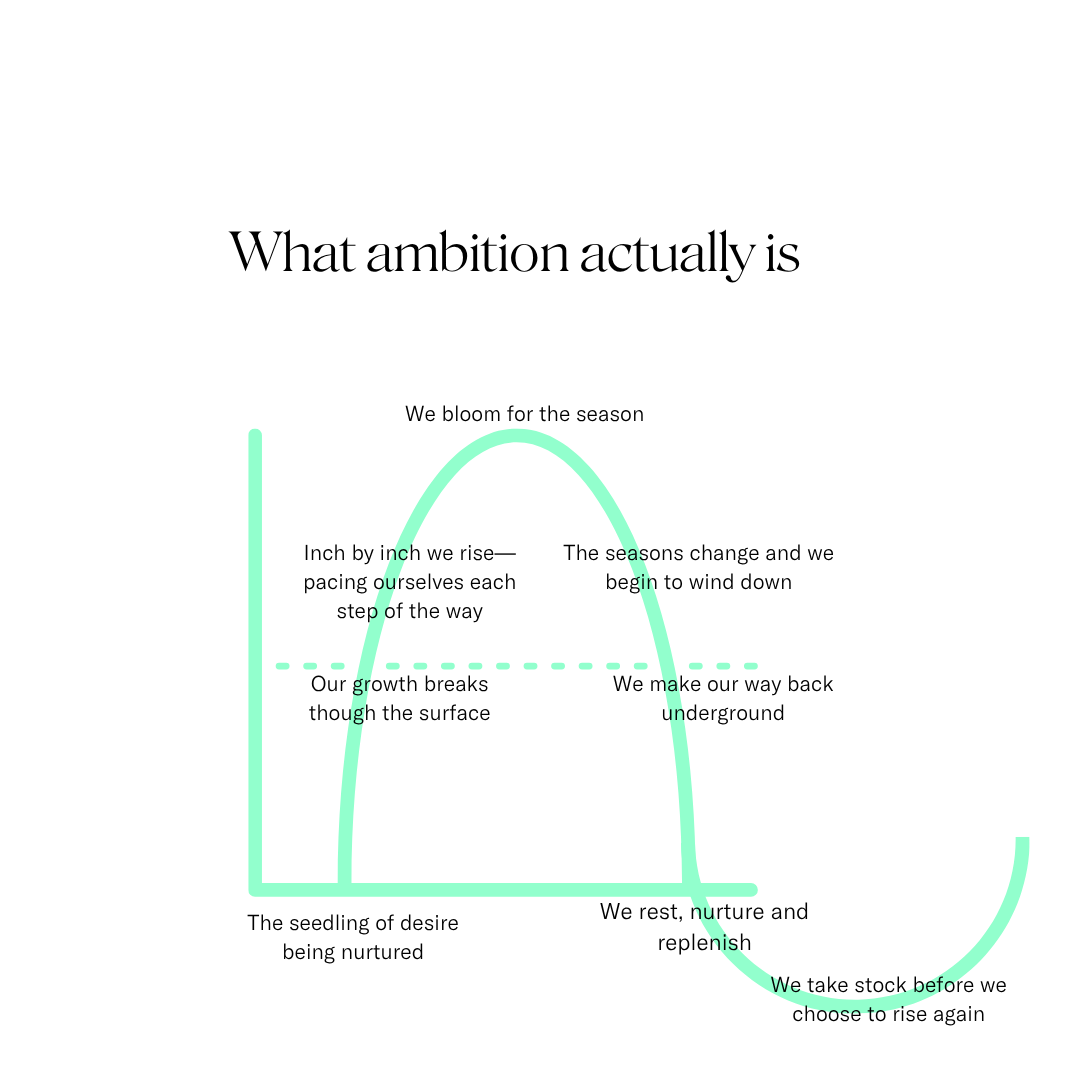
But it’s those underground moments that are the scariest. Where we lose the thread of who we are because we overidentify with the doer parts of us. I’ve been there more times than I can count, and so have my clients. And we usually try to muscle our way to the next climb so as not to feel the discomfort. But that rarely works.
However, I like to think of identity like a prism or a crystal. Crystals have all these different edges and points, and those edges and points are like aspects of our personality. But as I mentioned before, most of us ambitious women have overidentified with the doer part to the detriment of the other aspects of self. So, when we’re not achieving, we feel a deep ache of vast nothingness. But we are so much more than our climb. We are so much more than our achievements, and those other parts are just as worthy.
There is the playful part of us. The sensual part. The creative part. The deeply rested part. The spiritual part. The younger self who just wanted to be loved and safe. The future self who craves expansion but not at the cost of her well-being.
And often, when achievement quiets down, these neglected parts finally have room to speak.
This is why identity shifts can feel so destabilizing. Because growth is not just about becoming more. Sometimes growth asks us to loosen our grip on the identities that once kept us safe. The high-achiever. The fixer. The productive one. The person everyone relies on. Those identities may have helped us survive or succeed, but they are not the entirety of who we are. And often, when we turn the volume down on them, we allow their counter-quality to flourish and drive our lives forward.
If we allow it, these quieter seasons can become an invitation into a more integrated relationship with ourselves. Not a lesser self (I know where your brain just went!) A fuller one!
One of the most healing things we can do in these moments is get curious about the parts of ourselves that emerge when achievement is no longer center stage. Instead of immediately trying to optimize our way into the next milestone, we can ask:
What else is here?
Who else is here?
What other aspects of me want to come forward?
A Simple Reflection Practice
One exercise I often give clients is inspired by Internal Family Systems (IFS), a therapeutic model that views us as having many different “parts” within us.
Take out a journal and write down:
Who am I when I am not producing?
Then notice what parts of you respond.
Maybe a fearful part says:
I’m irrelevant.
Maybe a tired part says:
Thank God.
Maybe a younger part says:
I don’t know who I am without gold stars.
Maybe the wise self quietly whispers:
You are allowed to exist beyond your usefulness.
Instead of trying to silence any of these voices, simply listen. Get curious. Ask each part:
What are you afraid would happen if we slowed down?
What do you need from me right now?
You may be surprised by what emerges. You will be surprised by what emerges.
Because the goal of growth is not to become a machine for endless achievement. That way of being will eventually break us. The goal is to become more fully yourself. And sometimes the most important transformations happen underground, where no one can applaud them yet.