Storytelling is a Leadership Skill
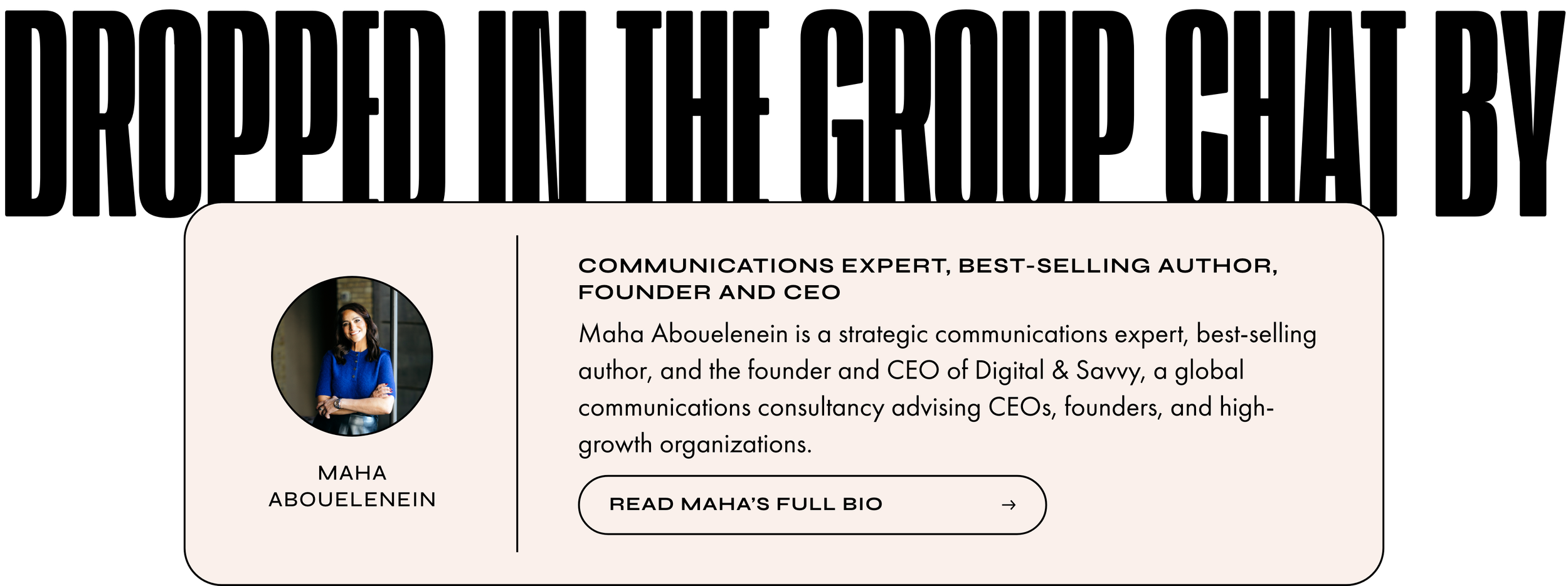
🗓️ Maha Abouleinein POSTED TO THE GROUP CHAT May 7, 2026
Most leaders underestimate how much of their success comes down to how well they communicate.
Not just what they say, but how clearly people understand it.
I’ve spent decades advising founders, CEOs, and global brands, and I’ve seen the same pattern repeat itself across industries. The leaders who stand out are not always the ones with the best ideas. They are the ones who know how to communicate those ideas into stories that people understand, remember, and believe in.
Leadership is not just about having a vision. It’s about making that vision clear to other people.
A strong narrative answers three simple questions: What are we doing? Why does it matter? And why should anyone believe in it? When leaders can answer those questions with clarity, they create alignment. When they can’t, they create confusion, and confusion is one of the fastest ways to lose trust.
Data supports decisions, but story is what brings people along. It’s what turns information into understanding. It’s what makes people care enough to act.
This is true inside an organization just as much as it is outside of it.
The best leaders don’t just communicate tasks. They communicate meaning. They help their teams understand what they are building, why it matters, and how their work contributes to something bigger. That’s what creates engagement. That’s what builds culture.
Culture is not something you write down. It’s something you reinforce every day through how you communicate. The stories you tell about your company, your values, your priorities, shape how people show up and how they make decisions when you’re not in the room.
The same applies externally. Customers, partners, and stakeholders are not just evaluating what you do. They are evaluating how you communicate it. If your message is unclear, inconsistent, or overly complicated, you create distance. If it’s simple and grounded, you build trust.
That’s what storytelling does. It removes friction. It makes things easier to understand, easier to remember, and easier to believe in.
This is where personal brand becomes part of leadership.
Every leader has a narrative, whether they are intentional about it or not. In today’s digital world, people are forming opinions long before they meet you. They are reading your content, listening to how you speak, and paying attention to how you show up.
If you are not shaping that narrative, it will be shaped for you.
There is also a misconception that storytelling is about being visible. Posting more, saying more, being everywhere. But storytelling is not about volume. It’s about clarity.
The strongest leaders are not the loudest. They are the clearest.
They know what they stand for. They know how to explain it. And they repeat it consistently.
If people cannot explain what you do, what you believe, or how you lead, they will not remember you. And if they don’t remember you, they cannot follow you.
What sets effective leaders apart today is not how much they communicate, but how well they communicate. They lead with perspective. They simplify complexity. They help others make sense of what is happening, especially in moments of uncertainty.
That’s what builds trust. And trust is the foundation of leadership.
The cost of getting this wrong is significant. When messaging is vague, alignment breaks down. When communication is inconsistent, credibility erodes. When leaders fail to articulate a clear narrative, they create uncertainty, and uncertainty slows everything down.
The shift I encourage leaders to make is this: stop thinking of storytelling as something you add at the end. It is not decoration. It is not a presentation skill.
It is how you lead.
It shapes how people understand your vision, how they align with your direction, and how they decide to trust you.
At its core, storytelling is about making meaning clear. It is about helping people connect the dots between what you are doing and why it matters. It is about turning ideas into something others can believe in and act on.
The leaders who understand this don’t just manage teams or run companies. They create clarity. They build alignment. And they lead in a way that people want to follow.
Storytelling is not optional.
It’s leadership.