
How Putting Your Health and Happiness First Can Improve Your Career
And benefit your company, too.

Photo: Smith House Photography
In 2016, the World Health Organization (WHO) turned their attention to a problem so severe and damaging they called it the “health epidemic of the 21st century.” That epidemic was stress. Fast-forward to 2020, and the WHO has updated its handbook of diseases to include burnout, calling it an "occupational phenomenon" characterized by "feelings of energy depletion or exhaustion, increased mental distance from one's job, or feelings of negativism or cynicism related to one's job.”
We are the first to admit that 80 hour work weeks and side hustles are the new norm. While we certainly aren’t going to be the ones to tell you to stop working your butt off if that is what you want to do, that doesn’t mean we don’t acknowledge that putting your health and happiness above your work is necessary for your general wellness. In fact, when you take care of your personal needs you may find that it benefits your career just as much as your well-being. Scroll on to find out how.
What Stress Does to Your Mind
Stress can cause physical maladies such as headaches, jaw clenching, teeth grinding, muscle spasms, heartburn, and nausea, as well as back, neck and chest pain. Even if you are a super human who doesn’t feel the physical side effects of exhaustion and stress, you might be falling victim to non-physical symptoms such as forgetfulness, disorganization, confusion, trouble learning new information, difficulty in making decisions, nervous habits and overreaction to petty annoyances. To top it all off, according to The American Institute of Stress you may also experience reduced work efficiency or productivity.
Carve Out Some “Me” Time
Everyone's wellness needs are going to be different. Some may not feel their best if they don’t take the time to cook healthy meals. Others may be strongly affected by not being able to spend as much time with their loved ones as they would like. Bookworms may feel more anxious if they can’t spend quiet time reading and escaping their troubles before bed. Think about what is important to you and what makes you feel like your best self, then carve out the time to do it. Seriously, add it to the to-do list and make sure it gets done like any other vital task.
Exercise is a great way to take care of both your physical and mental health at once. Physical activity releases endorphins in the brain and is proven to lower stress levels as well as symptoms associated with mild depression and anxiety. It can also help relax muscles and relieve tension in the body. When you don’t have time to squeeze in a workout, try having a good laugh. Laughing also releases endorphins, which are significantly more powerful than the pain-relieving drug morphine. If relieving stress and pain isn’t enough to convince you, then consider this: endorphins boost immunity which could save you a lot of out of office days come flu season.
It Benefits Your Company, Too
It would financially benefit companies to look out for their employees’ health and happiness, not to mention be the decent thing to do. In fact, workplace stress costs U.S. businesses $300 billion annually. On top of lost productivity, work-related stress causes 120,000 deaths and results in $190 billion in healthcare costs yearly. If employers value the wellness of their employees they should ensure that they are working manageable hours, taking lunch breaks, encourage time off and create a generally positive work environment.
You are entitled to take a breather, play hooky, nap a day away, laugh, cry, whatever it is that will make you feel lighter. Never skip a doctor's appointment for a meeting, leave a few minutes early to make it to that yoga class, go home when you aren’t feeling well, turn off your phone when you are on vacation. If you do this you will be more creative, in control, calm, productive, focused and most importantly happy.
About the Author: Jacqueline DeMarco is a freelance writer with experience in editorial and news writing.
This story was originally published on September 2, 2017, and has since been updated.
Up next: 10 Women Who Have Your Dream Job on How They Fight Burnout, Stay Motivated, and Get Re-Energized for Work
MORE ON THE BLOG
Ask an Expert: How to Adjust Your Business Strategy During the Coronavirus Crisis, According to a Business Coach
“This is a time to be swift, but not reactive.”
We’ve been spending a lot of time at Create & Cultivate HQ discussing how we can best show up for and support our community during this uncertain time. Community is at our core, and connecting with others through one-of-a-kind experiences is what we love to do. While the world has changed, our mission has not. We’re committed to helping women create and cultivate the career of their dreams, which is why we’re proud to announce our new Ask an Expert series. We’re hosting discussions with experts, mentors, and influencers daily at 9 am, 12 pm, and 3 pm PST on Instagram Live to cure your craving for community and bring you the expert advice you’ve come to know and love from C&C. Follow Create & Cultivate on Instagram, check out our Ask an Expert highlight reel for the latest schedule, and hit the countdown to get a reminder so you don’t miss out!

Photo: Courtesy of Gretchen Jones
In times of crisis, businesses are put to the test—supply chains are disrupted and profit margins are compromised. And the COVID-19 crisis is certainly no exception. As our founder and CEO Jaclyn Johnson says, a company’s success comes down to how it pivots and responds during times of great uncertainty. However, as one of today’s Ask an Expert pros reminded us, “Now is the time to be swift, not reactive."
For some #realtalk on how to pivot a business, manage expectations, and lead with purpose during a crisis, we tapped Gretchen Jones, a strategic business advisor (she advises our CEO), for a special installment of our wildly popular Instagram Live series, Ask an Expert. Read on for three things you should know about adjusting your business strategy right now. If you missed the conversation, you can watch it in full here, and be sure to tune into our next Ask an Expert conversation on Instagram Live.
1. I want to be proactive during this time of quarantine—what can I do to reach my business growth goals and hit the ground running when things go back to normal?
“Achieving business goals right now is theoretical. More than thinking about growth, work on managing a healthy relationship with your business, not the potential capabilities ahead of you. Look at this slowdown as an opportunity to rise to the occasion, and look at initiatives that you’ve wanted to dive into but haven’t had the time to until now.“
2. I’m a small business owner and I don’t know how much longer I can afford to pay our staff while we’re closed during this time of quarantine. What advice can you share?
“Being a good boss sometimes means that moving through the pain [and going through with layoffs] is doing what is right for your community because you acted with integrity. You holding onto your staff because you’re afraid of laying them off in the future is going to complicate they’re ability to gain access to unemployment benefits. Take care of them now so that they will want to come back and work for you.”
3. How can I be a better, more supportive leader for my team, especially now that we’re all working remotely?
“The first thing is communication. Lead with humanity first in all communication. And, set goals. Real goal setting is about making sure your team knows that they have purpose and value and make sure that the expectations are really clear. Set benchmarks or KPIs (key performance indicators) so that you have really thoughtful ways of checking in with your team. Most importantly, hold yourself accountable by being better and more communicative with your staff.”
About the Expert: Gretchen Jones is a strategic business advisor and public speaker, as well as an award-winning design director, ambassador for sustainability, and NLP practitioner. She works with entrepreneurs and companies to develop future-minded, visionary approaches to ourselves and our work. Her methodology brings a directional, mindful lens of reflection to processes and belief systems, inside and outside of our businesses.
Gretchen has generously offered Create & Cultivators a special discount. Use the code gJLOVESC&C for 33% off Critical Conversations for the next three months. The code expires June 1st and can be up to three times.
Tune in daily at 9 am, 12 pm, and 3 pm PST, for new installments of Ask an Expert.
Follow Create & Cultivate on Instagram, check out our Ask an Expert highlight reel for the schedule, and hit the countdown to get a reminder so you don’t miss out. See you there!









Slow Stories: Creating and Consuming Content During the COVID-19 Outbreak
“We've never had more tools at our disposal to create content that inspires action.”

Photo: Courtesy of Slow Stories
The spread of COVID-19 has upended the business community on a global level. However, living in an age of profound interconnectivity has brought people together in ways that we never expected—especially on social media.
Like so many others, I've tirelessly refreshed my news and social feeds and watched as they've unearthed a variety of responses to the uncertainty that we're all facing. Recently, I've also ruminated on the ways content can play a role in facilitating productivity in a time that will inevitably call for slowing down in nearly every aspect of our lives.
In one of my earlier columns, I outlined a few key pillars that our initial podcast interviewees attribute to the slow content movement. But as I look at the below touchpoints again (and in the context of present-day challenges), I find myself thinking about how we can take these one step further:
Slow content provides value and purpose.
Slow, thoughtful content has a clear intention. Whether it is to inspire or educate, creating content in this climate forces us to think about how we can provide value beyond our immediate business goals. Ask yourself: Can I provide value to my community by sharing a founder anecdote or reposting a fun image that evokes laughter? Even in a professional context, times of uncertainty offer the opportunity to create value for our customers in new (and necessary) ways.
Slow content considers data and fact-checking.
Content can be an incredible tool to drive conversations forward. Still, the spread of misinformation can also make it difficult to discern the difference between what is fabricated and what is real. During times where there is an uptick in sharing information, creators and businesses can engage with their community by using content to call attention to credible institutions and outlets.
Slowing down our relationship to content makes us nicer, more well-rounded people.
In a rapidly-changing news cycle and digital sharing landscape, slowing down our relationship with content can create more mental runway to think about the things that add value to our lives (beyond our devices). In the case of a global pandemic, finding a balance between staying aware and engaged while establishing healthy digital consumption habits will be essential in how we relate to one another through this trying time.
With so much hanging in the balance, our professional endeavors are certainly no exception. Many people in my own network have begun to think about how content and storytelling will play a role in their brands over the next few months. Below, I'm sharing a few things to consider as we recalibrate our routines and work through the challenges that are becoming increasingly present in our digital age.
Re-evaluate your communications strategy.
When there's an increase in online communication, content creators and business owners have the opportunity to streamline—and in some cases, reevaluate—their content, PR, and brand messaging so that the message they wish to convey is consistent across all communications channels. Use this time to think about what your brand wants to say, how you want it to come across, and how it can stay in-line with your usual voice and tone to avoid sounding inauthentic to your followers or customers.
Create content that inspires social/philanthropic participation.
We've never had more tools at our disposal to create content that inspires action.
However, it's essential to consider how to do this in a way that encourages inclusivity. From sharing charity donation stickers on Instagram Stories to creating bespoke content that ties in more personal brand narratives, creating content that can diversify how your community can get involved can elicit a powerful response. Thinking holistically about content in this way will also create more avenues for charitable goals to be reached, too.
Pause the post.
One of my interviewees said it best: "There is power in the pause." As we become more inundated with content from all directions, we have another option at our fingertips: to pause and step away. As consumers of content, we often forget to be discerning in what we choose to engage in a landscape that demands so much of our time and attention. Communicating what you want (and don't want!) from your favorite brands can be valuable feedback for business leaders to make informed decisions about their future storytelling and brand strategies. At the other end of the spectrum, if you're a content creator and unsure about how to proceed with your current storytelling efforts, use this period to take a step back and reflect. Your followers will thank you for it in the long run.
The points I've laid out in this article only scratch the surface of what we can be doing online. In any case, I hope this piece provides a jumping-off point for you to make thoughtful decisions about the kinds of stories you or your brand wants to tell in the near future. For more insights and musings on creating slow content and stories with longevity, I invite you to check out the ”Slow Stories” podcast (stay tuned for new episodes launching this spring) along with articles from my column here. And, most importantly, I wish you all health and happiness in this tumultuous time.
About the Author: Rachel Schwartzmann is the founder and CEO of The Style Line LLC. She created The Style Line in late January 2011 via Tumblr and has fostered The Style Line’s brand in its growth since then. Rachel has been featured in esteemed sources including Forbes, Refinery29, and MyDomaine and has also spoken at Create & Cultivate and Columbia University on establishing a unique brand point of view and entrepreneurship. On October 1, 2015, Rachel took The Style Line in a new direction as a boutique content company with the introduction of its slow content agency CONNECT(ED)ITORIAL.
You can follow Rachel at:
The Style Line: @thestyleline (Instagram, Facebook, Twitter)
CONNECT(ED)ITORIAL: @connecteditorial (Instagram)
Rachel Schwartzmann: @rachelschwartzmann (Instagram) @RMSchwartzmann (Twitter)
MORE ON THE BLOG

The First Four Things You Should Do EVERY Work Day
Eat the frog, get ahead, and hit all your goals.

If you're working from home and wondering where the week went, don’t worry—we're wondering the same thing. But instead of sitting here thinking about what we haven't yet achieved, we're sharing tips on how to take the next day by the horns. (World domination from there—who’s with us?)
If you're currently lacking in the productivity department, grab some coffee and start making these successful morning habits part of your routine. Ahead, we’re outlining exactly what you need to do to eat the frog, get ahead, and hit all your goals. Feeling pumped? Keep scrolling for more.
1. Eat the frog.
Mark Twain once said that if the first thing you do in the morning is eat a live frog, you can go through the rest of the day knowing it can’t get any worse. That doesn’t mean you have to go and switch your soy latte for a frog—it simply means you should do your most important assignment first. Studies have shown that you have the most willpower in the morning, so harness your motivation mojo and master your most important task bright and early.
2. Scan for red flags.
Productivity experts recommend that you not spend your morning reading and answering emails (it can totally derail your good AM intentions). Focus your morning on what you need to get done—not the little things people need from you. Quickly scan your emails to see if there is anything high-priority that will affect your goals for the day, then keep the trains moving. As Julie Morgenstern, author of Never Check Email in the Morning, told HuffPost, “Those requests and those interruptions and those unexpected surprises and those reminders and problems are endless… there is very little that cannot wait a minimum of 59 minutes.” So, if you want to be more productive throughout your day, step away from your inbox in the morning. Seriously.
3. Rally your to-do list.
Organizing your to-do list might sound like yet another thing to add to the chaos, but doing so is like creating a compass to get you to that golden “closing time” hour. How do you decide which task is “more important” than another? Use time management and productivity expert Laura Vanderkam’s advice and quickly ask yourself five questions: Does it take a step toward a big professional goal? Does your boss say it’s a top priority? Does it make you money? Does it lighten your mental load? Can it only be done today? Once you have your list organized, break down any big tasks into specific actions you’ll take to accomplish them.
4. Check-in with your team.
It’s small but mighty: Say hello to your colleagues in the morning. Not only will it help you start the day in a good mood, but they’ll be much more likely to help a friendly colleague than a Grumplestiltskin if you need help putting out a fire later that afternoon.
So, there you have it: The four things you should do to accomplish more throughout the workday. Drink coffee, eat a metaphorical frog, and get to work.
About the Author: Elana Lyn Gross is a freelance journalist and founder of the personal and professional development website, Elana Lyn. She has interviewed hundreds of businesswomen for her Career Profile series. Follow her here: @ElanaLynGross on Instagram and @ElanaLyn on Twitter.
This post was published on February 8, 2019, and has since been updated.
MORE ON THE BLOG

How to Get Rid of Stress and Feel Centered in 5 Minutes
Melt away stress with this easy trick.

Photo: Valeria Ushakova for Pexels
Feeling stressed? Like the type of stressed out where you’ve got so much going on that your brain is racing every night, or you just feel lost and don’t know what to do? I used to feel it, too. Overwhelmed with clients, my work, my personal life, I had no time for my relationship. No time to paint (which is my passion). No time to spend with family and friends. I felt like my life was in an endless whirlwind.
Then, I learned one of the most amazing techniques for how to relieve stress quickly. Over the past 10 years, through coaching some of the world’s most successful businesswomen, and with my deep study of the subconscious mind, I reframed a powerful technique from my mentor Dr. Coletta Long, a leading pioneer in the field of regression, to help even more people achieve the freedom from stress and anxiety.
It’s called the Emotional Reset Method. And it’s so simple (kind of like the Mel Robbins 5-second method, which I love).
So… what is it?
The Emotional Reset Method (ERM) is a five-step technique to identify, name, and release that feeling or sensation of stress, anxiety, pain, or worry that you don’t want in your body anymore so you can move forward with more lightness, freedom, and purpose.
It only takes about five minutes, but if you sit, center, and do it with integrity—it can really help you get back to doing what you do.
Step 1. Pause. Tune in to what you feel.
The first step is to pause. To stop, sit still, and breathe deeply into your belly. Before you can discover where you’re carrying your emotions, you need to ground yourself in your body.
We’re often so busy that we spend a lot of our time “out of our bodies.” Many mindfulness practices start with the breath, which allows you to slow down and bring yourself back “into your body.” Think about a tree: when the wind blows, it’s the root that lets the wind sway through the limbs without knocking it over. It just takes a minute to breathe deeply, connect your mind and body, and “root” down.
Sit down in a comfy seat, place your hands on your thighs, close your eyes, and breathe deeply, starting from your belly (your diaphragm). Slowly count in-and-out for five seconds. This will center and ground you. You’ll feel more calm and present.
Step 2. Describe it. What do you feel?
Next, ask yourself: What sensation am I feeling? Let go of any self-judgment. There’s no need to critique or criticize. The key to this step is to be relaxed and honest with yourself so you can feel into the sensations of your body (and emotions). When you release and let yourself feel, different sensations, emotions, and reactions will come up. Is it anxiety? Fear? Just… tired? The key here is to just sink in, let yourself feel, and then name that out into the world.
For me, what I was feeling was heavy anxiety and fatigue. A desire to “do it all.” That desire to do a million things and try to fit it all into my chaotic day.
Step 3. Locate it. Where do you feel it?
The third step is to identify where you’re feeling it. Have you ever been incredibly anxious or worried and felt a tightening feeling in your stomach or lungs? That feeling you perceive is emotion making its presence known physically. Locate where that place is in your body.
In my case, it was right in the middle of my stomach. So, I brought my attention to that sensation and location.
Step 4. Give it a visual. Can you describe it as a color?
What’s most easy to describe is a color and use it for visualization. You need to be able to visualize this feeling you defined in Step 3. For many, it’s easiest to describe it as a color. Just keep that feeling in your mind and say whatever first comes to your head. Is fear a deep blue? Is anxiety a subtle purple? It will be different for everyone and every sensation, but if you pause and feel it out – you can think of a color that represents this emotion and feeling.
In my case, it was blue. That heavy, radiating feeling in my stomach was like a deep, fuzzy blue just sitting there.
Step 5. Release it. Time to let it go.
Visualize the power of the mind pushing that defined feeling up and out of the body. Once you’ve named your feeling, located it in your body, and labeled it with description/color, you’re ready to let it go—to release it.
Take one more deep breath and then really picture pushing that feeling/color out of your body. Do you feel it sneaking up your chest and out of your head like a mist or cloud? Do you feel it pushing out of your feet and fingertips?
Everyone will experience this differently. Feel into it and picture it leaving you. Imagine the emotional block inside you dissolving. Fading out and away.
After doing that whole process, I felt such a lightness—a weight lifted—I ended up releasing this ball of stress and fatigue that was inside of me.
ERM will remind you that you have the power within to take charge. To create a plan to take action on what needs to get done and let go of what is not as important as you think it may be.
So, whenever you feel that wave of stress coming over you… or if you’re dreading a conversation with your partner … do the Emotional Reset Method. Your body, your mind, and your heart will all thank you.
About the Author: Robin Emmerich has spent close to a decade coaching some of the most successful women in business. She currently offers the CIJ Clarity Catalyst online course, based on the famed Stanford Masters Degree Course, “Creativity in Business,” individual coaching, regression, and worldwide retreats. Connect with Robin at robinemmerich.com and on Instagram.
This post was published on May 26, 2019, and has since been updated.

Ask an Expert: 5 Things a Lawyer Wants You to Know About Force Majeure Clauses and COVID-19
Can you get out of a contract RN?
We’ve been spending a lot of time at Create & Cultivate HQ discussing how we can best show up for and support our community during this uncertain time. Community is at our core, and connecting with others through one-of-a-kind experiences is what we love to do. While the world has changed, our mission has not. We’re committed to helping women create and cultivate the career of their dreams, which is why we’re proud to announce our new Ask an Expert series. We’re hosting discussions with experts, mentors, and influencers daily at 9 am, 12 pm, and 3 pm PST on Instagram Live to cure your craving for community and bring you the expert advice you’ve come to know and love from C&C. Follow Create & Cultivate on Instagram, check out our Ask an Expert highlight reel for the latest schedule, and hit the countdown to get a reminder so you don’t miss out!

Photo: Courtesy of Jamie Lieberman
Not to state the obvious, but talking to a lawyer can be intimidating. Between tracking down the right lawyer, budgeting for a consultation, and knowing which questions you need to ask, seeking out legal counsel can be daunting for a lot of small business owners. With that in mind—and given these unprecedented times—we asked an attorney to answer all your burning questions about force majeure contract clauses in the wake of the COVID-19 pandemic.
In this installment of our Instagram Live series, Ask an Expert, we tapped Jamie Lieberman, a seasoned attorney and the founder of Hashtag Legal, to discuss everything you need to know about force majeure clauses right now. Read on for five things you should know about getting out of a contract due to unforeseeable circumstances. If you missed the conversation, you can watch it in full here, and be sure to tune into our next Ask an Expert conversation on Instagram Live.
1. First things first, what is a force majeure clause anyway?
“It is a clause that’s written into many contracts that allows a contract to be canceled or postponed due to impossibility performance, which can be caused by things like natural disasters, strikes/riots, or ‘acts of God.’ Things that make it impossible for people to perform their obligations.”
2. What exactly is considered an act of God by a force majeure clause?
“Usually, an act of God includes natural disasters; hurricanes, floods, tornadoes. Illness is not always in the definition of force majeure. If you have a contract that you’re not sure about, you check whether or not there’s a force majeure clause in it and how it’s defined. Some contracts allow for cancellation and some just allow for postponement.”
3. What if I don’t have a force majeure clause in my contract?
“There are a number of ways you can be protected whether or not you have force majeure in your contract. If the purpose of the contracts is frustrated, meaning there’s no way for you to do it, you can be protected by the doctrine of impossibility or impracticability. If you can’t perform your contract, have that conversation with your client and see what you can do to postpone. Have a negotiation, have a conversation.”
4. What can I do if someone is trying to get out of a contract and I don't have a lawyer?
“Have the difficult conversations—don’t avoid them. Start negotiating and try to make new agreements so that you can move forward and both parties are protected. The worst thing you can do is avoid having these conversations.”
5. Do I need a contract?
“If there is anything of value being exchanged, whether it’s money, goods, or services, having a contract is a best practice. Contracts are meant to protect both parties—they’re not designed to favor one party or the other. And if you have everything in writing, you know what will happen in the event of something like the COVID-19 outbreak.”
About the Expert: Jamie Lieberman, owner and founder of Hashtag Legal has been a practicing lawyer for nearly 15 years. As an experienced entrepreneur, Jamie understands the unique needs of business owners at different stages in their organization’s growth. She has a deep commitment to making legal accessible and regularly speaks about legal matters, the art of negotiation and entrepreneurial topics at events such as Alt Summit, Podcast Movement, and FinCon and as an expert source for media like Digiday and Forbes. You can also catch her as a co-host on The FearLess Business Podcast.
Tune in daily at 9 am, 12 pm, and 3 pm PST, for new installments of Ask an Expert.
Follow Create & Cultivate on Instagram, check out our Ask an Expert highlight reel for the schedule, and hit the countdown to get a reminder so you don’t miss out. See you there!

6 Tips for Creating a Productive Work-From-Home Environment
Become a boss at working from home.

Photo: Polina Zimmerman for Pexels
Working from home. It sounds great in theory, but it actually takes a lot of discipline to establish a routine that makes working from home productive and fulfilling. Given that many companies are currently implementing work from home policies to help flatten the curve and prevent the spread of COVID-19, I feel compelled to share my tried-and-true tips for creating a productive work-from-home environment.
As someone who’s been freelancing and working from home for the past five years, I’ve gone through all of the ups and downs WFH life can present—from feeling lonely and needing to talk to someone to needing to get out of the house and take a break (while practicing social distancing, of course). Scroll on for my tips on how to create a dedicated work space, set office hours, eliminate distracts, and more.
Create a Dedicated Work Space
Find a place in your home that you can dedicate to work. This will be different for everyone, and while I highly encourage having a desk, a dining room table or breakfast bar are great substitutes.
I don’t recommend your workspace be on your couch or on anything where you can recline. While I love being on my laptop and having my feet up on my couch, I am never as productive as I am when sitting upright.
When choosing a space for work in your home, try to find an area that has the following:
Natural light
Quiet
Minimal household distractions (dirty dishes in the sink, children’s toys on the floor, etc.)
Find a space that you can check-in for work and check-out for everything you’d typically do while at home.
Set Office Hours
As a freelancer, it’s incredibly important to have office hours. Not only to manage client expectations but to give yourself structure.
Setting office hours should empower you to develop a routine for yourself like you typically would if you had a 9-to-5 office job. You’d wake up in the morning, enjoy your morning cup of coffee, maybe squeeze in a yoga class before you get dressed, and head to work. The same should be taken into consideration when you work from home.
Freelance life is supposed to allow you to do all of the things you want to do with your time. Don’t let it create an opposite effect where you convince yourself to always be on and working just because you’re able to do it from the freedom of your own home.
Eliminate Distractions
It’s so important to eliminate any distractions from your home that would take you away from getting work done. For me, I need my home to be clean - period. If the home isn’t tidy, I’m not focused.
Other distractions I try to eliminate are:
Mindless social media scrolling. There’s a difference between taking time to engage on social media to benefit your business and spending 20 minutes scrolling through videos of pigs taking a bath. Cut the scroll!
Noise. If noise distracts you (or a lack thereof), plug in your noise-canceling headphones or put on some white noise to help you regain focus.
Pets. I have two dogs who can be very needy for attention. They sleep for most of the day, but every now and then they have a tendency for loudly playing with each other while I’m on client calls. When that happens, or if I think it could happen, I put them in their beds in our master bedroom and shut the door. It’s never for long and it helps calm them down - and helps prevent me from having to apologize to a client for the squeaky toy noises in the background.
If you find yourself being distracted by a common theme throughout your days, find a way to eliminate that distraction so you can stay focused and do your best work.
Get Out of Your PJs
We all have days where we want to stay in our PJs, but it’s important to get out of the jammies and into something that says, “my day has started.”
Most of the time I will change out of PJs and into activewear or comfortable denim. I’ll wash my face, brush my teeth and hair, put on some CC cream and deodorant, and then get to work. It’s a small effort that makes a big difference.
Talk To Someone
One of the biggest things I didn’t realize about working from home is just how lonely it can be.
You are by yourself all day and unless you have clients who love phone calls, most of your correspondence will primarily be done through email. It’s important to talk to someone; anyone. Make time to pick up the phone and call a relative or an old friend. Schedule calls with people in your network so you don’t lose your conversation skills.
I realized a change in myself probably around my second or third year of freelancing, where I would struggle with conversation because I just wasn’t having any. I’d either talk too long or too fast, have difficulty forming sentences, and just felt awkward. This is not me.
Now I talk to everyone.
I am not shy when it comes to conversation and make an effort to have a casual chat with just about anybody I come into contact with throughout the day. That’s people I pass by when I’m walking the dogs, the barista at Alfred’s, Anthony who does my nails at Olive & June, Mary who delivers our mail… AN-Y-BOD-Y.
Get Out of the House
How many of you working from home and reading this typically don’t leave your house during the workweek? 🙋 I get it.
Your home is your office and your office is your home, but it’s still important to get out of the house every once in a while. Keep yourself active and engaged with things happening in your community so you can get out of your PJs, talk to somebody, and enjoy those office hours! (You like what I did there?)
It’s important to get outside and break away from work so you can actually stay engaged in work.
When I spend hours on my computer without any breaks my mind becomes fatigued, and I become less productive. So I’ll take the dogs for a longer walk, do a workout class on my balcony, or take my laptop to the coffee shop down the road and just take in a bit of new scenery to help adjust my internal boss mode.
So if you’re feeling uninspired or having trouble getting anything done, give yourself a break and get out.
About the author: Audrey Adair is a seasoned freelance communications professional and founder of The Scope, a platform providing resources and community to freelancers and the self-employed. Connect with The Scope on Instagram and join their email list to receive your free resource, The Freelancer Starter Kit.
This story was originally published on March 5, 2019, and has since been updated.

Ask an Expert: Here Are 7 Things a Financial Expert Says to Do to Prepare for COVID-19
“This is a public health crisis, this is not a financial crisis.”
We’ve been spending a lot of time at Create & Cultivate HQ discussing how we can best show up for and support our community during this uncertain time. Community is at our core, and connecting with others through one-of-a-kind experiences is what we love to do. While the world has changed, our mission has not. We’re committed to helping women create and cultivate the career of their dreams, which is why we’re proud to announce our new Ask an Expert series. Starting today, we will be hosting discussions with experts, mentors, and influencers daily at 9 am,12 pm, and 3 pm PST on Instagram Live to cure your craving for community and bring you the expert advice you’ve come to know and love from C&C. Follow Create & Cultivate on Instagram, check out our Ask an Expert highlight reel for the latest schedule, and hit the countdown to get a reminder so you don’t miss out!

Photo: Courtesy of Kristin O'Keeffe Merrick
Needless to say, the coronavirus outbreak has financially impacted businesses both large and small and employees and employers alike. With the OECD cutting global economic growth projections in half, the JPMorgan Global Manufacturing Purchasing Manager’s Index (PMI) falling to its lowest level since 2009, and U.S. stocks having their worst day since the 1987 stock market crash, it’s safe to say money anxiety is at an all-time high.
To help assuage our financial fears, we tapped money expert and financial advisor Kristin O'Keeffe Merrick, a financial advisor at O'Keeffe Financial Partners, for the first-ever installment of our Instagram Live series, Ask an Expert. She answered all our burning money questions in the wake of the coronavirus, including, how to cut unnecessary spending from your budget and how to fund your small business after you've maxed out all your credit cards.
Read on for seven things you can do right now to feel financially stable, and be sure to tune into our next Ask an Expert conversation with Jamie Lieberman, attorney and founder of Hashtag Legal, on force majeure and if you can get out of a contract due to unforeseeable circumstances, tomorrow at 9 am PST on Instagram Live. Trust us, you won’t want to miss it!
1. Take stock of your subscription services.
“If you haven’t used your Hulu subscription by day four of self-isolating, you probably don’t need it. If you’re in a cash crunch, consider canceling or putting subscriptions you’re not using right now on hold."
2. File your taxes.
“If you’re worried about a cash crunch and you might be in line to get a refund, file your taxes early. If you’re a freelancer or an entrepreneur, you might need some liquidity right now, so think about filing now to get that refund.”
3. Make an IRA contribution.
“If you have a high risk tolerance for investing, put your IRA money to work.” (Note: If you’re a first-time investor, you should seek out professional advice before taking action here.)
4. Pay off debt.
“If you’re still getting a regular paycheck, use this as an opportunity to pay off some debt and put some money into an emergency fund.”
5. Start a savings account.
“One of the silver linings is that we’re not going out and spending money on drinks/dinner/coffee. Consider moving the money that you’d normally be spending to live and enjoy your life to a savings account or an emergency fund.”
6. Create a budget.
“Think about your fixed and variable costs. Fixed costs are things that won’t go away no matter what: your rent, car insurance, utilities, mortgage, etc. To look at your variable costs, pull up you bank and/or credit card statements for the last three months, and look at how you’re spending your money. Think about where your money goes and why you can’t save money; think about all the things you can lower and ways to allocate ways to save money.”
7. Read books that can help you get more financially savvy.
“If you’re looking to get more financially savvy, there’s no better time. One of the few money books I love is You Are a Badass at Making Money. Don’t overwhelm yourself with info, but use this time to get familiar with financial terms or investment terms.”
About the Expert: Kristin O’Keeffe Merrick is a money expert and financial advisor at her family-run firm, O'Keeffe Financial Partners, based in Fairfield, NJ. Kristin has over 19 years of investment experience, having spent the first part of her career as currency trader, and serving most recently as Vice President at Morgan Stanley. She has contributed to Forbes, CNBC,NY Magazine, Girlboss, Hey Mama, My Domaine, and Coveteur. She is a frequent guest on the Today Show, the NBC Nightly News and Yahoo Finance. Kristin was also recently named as 2020 Badass 50 by InStyle Magazine.
Tune in daily at 9 am, 12 pm, and 3 pm PST, for new installments of Ask an Expert.
Follow Create & Cultivate on Instagram, check out our Ask an Expert highlight reel for the schedule, and hit the countdown to get a reminder so you don’t miss out. See you there!

"I Maxed Out All of My Credit Cards and Lived Off Savings"—Now She's Built a $100M Company
CAULIPOWER CEO, Gail Becker gets real about bootstrapping, raising money, and running a multi-million dollar business.

You asked for more content around business finances, so we’re delivering. Welcome to Money Matters where we give you an inside look at the pocketbooks of CEOs and entrepreneurs. In this series, you’ll learn what successful women in business spend on office spaces and employee salaries, how they knew it was time to hire someone to manage their finances, and their best advice for talking about money.

“I took a risk and bet on myself. That’s the hardest part. If you don’t bet on yourself, who else ever will?”
—Gail Becker, CEO of CAULIPOWER
Money: like religion and politics, it’s off the table but if there’s one thing we need to talk about more, it’s money, especially as women. Why? Because more women than ever before are starting their own businesses and they’re growing at twice the speed. In fact, a new report found that 42% of all firms are female-owned and women started 1,817 businesses a day in the past year. Despite that, women-owned businesses still struggle to get crucial financing so we need to ditch the taboo and open up a public dialogue to better understand how to raise it, manage it, and grow it.
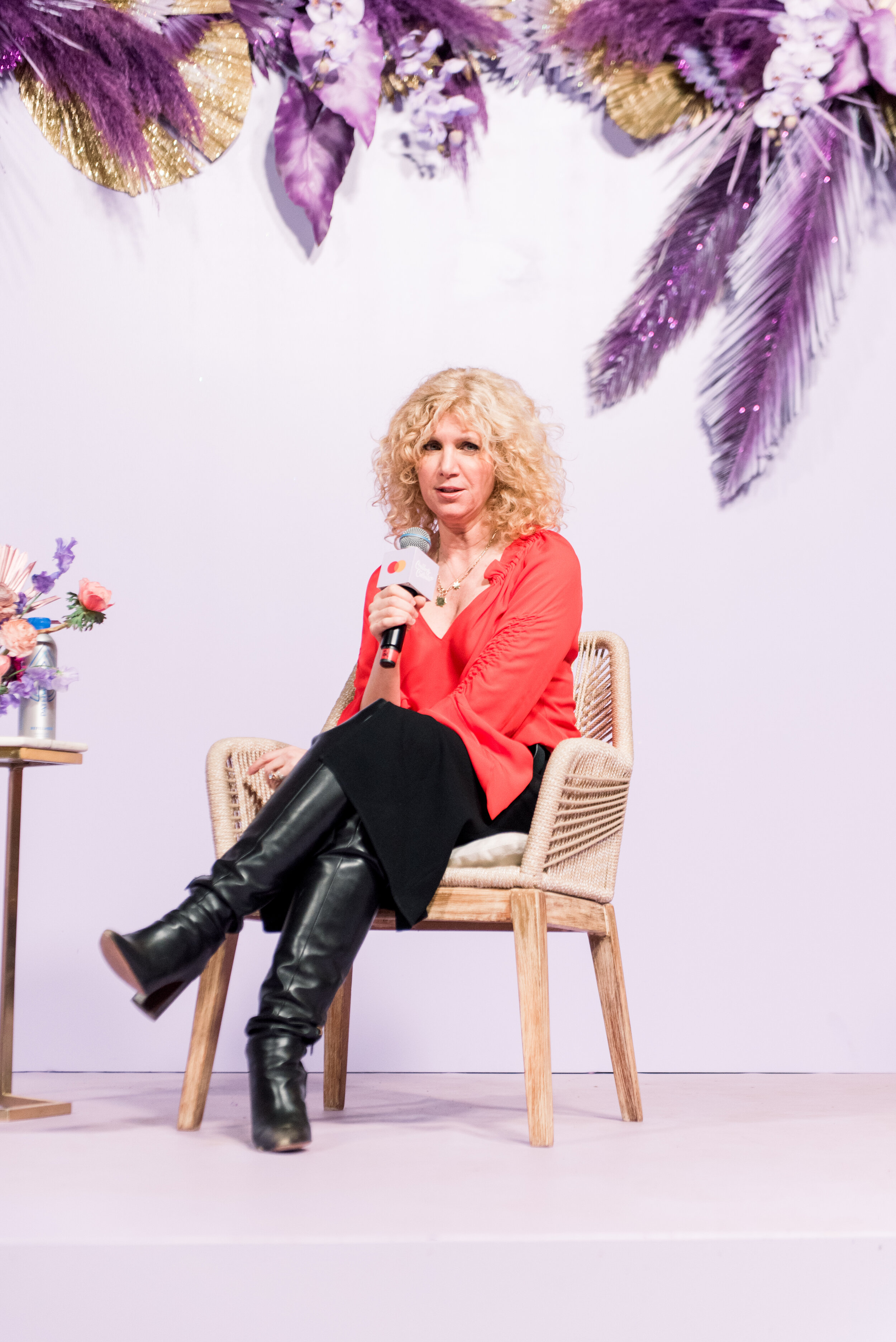
Someone who is boycotting that ban is the founder, and CEO of CAULIPOWER, Gail Becker. Since 2017, Becker has built a $100m company and completely disrupted the food industry to become the #1 better-for-you pizza in the U.S. At our recent LA2020 conference, Becker had some no-filter money advice, especially around the topic of raising it. Having taken on two rounds of investment for CAULIPOWER, she knows each entrepreneur must make the right choice for them. “Just because you can raise more money, doesn’t mean that you should” she told the audience. “It’s not a symbol of how successful you are… or will be.”
Becker also decided against a friends and family round for her startup. “It made me nervous to play with my friends’ and family’s money,” she explained. “I waited as long as I could before seeking outside funding. I used all of my own money initially and maxed out all my credit cards.” There are different ways to fund your business and, ultimately, it needs to come down to what you feel most comfortable with and what your business needs are,” she explained. “I took a risk and bet on myself,“ she said. “That’s the hardest part. If you don’t bet on yourself, who else ever will?”
So, we tapped the powerhouse founder and CEO to share more of her money lessons, mistakes she’s made, and advice for small business owners. Read on and grab a pen, you’ll want to write these down.



On bootstrapping the company in the beginning…
When I first started CAULIPOWER, my goal actually wasn’t to make money. My dad, who was an entrepreneur and a Holocaust survivor, had recently passed away, and it made me recognize the fragility of life. I had been working my way up the proverbial ladder of corporate America, and then decided that I really didn’t like the view. I wanted to do something more meaningful with my life and I realized that I needed to make a change. That, along with my frustration in what I was seeing in the freezer aisle, created an ‘aha' moment that inspired me to launch CAULIPOWER.
My dad had left me with a small amount of money, and I knew the best way to honor his memory was to follow in his entrepreneurial footsteps. I knew how hard my father worked for every dollar he made, so I spent each one cautiously. I also put in a fair amount of my own money and lived off my savings. On a personal note, it was an interesting transition for me. I was coming from a comfortable job in corporate America with a comfortable salary, and I was used to a certain lifestyle.
When I started CAULIPOWER, I said goodbye to that life and paid attention to every dollar that I was spending, both personally and for the company. I downgraded my lifestyle significantly, saying goodbye to any shopping (outside of the grocery store) and vacations, and even sold most of my former wardrobe such as purses and shoes online. Even that wasn’t enough to sustain the launch of CAULIPOWER, so I maxed out all of my credit cards and tapped into more of my savings.
While this was the right decision for me, everyone has to choose the route that makes sense for them. For me, this was the only way I could bring my vision to life. I was nervous to take money from friends or family, but that doesn’t mean that’s the wrong choice for others. In hindsight, I have several friends and family who now wish I would have asked. At the time, I just followed my gut and made a choice about how I could make things work without negatively impacting others.
On raising money twice since then…
I raised money for a few reasons. First, the frozen food industry is an extremely cash-intensive business. You have to make the product before you can sell it, and there’s a pretty quick need for money given cash flow. When it comes to raising money, timing is incredibly important. I learned quickly that you should try and build the business as much as possible before you raise money. Why? The smaller your business is, the more of the company you will have to give away when you raise money in exchange for equity. Ideally, it’s best to try and hold off until you’ve made some actual sales.
Having said that, one of the worst things you can do is starve a business from cash. Cash is like fuel. We need it to make our products, to pay for promotions, to hire staff, and to market the brand. The timing of it all is a delicate balance between raising too much money, forcing you to give away more of the company when it is of the least value and starving the business, stunting its growth and first-to-market advantage.
“Just because you can raise more money, doesn’t mean that you should. It’s not a symbol of how successful you are or will be.”
On the most surprising part of the venture capital process…
I was surprised at how personal the process became. It would be easy for someone to interpret reactions as a reflection of the quality of one’s idea. If a VC didn’t want to invest in CAULIPOWER or wanted to wait for more data, I questioned myself. What did that say about my idea? The reverse was also true. When you find a partner that believes in you and is prepared to invest money into your business, it can be an incredible confidence boost. It’s a moment when you finally think, maybe this idea is not so crazy after all?!
One of the biggest mistakes that some people make during the fundraising process, is the instinctual desire to take money from the first person that offers it. You should always try to take ‘“smart” money—money from people who know more about the industry, category, and process of building a company than you do. What’s most important is to take money from people who will work hard for you and your idea.
Another part of the fundraising process that surprised me was how similar it was to, well, dating?! Remember, they’re not just interviewing you; you’re interviewing them too! You have to ask yourself ‘who do you want to be in the trenches with you for the long-term? Who will be there for you when the times and decisions get tough—because they will! Who shares your vision?
On the most common mistakes people make when raising money…
Raising too much. Just because you can, doesn’t mean you should. The ability to raise large amounts is not an indicator of the success of your business, rather it’s an indicator that a lot of people will be counting on you and you better deliver. It’s important to raise what you need, which should be enough to hold you over for a while, but not forever. From there, you can build the company to something bigger, then raise more money when it becomes more valuable. My first round of funding was $2M.
“One of the worst things you can do is starve a business from cash—cash is like fuel. ”
On the three crucial elements, every pitch deck should include…
First, you need to show the potential of the company or the white space. Why is this the right business at this time? What hole are you filling that currently doesn’t exist? Another crucial element is the data. You should try and show as much data as you can, even if you have to buy some of it. Show the real performance of your product if it's currently in stores, or use other competitive data to give a sense of how it might do. If it’s not already in the market, you need to prove why you believe it would do well, and this is best accomplished by definitive proof points. Show them that you have done your homework and that you don’t expect anyone to just take your word for it.
Finally, you need to show your passion. Most investors are not just investing in the business; they’re investing in YOU, the entrepreneur. If you're not passionate—and confident—about your own idea, then it really doesn't matter how good of a business plan you have.
On how much she paid herself in the beginning…
I didn't pay myself in the beginning. I lived off of my savings from about May 2016 to September 2017. Once I got VC funding, they made me take a salary and I’ve had the same one ever since. For comparison purposes, it is less than 1/5th of what I used to make when I worked in the corporate world… but I couldn't be happier.

On her first hire…
My first hire was someone who helped me fill out the deluge of paperwork I was facing from the retailers, brokers, and distributors. I realized all the time I was spending with paperwork was a huge opportunity cost and that my time would be better spent in other areas of the business.
On the first big expense as a business owner…
The first order I placed to make the first product.
On when she hired an accountant…
One of the best things about the economy we live in is that you can hire contractors to help you with just about anything. Thanks to some referrals, Google, and some other people I had met in the industry, I came across an agency that performed CFO duties for-hire for small companies. As soon as I got my first order, I knew I had to hire them.
I strongly believe that the most important thing to know as a first-time entrepreneur is to know what you don’t know and then hire around it. Many entrepreneurs mistakenly believe that they somehow need to know all aspects of their business. Nothing could be further from the truth. Know what you know and then hire experts to fill in the gaps.
“Know what you know and then hire experts to fill in the gaps. ”
On the most important area for business owners to focus their financial energy…
Put it into making the best product or service you possibly can. At the end of the day, you can have everything else figured out, but if you don’t have a product that people want, nothing else matters.
On why women should talk about money and business more…
When I was in my first marriage and at my old job, I’m embarrassed to admit that there was a lot I didn’t know about my own finances. I wasn’t financially illiterate, but I never made it a priority to become informed. When I got divorced, the need to become financially literate hit me in the face. I remember thinking, “I will never do that again.”
On having a financial mentor…
I did have some incredible people in the industry (and outside of it) that I looked up to, asked lots of questions of and with whom I’ve stayed connected. I never really had a financial mentor, but then again that wasn’t the primary reason why I started CAULIPOWER. My initial goal wasn’t to make lots of money; it was simply to help people have access to better options. If that’s why you start your business though, then that’s fantastic and finding a financial mentor might be the right choice for you. Now that I am running a business and am responsible for other people, the financial decisions I take on have tremendous importance.
On the money mistakes she’s made and learned from along the way…
I think it all depends on whether you’re new to your industry or if you have a background in it. If I had any sort of experience in the frozen food space prior to launching CAULIPOWER, I probably could have made some different decisions. Since that wasn’t the case, I placed a lot of trust in other people. I trusted that they knew more than I did and there’s a fair amount of trust that I probably placed blindly. In some cases, that ended up having a high price tag associated with it.
“If you’re not passionate—and confident—about your own idea, then it really doesn’t matter how good of a business plan you have. ”
On her best money advice for new entrepreneurs…
You don’t have to know all of the answers. You just have to know enough to hire the people who do. Just because you may not be a financial wizard, it doesn’t mean you shouldn't go into business. Just surround yourself with the right people who can teach you…and ask lots of questions. Daily.
I don’t equate money and happiness. The experience of launching and building CAULIPOWER showed me that one of the reasons I was so hesitant to leave my stable career is that I thought I had a great life. There was this inherent fear that if I lost all of those trappings that I had grown accustomed to, I wouldn’t be happy.
Today people who know me often hear me say “half as rich, but twice as happy” and no sentiment could be truer. Now, I realize that those things didn’t matter at all and the chance to build CAULIPOWER, take a bet on myself and help other people along the way has been the greatest professional joy of my life. I hope these words help to realize the same in you.

To learn more about CAULIPOWER and try their delicious pizzas, visit eatcaulipower.com.

Meet the Co-Founders Disrupting the $532-Billion Beauty Industry With a High-Performance Plant-Based Skincare Brand
Get to know Furtuna Skin.


We know how daunting it can be to start a new business, especially if you’re disrupting an industry or creating an entirely new one. When there is no path to follow, the biggest question is, where do I start? There is so much to do, but before you get ahead of yourself, let’s start at the beginning. To kick-start the process and ease some of those first-time founder nerves, we’re asking successful entrepreneurs to share their stories in our series, From Scratch. But this isn’t your typical day-in-the-life profile. We’re getting into the nitty-gritty details—from writing a business plan (or not) to sourcing manufacturers and how much they pay themselves—we’re not holding back.

Valued at $532 billion and counting, the beauty industry is on an upward trajectory that doesn’t appear to be letting up anytime soon. Despite the break-neck speed that’s driving the market forward, there’s one skincare brand that’s doing things differently—Furtuna Skin.
Built on a platform of radical transparency, Furtuna Skin is disrupting the industry by creating high-performance, plant-based products that are made with sustainably sourced ingredients—and their approach is paying off. The brand has already developed a cult-like following, including celebrity estheticians like Gina Marie and Shani Darden, to name-drop just a few high-profile Furtuna Skin devotees.
Ahead, Furtuna Skin’s co-founders, Agatha Relota Luczo and Kim Walls, break down how they built a high-performance, plant-based skincare brand from scratch, including why they didn’t write a business plan and what made them decide to go the self-funded route.
CREATE & CULTIVATE: Take us back to the beginning. How did you both meet and what was the lightbulb moment for Furtuna Skin?
AGATHA RELOTA LUCZO: We met first while working on creating organic, natural topical health remedies for our children (which is now our Bambini Furtuna brand). The more time we spent together, the more ideas we had for unique and powerful skincare products for adults. The plants on my family farm in Sicily were so powerful, so potent, that it became abundantly clear to us pretty immediately that we could create something special with these plants. Something groundbreaking that could redefine the very meaning of “clean beauty” by combining ancient wisdom with modern science using high potency organic plants to give beauty lovers high-performance results that they deserve from clean products—something we both struggled to find.
We’re both fiercely driven women who are passionately committed to achieving the best outcomes. We had unique areas of expertise that allowed each of us to bring something to the table that the other couldn’t. And we liked each other. A lot. There wasn’t much of a conversation about whether or not we were going to create Furtuna Skin. It happened because it couldn't not happen. In a way, Furtuna Skin willed itself to live through us. The brand took us both by the heart and that was that. We were off.
C&C: Did you write a business plan?
KIM WALLS: We had an aligned five-year vision for the brand within a few weeks of deciding we were doing it. With that, we created a product roadmap and began investigating the time and costs that would be associated with bringing those products to life. Our approach was the very definition of a product-driven company. From there, we created a financial model based on our strategy and assumptions. We still use that model today… updating it as we learn. We didn't write a traditional business plan but we agreed on targets to hit and milestones to measure our performance. The bottom line for us has always been that we wanted to create products that would be truly transformational.

C&C: How did you come up with the name Furtuna Skin?
AGATHA RELOTA LUCZO: It was important to us to keep the name “Furtuna” as part of our estate’s name where we forage our ingredients. My husband’s grandparents lived on the farm in Sicily before they moved to the United States. They used to say “Bona Furtuna!” to him with great love and excitement when they would say goodbye to each other. Bona Furtuna means “good luck or good fortune” in Sicilian. His Nona Rose was the inspiration for the farm’s name—La Furtuna Estate. The word “Fortune” is “Fortuna” in Italian, but in Sicilia, it is Furtuna. Our name honors our family, the powerful medicinal heritage of the land, and the great people who are there now and who came before us.
C&C: What were the immediate things you had to take care of to set up the business?
KIM WALLS: All of the standard business pieces like domain, trademarks, social channels. We did all of those things but we didn’t let the logistics distract us from the more complex and challenging work of creating transformational products. We’ve seen too many people get caught up in the logistical details of it all and forget to think big. They shoot themselves in the foot by spending too much time on things that don’t matter unless you actually have a business. That said, intellectual property is important. We invested in locking down our trademarks in all critical markets because we knew that we wanted to create the opportunity for people around the world to experience the seemingly magical power of wildly potent ingredients.
C&C: What research did you do for the brand beforehand?
KIM WALLS: When it came to the plants and the performance of those plants to deliver unparalleled skincare results, we went all-in on research from day one. We knew that what we were setting out to do was incredibly complex, hadn’t been done before in the industry, and that there would be a great many challenges to overcome in the process. We surround ourselves with experts—like Mimmo who is the PhD botanist and biologist on the farm—to help answer the many questions we needed to answer, and to help figure out what additional questions we should be asking. We worked with pharmaceutical experts, ultrasound equipment experts, biochemists, nutritionists, and clinicians with extensive knowledge and niche expertise in a great many areas of science.
We spent almost all of our time in the early days researching and thinking about the details that would bring our full vision to life. We began with plants growing from the earth to transform them into skincare ingredients, which we then turned into skincare formulas… while also working on the fonts, textures, colors, coatings, materials, brand stories, and overall feel of Furtuna Skin. There was an enormous amount of research. We would each do big bursts of work in our respective areas of expertise and then come back together to share and refine our concepts by truly listening to each other’s thoughts, perspectives, and feedback… and then do it again. And again. And again.
We relied on Slack, Dropbox and Google Drive for a long time, and then moved onto programs that would allow for more complicated data associations like the Gantt charts in Asana and the cross-indexing of data and imagery that you can create in programs like Swivvel and Airtable. When you’re starting out though, there’s nothing better than a good old fashioned phone call to work through it all together.
“We approach our partnership like a marriage. Fundamentally, we care about each other and respect each other. When you and your partner want the same BIG things, then the little things don’t matter as much.”
C&C: How did you find the manufacturer/production facility that you use What advice do you have for other founders looking for a trustworthy manufacturer?
KIM WALLS: It is an absolutely monumental task to find the right labs, fillers, testers, designers, teammates, partners, agencies, sources of materials, and more, then to conduct them in alignment so they work together like an experienced orchestra. The difficulty of this process cannot be underestimated. There is no right answer to “who’s right for everyone.” The trick is to truly understand your needs, and then find partners who are excited to fulfill those needs.
In our case, we needed partners who had world-class track records in creating innovative skincare formulas using new organic ingredients and new processes. We needed people who had the right kind of experience—from pharmaceutical to nutraceutical—who were such deeply entrenched experts that they were comfortable in the space of experimentation and who were willing to dedicate countless hours to bringing together myriad unknowns to create finished skincare products that hit new levels in clean beauty and that would deliver on the results that they promised, from brightening the skin all over to instantly lifting and plumping fine lines around the lip and eye area.
C&C: Did you self-fund the company? Did you do a friends and family round? Or did you raise seed money or initial investment money?
AGATHA RELOTA LUCZO: We’re self-funded. We’ve both been involved in VC-, PE-, and F&F-backed businesses in the past, but we wanted to get Furtuna Skin off the ground ourselves because we wanted to ensure that we would have the time and space needed to develop the highest quality, most effective skincare ingredients from our organic estate in Sicily. For many years, we were working with a complex matrix of unknowns that, because we weren't being pushed for time in the early days, have now resulted in groundbreaking products that we are proud and honored to see empowering our clientele with a deep sense of transformational beauty.
C&C: How much did you pay yourself, and how did you know what to pay yourself?
KIM WALLS: Every situation is different, and there’s no one right way to go about determining when and how much to pay yourself. BUT, you must pay yourself. Even if the number is small, the mental effect is huge. For most people, it is a psychological fact that if they aren’t being paid with at least some cash, they will not give their greatest effort despite best intentions.
La Furtuna Estate in Sicily




C&C: How big is your team now, and what has the hiring process been like? Did you have any hiring experience? What advice can you share?
KIM WALLS: Not including us, our current team is nine people. We both have hiring experience from previous work. We created an organizational chart and have stayed pretty true to that chart so far. Putting in the time upfront to understand which skillsets we needed to find to create and market groundbreaking products helped us think through the roles we need to bring our dream to life. For any given position, we collaborate with internal team members to develop a job description and then begin the search. It is very important to us that we hire to a role, but we do also shape and reshape roles around the people we hire. In the early days, growing a team is like building a jigsaw puzzle, you might not know where one piece fits until another is in place. We want our people to be set up for success, and sometimes that means being flexible about the role each person plays in the company. When starting our company, it was critically important for us to hire people who thrive in a fast-paced environment where things can change quickly, and any team member might need to wear multiple hats. Because we outline the job descriptions and start with an understanding of how people will fit into our world both in the immediate term and the long term, we hire with the future in mind. Equally important to our peoples’ skill sets, we hire for energy. If the “vibe” isn’t there, then we keep searching regardless of the list of accomplishments a person may bring to the table.
We recently learned that the ideal number of people to interview any candidate is four. Data supports that if four team members think someone is a good fit for the role, then the candidate is more likely to be successful in that role. Once we had four people in the company, we started following that rule of thumb. The last bit of advice here is that you probably don’t need to bother checking the references that a candidate provides to you unless it is an extremely junior hire. Leverage your network of friends or even strangers to talk with people that have worked with your candidate before. That’s how you can learn the most about your candidate, and whether or not that person's particular quirks are going to be complimentary with your team… or not.
C&C: As co-founders, how have you developed a good working relationship? What tips can you give to other business partners trying to make it work?
AGATHA RELOTA LUCZO: We approach our partnership like a marriage. We’ve both been happily married for a long time, so we have practice doing this. Fundamentally, we care about each other and respect each other. We let each lead in the areas we’ve entrusted to each other. (I lead the creative function, and Kim leads the executive function.) Our partnership is part of what makes the work feel good and the journey worth taking. Tips for others would be to say the hard things. Be honest with yourself and your partner. Be willing to give in and to see when you are wrong. Make the big decisions together by taking time upfront to thoroughly talk through your perspectives. If your roles are clearly defined in the beginning and you butt heads about something, then if it isn’t your lead role, give in. Let it go, and do it because you remember that you entrusted this person with the responsibility to lead where they are leading and that you share a common vision and goal. When you and your partner want the same BIG things, then the little things don’t matter as much.
“In the early days, growing a team is like building a jigsaw puzzle, you might not know where one piece fits until another is in place.”
C&C: Did you hire an accountant? Who helped you with the financial decisions and set up?
KIM WALLS: Oh yes. Business is business. We had a freelance bookkeeper and accountant very shortly after we started spending money. As is true with most things in life, we knew that if our foundation wasn’t strong, we wouldn’t be able to focus our attention on what matters most to us—creating beautifully clean and effective, high-performance skincare that brings a deep sense of transformational beauty into the lives of our clientele.
C&C: What has been the biggest learning curve during the process of establishing a business?
KIM WALLS: It is SO hard to wait sometimes. Most skincare products take anywhere from six months to a year to create and get to market. In our case, we start with people on the land who are wild foraging many of our ingredients. The extra time it takes to forage and then turn those plants into skincare ingredients, then test them for quality, purity, and effectiveness before we can even begin to use them to make skincare products can feel like forever by comparison to how most products are made in our industry. After we had our first finished formula, we were so excited to share it with people that we rushed to order some components (caps for our bottles) that we didn’t truly love. In the end, we scrapped those and made our own custom caps that we do truly love. In that haste, we created a lot of complexity for ourselves that we probably shouldn’t have. The old saying, “patience is a virtue,” is one that we need to remind ourselves of constantly.
C&C: How did you get retailers to start stocking your product? Were you told “no?” What advice can you share?
AGATHA RELOTA LUCZO: We launched on our own site and with our friend and partner Shani Darden, an esthetician who we respect immensely for her extensive knowledge, integrity, and the results she brings to her clientele. Retailers are calling us now, so you’ll start seeing us more and more in 2020.
When it comes to choosing retail partners, it is all about fit and sell-through. Sometimes it takes a long time to make retail happen, but if the fit is there, the product is great and you can drive customers to their stores to buy your products, then magic can happen. Most fundamentally, most retailers care about two things: a) will you drive traffic into their store, and b) will enough of the customers they already have want your products to make it worth their shelf space. Most retailers have metrics that they adhere to—like $10K per week in sales of any brand, for example. Find out what their metrics are and prove that they will sell enough of your product for them to exceed their metrics. With that, you’ll probably get the chance to partner with the retailers you want.

C&C: Do you have a business coach or mentor? How has this person helped? Would you recommend one?
AGATHA RELOTA LUCZO: We are unbelievably lucky to have one of the most successful businessman in history (literally) on our board, so when he talks we listen. We always seek outside advice to check our big assumptions. Mentors have been pivotal to the success that each of us have experienced in our lives. Most of the time, it isn’t a planned relationship. People who love to mentor get as much out of that relationship as the mentee because they love to teach and share their knowledge. If you want a great mentor, be someone who is worth mentoring. Come with great questions, show progress, listen, and act accordingly, tell your mentor how you have benefitted through their advice by sharing specific progress with them. They will probably get as much joy from your success as you do. Sharing progress that is partially attributable to your mentor will remind them of the value they are getting out of the relationship and make them want to give you more.
C&C: How did you promote your company? How did you get people to know who you are and create buzz?
KIM WALLS: We both knew a lot about marketing when we started, but marketing changes at light speed. It is important to both of us to stay relevant in our knowledge and to bring rockstars onto our team who focus exclusively on the most current forms of marketing at any given time. For example, we partnered with Shadow PR, an outstanding agency, and have leaned on their expertise and relationships. We also have relationships of our own from working in the beauty industry for decades. We work with celebrity estheticians like Gina Marie and Shani Darden, who have been incredible. They use our products in their facials on their amazing clients, and we’re also lucky to have the support of VIP friends like Jamie Greenberg and Lauren Roxburgh who share their love for the benefits of our products with their clientele too.
On the question of marketing spend as a percent of revenue, the rule of thumb in our industry is to spend about 15% of revenue on marketing to scale. These days, the average percentage is increasing. In the early days, the vast majority of cash in a consumer brand is spent on marketing because you probably don’t have much (or any) revenue to speak of, so your spend probably can’t be considered as a percent of revenue. The best advice we could give is to create reasonable goals for your business and then figure out what it is going to take to hit those goals and how much it will cost to do the things you think you need to do to hit the goals. Measure. Repeat. Measure. Repeat.
“If you want a great mentor, be someone who is worth mentoring. Come with great questions, show progress, listen, and act accordingly, tell your mentor how you have benefitted through their advice by sharing specific progress with them.”
C&C: What is one thing you didn’t do in the setup process, that ended up being crucial to the business and would advise others to do asap?
KIM WALLS: We have started other businesses in the past, and we learned a lot of things the hard way, so we were in a more informed position this time around. We've made fewer mistakes, thankfully! From experience in our prior lives, we’d share that you must get comfortable with the basics of finance, at the very least, or you will definitely hurt yourself. Too many entrepreneurs underestimate the importance of nailing these essentials. If you don’t already, then learn to truly understand your balance sheet, P&L statement, and cash flow…. and maybe, more importantly, learn to understand the business drivers that most influence the outcomes represented by those basic documents for your endeavor.
C&C: For those who haven’t started a business (or are about to) what advice do you have?
KIM WALLS: Don’t get decision paralysis, and recognize that progress takes lots of different forms. There’s no one right way to accomplish what you want to accomplish. Recognize that it might be insanely hard to do what you want to do and accept the challenge in full light. When you get stuck (which you will) move forward no matter what. Look hard in the mirror when you make a mistake and set up a specific process so you don’t make the same mistake twice.
C&C: Anything else to add?
AGATHA RELOTA LUCZO: Yes! We need more and more women out there living up to their full potential and exceeding their self-imposed personal limits. Go hard at your dream, and keep going. When one dream doesn’t pan out, pick a new one. Enjoy your feeling of purpose and drive hard.
Our friends at Furtuna Skin were nice enough to share a giveaway with Create & Cultivate readers!
One lucky reader will receive a year’s supply of Furtuna Skin products. Simply fill out the form below to enter to win. *U.S. residents only.* The winner will be chosen randomly and contacted via email. Good luck!
Giveaway now closed, thank you for entering! We will email the winners directly.
MORE ON THE BLOG

We Talked to 4 Biz Owners About How They're Tackling COVID-19
Lauren Kleban, Dianna Cohen, and more weigh in.

As a small business, we here at Create & Cultivate understand how much the COVID-19 outbreak is impacting companies across the globe.
By shuttering offices, disrupting supply chains, canceling events, and clearing out public spaces like malls, restaurants, and gyms, the coronavirus’ impact on companies—particularly startups that don’t have the resources of Fortune 500 companies—is significant. However, as our founder and CEO Jaclyn Johnson says, a company’s success comes down to how it pivots and responds during times of great uncertainty.
Of course, we know that you, our Create & Cultivate audience of entrepreneurs and founders, are also grappling with this right now, so we reached out to some of the savviest business owners we know to find out how they’re handling the news, responding as a company, and, most importantly, pivoting their businesses in response. Scroll on to read how four founders are confronting the coronavirus crisis head-on.
Dianna Cohen, Founder & CEO, Crown Affair
How are you handling the news as a founder? Is your team working from home? How have you pivoted to that schedule?
The wellbeing of our team and customers is the most important thing to us. Our brand was built on the concept of the ritual—all the things you do to take care of yourself and make you feel whole. Whether that’s journaling, stretching, or brushing your hair before bed, we’re all about taking those extra few minutes to reset and recharge. During this time of uncertainty and unrest, we're letting our community know it's key to time for themselves and their friends and family that might need support and care as well.
How have the announcements impacted your business operations and financials? What tactics and strategies have you put in place to pivot and ensure your business is successful through this period?
We're monitoring the guidance of the CDC and health officials, so we're currently remote and will keep our scheduled meetings and touch bases, but do them via video or phone. Tools like Asana and Slack have been helpful for daily stand-ups to make sure as a new business (we're six weeks old!) we're staying on track and actively communicating. Because we're a digital-first company that sells products online, we've been able to continue connecting with our customers and growing the business. When the news first hit, we were mindful to order into inventory that wouldn't impact supply chain for our customers, and internally communicate updated daily goals and KPIs given there are global updates daily.
What advice can you share for small business owners, founders, and entrepreneurs who are also reeling in response to the news?
1. Have honest conversations with your team and community, we're in this together.
2. Your senior leadership team should plan into a mindful monthly spend to make sure you're preparing for any potential changes in supply chain or any area of the business that might be a meaningful part of your overhead.
3. See this as an opportunity to evaluate your strengths as a business and focus on clever, new ways you can still bring that to your audience.
Madison Ruggieri, Co-Founder, Onekind
How are you handling the news as a founder? How have you responded as a company? Is your team working from home?
As a founder, we’re really trying to carry on business as usual. We’re an online retailer and a very small team in a large office space, so, as of now, we’re still working from our office but thinking ahead in case that needs to change with a moment’s notice. Luckily, most of what we do can happen remotely if need be.
We fulfill all orders from our office, but if we were working with a 3PL for fulfillment, I’d be concerned that they might be shutting down temporarily. For brands who do rely on a 3PL, that would significantly impact their ability to continue processing orders.
How have the announcements impacted your business operations and financials?
Right now, we’re most concerned about the financial impact COVID-19 is having on those who are out of work because of it and whether it’s affecting our customers. We’re very aware that this could have an impact on people’s spending habits and that’s something that definitely worries me as a small business owner.
What advice can you share for small business owners, founders, and entrepreneurs who are also reeling in response to the news?
My advice to small business owners is to stay as calm as possible, stay informed, and try to plan a few steps ahead. If your business model allows for the ability to focus on digital sales/work, put your energy there. Most importantly, take care of your own health and the health and well-being of your team. Also, remember there’s a whole community of entrepreneurs dealing with the same issues right now, so let’s support each other in any way we can as we all get through this together.
Sonja Rasula, Founder & CEO, Unique Markets
How are you handling the news as a founder? Is your team working from home? How have you pivoted to that schedule?
As a founder, I'm in emergency-mode, which means I went from being in shock and assessing the situation, to now doing all I can to ensure my employees have jobs and income over the next few months. Every day this week has brought new information and bad news, but as a leader and founder, it's my job to now push emotions aside and turn this situation into an opportunity, to be responsible for my team and put on a happy face. As a company, we are working from home. But to be honest, it's not that different because I offer weekly "work from home" days already, which means we're all used to communicating via Slack or video already. One good thing! :)
How have the announcements impacted your business operations and financials? What tactics and strategies have you put in place to pivot and ensure your business is successful through this period?
My business is events based. We create amazing, community-based IRL pop-up markets that feature hundreds of small business owners and designers. Because we had to cancel our spring markets, I'm literally dealing with zero income for the next 3-4 months. In my past life, I designed and launched Fortune 500 websites and integrated e-commerce, so creating an online store as another revenue stream for us is the most obvious answer, but that takes a huge amount of resources and roles we don't currently have. While it's now something I'm looking at for 2021, we're going to do a few smaller, more manageable things over the next few months:
We've released online tickets to our summer markets already and are asking our community to purchase them and spread the word, which will provide some income and cash flow.
We're going to hold a series of live online workshops over the next two months, some free and some paid.
We're going to launch a weekly newsletter filled with stories of inspirational small business owners, design news, videos, and more.
What advice can you share for small business owners, founders, and entrepreneurs who are also reeling in response to the news?
My advice is twofold: First, take this time to pause. Seriously allow yourself to pause and evaluate what you are currently doing, what makes you happy, how you can improve. As entrepreneurs, we rarely get time to stop and breathe, so see this as an opportunity!
And then, second, get shit done! As the world slows to a halt, take advantage and use this time to redesign your website, take new product photography, work on your brand bible or style guide, watch YouTube or Skillshare to take a class and improve your skills (so many small business owners don't know graphic design programs like Illustrator, which could help them save so much money and have more creative control). Onward and upward!
*Also, I understand how daunting and downright depressing this is—I've ugly-cried too many times to count this week. But if you own a company that sells stuff online, you're already doing better than me, so cheer up a bit! And keep this in mind: You are a superhero, someone so strong and confident and passionate that you walked away from a 9-5 and regular paycheck to do your own thing! It's the harder choice. It's the lonlier choice. It's the challenging choice. You've made it this far, you've overcome too much to let a freaking global pandemic get you down. KEEP GOING.
Lauren Kleban, Founder & CEO, LEKFIT
How are you handling the news as a founder? How have you responded as a company?
We are taking the news day by day and not panicking. We have always taken extreme measures to maintain a clean studio space. We are a digital band first, and in a time like this, we take pride in knowing we can accommodate our customers as they are dealing with closures and quarantines. We maintain business as usual and believe that consistency is key for both our team and customers. The LEKFIT brand has consistently been a safe space both in-studio and online. We have taken major strides to provide a space for relief and our job is to remain calm for our customers.
How have the announcements impacted your business operations and financials?
We have not been impacted at this point, and hope that remains to be the case. We are slightly concerned this will delay the final week's construction of our flagship, set to open in April, but we will keep our pop-up doors open until we move.
What advice can you share for small business owners, founders, and entrepreneurs who are also reeling in response to the news?
Don't panic, and make decisions that are most beneficial for your team and customers. The best thing we can do is listen to the authorities, work together, and be kind.
For up-to-date information on the COVID-19 outbreak, we recommend referring to the Centers for Disease Control and Prevention or the World Health Organization.
Up next: We Scrubbed the Internet for the Best Advice for Startup Founders During the COVID-19 Pandemic

3 Things That Are Holding You Back at Work
“If you’re not going to kick ass at work, what’s the point of spending all your time there?!”

Photo: Bru Santos for Pexels
Most of us spend half of our waking hours at work, five days a week—sometimes more! According to a recent study, the average full-time employee works 47 hours a week (yes, that’s 7 hours more than the standard 40). It’s no wonder so many of us name work as the most stressful aspect of our lives.
The good news is that with a few tweaks to your environment and brain, you can increase your productivity, decrease your stress, and advance faster than you’d expect. Based on cognitive science from a feminist POV, here are the top three ways you’re holding yourself back at work—and three solutions to start implementing today.
1. You’re underselling yourself—to your colleagues and yourself.
Imposter syndrome is no joke (even Martha Stewart isn’t immune to it). It’s also not an accident.
Women are socialized to constantly doubt themselves, underestimate their abilities, and believe that others are more qualified and talented than they are. Studies show that when women are primed with stereotypes about their abilities, they perform more poorly on cognitive and skill-based tests.
The insidious thing about this socialization is that it gets absorbed into your brain and then floats up into your consciousness as if it’s your own thoughts. So you don’t think, “Women aren’t good at project management, so I must be bad at my job.” Instead you think things like, “I’m not as organized as I should be and don’t think I’m doing a good job.” You think that because the thought came into your brain, it must be true.
Once you have that belief, your brain is constantly looking for evidence to justify it—which means you don’t show up as a confident badass who’s happy to take credit for her work, promote herself, and volunteer for new responsibilities. If you’re not going to kick ass at work, what’s the point of spending all your time there?!
The cure for imposter syndrome is to learn how to notice, evaluate, and change your negative thoughts about yourself.
2. You aren’t using your calendar correctly.
What’s on your calendar? Personal appointments, holidays, birthdays? Some of you are feeling advanced because you have work deadlines on there, too, and think that’s what I’m going to recommend.
NOPE.
Here’s how you should be using your calendar: schedule out every bit of work you have to do, from now until forever.
Did you just pass out? It’s OK, get the smelling salts. I’ll wait.
Here’s what I’ve discovered from coaching hundreds of high-powered women of all professions: 99.9% of us have no idea how we spend our time.
Knowing how much time you have and what you’re using it on is crucial for two reasons:
First, it helps your brain relax. When you just have a long to-do list and some deadlines on your calendar, what your brain thinks is, “I have a lot to do, and I don’t know when I’m going to do it.” That thought is stressful. So your brain keeps thinking that over and over and never gets an answer.
Second, it’s miraculously the cure for both doing too little and trying to do too much. When you block out the time you’re going to spend on every element of your work, you’ll quickly learn when you’re wasting time on social media, gossiping, or napping under your desk. You’ll also learn when you’re setting unrealistic deadlines and goals. Calendaring is where the delusions of perfectionism and the “I’m too busy” lie run into a concrete picture of reality. Want more info? I have a podcast about my organizational system you can find here.
3. You think multitasking is a thing. (Alternative: your phone is running your life.)
Do you take pride in being a great multitasker? Here’s the truth: You’re taking pride in not really ever getting anything done. Multitasking is a myth. It’s your brain’s way of distracting itself on the regular. Studies show “multitasking” makes your short-term memory worse, makes you less productive, and causes more mistakes. Imagine you’re trying to find a path through a forest, but you kept blacking out every three minutes and coming back into consciousness three minutes later. Do you think you’d get through that forest as quickly as if you were conscious and working on getting out the whole time?
The number one multitasking enabler right now is electronic notifications. Imagine trying to get something done while a toddler pokes you every 45 seconds yelling, “PAY ATTENTION TO ME.” That’s what’s happening when you have your email, Slack, text messages, Instagram, Facebook, Twitter, and Snapchat all pinging away at you on your computer and phone all the time. It’s impossible to focus when you’re giving yourself constant stimulation and reasons to look at a different part of your device.
The solution is simple to explain but challenging to do: TURN THAT SH*T OFF. Remember in #2 when we decided to schedule out work? That should include scheduling time for Slack, email, and social media. Even if you work in a fast-paced comms-driven environment, you truly can go 15 minutes without checking your devices. Start there. Close out every notification on your computer, mute your phone, and work on one thing at a time for 15 minutes. Then check all your notifications for 15 minutes, then back to working on one thing. Slowly increase the periods you’re able to focus working, and decrease the frequency of notification checking until you’re actually making progress on your real work. Don’t believe your brain when it tells you it’s part of your job to check your email every 30 seconds. Your brain is a dopamine addict, and notifications are its drug of choice. Like any addiction, it’s uncomfortable to go through withdrawal, but you’ll be amazed at how much your life improves on the other side!
This story was originally published on April 6, 2019, and has since been updated.

About the author: Kara Loewentheil is a Certified Master Coach, speaker, and author who left a career defending women’s rights in the courtroom to empower women where it all starts: In their own minds. Using cognitive science and a feminist perspective, she teaches women how to literally rewire their brains to get patriarchy out and self-confidence in. Her podcast, UnF*ck Your Brain, has been downloaded 3 million times and teaches concrete brain-change strategies to women all over the world.
MORE ON THE BLOG

Sharing Finances? Here Are 5 Ways to Do It Right
Joint lives? Joint account?

Photo: Retha Ferguson for Pexels
In April of 1975, Judy Hendren Mello created the First Women’s Bank in Manhattan.
It was the first bank in the United States to be run by and operated for women, during a period where women were highly discriminated against by banks. (Fun fact: Betty Friedan had an account there.) Just one year prior, banks required single, widowed, or divorced women to bring a man to co-sign any credit application, regardless of their income.
Thankfully, much has changed since then, and more women are household breadwinners than ever before, as well as finding ways to to split costs with their partners. Given that wedding season is rapidly approaching, we figured there’s no better time to break down five different approaches to sharing finances that have worked well for couples.
The 2:1 Approach
This is a scenario in which you keep most of your finances separate, but have one joint account you both contribute to equally.
You can choose to contribute a dollar amount or a percentage of monthly earnings to that account. With one joint account, you are taking baby steps to trusting your significant other with your money. You get to see how they spend and if you’re comfortable giving them purchasing power with your hard earned cash.
Most often, couples who live together and are fairly evenly matched when it comes to income and debt favor this approach. That way the joint account is what you use for household purchases—everything from toilet paper to a new couch.
The Solo Dolo
Some couples keep all finances separate, and it works for them. If each of you are financially independent, have no desire to share finances and would rather split household expenses in a way that makes you the most comfortable, this is an easy option.
Sometimes that means splitting things 50-50. Sometimes that’s not the case. If it’s not, we suggest having a conversation, especially if one side of the equation makes a significant amount more. What you don’t want is to commit to a living or a financial situation where you feel taken advantage of, or where you resent how much the other person is making and contributing.
If you really like keeping everything solo, but your incomes are vastly disparate—we suggest the next approach to avoid future disagreements.
The Pick-and-Choose
This approach is best for couples who share everything, except comparable salaries. When you don’t want to let one person “handle it all” (which, is certainly another way to go), but rather want each party to contributing their “fair share,” each person picks certain bills and expenses.
These don’t have to be equal shares.
For instance, if you own a house together, one person pays the mortgage and the other fills the fridge. Or perhaps, one of you pays the rent and the other handles electric, gas, and the WiFi situation.
This works for both unmarried and married couples. The most important part of this arrangement, is that each person is getting a fair shake, not a shake down.
With the pick-and-choose, and all the above options, individual debts remain the responsibility of the indebted, however, this could (and often should) be considered when splitting up costs.
The Spend One, Save One
This is an interesting approach being taken by couples who have not yet made those major life purchases, but are working toward them.
They will live on one salary—typically the larger—and save the entirety of the rest. This is also a useful approach for couples who haven’t yet been able to put away that rainy day money or save for retirement. It typically involves living below your means, but is a smart investment to make in your future.
The Merge It All
This is an approach most often used by married couples who combine their lives, finances and all, entirely. Most often, neither party is entering into the marriage with significant assets—like a house—as this is a purchase that will be made together. Or debts, like student loans, that need to pay off.
However, even within “merge it all” it isn’t uncommon for couples to share one joint account while keeping individual checking accounts. What you put into those individual accounts? It varies. Bonuses or checks from grandma and grandpa could be considered “fun” individual money. Cash that doesn’t have to go toward life expenses and allows each person to feel like they’ve got some disposable income.
This post was published on May 23, 2017, and has since been updated.





6 Questions You Should Ask When Your Dream Job Turns Into a Total Nightmare
Don't give up your swivel chair just yet.

Photo: Smith House Photo
You worked hard to get this job. You scored a meeting, nailed the interview, and landed yourself in a seat you've been dreaming about since graduation. But then something horrible happened: you realized that the inner workings of the company didn't line up with your expectations. Or you've encountered a workplace foe. Or maybe you and your boss, not matter how well you initially hit it off, are forever at odds.
The problem with dream jobs turning sour is that we tend to hold on to them because of how sought-after the positions are. But surely you've heard the saying one man's trash is another's treasure. This job might be the bees knees for someone else and the wrong hive for you. However, before you bounce, ask and answer these six questions honestly.
Are Your Expectations Too High?
The small prob with "dream" anything, is that there's always an underside. The dream hangover, if you will. No job is perfect, and if the expectation was that it would be, you need to check your battery and your priorities.
No job is brunch and selfies and fashion! all the time, and if you were expecting a front-row seat to fun and fancy-freebies, remember that late nights, tough moments, doing it wrong and getting called out for it, are all part of the dream.
Are You Part of the Problem?
This is hard for most people to answer, because it's impossible to see the tornado's destruction when you're swirling around inside of it. But if you and a co-worker are really butting heads and leaving a trail, paper or otherwise, of destruction in your wake, there's a good chance it's not only on her. Sit yourself down and give yourself a proper pep talk about relationships in the workplace, and your hand in the issue.
If you are truly attempting to make an impossible situation work, and it's really not panning out (and driving you to tears on the way home) it might be time to walk away.
Were You Hand Held at Your Past Job?
Maybe you've been thrown in with the sharks and you weren't ready for it. Dream jobs are typically highly competitive, hard knock environments, and you need to be able to hold your own—not someone else's hand.
This has a bit to do with expectation as well. If your former employers weren't as "tough," because they gave you outs, or let you go home early, or didn't expect more, it's time to try harder.
In short, you need to kill it, and kill it every day. If you are unhappy because you're in over your head, swim UP. No matter how strong the current, you can be stronger, and that just might shift your nightmare back into a dream.
It's foolish to think the "dream" will be simple.
Do You Feel Undervalued? Maybe You Are. But Have You Done Anything About It?
Are you feeling frustrated because you ARE KILLING IT, and no one's noticing? First, realize that to make a company run well and effectively, everyone is going above and beyond; you're not the only one. You are supposed to be doing everything. (Or everything you can to be the best at your job.) If you're expecting heaps of praise, re-read question #1.
But if you're truly feeling undervalued and as a result are considering bouncing, ask for a meeting with your supervisor and express your frustrations. If you're bottling everything up, you may end up blowing what really is a dream. Have the convo before you opt out of a great opportunity.
Are You Just Being Sensitive?
Controversial word, sensitive. It implies that you're too emotional, and emotional in the workplace is usually directed at women. So how does one determine whether if they need a thicker skin, or it really is the job? One, no job should come at the expense of your health or well-being.
However, if you're crying at work, before you give up, run what you're feeling by someone else who can be objective (i.e. don't take this to your boss). Ask your business bestie's (if you don't have one, find one) advice, and actually listen to their input. If they say you're overreacting, take their word for it and give your dream job another shot.
Like any relationship, a healthy work relationship won't be perfect all the time.
Are You Unable to Read Your Boss' Mind?
BIG problem. As an employee you should be a psychic and ten steps ahead of your boss all the time. JK BABES. But part of being a good employee, and therefore a happy one, is anticipating what your boss wants. If you aren't great at doing so, find out how to get on your boss' good side.
This post was published on March 8, 2019, and has since been updated.

We Scrubbed the Internet for the Best Advice for Startup Founders During the COVID-19 Pandemic
Adapting to the ever-changing circumstances of the crisis is key.

Photo: Smith House Photo
The COVID-19 outbreak is impacting communities—canceling events, shuttering offices, and suspending classes—around the globe. Of course, the focus is (and should be!) on preventing the spread of the disease, but the economic effects of the outbreak are impossible to ignore as companies large and small adapt to the ever-changing circumstances of the crisis.
In the last few weeks, the OECD cut global economic growth projections in half, the JPMorgan Global Manufacturing Purchasing Manager’s Index (PMI) fell to its lowest level since 2009, and U.S. stocks had their worst day since the 1987 stock market crash. Needless to say, supply chain disruptions, facility closures, and staffing deficits can put extra strain on startups.
Here are three things that startup founders can do now to adapt to the ever-changing circumstances, according to the Harvard Business Review.
Set up business tracking and forecasting.
Fluctuations are inevitable in the midst of a crisis. "Put in place rapid-reporting cycles so that you can understand how your business is being affected, where mitigation is required, and how quickly operations are recovering," notes Harvard Business Review. "A crisis doesn’t imply immunity from performance management, and sooner or later markets will judge which companies managed the challenge most effectively.”
Plan for remote work.
With the CDC recommending social distancing and zero-tolerance sick policies to prevent the spread of COVID-19, planning for remote work is essential. “Be clear on your policies—where they apply, how they will work, and when they will be reviewed,” advises Harvard Business Review for the best results.
Microsoft, Google, and Cisco Webex are among a number of tech companies providing free remote working tools during the coronavirus outbreak. Additionally, Slack’s Guide to Working Remotely, Gitlab’s Guide to Remote Work, and Google are all great resources for setting up a successful remote work strategy.
Be a part of the broader solution.
“As a corporate citizen, you should support others in your supply chain, industry, community, and local government,” notes Harvard Business Review. “Consider how your business can contribute, be it in health care, communications, food, or some other domain. Focus on the intersection between acute social needs and your specific capabilities—in other words, live your purpose.”
Head over to Harvard Business Review for more advice on how to lead your business through the coronavirus crisis.
For up-to-date information on the COVID-19 outbreak, we recommend referring to the Centers for Disease Control and Prevention or the World Health Organization.

15 Headache-Preventing Tax Tips You Can Use Right Now
Tackle tax season like a pro.

Photo: Smith House Photo
Overwhelm. Cold sweats. Glazed-over eyes.
Every year, these are the emotions felt by many of us come April 15, a.k.a when it’s time to file our tax returns. It seems like tax season sneaks up on us every year, and no matter how hard we try to be proactive, to plan and prepare, most of us are left doing everything at the last minute.
So to help you get a handle on your taxes this year—and better prepare for tax season next year—we asked Natalie Asghari, a CPA at NA Business Advisors and CPAs, Inc. (NABA), to share tax tips that we can all implement into our financial life. Whether you’re employed full-time, self-employed, or working several side hustles, scroll on to find out how to get your 2019 taxes in order.
Tips for Everyone
1. Gather all your records in advance.
Gather all documents or forms you’ll need when filing your taxes: receipts, canceled checks, and other documents that support income or deductions you’re claiming on your return.
Always keep originals. Make copies of all valid documents that you will provide for filing.
Group together documents regarding mortgage interest payments, property taxes, charitable gifts, medical bills, and any other items that may count as deductions.
2. Keep track of important records.
The best way to do this is by staying organized throughout the year. Don’t wait until the end of the year to consolidate your documents. Gathering information at the beginning of the year will save you time and reduce the chance of omitting information and amending tax returns when it actually comes time to file.
Keep track of your expenses on a quarterly or monthly basis by record keeping, especially if you are self-employed.
Keep a record of tuition, books, computers, and fees that you pay because you may be able to claim an education credit or deduction for the amounts you pay.
Records need to be kept for at least three years (four for state of CA) from the date you filed the related income tax return. You should keep a copy of your actual tax returns, W-2s, 1099s, etc.
3. Decide how you’re going to file.
Be sure to consider different tax statuses if you are eligible for more than one. For example, if you’re married and can file either jointly with your spouse or separately, be sure to consider both options. This might be something for you to investigate throughout the year, especially if your circumstances change.
4. Review! Review! Review!
Don’t rush. We all make mistakes when we rush. Mistakes will slow down the processing of your return. Be sure to double-check all Social Security numbers and other personal information on your return. Remember, you are the taxpayer signing the return and you are responsible for any missed information.
5. Keep up-to-date on tax laws.
While it might be a good idea to get expert advice regarding tax law, you should also keep an eye on the news for anything that might affect you or your business. A well-informed client can often help an accountant give the best advice, so make sure you know about any changes in tax provisions that could apply to you. Ask questions if you believe something you read or heard may affect you.
6. Hire an accountant or professional tax preparer to do your taxes.
Because constant changes make the tax code more complex each year, you may be more comfortable–and able to use tax savings strategies, pay fewer taxes or receive a bigger refund–if you have a professional prepare your returns.
Tips for the Self-Employed
7. If you are self-employed, you may have to make estimated tax payments.
This applies even if you also have a full-time or part-time job and your employer withholds taxes from your wages. Estimated tax is the method used to pay tax on income that is not subject to withholding. If you fail to make quarterly payments, you may be penalized for underpayment at the end of the tax year.
8. Keep a good record of income and expense for your business.
To be deductible, a business expense must be both ordinary and necessary. An ordinary expense is one that is common and accepted in your field of business. A necessary expense is one that is helpful and appropriate for your business.
9. Set up a retirement plan.
A retirement plan not only benefits you later in life, but it is also a method of reducing your current tax liability, and often reducing taxable payment on a set amount of money at any point in time. Your taxable income at retirement will most likely be a lower bracket than your working income.
10. Don’t miss the health insurance deduction.
The deduction is for medical, dental or long-term care insurance premiums that self-employed people often pay for themselves, their spouse and their dependents.
11. Deduct transportation costs.
You should be able to fully deduct any transportation costs (plane tickets, taxis, airport parking, etc.).
If you’re driving to meet a customer or conducting business travel, you will need to keep a schedule/log with dates, mileage, etc. If your trip was primarily for business purposes, you can deduct certain expenses, such as hotel costs for any business days; if you combine work and play, you can’t deduct lodging and meals for your personal days.
12. Deduct meals and entertainment for clients.
Paying for meals and entertainment for current or potential clients can be deductible, as long as the meals or entertainment was directly related to and associated with the business. Be sure to keep records such as the date, the purpose of the meeting, and the parties involved.
Tips for Employees/Employed Individuals
13. Collect all your W-2s and 1099s.
You’ll need these to file your tax return. Check and make sure your withholdings from paychecks are correct based on your situation–especially if you had life changes such as purchasing a primary residence, getting married or having a child.
14. Pay estimated taxes.
If you do not pay your tax through withholdings or do not pay enough tax that way, you might have to pay estimated taxes or you may have additional tax liabilities when it comes time to file your tax returns. You may have to pay estimated tax if you receive income such as dividends, interest, capital gains, rent, and royalties.
15. Deduct job-related expenses.
If you paid for expenses related to your job during the tax year, many of these expenses may be eligible to be deducted on your return if they are unreimbursed by your employer. Deductible unreimbursed employee expenses generally fall into one of two categories: job-specific expenses and travel-related expenses. Some examples of job-specific expenses are protective clothing required in your work, such as hard hats, safety shoes, and glasses; physical examinations required by your employer; dues to professional organizations and chambers of commerce; licenses; and regulatory fees, to name a few.
Don’t let tax season scare you into an anxious state this year. Instead, spend some time, plan ahead and follow the tips outlined in this article. I believe you can make it through tax season without pulling out your hair. Now, I ask you, what tip will you be following this tax season?
This story was originally published on February 12, 2016, and has since been updated.

Brittney Castro is the Founder & CEO of Financially Wise Women, an LA-based financial planning firm for women. She specializes in working with busy, established professional and entrepreneurial women who are passionate about life and want to finally understand money—how to manage it, save it, invest it, and protect it—in a fun and simple way.
Brittney has been featured in the Wall Street Journal, New York Times, CNBC, Glamour.com, Entrepreneur.com, KTLA, CBS, and more. Away from the office, you can find Brittney working out, drinking coffee with steamed almond milk, reading, playing with her fur baby Arya, and of course dancing!
Sign up to receive your Financially Wise Toolkit jam-packed with great tools and resources to help you on your financial journey at financiallywisewomen.com. Follow Brittney @brittneycastro.

This Founder Walked Away From a Steady Wall Street Job to Bootstrap a Clean Beauty Brand
And the risk paid off.

You asked for more content around business finances, so we’re delivering. Welcome to Money Matters where we give you an inside look at the pocketbooks of CEOs and entrepreneurs. In this series, you’ll learn what successful women in business spend on office spaces and employee salaries, how they knew it was time to hire someone to manage their finances, and their best advice for talking about money.

Photo: Courtesy of Cocokind
Leaving a steady job and switching lanes isn’t easy.
Just ask Priscilla Tsai, who was climbing the Wall Street corporate ladder when she decided to shift gears and launch Cocokind, a clean, conscious, sustainable skincare brand. "The first years were tough,” the founder and CEO tells Create & Cultivate. “I was only 25, considered successful in my career, and about to leave it all behind to start a company in an industry that I had very little experience in."
Disappointed by the lack of transparency in the beauty industry and sparked by her own struggles with hormonal acne, Tsai felt compelled to ditch her high-paying job in finance to launch an accessible clean-skincare company. Of course, it’s safe to say that Tsai’s risk has more than paid off—Cocokind is now stocked in every Whole Foods store in the U.S.—but all that success didn’t come without hard work and determination.
In this installment of Money Matters, Tsai shares the nitty-gritty financial details behind what it really takes to get a business off the ground.
CREATE & CULTIVATE: You walked away from a career on Wall Street before bootstrapping your business. What led you to leave a steady paycheck and switch lanes from finance to beauty?
PRISCILLA TSAI: I always knew I wanted to start my own company. My mom is an entrepreneur and watching her career progress definitely inspired me. Separately, my hormonal acne was my biggest insecurity, and I hated the harsh medications and pills that my dermatologist prescribed me. They kept my skin technically clear, but they also totally stripped it of moisture and gave me digestion issues. Ultimately, I decided to explore more holistic remedies for my skin and body, and when I’d created something that worked and that I was proud of, I knew I needed to share it. As a consumer, I was also disappointed at the lack of clean ingredients and transparency in the beauty industry, and I felt compelled to offer a better, more accessible option.
Can you explain what those founding years were like financially?
The first years were tough. I was only 25, considered successful in my career, and about to leave it all behind to start a company in an industry that I had very little experience in. I hustled in every way possible. I made full batches of products by myself. I created our first labels on Photoshop instead of hiring a designer.
I think many founders think that they need a ton of capital to start a company. Obviously, capital is important, but for me, time was almost as important as money. It took a lot of time for me to get Cocokind’s formulas to meet my standards, and it took a lot of energy and persistence to get our products into brick and mortar stores. I went door to door to Whole Foods’ in northern California to demo my products to the regional buyers, which led to building great relationships with them. Today, Whole Foods is one of our biggest retailers—we’re actually stocked in every single store in the United States.
“Knowledge is power. Knowing as much as you can about your financial situation is essential to feeling financially empowered and independent.”
Talk us through your bootstrapping process. How did you self-fund your business? Would you recommend that route to other entrepreneurs?
I really just tried to take things one step at a time, but I also worked quickly once I had a product concept and samples. I started going door to door to get my product out there and to start bringing in revenue as quickly as possible. Finding retail partners like Whole Foods helped me get Cocokind off the ground pretty immediately.
These days, it’s much more common to raise than to bootstrap and I think that either strategy can be effective. It’s really just about what the founder wants and which approach makes more sense for their work style and personality. I personally loved bootstrapping, but I definitely don’t think it’s for everyone.
How did you know the brand was ready to scale and introduce new products?
At Cocokind, we’ve always been big on social media because it makes it easy to build relationships with customers and hear their opinions and feedback. We’re able to use this feedback to decide what our community and what the market, in general, wants.
In the beginning especially, we funded new products by starting with really small batches—that way, we were never taking huge risks with inventory. On top of that, I thought it’d be better to sell out of a product and have a waitlist than it would be to overproduce a product and potentially run the risk of not selling enough of it.
I guess my main point here is that entrepreneurs should always recognize that their product will most likely change to improve, so over-investing in early iterations can be a bad idea.

“I hustled in every way possible. I made full batches of products by myself. I created our first labels on Photoshop instead of hiring a designer.
”
-Priscilla Tsai, CEO and founder of Cocokind
What was your first big expense as a business owner?
Either insurance or inventory!
How did you decide what to pay yourself?
I didn’t! I didn’t pay myself for the first two years of my business, but I was lucky enough to be able to live off of savings during that time.
How did you decide what to pay employees?
Research. I always want my employees to be paid fairly but as competitively as possible.
What are your top three largest expenses every month?
Payroll, inventory, and rent for our office and warehouse.
How much do you spend on office space?
We’ve always tried to spend 4% of our sales or less on rent. We did recently just relocate to a larger office space so we can continue to grow our staff.
How much are you saving? When did you start being able to save some of your income?
It varies. Saving has always been important to me, even more so when I had a regular job, before starting Cocokind. When I was in college, my parents helped me with my tuition and living expenses as long as I sent them an itemized list of all of my expenses every month. That experience helped me learn how to budget and it also taught me that when you know your numbers, you save more.
“Cash is everything. No matter how much profit your company is bringing in, you need to adhere to a tight cash flow model.”
What apps or software are you using for finances?
I actually just use Excel to track all of my expenses. I don’t have a financial advisor at this time.
Do you wish you’d done anything differently in your financial journey as a business owner?
Nope! I’m really proud of Cocokind and how far we’ve come, and I think we’ve always been responsible with capital.
Why should we all be talking about money?
I think everyone should talk about money. Knowledge is power. Knowing as much as you can about your financial situation is essential to feeling financially empowered and independent.
Do you have a financial mentor?
I don’t. But my parents did and do a great job of teaching me strong values when it comes to my finances and how I think about them, and I’m grateful for that.
What is your best piece of financial advice for new entrepreneurs?
Again, knowledge is power! Knowing your numbers and staying on top of them is crucially important to starting and running a sustainable business.
What is the biggest money lesson you've learned since starting Cocokind?
Cash is everything. No matter how much profit your company is bringing in, you need to adhere to a tight cash flow model. It’s something I’m still learning and always trying to improve upon.





Can You Afford to Take an Entry-Level Salary?
But seriously, how low should you go?

Photo: Polina Zimmerman for Pexels
When it’s your first job offer, salary negotiation might not be the first thing on your mind—and you’re not alone. In fact, just 38% of recent college graduates negotiate with their employer upon receiving a job offer, despite the fact that three-quarters of employers saying they typically have room to increase their first salary offer by 5 to 10%, according to a study by the personal finance site NerdWallet.
Of course, when it comes to negotiating salary, there is no one right solution for everyone, and in this case, the answer depends on which of two major career groups you fall into—people starting out at the bottom and working their way up in their career and people starting at a higher level or specialized position and working up from there. Regardless of where you start, determining your entry-level salary requirements is a must!
Scroll on to find out if you can afford to take an entry-level salary and what that number should mean to you.
People Starting at the Bottom and Working Their Way Up in Their Careers
In many industries, you’ll find yourself starting at the very bottom working your way up the ladder of authority. Such industries include marketing, design, and some forms of IT (among many others). In these industries, people often start as an intern, assistant, or in admin which are known for lower pay grades.
If you are starting out with a low authority or unspecialized job, your first salary isn’t very important because you will most likely move on (and up) from there, however, you do need to see how low you can go to still be able to live within your means. Salary negotiation here means figuring out what you need to survive while you find your way.
Determining How Low of a Salary You Can Afford to Take at Your First Job
Map Out How Much Money You Spend: If you’re new at creating a budget, there are a lot of great apps such as Mint that let you input your information so you can see your total spending. This app will also give you tips and notifications to make sure you’re on top of your finances.
Determine How Much You Want to Save: Once you’ve determined how much you spend, you can then determine how much you want to save. Mint can help you do that, or you can always set up an appointment with a financial advisor at your bank. Consultations and advice are usually free of charge, so this is a great option if you want to speak with someone face to face when discussing your finances.
Determine What the Average Salary Is for Your Job and Region: It is important to be aware of the average salary for your position based on location in order to ensure you are not being underpaid or taken advantage of. A great tool for this is the Bureau of Labor Statistics where you can see average wage data based on job, state, and metropolitan area. While your first salary may not be very important in determining your salary throughout your career, it is important to make sure you are being fairly compensated for your time and effort.
Consider All of the Numbers: Once you’ve done the three steps above, you can now consider all of the numbers to determine the realistic lowest salary you can accept. While experience is important, the bottom line is that you need to be able to pay your bills. If you need to cut back here and there, (i.e. take public transportation instead of Uber, or start packing your lunches) so be it, but you must be able to afford necessities such as food, housing, and medical expenses with a little extra to spare in case of emergency.
The most important aspect of your first job is to gain necessary industry experience (and "get your foot in the door), but make sure you accept a salary that is realistic for you—one that you can survive on. Companies are often open to negotiation, so don’t feel pressure to take the first number offered to you. No one started out as a marketing exec or magazine editor without doing a lot of grunt work prior to it, so no one will expect you to be the highest-paid person in the company when you’re first starting out.
“No one started out as a marketing exec or magazine editor without doing a lot of grunt work.”
People Starting Out With Specialized Skills and/or Training
On the opposite end of the spectrum, there are a lot of people who go into a specialized career, or one that requires extra schooling, (i.e. the medical field, engineering, coding/programming, etc.). People with postgraduate degrees often start out with a relatively high level of authority, meaning that you couldn’t just jump into the position and learn as you go. You need to know what you’re doing and have specialized training or education in order to be in that role.
For these kinds of jobs, your first salary does matter. The reason behind this is that you are coming in at a higher level than other people, therefore you have less room to grow. Think of it this way: If you start out as an administrative assistant but work your way up to an executive or CEO, you’ve basically gone from zero to one hundred. However, if you start off as a doctor, engineer, or manager, you really can only become more experienced in your role and be given more authority, so instead of going from zero to one hundred in your career, you’re starting off at sixty-five or seventy and moving up to one hundred.
Because there is less growth in specialized careers, your first salary sets the tone for all the jobs to come. Companies often ask what your previous salary is so that they can give you a proportional salary increase, and sometimes save themselves a little bit of money. In a specialized career, your first salary does matter, but if you do find yourself underpaid and overachieving, there is a way to remedy the situation. It all comes down to knowledge and confidence.
How to Negotiate Salary If You’ve Been Underpaid
This actually goes for both specialized and unspecialized positions: let’s say you find yourself severely underpaid based on statistics and your accomplishments. When you go to interview for other positions, make sure you are armed with facts and evidence to support your desired pay increase.
A great way to explain your situation to an interviewer is as follows:
“I am aware that I am being underpaid at my current job, however, I have learned x, y, and z from this experience/job, and based on information posted by The Bureau of Labor Statistics, the average pay for this position in this area is x. Due to my accomplishments of a and b, I’m aiming for a salary of $x.”
If you give a statement like this, you will come off as knowledgeable, confident, and motivated. Having evidence of your achievements and statistics will also make you appear researched and show interviewers that you have put effort into getting fairly compensated.
The Salary Requirements Checklist
If you’re sitting there wondering, “How important is my first salary?,” think about the many different factors that go into it. Make a checklist and answer the following questions:
Is your position specialized/did you need special training to qualify for the position?
If you’re not in a specialized position, is there room for growth in your career?
How much money do you need to make to pay off your current expenses?
How much money do you want to be able to save each month/year?
How much money does the average person in your job/region make? (consult the Bureau of Labor Statistics)
Are you willing to take a lower salary (that’s still realistic) to take a job that you love or one that will provide you a lot of experience?
And, if so, are there areas that you can cut back on your spending in order to accommodate for this?
If you’re already past the point of a low first salary, do your research, itemize your accomplishments, and show people why you deserve the higher pay!
The original version of this article appeared on Career Contessa, written by Michele Lando.
This post was originally published on September 18, 2016, and has since been updated.
MORE FROM OUR BLOG

From Scratch: How This Founder Turned Her Passion for Fashion Into Financial Success
“We’ve always self-funded our ventures—I like the freedom of being able to find our own way.”
Written by Jackie Sedley.
We know how daunting it can be to start a new business, especially if you’re disrupting an industry or creating an entirely new one. When there is no path to follow, the biggest question is, where do I start? There is so much to do but before you get ahead of yourself, let’s start at the beginning. To kickstart the process (and ease some of those first-time founder nerves) we’re asking successful entrepreneurs to share their story in our new series, From Scratch. But this isn’t your typical day in the life. We’re getting down to the nitty-gritty from writing a business plan (or not) to sourcing manufacturers and how much they pay themselves, we’re not holding back. If you want to know how to start a business, you’ve come to the right place.

Photo: Courtesy of Printfresh
The world of fashion is ever-changing. Just ask Amy Voloshin, the creative director and co-founder of Printfresh; she has been immersed in the world of style and design since early childhood. After studying textiles and fine arts in college, Voloshin took her knowledge of design and her eye for aesthetics and turned it into a stylish and über-successful textile company.
Rome wasn’t built in a day, and neither was Voloshin’s design company. While she makes it look easy, putting out fashionable accessories, cozy sleepwear, and beautiful stationery is hard work but Voloshin has mastered the art of leadership through years of experience in her field.
Thankfully, Voloshin let us pick her brain and learn more about how her company came to fruition, what she’s learned along the way, and how important it is to keep up with the constant shifts in the world of business.
CREATE & CULTIVATE: Did you write a business plan?
AMY VOLOSHIN: I’m a planner so I always write a business plan for my new ventures. It helps me think through a lot of the details that I’ll need to tackle to get going. I think it’s important to jot down the basic outline of what you are selling, how and where it will be sold, who will be on your team and what roles you will need to fill in your first year. If you self-fund like I’ve done, it’s really just whatever will be helpful to you and to those helping. I also use the business plan as a place to store a lot of research—I love researching, so it’s a great place to collect ideas and thoughts on how other companies are executing similar businesses.
How did you come up with the name? What was the process like?
Our name came from our first business, Printfresh Studio. That business is all about designing prints for the fashion industry. As that business matured and everyone kept asking us “Where can we buy your prints?” we always had to shrug and tell people we don’t know or couldn’t tell them due to the non-disclosure agreements we signed. So when we decided to take the plunge and start our brand, we brought the name along. When we started out we thought we could put crazy prints on everything but instead decided to stay focused around our love of textiles - hence all the sumptuous velvet journals. Now that we are expanding into pajamas, I’m really excited to use more prints in our collections.
What were the immediate things you had to take care of to set up the business?
Getting the name sorted out was really the first part since so much of the branding and design can’t begin until that is set. In this day and age of social media, having a good handle is important for social marketing. Getting the domain is important too, but with the new suffixes that are out there now, there’s more flexibility than there used to be when everything was only .com. Trademark is something we worked on as well, but that can wait till you get things into the market. Definitely get your website up and a fun splash page and start collecting emails. You never know when things will change with social media, but email has been a really consistent place for us to get information to our customers about new products and sales.
What research did you do for the brand beforehand? Why would you recommend it?
I’m what my business partner would describe as ‘an exhaustive researcher,’ which is funny since he worked in clinical pharmaceutical research before teaming up with me. I sometimes research something to a point that might be inadvisable! But, there is so much product out there and so many companies, so it’s important to find ways to stand out in a positive way. It’s important to answer some questions—is someone out there already doing what I want to do? Is what I’m going to do providing something different and exciting that doesn’t exist already at a good price? It’s also important to know when to stop researching. With all the online resources out there it can be easy to research too much and delay the fun parts like designing.
“I’ve learned that listening to the expertise of others can help you avoid making costly mistakes and can also help open doors that may otherwise have taken forever to get open. ”
How did you find the manufacturer/production facility that you use? Did you have any bad experiences?
Being alumni of Urban Outfitters and calling Philadelphia home, we are blessed with a great network to tap into. We had a lot of friends that were able to make connections to some fantastic factories in India and China. There are so many factories out there but it’s important to find ones that have experience making the type of product we are looking to develop, and that their ethics in terms of labor and environmental concerns are the same as our own. I travel to India and spend a lot of time meeting new partners, working in factories, and ensuring that the partnerships are the right ones. For example, we were able to find a factory for our pajamas that do so many great things environmentally, like use solar power and recycle gray water for use in their garden.
Did you self-fund the company? Did you raise seed money or initial investment money? What would you recommend?
We self-funded the company and had some help from our family. We’ve always self-funded our ventures—I like the freedom of being able to find our own way. It’s something I’m open to in the future, but I wanted to develop the company independently and experiment. If we pursue investment money in the future, it would probably be to invest in advertising and marketing to help expand the brand and become more known in the US market.
How much did you pay yourself? How did you know what to pay yourself?
Haha, yeah, that’s a tough one. In my first business, I started, it took about six months to be able to pay myself a small income. We’ve reinvested all of the money that we are making back into the company. Fortunately, we have some real estate ventures that help us live modestly while the business grows a bit bigger. It’s one of those things where it’s just a moment in time and hopefully, through working really hard we will see a return in a few years on our investment of time, energy, and money.
How big is your team now? What has the hiring process like?
Printfresh is a small team of five and we all work across some of the other companies we operate (like the fashion line Voloshin). We’ve been hiring for over a decade for Printfresh Studio, so I feel like I’ve learned a lot along the way. One book that helped me figure out how to hire better is The Who Method by Geoff and Randy Smart—it really helped us set up our hiring process and we use that methodology all the time. It’s helpful to have a set way of interviewing for the team to follow.
For a start-up especially, hiring those who have skill sets I don’t have has been important. Also, hiring for work ethic and the ability to finish projects independently has been critical for our start-up. When hiring, I like to spend a really long time getting to know applicants—typically, I’ll meet with them for 1-2 hours and really try to understand why they are leaving their current job, why this company is the right place for them, do our values synch up. I want to make sure that we will work well together since we will be spending so much time together.

Photo: Courtesy of Printfresh
Did you hire an accountant? Who helped you with the financial decisions and set up?
We’ve been using QuickBooks for 13 years and have had our accountant for almost the same length of time. When we first started, we used the accountant that my grandmother, and then my father, used in their businesses. Then, we got to the point where we needed someone who could come in and review the P&L with us on a quarterly basis. This has helped us really understand the numbers and trends in a way that allows us to make changes as necessary.
What has been the biggest learning curve during the process of establishing a business?
With this business, the greatest learning curve has been really learning to listen to our customers. We have never had the opportunity to work with consumers directly and seeing how people interact with our products and the reactions they have has been really informative. Really understanding why the consumer likes certain items has helped us continue to develop new and innovative products (like our upcoming mindfulness morning rituals and night time reflections guided journals).
How did you get retailers to start stocking your product? Were you told no? How did you handle that rejection?
I decided to take the plunge and signed us up for the National Stationery Show two years ago. We built an amazing booth with the help of our friend Luren and showed up at the show to try and get as many customers as possible. We printed a ton of tote bags and gave them away at the show and it got everyone talking about it. We picked up 30 stores at that show. But more importantly, we met our real-life fairy godmother, Tara Riceberg, who has this amazing store in L.A. called TWEAK and she introduced us to Karen Alweil, who is now our wholesale sales rep. She’s gotten us into over 300 stores over the last few years. Rejection, though, is a daily constant for anyone in our business. As we go after bigger retailers, we just need to remember that ‘no’ usually just means ‘not now.’
“We’ve always self-funded our ventures—I like the freedom of being able to find our own way.”
Do you have a business coach or mentor? How has this person helped?
We have had some sort of mentor from the very early stages of starting our business. I’ve learned that listening to the expertise of others can help you avoid making costly mistakes and can also help open doors that may otherwise have taken forever to get open. Early on we used SCORE, which is a national organization with chapters all over the country. We have also used the SBDC (Small Business Development Center) at the University of Pennsylvania with a lot of success. Over the last few years we have been working with our mentor Steve Smolinsky—he has years of experience and a great perspective that helps us avoid obstacles before we even see them.
I was also able to find mentors through doing the Philadelphia Fashion Incubator, which connected me to some amazing industry veterans who have been very instrumental in helping me navigate areas of the business that I lack experience in. I highly recommend having a mentor—it’s amazing to have a life-line to reach out to during some of the challenges that arise when running a small business. There’s lots of information on the web, but not all of it’s perfect or right for your business. Having great mentors with real-life experience and who know you personally can really help you find solutions that you may have not arrived at otherwise.
How did you promote your company? How did you get people to know who you are and create buzz?
We are definitely still learning! Marketing has changed so much in the last couple of years and I think all businesses are challenged by keeping up with the changing technology and the way it’s being used. Printfresh Studio is so B2B (business to business) that we never had to market to the consumer. But we are slowly starting to figure it out. We spend a lot of time on getting great photos of our products and try to stay in touch with blogs and people who share our interests. Sending small gifts to people who you want to use your product and have a platform to share them on has been working as well.
What is one thing you didn’t do in the setup process, that ended up being crucial to the business and would advise others to do ASAP?
If you are sure you have a great product, then getting it out to the media is important. Whether you find the time to do it yourself or you hire a great PR company (like Push the Envelope PR), it’s something that needs to happen ASAP. We only recently focused our energy on it and are kicking ourselves for not doing it earlier. We didn’t really know how to go about finding the right PR company and didn’t know what to look for.
For those who haven’t started a business (or are about to) what advice do you have?
My top tips would be to: write a business plan, read as many books as you can about the industry you’re getting into, figure out how you’ll be different, and get yourself in an incubator or something similar as soon as possible to start growing your network.
View the new Printfresh collection at printfresh.com and throughout the U.S. in specialty boutiques.

Photo: Courtesy of Printfresh

Money Matters: "Make a Profit So You Have the Space to Experiment and Make Mistakes."
The co-founder of KeepCup spills the (financial) tea.
You asked for more content around business finances, so we’re delivering. Welcome to Money Matters where we give you an inside look at the pocketbooks of CEOs and entrepreneurs. In this series, you’ll learn what successful women in business spend on office spaces and employee salaries, how they knew it was time to hire someone to manage their finances, and their best advice for talking about money.

Photo: Courtesy of Keep Cup
When Abigail Forsyth launched her reusable coffee cup 10 years ago in a bid to eradicate disposable single-use cups, she had no idea it would become the global brand it is today. Now, KeepCup has sold over 12 million reusable cups, is used in over 65 countries and their customers have diverted an estimated 8 billion disposable cups from landfill each year—not to mention she’s kickstarted the global movement to eradicate disposable coffee cups. Forsyth is a leader in the global movement to inspire reduce and reuse, with a passion to reduce the use of single-use items.
But her career didn’t start off this way. Forsyth actually had a successful career as a lawyer before joining forces with her brother to launch Bluebag cafe. This is where her awareness around single-use coffee cups was heightened and soon after, KeepCup was born. But despite the global growth, Forsyth has managed to stay completely self-funded without taking any outside investment (which she recommends to fellow entrepreneurs, too.
Read on to hear her money advice, mistakes, and financial lessons learned along the way. You’ll want to write these down.
On why she self-funded the business…
We had a small loan, some grants from the City of Melbourne and Design Victoria, cash flow from our café business Bluebag, and presales off of the KeepCup product prototype. Yes, I would recommend other entrepreneurs to self-fund their businesses. We are fortunate enough to sustain our business and grow without taking on outside investment, which means we have been able to remain nimble, iterative and independent. You need to make money to stay in business, so be wary that outside funding can compromise your ability to have a vision beyond shareholder value.
On how much she pays herself…
We are a certified B Corporation which means that, as a business, we have to meet certain standards of verified social and environmental performance, public transparency, and legal accountability and balance profit and purpose. In line with this, my earnings are capped at 10x the lowest-paid employee.
On how much to pay employees…
We have looked at payscale, similar job descriptions, and have occasionally worked with recruiters to determine appropriate living wages for all our employees. Last year, we recruited a people and culture manager, and took the time to benchmark salaries and review our remuneration structure. Things can change as the business grows, and you have a mix of old and new employees, so we had to revisit our structures and processes.
“You need to make money to stay in business, so be wary that outside funding can compromise your ability to have a vision beyond shareholder value.”
On the most important area for business owners to focus their financial energy…
Right now, all businesses must focus on carbon neutrality: decarbonizing and dematerializing their operations, use their business to make a positive contribution. There’s no business on a dead planet.
Focus your financial energy in places that align with your company’s mission. At KeepCup, our mission is to inspire the world to reduce and reuse, and we’re committed to championing the cause for a more sustainable future. In everything we do, we adopt sustainable business practices from manufacturing to our office space, all the way down to the actual product.
We’re really focused on adopting and setting best practices in sustainable product design and business, even if this means it is at an additional cost to our business. For example, we donate 1% of global revenue to environmental causes and are a certified B Corporation, as we are committed to driving the transition to the circular economy and promoting reduced consumption, reuse and repair.
On the first big expense as a business owner…
Our first big expenses were committing to tooling and the endless road of website development.
On how much they spend on office space…
Too much! We have just spent a year refitting our HQ in Melbourne, Australia to make it consistent with our company values and vision for a more sustainable future. It is a very well insulated solar-powered building with plenty of natural light and green space. Most of the furniture is second hand, and is beautiful, but does not use new resources.
“Build your business from the ground up on purpose beyond profit.”
On when she was able to start saving income…
The savings wax and wane depending on where we are at with things like product development, website updates, and premises etc. I like to have something set aside for opportunities or issues that might come up. As well as committing to providing 1% of our revenue to environmental causes, we are committed to being carbon neutral by 2025. We will see where that journey takes us. I’m also really interested in rehabilitating the natural landscape, particularly in Australia. We have just donated $100,000 for bushfire relief and commit 1% of our revenue, as opposed to profit, to environmental causes.
On setting up the business financials…
When we set up our accounting system I made a lot of noise about how it was overcooked for the simplicity of the business 10 years ago, and that decision has held us in good stead. We always had an external accountant, and our internal accountant was one of our first hires. There is a story about me paying the invoices and throwing them into a tomato box as a filing system, which may or may not be true!
On the tools, she uses to stay on top of the business financials…
In my view, the most valuable tool is a great finance team, and a great set of reports to check the ongoing health of the business. In terms of software, we use Microsoft Navision and Power BI.
On what she wishes she’d done anything differently financially…
I wish we had created a better structure at the outset in partnership with my brother. When we started the business, we were young singles—priorities shifted as the business grew. We also progressed in our personal lives, started families and our individual priorities shifted. Separating business ownership from your role in the business at the beginning is really important.
“Make a profit so you have the space to experiment and make mistakes.”
On why she thinks women should talk about money and business more…
Women should absolutely talk about money and business more. I feel a real sense of responsibility to do right by people and the planet, but it’s really important to acknowledge and talk about the fact that this has not been at the cost of financial success. It creates the space for change.
It’s been really important to me as a woman, to be commercially successful and financially independent, this gives me a voice to talk about the values I believe in and press for change.
On having financial mentors…
No. I don’t have a financial mentor, but I think business owners may very well need one depending on their circumstances. There is an endless parade of people who will line up to tell you what to do and how to do it, and whilst relying on expertise is very important, it’s equally important also ask whose interests they serve. No one will care about or think about your business more than you.
On the money mistakes she’s made along the way…
Throughout our 10 years in business, the biggest lessons I’ve learned have been around understanding margin, understanding the cost impact of waste, balance sheets, and profit and loss and having the right insurance. I would not say these are mistakes, I would say it has been a journey in deepening my understanding and balancing the internal needs of the business with the external environment in which we operate.
On her best money advice for new entrepreneurs…
Build your business from the ground up on purpose beyond profit. I truly believe businesses ought to serve a purpose that is of benefit to people and the planet. Businesses must serve the communities in which they operate, respect the natural resources (which in my view belongs to everyone), respect their employees and protect the natural world.
If you aren’t in business to dematerialize and decarbonize the economy, you are in the wrong business. I think the world is hopefully waking up to the futility of balanced books on a dead planet. We are all in this together.
On the hardest money lessons she’s learned…
Make a profit so you have the space to experiment and make mistakes.