
If You're Struggling From the Work From Home Blues, Read This
Work from home, be happy.

Working from home—that is the dream, right? A recent study found that 80 percent of workers reported higher morale when working from home. But we know this isn't always the case.
Working from home can be filled with creative freedom, independence and ownership over your career. It can also be isolating, and many content creators have admitted to struggling with the “work-from-home blues.”
Don't fret yet. Follow these six work-from-home tips and you will be well on your way to a happier, healthier work/life balance.
GET DRESSED
Staying in your pajamas all day? Not great for tackling the WFH blues. Pretend you have a meeting every single day. Get dressed, do your hair and make-up and make yourself a cup of coffee.
CREATE A SPACE
Even if you don’t have a dedicated room or studio in your house, you can still create an inviting workspace. Make sure this space is quiet and free from distraction. It’s also important to make your space a real workspace—it should be the place that you go to work on your business, not a place where you chat on the phone with your bestie. Creating a distinct place will help you distinguish between work time and play time.
GET OUT
Even if you have a dedicated work-from-home space, it can sometimes feel isolating to be alone all day. Go work at a coffee shop, library or co-working space. Even if you only make small talk with the barista, you’ll feel less like a shut-in.
GET MOVING
When you work from home, it is easy to fall into the trap of working all the time. Try scheduling breaks into your daily routine, and make exercise of the upmost importance. Whether you start your day with Pilates, go to spinning at lunch, or end your day with a walk around the block, exercise helps jump start your creativity and gives your brain a break.
BE SOCIAL
Reach out to fellow content creators or anyone that you know who works from home. Schedule weekly lunch dates, coffee meet-ups or even happy hour sessions. Remember, you want to schedule leaving the house and doing social things so that you don’t feel isolated.
Reach out to fellow content creators or anyone that you know who works from home.
CLICK TO TWEET
FOLLOW A SCHEDULE
One of the best things about working from home is that you get to create your own schedule. Still, all that freedom can often cause you to procrastinate or get easily distracted. Real Housewives marathon, anyone?
To combat this, stick to a schedule during the week. Wake up at the same time every day, exercise, schedule weekly meetings, and you’ll be happier, more creative and more productive.
What are your WFH tips? Share with us in the comments!
The original version of this article appeared on IPSY .
MORE FROM OUR BLOG

#FollowFridays: The 8 Female Artists We're Obsessing Over
Much-needed weekend inspo.
Need new inspirational IG accounts to follow? Our #FollowFridays posts will have you showing mad love online when we round up our favs in art, business, wellness, philanthropy, tech, media + so much more. Check out who we're following below!
@monicaahan + @jackeyblue_


CLICK THEIR HANDLES. LEARN MORE ABOUT THE ARTISTS & SHOW THEM SOME LOVE.
Who are you following?
MORE FROM OUR BLOG

Why GoDaddy Encourages Their Employees to Have Other Jobs
Heidi Gibson is an engineer with degrees from MIT. She's also won the national Grilled Cheese Invitational.

photo credit: Unsplash
Heidi Gibson, Direct of Product Management at GoDaddy, also runs a small local restaurant chain in San Francisco-- The American Grilled Cheese Kitchen. More so, she has written two successful cookbooks, won the National Grilled Cheese Invitational, been called the grilled cheese savant, and for eight years plus she's taught entrepreneurship and small business finance at The Renaissance Center, a non-profit entrepreneurship hub that serves women and minorities.
WOAH HEIDI. She's climbed so many mountains, we needed to know what the air was like from up top. Does it smell better?
How does one manage everything as a tech expert at GoDaddy and as a business owner? Her answers might surprise you. What also comes as a bit of a surprise is that GoDaddy encourages their employees to have other jobs. Yep. It shocked Heidi too, who was used to having to sign all kinds of contracts preventing her from working on other projects.
Read more to find out how she does it all, keeps her head on, and what 60 pounds of onions has to do with it.
How she builds products for small businesses:
My job is to figure out what small businesses want and need. Which you can do in a variety of ways, my favorite being, talk to them. Then you start with user needs and wants to get your insights.
For example...
We work with a lot of small businesses, those with 1 - 5 employees, and the majority of our customers are women. Our fastest growth areas are outside of the U.S., so we have exploding user bases in India and Africa and South America.
There are a lot of small entrepreneurs starting businesses. An example insight is, a lot of these folks think, if you build a website, it’ll show up. Right? Build it and they will come. So it’s a common thing here, historically, that small business owners build a WIX website and then call up support complaining because they’re not getting any traffic. From that insight, we’ll generate lists of hypotheses from additional research. And we’re like, okay, how do we help small businesses understand that they’ll actually need to market their website in order to get traffic? Then, how do we help them execute on that marketing in a completely seamless way, meeting them where they’re at? So, we’re not targeting developers. Most of our customers don’t know what SEO is, they’ve probably never even heard the term. And I would argue that there’s no good reason a baker should understand what SEO is.
"There’s no good reason a baker should understand what SEO is."
Tweet this.
On how she's breaking down the barrier between creative and tech:
Part of the reason I ended up at GoDaddy is because I have a unique background. I worked in tech for 20 years building consumer facing products and I am a small business owner. I've also have been volunteering and teaching entrepreneurship to women and minorities for the past 9 years at a local non-profit. I won the SBA small business of the year award, and so I am part of the San Francisco small business community. And very few people in tech are…
Why this matters, as both an employee and an employer:
What’s very unique about GoDaddy is that they actually encourage that in their employees. As a restaurant owner, every other place I’ve worked I had go through all these hoops with legal-- from conflict of interest forms and all this nonsense to have my other business on the side. And when I went to GoDaddy I asked, 'Okay, where’s the conflict of interest form?' And they said, 'Are you kidding? Run your business, promote your business, we want you to promote it inside, can we hire you for catering? Like, conflict of interest my ass, you know? Your business is a critical part of your success here.' GoDaddy actively encourages it’s employees. Support agents are encouraged to have a side business, even consulting and building websites for people. Even those directly competitive to GoDaddy. You’re not allowed to fully poach customers directly, of course. But you can be direct competitors and apply what you learn on the job. It's no problem, whatsoever because they’re such believers of you really living in your customer's shoes. It’s really refreshing.


So cheesy. Above: bites from the American.
Her standard piece of advice on launching a small business:
Figure out how to start small with what you have, and test your idea. It’s the same thing I do with software. You identify an opportunity, you gather insights, you form a hypothesis and then you ask yourself, “What is the piece of test I can run? How can I prove out my hypothesis in the fastest, cheapest, easiest way?” Your ability to do that is really gonna vary on your business. If you’re interested in marketing consulting, it’s pretty easy to hang a shingle out there, go do some networking, and find yourself a client or two. You’re probably already doing that work pro-bono for friends and family, right? It’d be pretty easy to say, alright, I’m gonna find someone to do this for and charge them and see how this goes and take a step into it without having to give up your day job. Then wait and work it to the point where you just can’t do both. I would say you can do that and that’s where it starts. It gives you freedom to learn and adapt as you go. You can really approach the whole thing in a really scientific way. You know, come up with a hypothesis and test it and think about what worked, what didn’t, and then adjust. Then test again. You have to be objective about your business. It’s hard because you get so caught up in it, and you feel like it’s you and you being the face of your business is also so critical for the success of small businesses. But you have to be able to step back and be like, what’s working, what’s not? Is my price right? Am I talking to the right clients, is this the right product? What’s the fit here and what is really the longer term opportunity and how does this grow? Also, write a business plan.
On whether you need a business degree and dealing with the numbers:
I’ve heard so many people saying “Who needs an MBA?” This one woman said to me, “I went through bankruptcy and I did write a business plan and I think that’s so much more valuable than an MBA” I gotta say I don’t entirely agree. I do question the value of an MBA for a lot of people too, but that old adage of failing to plan is planning to fail, I think is still true. Even if you’re constantly adjusting along the way, you still need to have this vision of where this thing is going and work backward from that vision. Instead of just playing around and hoping something sticks.
"Failing to plan is planning to fail-- I think that's still true."
Tweet this.
Force yourself to go through the act of writing the business plan, even if not a single number in there will ever come to pass. If you’re lucky, you’re 50% off, and that’s fine! It still gives you this benchmark for success, and now you’ve got a plan for success. If you go through the effort of doing the math and doing the research, you will learn so much along the way of putting together that research by forcing yourself to write a marketing plan and the financial projections. Yeah, it’s tedious but what you’re going to get out of it is so much more than what you’ll be putting into it. And another critical part of what that process makes you confront is realizing what you’re good at, what you know, and what you’re not good at and what you don’t know. And also, forcing you to think through, “What am I going to do? Okay, I don’t anything about finance and bookkeeping.” For more common scenarios, you’ll have some artisans who may not know marketing or bookkeeping or finance, which, good news, there’s plenty of people who do. But recognize that and plan for it and budget for it. When you’re starting out, you’ll probably have to do it yourself as best as you can and that might mean you might be uncomfortable. But understanding that long term you’re gonna need to budget for an accountant and a bookkeeper to help you figure out what your pricing is or how much you need to sell and to do that calculation of when to quit your job and go fully into it.
What she encourages young entrepreneurs to do:
I tell a lot of young people to go out and get an internship with a business owner. Specifically with the kind of business you want yours to be and what you want to do.
Yes. She did this herself.
Here I was, a VP of product and I went out and knocked on doors of cafes and sandwich shops until I got a little bagel shop to hire me-- they didn’t even pay me. I just worked for free. And we told him what we were doing. That we wanted to our own sandwich shop. It had been 15 years since I worked at a restaurant. I told him, 'I want to follow you around. Here’s what you’re going to get out if, I’m going to work for you for 6 months, which is longer than most people stay in restaurants. I’m going to rewrite all of your training documentation for you, update your systems, all of your ordering paperwork and do all this admin stuff, if you allow me to use that as a template for my own business.' Certain entrepreneurs will bite at that and realize, here’s the most motivated person I’m ever going to have and they’ll understand that you’re not a threat, you know? You’re not opening a sandwich shop across the street from you. I’m across town! People aren’t going to be deciding whether to go to my place or your place.
You can do it almost anywhere. You’d be surprised at how often, if you go through the owner, the amount of people who have gone through this journey at some time in their life. Usually they all say yes! What do they have to lose?
And she does it for others.
There’s a woman who owns an Indian wine bar in the city who was a system engineer and took my business planning class and was writing a business plan for her wine bar and she had no restaurant experience. She’d worked in tech her whole life and I let her know it's way harder than you think. And she goes, 'I get it, I get it.' So I said, 'Okay, come work at my restaurant.' And she did. And I told her, 'Okay break down these 50 pounds of potatoes and 60 pounds of onions.'
For women trying to find their voice. Gibson says:
Find an excuse to stand up during meetings. Walk up to the screen and gesticulate, assign people follow-up work – everyone will pay attention to you if you're standing, it's like a miracle has occurred. Suddenly you're in charge. It's now a joke in the office every time I do it (“Ha! Heidi's hijacking the meeting again!”), but it still works!
Expect that you'll need to 'socialize' your idea, no matter how fantastic it is. You'll likely have to pitch it to all the stakeholders separately and talk it up repeatedly for it to 'stick.' Don't get discouraged if, initially, people are interested but nothing happens. Also don't get discouraged if, after a while, nobody realizes it was originally your idea.
Let's say it again, WOAH Heidi, you superhero.
MORE FROM OUR BLOG

5 Crucial Tips for Conducting a Phone Interview
Listening is a good start.

Scoring the interview is a major coup. Nailing the interview is a whole different story.
People have started to rely on email Q&A (guilty::raises hand) but it never makes for the same kind of piece. When and if it makes sense, hop on the phone. You will always get better material from your subject, even if they push back a little. We're all out of practice on the phone and it can be intimidating.
It doesn't need to be.
Here are tips for conducting a phone interview that will get you the unique content you want.
FIRST THINGS, FIRST
Get your recording equipment set up and ready to go. Yes, you need to record the interview. Everyone has their own style and preference when it comes to programs, but don't rely on transcribing as the subject speaks.
Know that the fear that tech is going to fail you (this even happens to seasoned journalist Moira Forbes who told us that the “angst of losing an interview” is so real) and that you’re going to hop off the phone and have zero percent of the convo.Some people take notes as they go to counter that anxiety but if you’re too busy typing, it also means that you’re also busy not listening.
Do a bit of both. Hit record and listen for the golden nuggets. Typing while the person is talking can be a bit distracting to both parties, so opt to write notes by hand. Whether it's specific lines or taking note of a time of some great, jaw-dropping sound bite. Time stamping specific parts will help you when you're trying to piece together the story, or find the meat of the interview.
Trust your gut and know that you probably picked up on the guts and glory of the story as it was happening.
RIGHT, RIGHT, RIGHT?
You’re going to feel compelled to say something. For me, this is “right.” It’s part habit, part tick, but it’s also a tiny word that let’s the person on the other end know that you’re alive and paying attention.
In person this can often be achieved with a head nod. On the phone you need to fine tune this because you don’t want to throw the interviewee off track. A well-placed “right,” is sometimes the encouragement the subject needs to keep talking, however if you overuse the word or interject in the wrong place it will throw your subject off. If you’re only saying “right,” to make yourself feel relevant on the call, it’s not the correct time to say it. A good phone interview is both about leading and being lead. If the person is comfortable speaking without being prompted, allow them the space to speak. Use this as an opportunity to dig in a little deeper, jotting quick hand-written notes on pars of the convo that you want to ask follow-up questions about.
NOTES, NOTES, NOTES//LISTEN, LISTEN, LISTEN
Don’t let yourself get distracted. When you’re on the phone it’s easier to check your email, respond to a colleague's question, scroll social media (tsk, don’t) -- the “rudies” that you would never do during an in person interview. However accidentally, getting distracted on a long phone call, happens.
A great way to stop it from happening is to take the aforementioned notes. This solves two problems: one, if for some reason your recording device fails, you still have some content. And two, it helps you give your subject your undivided attention.
Remember that? From grammar school? Undivided is what you gave your teacher and it’s what you should give the interview. If you don’t, you WILL miss specific words and pauses and cues that allow you to ask more intricate and finely tuned questions. People are almost always willing to talk about themselves, but you have to know when to ask.
THE BEST PIECE OF ADVICE
One key piece of advice I heard early on is this: listen for the question not being answered. What does that mean?
Interview advice: Listen for the question not being answered.
Tweet this.
Within any given answer is a question you’re not asking-- one that you haven’t thought to ask or one that you didn’t know to ask. It’s when someone reveals something about themselves that feeds into (what might be) the most important question (or set of questions) you will ask during the entire interview: the one that’s not scripted.
IF YOU HAVE TO SEND OVER QUESTIONS BEFOREHAND
It’s common to have to send questions prior to a phoner so that the subject has the chance to review. Most people don’t like going into interviews blind (though, it certainly makes for a better, unrehearsed piece.) If you have to do this, don’t simply read from the scrip while you're on the phone. Listen for pauses and cues where you have the opportunity to ask something off the cuff. Make it a conversation and you will be rewarded when writing the piece.
This brings up something else that’s crucial: use the internet to do your research, not to write your questions. Do the research, commit the person’s story to mind, and then write and craft questions at a different point in time. That way you let their story soak into your brain a bit. This allows you to create questions not solely based off of information that already exists.
When it comes time to pick up the phone, do so with confidence and an understanding of your subject and their business. An unprepared interviewer is the worst.
MORE FROM OUR BLOG

How This LA Business Owner Tries to Live a Zero Waste Life
Waste not, want not.

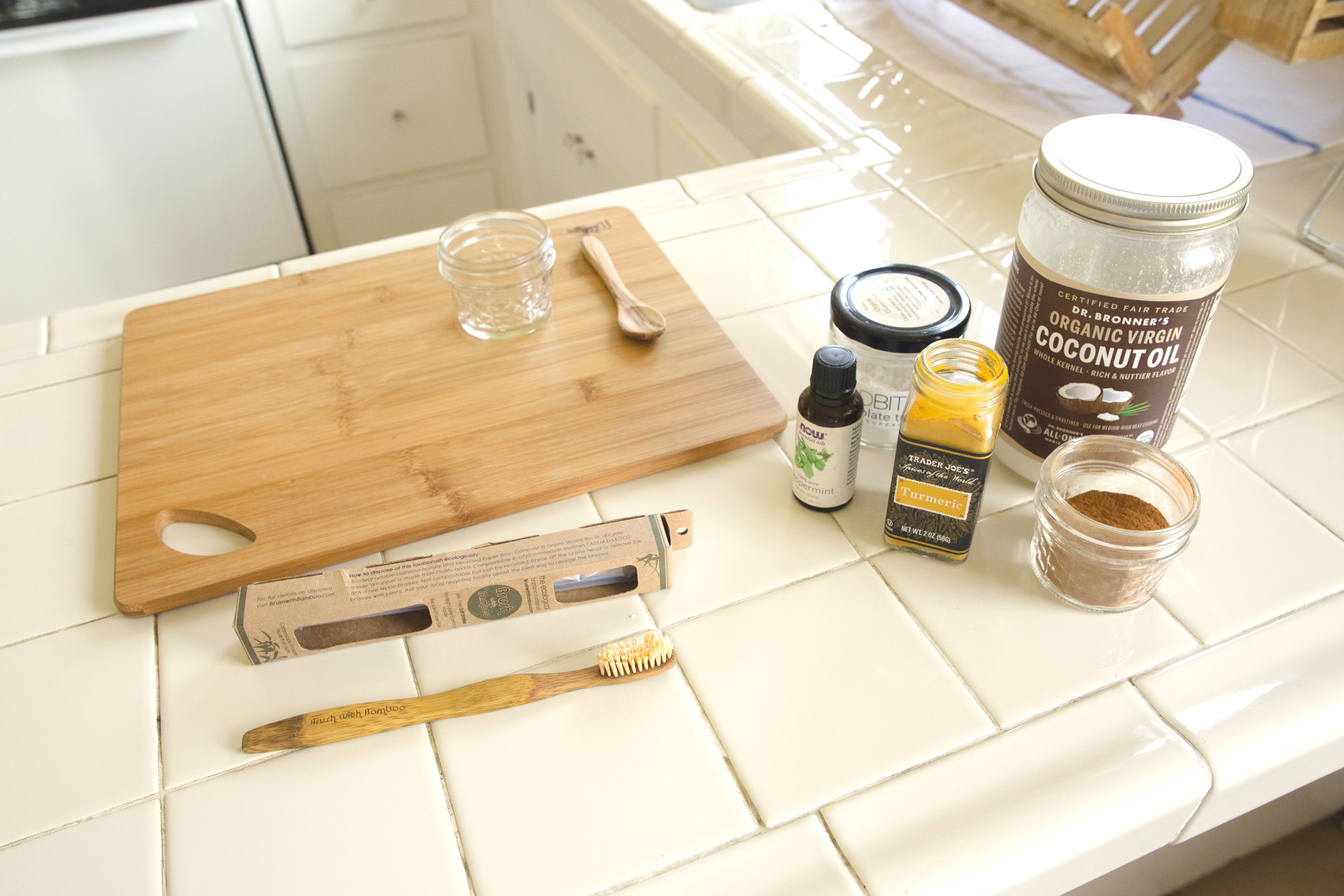
We’re making zero waste toothpaste in the kitchen of Meryl Pritchard of Kore Kitchen. She’s using an olive wood spoon made from branches; no trees were cut down in the name of the spoon. She uses aloe instead of Bandaids. Her water jug is filled with spring water a friend delivers. Even her TP is made with wheat straw and requires no deforestation.
“Why would we cut down trees so we can wipe our butts?” she asks me as she mixes the concoction of coconut oil, baking soda, turmeric, peppermint, and cinnamon. She scoops it into a glass jar for me to take home.
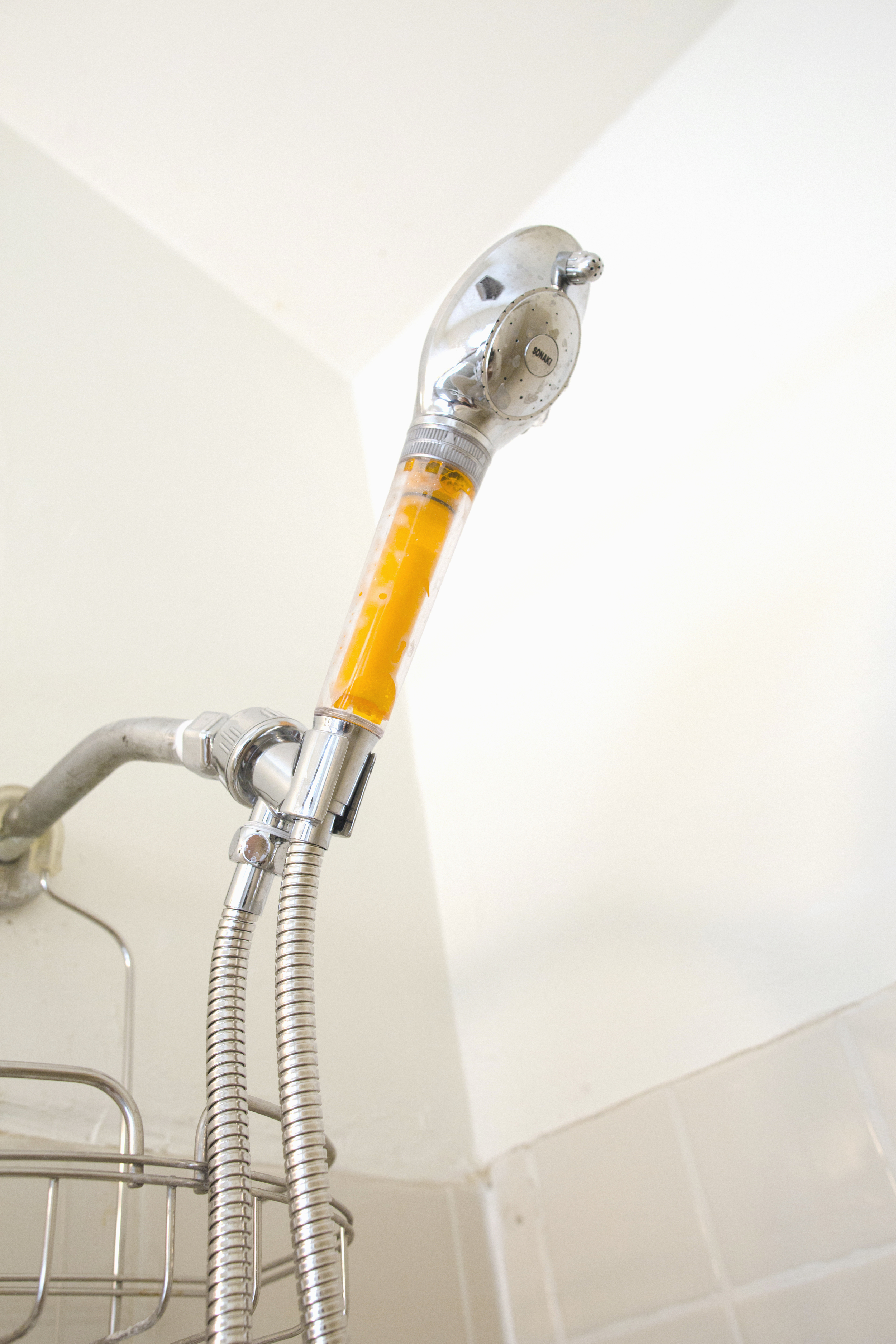
“The turmeric makes the toothbrush orange,” she tells me, “so don’t get weirded out.”
What’s weird is how little I know about recycling; a blue bin is hardly a perfect solution. “Less than 10 percent of plastic that gets thrown in blue bins is recycled,” she explains. The reasons for this are multifold: people don't sort, rinse, or really know what can and cannot be recycled.
[Unfun fact: In Los Angeles alone nearly 10 tons of plastic fragments-- think parts of plastic bags, straws, and soda bottles-- are carried into the Pacific Ocean, every day.]
Meryl hasn’t always been about that zero waste lifestyle. For a minute she was about that life. In her early twenties she was working for a well-known Hollywood celebrity stylist. “We’d spend days picking dresses, fitting these beautiful women, and then they’d get torn to pieces in the press.” It made her feel terrible about herself and her body. “At the end of the day,” she tells me, “I’d think, if people are saying this gorgeous woman looks terrible, how am I supposed to feel about myself?” It lead her down a dark road rife with body image issues: “I was trying every fad diet out there, not eating,” she says. “Feeling bad in your own skin is the single worst feeling.”
[Define it: Zero Waste is a philosophy that encourages the redesign of resource life cycles so that all products are reused. No trash is sent to landfills or incinerators.]
“Feeling bad in your own skin is the single worst feeling."
Tweet this.

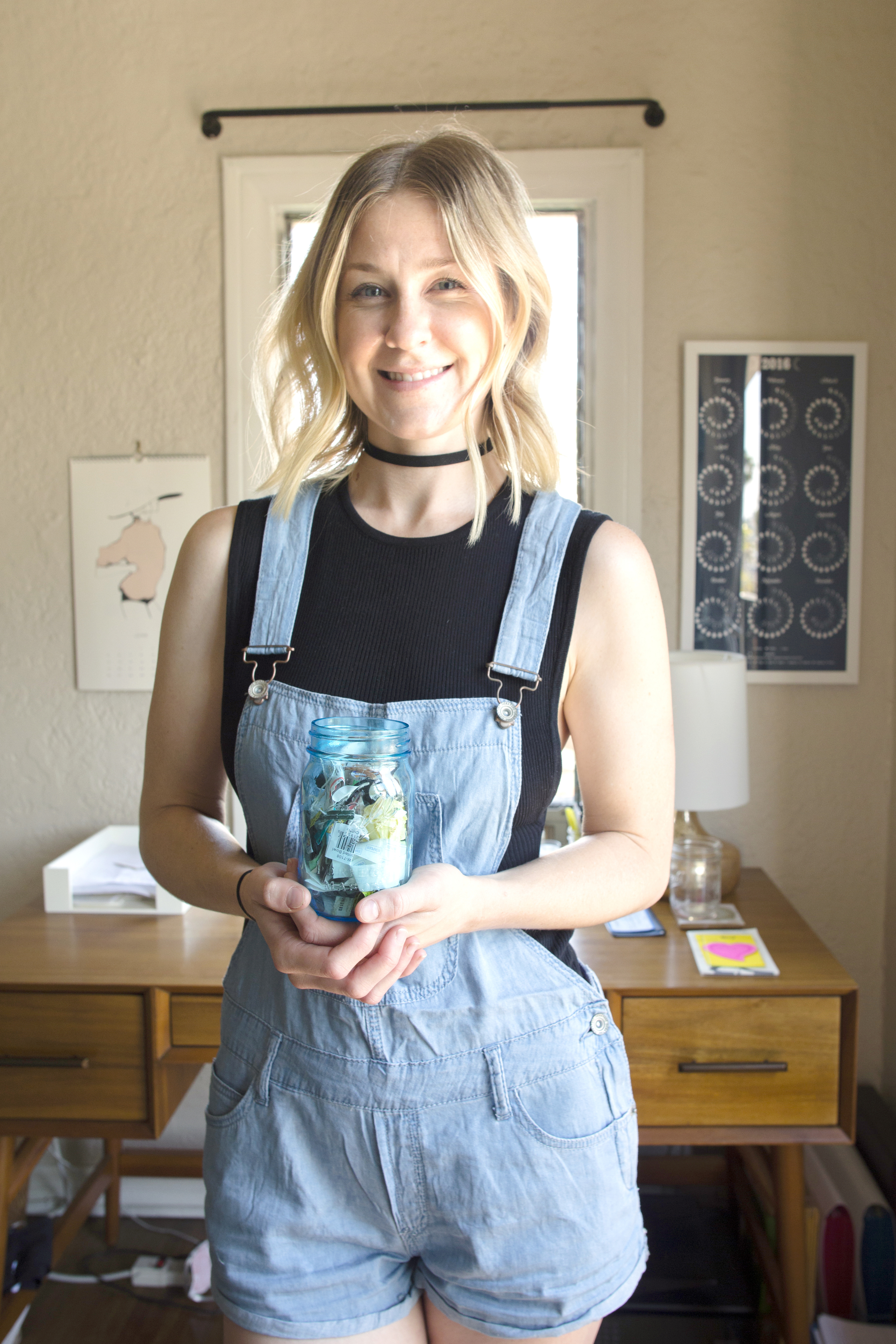
“This is my trash from the past three months!” she exclaims. "I’ll keep it and I’ll analyze it. I like to keep it because then I can go through it and find a solution.We don’t have a relationship to trash. People just don’t know where it’s going-- someone picks it up, takes it away, so how are you supposed to care when you don’t see it?”
But then she came across a book, “The Kind Diet,” by Alicia Silverstone. Meryl says she had so many ah-ha moments while reading, from coming to understand aspects of the food industry to what she was putting in her body, she knew it was time for a change. She emailed “every single holistic nutritionist in LA who had a website and seemed legit,” and was surprised when they all responded nicely. “I was so used to dealing with people not getting back to me or being nice,” she says in reference to her styling career, “that the energy immediately felt different and promising.”
She began working with a holistic nutritionist who let her sit in on all client sessions. “That’s when I saw healing first hand. I watched as people would cancel surgeries doctors told them were 100% necessary, and they’d go on to live life healthy.” With a little experience and a lot of enthusiasm she went back to school at 23. What she says is a “great age to make a shift.”
She attended The Institute for Integrative Nutrition, which teaches over 100 different dietary theories. As she was learning them, she’d try them. “You are the best doctor you can have— you live in your body, you feed it, you feel what doesn’t work.” The hitch was that Meryl had no idea how to cook. “I would go on Google or talk to Siri and ask really basic things like, ‘Siri, how do I cook a chicken breast?’ But it taught me that I can do anything. If you want to, you can figure it out.”
Kore Kitchen evolved naturally from this mindset. Kore is a “curated and nutritionally designed, meal delivery service and cleanse offering based in Los Angeles.” The intention is to help clients adapt a healthier lifestyle through simple nutritional philosophies: eat whole, organic foods, that are local and sustainably sourced.
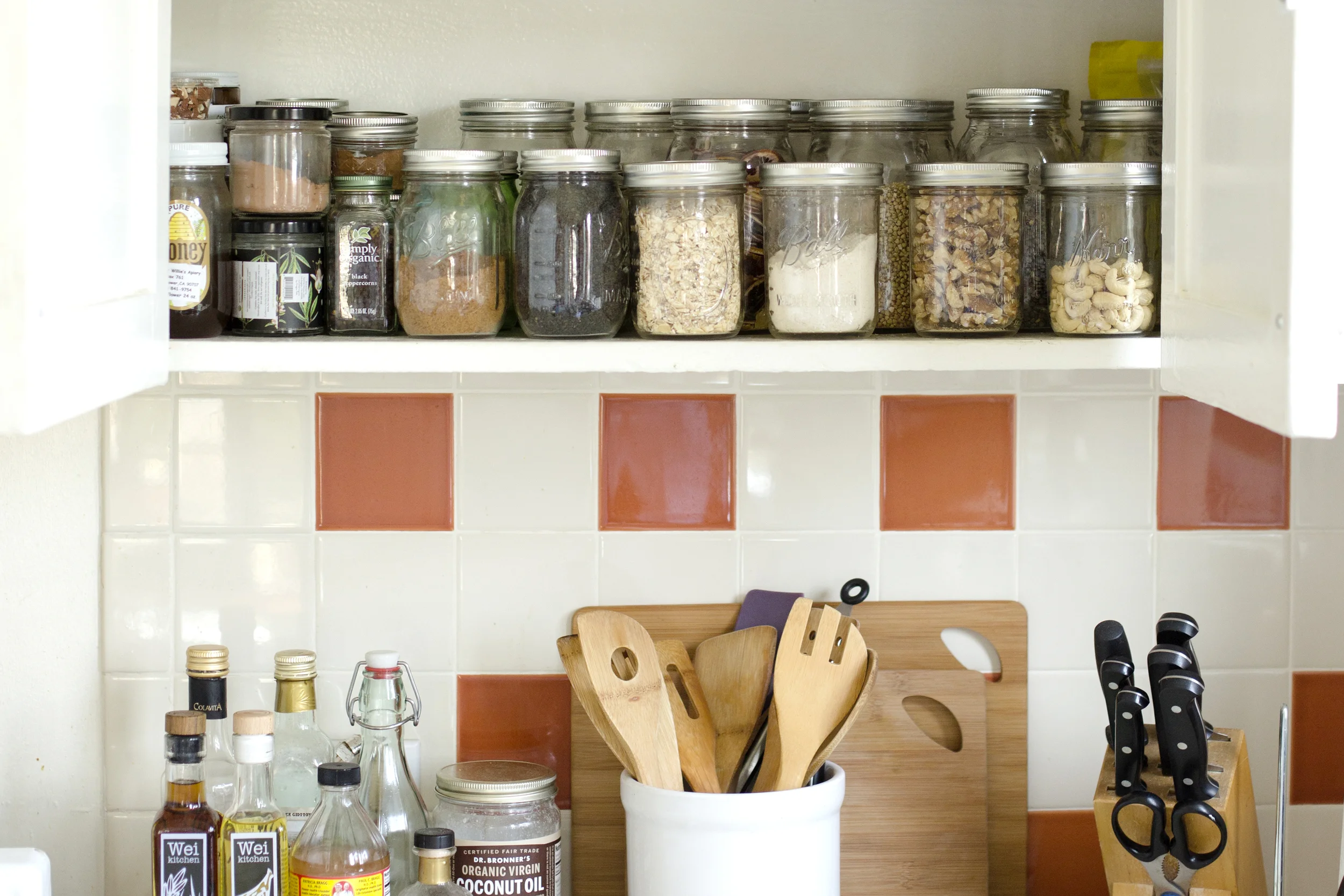
There's no packaging in her pantry. She fills reusable glass jars with foods from the bulk bins.
With these Kore values in mind she began cooking for friends and delivering meals. “It would take me forever.” she says. “What would take a chef 20 minutes would take me 3 hours, but with food you’re transferring energy into the meals.”
“I was planning the menu, doing the shopping, the cooking, the delivery, and right after I finished I’d get up and do it all over again.”
She had a few clients during this time, but it was when friends and clients Donovan and Libby Leitch recommended her to Gwyneth Paltrow, the business took an unexpected turn. “I delivered her meals and heard nothing for a few months,” she says. Until Goop’s food editor reached out in December 2014, saying they loved her recipes and would she contribute a few to the site. She shared some recipes for Goop’s 2015 Detox Guide and the email floodgates opened.
“It was just me with one pan, in this kitchen, and I had all these orders.” She hunkered down, found a chef, Anna Lagura, whom she met through a happenstance convo with her neighbors across the hall, and signed a lease for a commercial kitchen space. Anna and Meryl now work out of L.A. Prep.
Of Anna, Meryl says, “She’s the person I’m most inspired by. I can send her a photo of any dish and she can make it with our philosophy. And she knows all of the clients and their food preferences by name and memory.” The meals Kore offers are organic and made from local ingredients whenever possible. They use no processed foods, no additives, no antibiotics or hormones, no preservatives, and no refined cooking oils or refined sugars. They are 100% gluten-free and dairy-free.
The business has been running for about a year and a half, and Meryl acknowledges the difficulties of being a self-funded, small business, but insists that she prefers it this way. "No funding required us to be more creative with our marketing," she says, adding "and I think we have a stronger connection to our clients."
“It’s difficult, but it’s also really fun. Business is like life, there shouldn’t be an end goal— you should be learning and growing all the time.”
"Business is like life, there shouldn’t be an end goal— you should be learning and growing all the time.”
Tweet this.
Growth for Kore however, does not include meal delivery services outside of Los Angeles. It is important to Meryl that they stick to their values of staying local. “We’re not a corporation, we’re a small business.”
“I don’t want to grow outside of LA. Local is really important to me because of the carbon footprint. With other meal delivery programs, you have to wonder, why are you in California eating food from North Carolina?”
It’s also why they have partnered with LA Compost, a local compost with four hubs, one of which is five minus from the commercial kitchen space. “All of the food that you’re eating, the scraps are going directly to the compost. Not trucked out of the city and brought back to be sold as soil.” They also now have a plot at the Elysian Valley Community Garden where Meryl is trying out her green thumb.
“We’re not trying to feed everybody,” she says, “we’re trying to feed our community.”
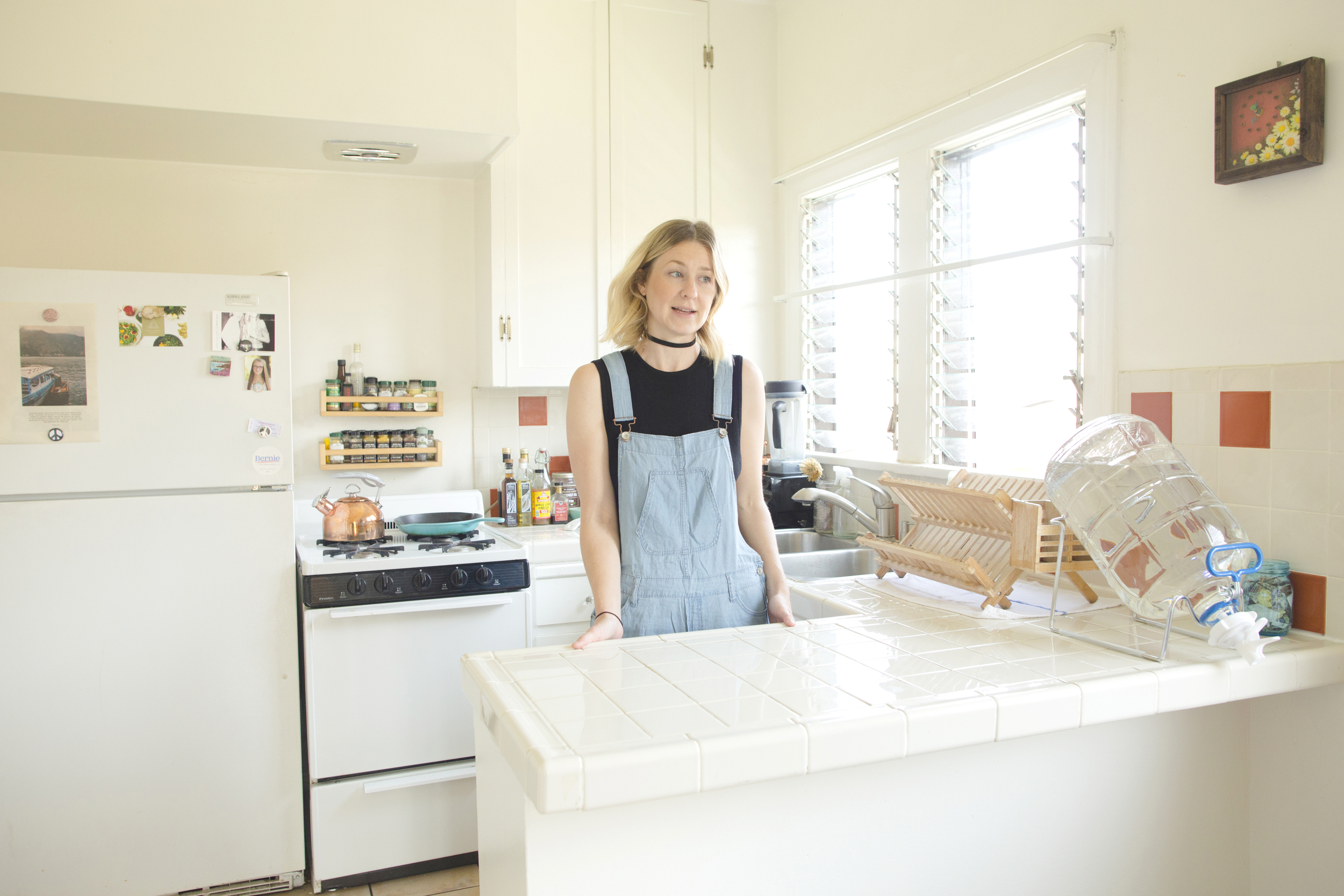
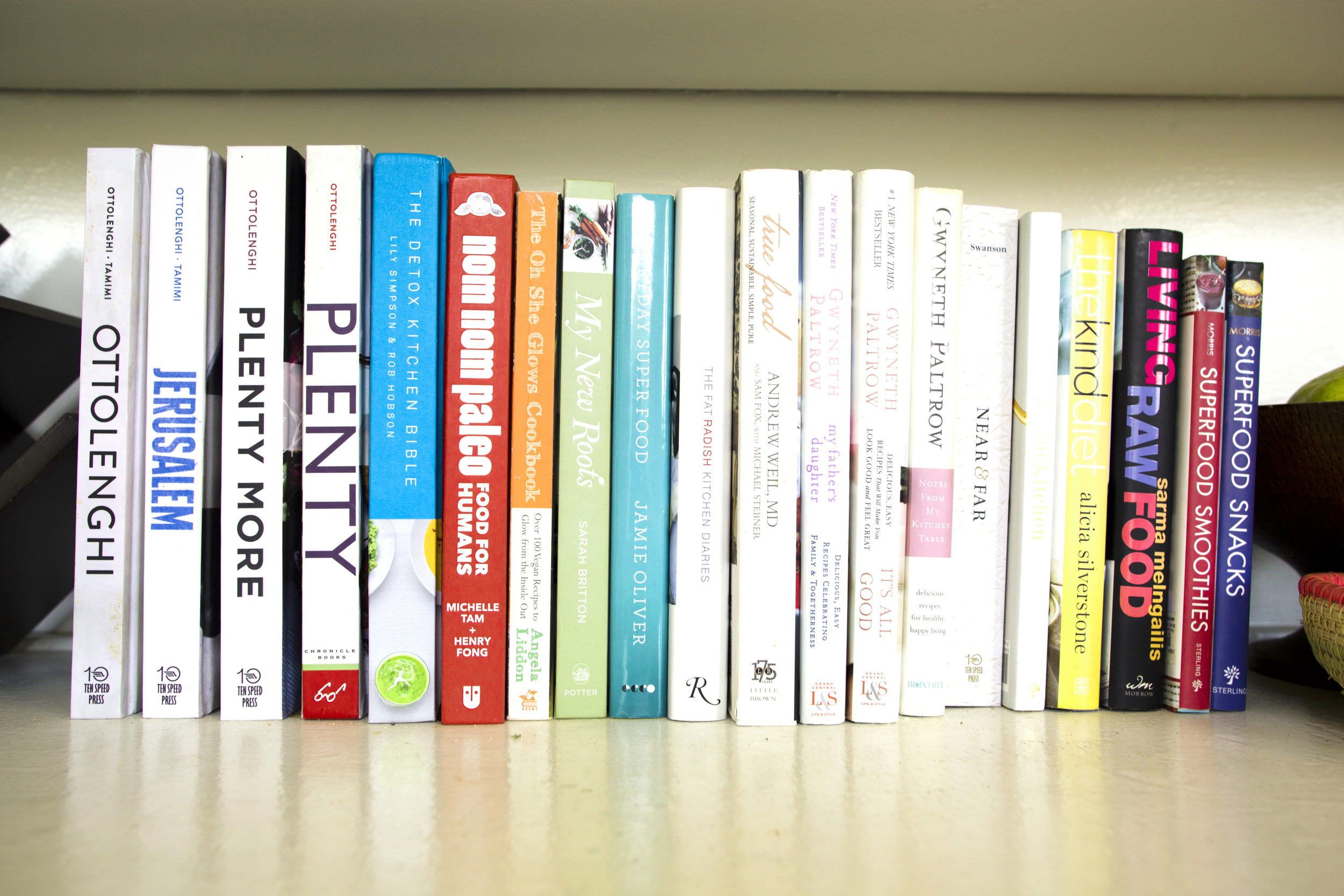
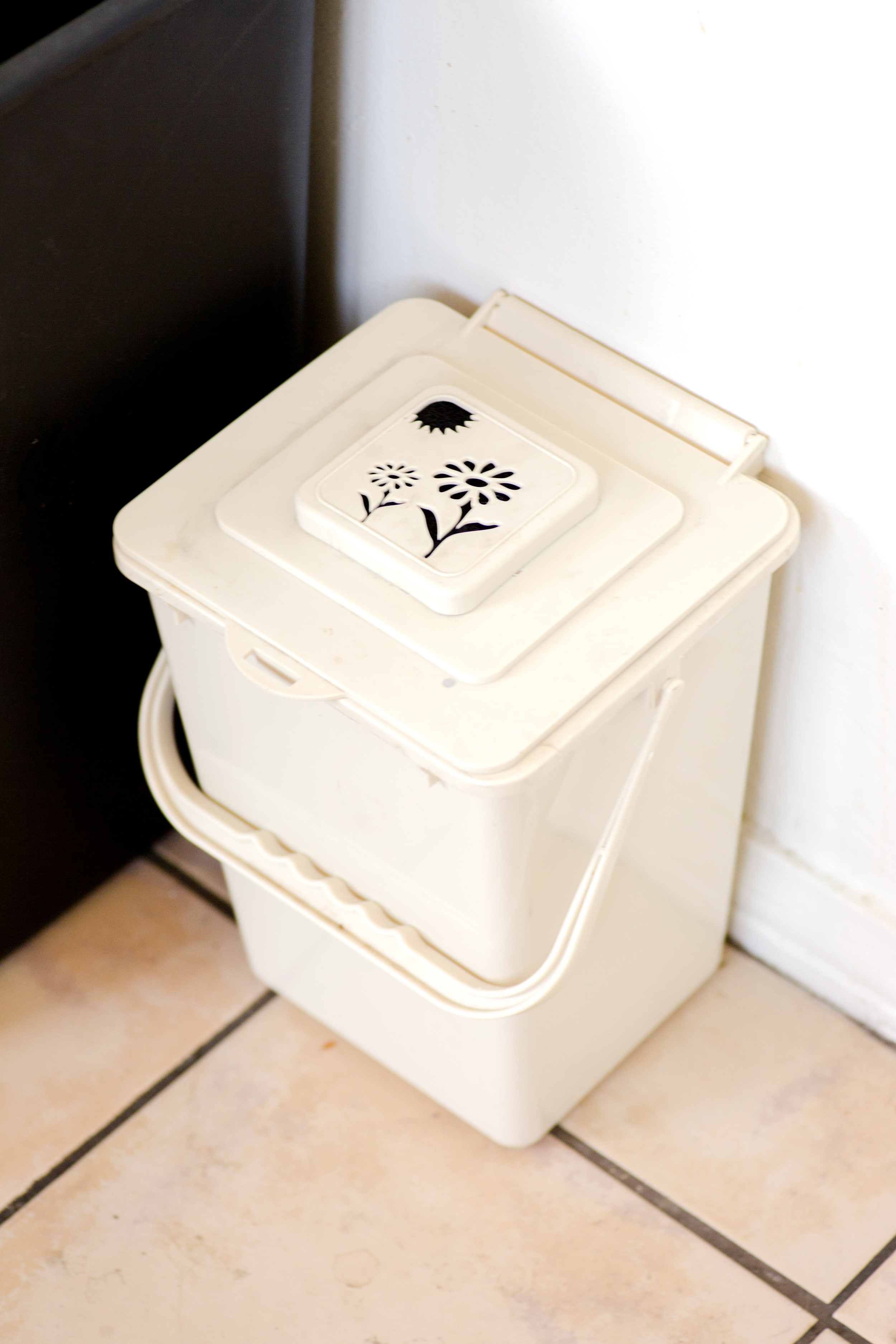
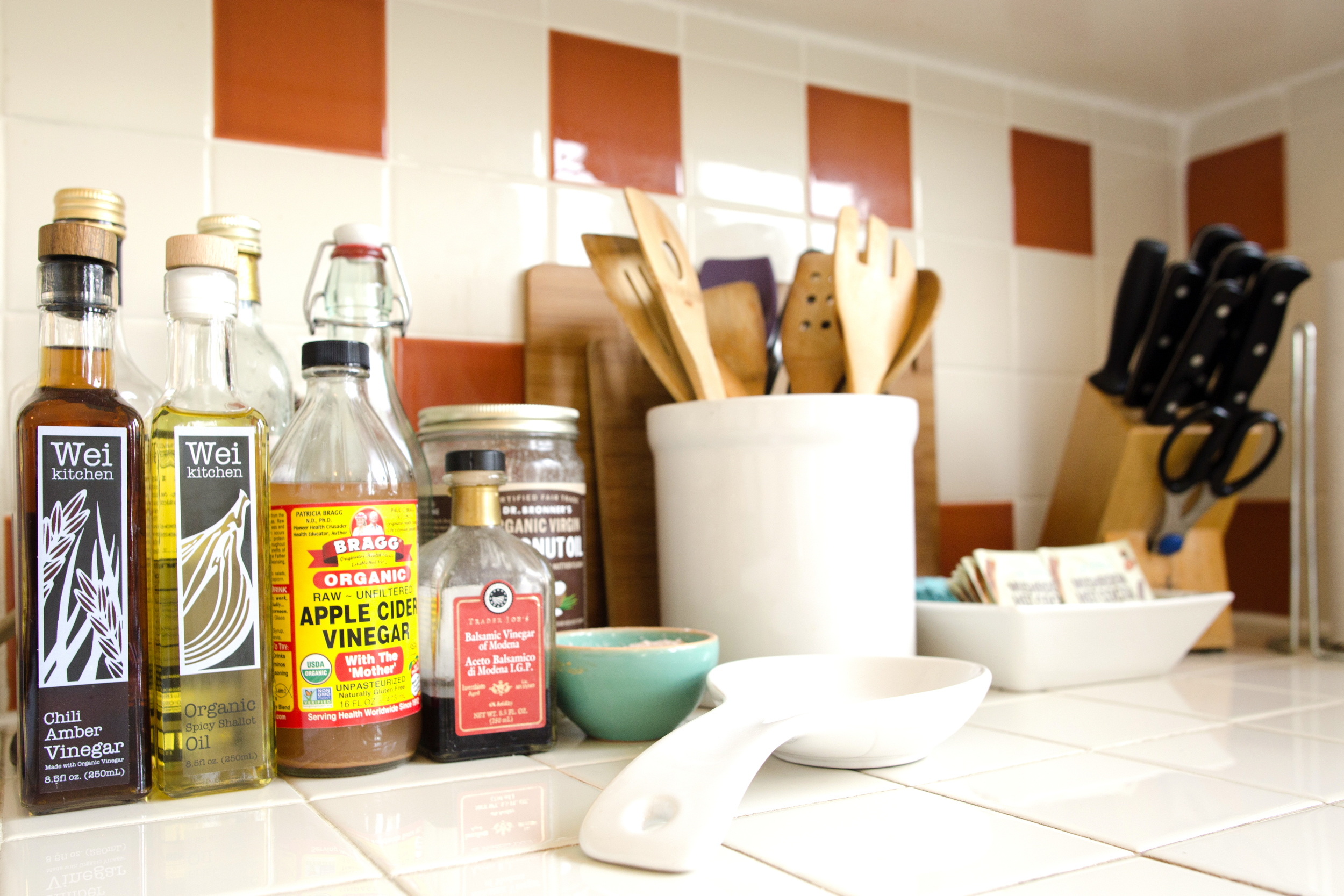
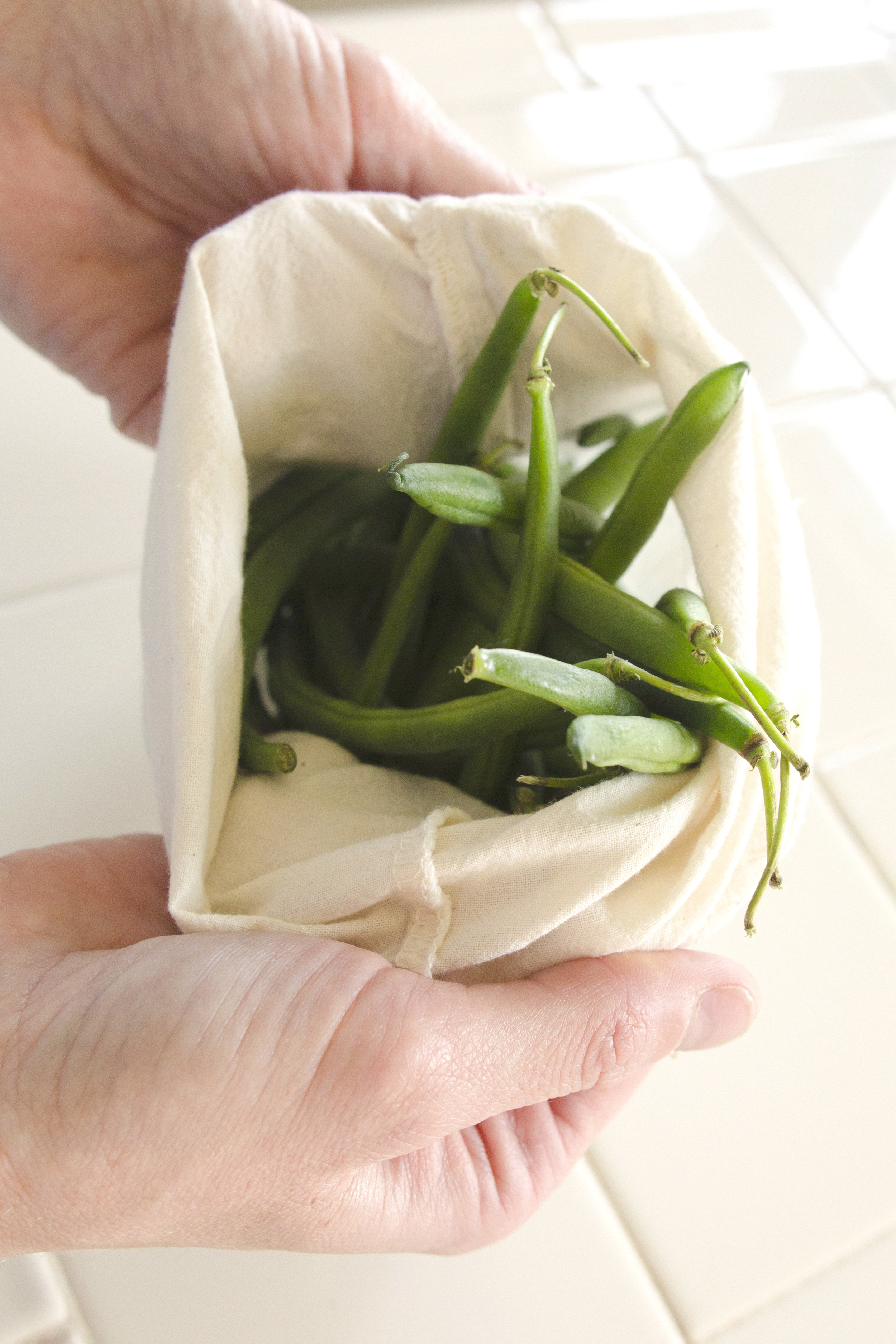
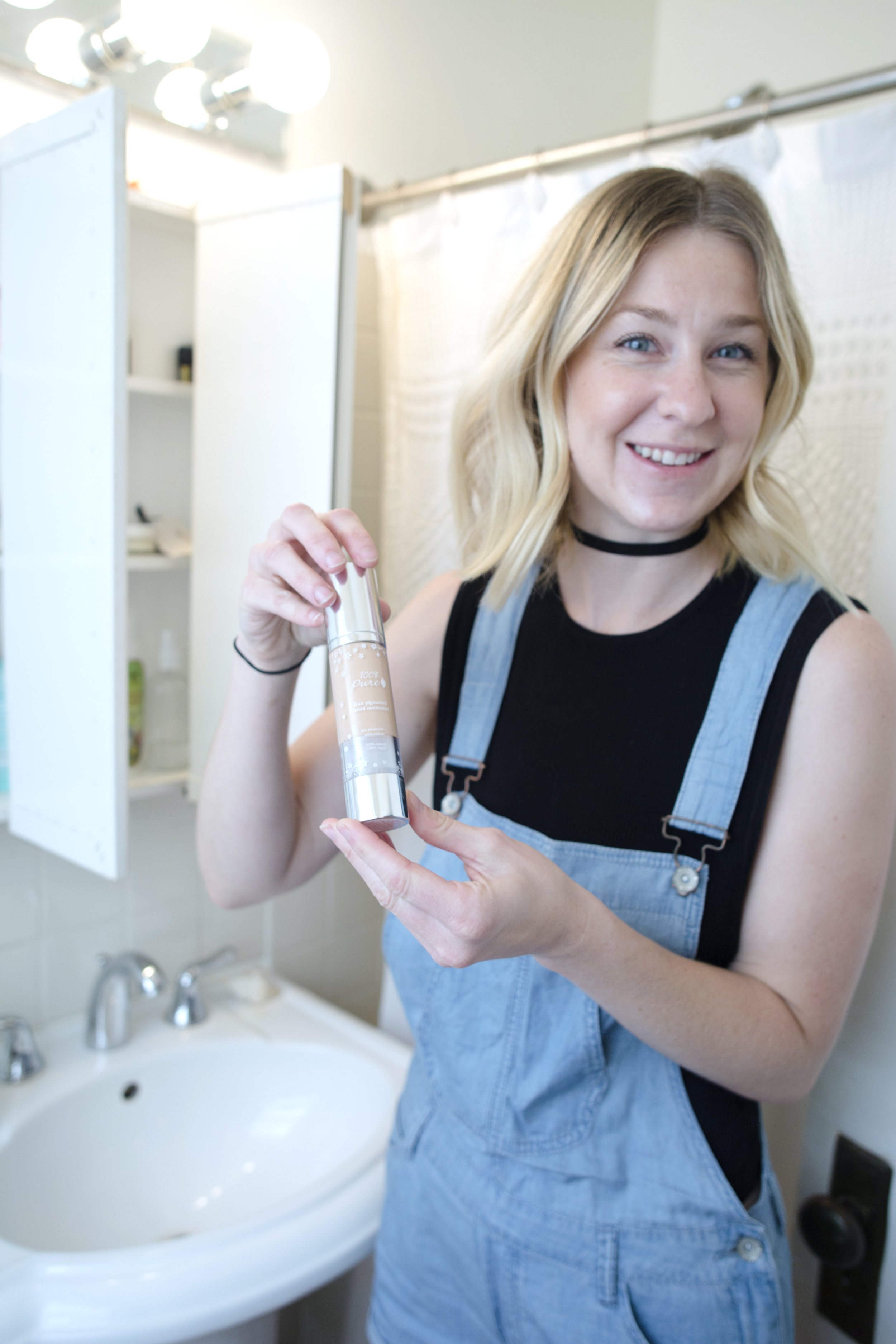
Click through the below gallery to see more of Meryl's zero waste lifestyle and see our toothpaste!

More from our blog:





C&C Classifieds No 66: Rolling Greens, Paperless Post & More
I spy with my little eye... jobs.

Who says you have to follow one career track? Or go with convention? These women certainly didn't. Nor did Kore Kitchen founder Meryl Pritchard who abides by a zero waste lifestyle policy (and incorporates those aspects into her biz). Want to join her team? We've got offerings from Meryl and other rad companies in this week's Create & Cultivate Classifieds.
Shake Shack - New York NY
Paperless Post - New York, NY
Crate and Barrel, Northbrook, IL
Wendi & Nicole - Los Angeles, CA
Rolling Greens - Los Angeles, CA
Kore Kitchen - Los Angeles, CA
WANT MORE? SIGN UP FOR OUR FULL LIST OF CLASSIFIEDS HERE.
MORE FROM OUR BLOG

Hello to 5 Time-Saving Beauty Tips from Nikki DeRoest
The Hello to Beauty founder is dishing the beauty goods.

Our schedules are crammed. We can barely make enough time to get to that 7PM spin class after work-- so forget a 30-minute AM prep before work when we need to look presentable. We need a beauty routine that works for our schedules, not against them.
When you work a 9 to 9 every second is valuable.
To help us hack our morning beauty routine, we asked Create & Cultivate DTLA panelist Nikki DeRoest and Hello to Beauty guru to dish the beauty tricks she uses to make her life a little easier. Check her 5 key tips below, and be sure to catch her on panel this May as she shares how to succeed in the business of beauty!
1. Style your hair the night before.
Wash your hair in the evening and let it air dry either all the way or 80% of the way and then finish the last 20% with a blowdryer. You'll save time washing it at night, and will also help the health of your hair. I often completely style my hair at night so that I can do minor touch ups in the morning. You know what they say, when a woman says she can't go out because she has to wash her hair....there's some truth to that!
2. Invest in a good at-home mani.
I always use a "gel" topcoat on all of my at-home manicures. My favorite one is from Sally Hansen’s Miracle Gel, and it prolongs any of my manicures to last at least a week, but I don't damage my nails like the in-salon gel manicures. (Tip: You can use ANY brand nail polish with that topcoat and it works wonders!)
3. Have a masquerade party.
I don't know if I'd call it a hack, but using a lot of face masques is a REALLY good idea! Your skin will love you for it. I switch up the different types of masques, and usually sleep in them.
4. Glow up.
Glowing skin will always make you look younger. Promise.
Make sure to always add a good highlight to the cheekbones to give yourself a youthful glow. My favorite is RMS's Living Luminizer.
5. Have your boss look nailed down.
If you are a busy boss, I think it's important to come up with your "look." That way when you are getting ready for your day-to-day, you don't have to think too hard and can feel confident walking out the door.
MORNING HACK: HAVE YOUR BOSS LOOK NAILED DOWN.
Tweet this.
I have my standard "look" and easily switch it up with different lipstick shades. Of course, in the evening or weekends it can be more of a free-for-all, but I think it's important to know your routine and look so you can get it done quickly.

Why It's Time to Ditch the "YOLO" Mindset
Your old pals dollars and sense say so.

Don't worry, she made that coffee at home...
These days, in our world of instant gratification (we may even be able to leverage our selfies to make purchases), it’s more necessary than ever to be able to stay focused on saving money any way you can. So to help you monitor your spending habits and cut expenses (to put more $$$ in your pocket), here are 20 easy hacks you can use every day—starting right now. Now, that’s instant gratification at its finest!
1. Have a weekly money date.
Commit to sitting down with your money once a week for a money date. During this time, update your budget, review your accounts and track your progress against your financial goals. Like any relationship, if you want your financial life to improve, you must spend time with your money.
2. Plan out your meals for the week.
Taking a few hours every weekend to grocery shop and meal plan for the week will definitely save you money, as dining out is the No. 1 expense for most households. By eating at home, you save money that would otherwise be spent on tax and tip—and you usually save calories, too.
3. Cut out cable.
Gasp! Cut out TV?! Never! But with services like Hulu, Netflix and Amazon Prime, you can now watch your favorite TV shows and movies for a fraction of the cost of cable TV. A study by NPD shows that cable bills will soon grow to an average of $123 per month, or $1,476 per year. By switching over to an online service or cutting out TV altogether, you can save that money for another financial goal—like paying off debt, traveling or saving for a home down payment.
4. Host a potluck.
The more friends you have, the more money you spend on lunch dates, birthday parties and gifts. Switch it up and instead of meeting over a fancy dinner, host a potluck and have everyone bring his or her favorite dish. That way you can save money you’d spend on restaurant extras like tax, tip and parking—and you’ll usually have a more intimate meal together, too.
5. Leverage Airbnb.
Finding a place to stay while traveling is so convenient when you use Airbnb. You can often find a place that has a kitchen (so you can cook meals at home to save money) at a rate that’s comparable to hotels. You can even rent out your own place on Airbnb while you travel to make some extra cash to pay for your own travel expenses. It’s a win-win scenario.
6. Make coffee at home.
This one’s not my favorite, as I absolutely love going to coffee shops and drinking organic, delicious coffee. However, spending $4 to $5 on coffee every day definitely adds up. So try my approach and allow yourself a few days a week to buy coffee at cafes, and make it at home the rest of the time.
7. Work more.
When you’re working a lot, there’s not much time left to shop and spend money. Stay busy and pursue a career you love—then watch how when you’re busy hustling, you spend less.
8. Wait 48 hours before you click “buy.”
Since we can have anything we want these days with just the click of a button (there’s that instant gratification again!), you need to find a system to help buffer your impulse purchases. Example: Wait 48 hours before spending money on things that cost more than a certain amount. When you do, you will find that most of the time the item was more of a “want” than a “need.” Plus, you’ll save money and work toward being more mindful with your spending.
Stop spending money on things you don’t need to impress people you don’t like.
tweet this
9. Use blogs and Pinterest to learn DIY beauty treatments.
Self-care is important—but going to spas and getting pedicures, massages, etc. can really add up. Allow yourself a certain amount to spend on these things, then use blogs and Pinterest to find at-home beauty treatments to help you save money. Often you can find a DIY, organic option using common household or kitchen products.
10. Outsource with Fivrr or Task Rabbit.
Time is a commodity, and your time is precious and valuable. And these days, there are so many tasks you can outsource that will save you time and money. But how do you figure out if outsourcing something is worth the expense? A great thing to do is to actually calculate the cost of your time, which will help you figure out if you can pay someone to do something for less than your hourly rate. Here’s an example: A monthly net income of $3,000 divided by a total of 160 hours worked equals an hourly rate of $16.75. Now that you know the value of your time, you can strategically outsource it, using a service like Fivrr or Task Rabbit, for a fraction of your hourly rate.
11. Get creative with gifts
Find creative ways to express your love to friends and family members for birthday and holiday gifts. After all, a handwritten note explaining why you love someone can be more sentimental than some expensive gift he or she may never even use. Most people will appreciate the thought behind your gifts more than anything, so don’t be afraid to save money and find free ways to celebrate birthdays and holidays.
12. Choose quality over quantity
This can apply to food, clothes, electronics and much more. Although it’s tempting to choose the more budget-friendly version of an item, sometimes choosing quality over quantity will save you more in the long run. Save up your money and get the best-quality product you can afford, and leverage the cost-per-wear philosophy with more expensive clothing and shoes. This applies to food, too: Buying quality organic food can nourish you in ways that fill you up more than the pre-packaged, processed stuff and potentially save you health care costs in the future, since you’re taking good care of yourself. Find a balance that is right for you and choose quality whenever you can.
13. Deal with your emotions.
A lot of times excessive spending is a way to avoid feeling certain emotions. If you check in with yourself before you go on a major spending spree, you may be able to identify if you’re feeling bored, lonely or stressed and spending money as a way to avoid the underlying emotion. Check in before you buy and be mindful with your spending.
14. Stop trying to keep up with the Kardashians.
It’s hard to keep your blinders on and not compare your financial life to others’, especially celebrities. However, it is really important to be clear about what matters most to you and make sure you build a financial plan that supports that vision. This will keep you moving toward your financial goals and stop you from spending money on things you don’t need to impress people you don’t like.
15. Read a personal finance book.
When you learn about personal finance, you’ll learn even more strategies to help you save money for your goals in life. Knowledge is power and the more you know, the more you can save.
16. Balance out your “YOLO” mindset.
With social media controlling our lives like never before, people often fall victim to the “fear of missing out” phenomenon and instead go overboard with a “you only live once” mentality. While it is important to live in the present and soak up each precious moment of life, make sure you balance that out by saving for your financial future, too. Without checks and balances in place, you can find yourself saying yes to everything and spending more money than you have—all because of the fear of missing out.
17. Map out your financial goals.
Be very specific with your financial goals. For example, saying, “I want to save for a home down payment” is not enough. You need to map out how much you need, by when, and what you need to save every month in order to reach the goal. When you know what your targets are, you’re more likely to stay the course and continue saving for them for the long-term.
18. Keep your eye on the prize.
Staying focused on your goals take discipline and determination. Saving can be easy and exciting at first, but after a while you may lose that initial motivation and start to find other things you can spend that money on. To avoid veering off course, check in with your goals regularly and keep your eye on the prize.
19. Track your progress
People in the U.S. save only 5.5% of their money compared to the 20% that personal finance teaches that you should put away. But instead of feeling ashamed about your lack of savings, just start by saving something. Even 1% is better than nothing. Track your progress and continue to increase the number year after year. Step by step, day by day, you can get to that 20% savings level. The truth is there are many ways to save money. Find the ways that work for you and slowly start incorporating the strategies into your life.
What tricks do you have for saving money?

Brittney Castro is the Founder & CEO of Financially Wise Women, an LA-based financial planning firm for women. Brittney has been featured in the Wall Street Journal, New York Times, CNBC, Glamour.com, KTLA, Entrepreneur.com, CBS, and more. Away from the office, you can find Brittney working out, drinking coffee with steamed almond milk, reading, playing with her fur baby Arya, and, of course, dancing. Follow her at @brittneycastro.
Celebrating #WorldKindnessDay with the Founders of The Kind Campaign
Killing it with kindness.
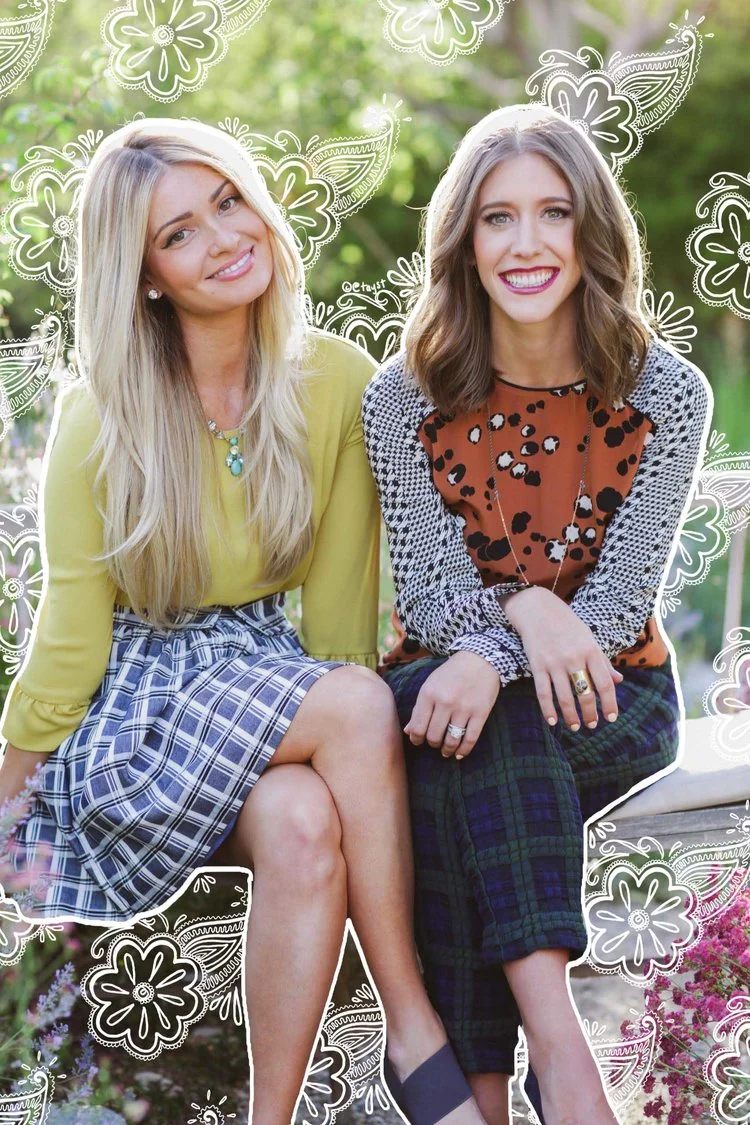
Kindness Day was born when a collection of humanitarian groups came together on November 13, 1997 and made a “Declaration of Kindness”. Donating books, food or clothes to your local community is a great way to celebrate. However, these boss ladies went even further and launched an entire campaign.
Both Lauren Paul and Molly Thompson, co-founders of The Kind Campaign experienced bullying in middle and high school. Experiences that shaped who they are and gave them the first-hand knowledge needed when they launched Kind Campaign.
While attending Pepperdine University, Lauren had the opportunity to intern for Tom Shadyac on his documentary project, I Am. Wanting to do something since being "severely bullied" in middle school, Lauren shares that the experience working on a documentary gave her the idea to work on a documentary of her own. One that specifically addressed the issues of bullying.
Lunch in the Broadway Cafe at Pepperdine was the starting point, when both Molly and Lauren enthusiastically said, “YES” to an “uncharted adventure.”
“It was during that life-changing lunch,” shares Lauren, “that I pitched the idea about creating a documentary.” Molly was all-in. “From that moment on,” she says, “we dove head first into everything. The moment we turned on the cameras and held our first interview for the film, we both knew there was a huge potential for something greater.”
That was in 2008. Bullying wasn’t the hot-button topic it is now. They didn’t know if people would be willing to open up about their experiences. But the moment women and girls started talking it was clear that the issue had been swept under the rug for too long. Like Lauren, Molly had her own share of bullying experiences in high school. “Bullying specifically between females,” shares Molly, “was not addressed. It was almost expected and accepted as a rite of passage.”
The college seniors were about to launch a movement.
Those initial interviews for Finding Kind, paved the road toward Kind Campaign, which officially launched in February, 2009. Since inception, Molly and Lauren have spoken at over 400 schools in North American and the UK, activated 390 Kind Clubs across the globe, and Lauren shares that “Kind Campaign Assemblies are now hosted by faculty and volunteers almost every day of the school year.” The co-founders are getting ready to head out on their 12th Founders Assembly Tour.
It’s been an incredible journey for both. Lauren grew up in Orange County and Molly in Dallas, but after sharing a laugh over a YouTube video their junior year of college the two became “fast friends.”
“It feels very surreal looking back on the last several years,” shares Molly who gave birth to daughter Lyla last August and understands the power of the messaging more than ever. “When we first started Kind Campaign, we were running on passion and adrenaline, pulling all nighters and barely scraping by with enough funds to keep going and spreading the movement.” Now the goal of offering free global programming is a reality.
Lauren knows that more than ever young women need to know “that they matter, they are heard and they are equal. That no one can tell them who they are and what they can and can't accomplish.” She also brings up the power of social media and the influence it has over girls’ self-esteem. “There needs to be more conversation about how to have a healthy relationship with your phone. To remind girls that their worth is not determined by how many likes or followers they have.” Adding, “This is something we ALL need to hear and think about.”

More from the co-founders below.
What do you think young women and girls need to hear now more than ever?
Molly: That they are strong, powerful, beautiful, inspiring, unique, and more than capable of accomplishing anything that they put their minds to. And then remind them of this over and over and over again in order to combat the mixed messages that women and girls are fed by the media, by what is going on in our world today, by the experience that they have at school or in the workplace, and by the things that they start to tell themselves because it has become so ingrained within them. I think more than anything they need to be encouraged and allowed to be whoever it is they truly are, rather than to be told what it is they can or can't do, or be put in a box. Now, more than ever, I think we need to remind ourselves and our peers that we are enough, more than enough; and no one can take away our intellect, our self-respect, our beauty, our talents, our voice, or our worth
How can we each carry kindness into the world?
Lauren: Serving others doesn’t necessarily mean starting your own non-profit or dedicating your whole life to community service. One of my favorite quotes was said by Howard Thurman. It reads: “Don't ask yourself what the world needs; ask yourself what makes you come alive. And then go and do that. Because what the world needs is people who have come alive.”
I deeply believe in that motto. There is nothing better than a person who comes alive when they tell or show you what they do or what they’re passionate about, whether that’s being a teacher, sailing, owning a bakery, being a lawyer, singing or being a mom. You will be the best you if you find a way to do what you love and love what you do.
Molly: Every single person has the ability to change the course of someone else's life, just by being awake, being aware, and being kind. We truly do not know the battles that others face in their day-to-day lives, so if we just focus on ourselves and our ability to carry kindness into the world, and we are a light in someone else's life (however small it may be), we have the chance to make someone's day and even save their life.
What is a time in your life when you thought, 'I can't do this anymore?'
Lauren: When I went through my experience being bullied in middle school I remember waking up every morning and thinking that there was no way I was going to make it through another day of school. I went to bed every night not wanting to wake up in the morning. I truly lost myself. But with the support of one friend and my family, I was able to dig myself out of that depression and now I look back and that dark time and know that it all happened for a reason. Without that experience, I would not be doing the work I am doing. I am now able to stand in front of hundreds of girls in our assemblies and remind them that their school experience is just one chapter of their story. That no matter how dark the chapter is that you are in, there is a whole life ahead of you, waiting to be lived, filled with love and adventure.
What's a surprising story you heard during a school assembly that's stuck with you?
Lauren: Rachel is a girl we met during our last Spring tour while in Utah. At the end of all of our assemblies, we take a picture with the group of girls we are speaking to and post the picture on Kind Campaign’s social media. We were scrolling through the girls comments on her school’s photo and came across this comment from Rachel:
“I was at the Kind Campaign assembly at Draper Park. You guys really changed my point of view on everything. I can relate to everyone in the film. Every girlfriend I've had, I have lost.This morning when I woke up I was thinking about committing suicide. I came to school today on the verge of tears. Once I got in and sat down I wasn't really paying attention but once I watched the movie and I was in tears. I came up and shared my Kind Card. It was about one of my best friends. He stood by me through all my hard times. Once I got home I realized that even though some girls can be rude and don't understand what their words can do that it shouldn't be worth dying over. I called my best friend and talked to him for an hour. I was just crying my eyes out. Your assembly today? Yeah, it saved my life.”
We were really moved after reading that and immediately connected with her through Instagram and offered further support with our in-house counselor. Our on-call therapist counsels girls and parents who write to Kind Campaign and need extra conversation and support. This service is free of charge. I still keep in touch with Rachel and she is happy, healthy and doing so well!
What does female empowerment mean to you?
Molly: Everything. Female empowerment is everything. Celebrating each other, our accomplishments, our differences, our failures and our victories so that we feel emboldened and proud of who we are with the knowledge that we are good enough. It has taken on a new meaning since having Lyla. Even though it's always been important to me, now it's even more personal. Not just for myself, not even for all of the incredible young women we meet through our work, but for her - my little heartbeat. She needs to know her worth and feel supported and celebrated. Not judged and picked a part, scrutinized under a more harsh microscope than others.
"Female empowerment is everything."
Tweet this.
Lauren: It means getting to know yourself. Loving and respecting your body, heart and mind. It means doing your best to let go of those female insecurities we all harbor. It means feeling genuinely happy for other women and celebrating their beauty, uniqueness and accomplishments without going to a jealous or competitive place. Don’t be a part of drama and gossip.
What’s on your career bucket list?
Lauren: I’ve always dreamt of writing a book. I would also love to continue speaking in other countries. Molly and I took our Kind Campaign Founders Assemblies to the UK last year and I would love to see our programming continue to spread globally.
Molly: Honestly, in so many ways I feel like I've already exceeded what any bucket list could capture. Not to sound cheesy, but I really do feel so unbelievably lucky to be in the position I am and do what we do. We have always said, "If we can just impact one person, then it has all been worth it." And thanks to social media for making this world seem so small and allowing us to see Kind Campaign's impact, we have the opportunity to hear from that "one person" who has been impacted on a regular basis. So I guess my career bucket list would be to keep Kind Campaign's messaging current enough as time goes on to continue to have such a profound impact on people. And to meet Oprah.

How This Female Comedian Went From Master of None to Master of All
There's no such thing as a career path.
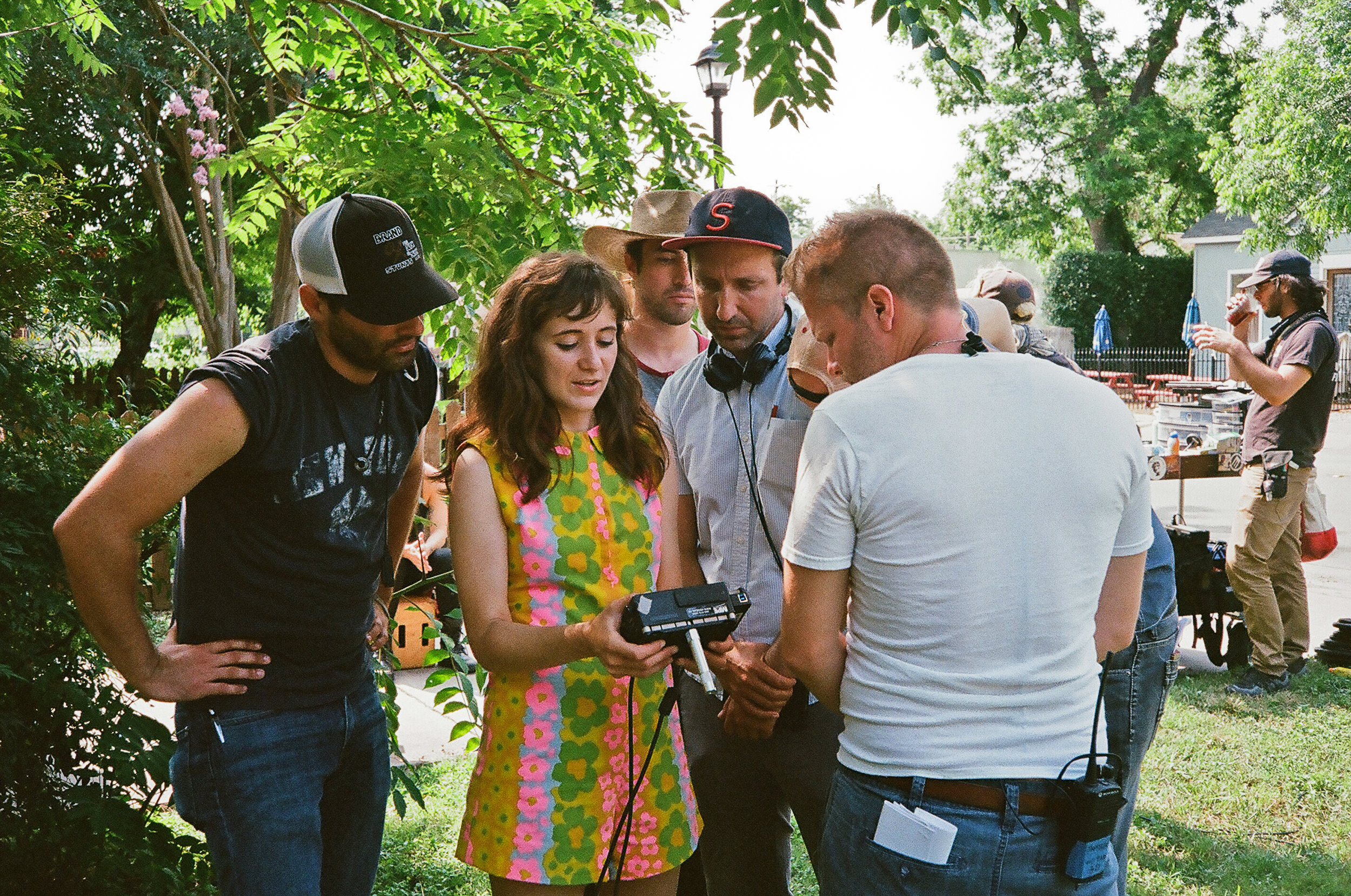
Noël Wells spent one-season on Saturday Night Live before she landed opposite Aziz Ansari on Master of None, where she played Rachel.
She's also writes and sings lead in her band @t.h.e.m.a.r.y.s. and Power Couple (working title) a show she created, wrote, and is attached to star, was picked up by Comedy Central.
If that's not enough, earlier this year at SXSW Wells made her directorial debut in Mr. Roosevelt, a coming-of-age comedy that Wells wrote, directed, and stared in. The movie follows a young comedian Emily, played by Wells, who has gone "viral" with a spaghetti vid. But going viral isn't all it's cracked up to be, and when the titular character (spoiler: her cat) falls ill, Emily treks it back to her hometown of Austin where she must face the life she left behind. Namely, her ex-boyfriend and his Pinterest-perfect new girlfriend, who has gallery-walled the living room space and has the pair off coffee.
What follows is a frank misfortune of events (plus some smack talking on LA Mexican food) that leaves Emily wondering WTF happened to her life? We caught up with the quad-threat to real talk airbrushed armpits and why "Hollywood is just a bunch of weirdos trying to find their way."
Important question first: Why name the cat Teddy Roosevelt?
I wanted the cat to have a sort of timeless iconic name, the sort of name a younger person would think to name an animal, but also one that could sound like an actual important person so audiences who haven’t read the synopsis could have the potential of being surprised about who Mr. Roosevelt is. Originally I named him Mr. Rogers, which felt very much like “childhood” and burying the past, but my producers were working on a Fred Rogers movie already and so we had to change the name. After a couple of ideas, Teddy Roosevelt felt like it matched a big, orange cat and had the gravitas of something bigger. Since then we have had a lot of weird Teddy Roosevelt coincidences surrounding the film, so it feels meant to be.
Second: Do you really think LA has bad tacos?
Well I think my real battle is the big burrito/taco standoff. Tacos beat burritos, hands down. As far as LA tacos vs. Austin tacos, I like smaller taco trucks in LA, but I think generally I prefer Mexican food in Texas. It’s just more flavorful! Please don’t hate me!
Now...Working with Aziz you said that you felt the two characters were “on equal footing.” Why, besides the obvious, was this important to you?
I just am not interested in being an actress or creative that doesn’t have some say in what’s happening. I like collaborating, I want to be engaged. I have too many things inside me and I need places to put them. When I don’t, I get really depressed and despondent.
Do you feel like you’ve been able to be your authentic self in Hollywood?
I’m sure we all cave to some pressure to be like “something” else in order to fit in, and as much as I think I’m always being true to who I am, I see many ways I chase after the wrong things or people in this town. That being said, Hollywood is just a bunch of weirdos trying to find their way, and because of that, I’ve been able to find my true self more and more and it’s even welcomed. The most awkward things for me are glamorous events. I’m not great on red carpets or photo shoots, but I’m learning how to have fun with image where before I would think I was a liar or faking if I dressed up. I think I’m realizing I’ve been in the glamour closet and I actually like being fabulous. Time will tell.

Wells in Mr. Roosevelt
You’ve been promoting your directorial debut, Mr. Roosevelt, which, you also wrote and star in. More women are taking their careers into their own hands. Why was this an essential part of your journey?
I am always thinking about things to make and write and create, it’s always in my head and I go crazy if I’m not making something. This just felt like a natural progression of that journey. I think now it stands as proof to myself and other people that I have the capacity to do much bigger things.
Speaking of your journey, in the movie your character, Emily, works an editing job while pursuing her dream, what are some of the odder jobs you’ve taken while hustling your dream?
Oh boy. I’ve been working since I was 15, oftentimes having 2-3 jobs at a time so I’ve had many an odd job. A few that come to mind: I was a manager of an ice cream store, I created Wikipedia pages for businesses, I wrote and photographed how-to articles for listicle websites along the lines of “How to make a smoothie” or “How to give yourself a pedicure”...and I used to make my own clothes and sell them on eBay.
Mr. Roosevelt addresses the aimlessness that so many young women feel. What’s your advice to them?
We are in uncharted times economically as so many careers shift into tech and so much is being outsourced. I think my advice is really about healing and community. We’ve become so fractured as a culture, the only way to sustain ourselves is to come back together, and if you take care of yourself and get better, you’re going to be able to help other people too. This gives you a sense of purpose, and you get better, so it’s a win-win.
"The only way to sustain ourselves is to come back together."
Tweet this.
There’s a brief moment in the film when Emily looks at her diploma that’s been left in a box in a shed-- and there’s this universal feeling of 'oh, right, this thing. What IS this THING?' And she puts it back. Have you had similar moments?
Yeah. My favorite part about college was that I picked up a lot of useful skills in production classes, but I think in many ways, it seemed like a developmental delay. A diploma doesn’t really mean anything, really. After college I sort of realized I was trying way too hard to succeed in a system, and that success wasn’t really making me happy. I missed out on other real-world experiences I should have been having. But it’s different for everyone!
This also might seem rather minute, but when the she meets up with the crew at the swim hole, no one has perfectly shaved armpits. And it felt like another fresh breath of relief. Let’s not airbrush armpits! Let’s not airbrush life. There’s obviously some poking at Pinterest-life throughout the movie. “Pecans from another state,” meltdown in mind here. Would love hear your thoughts on this.
My big thing in life, is I’m just not interested in manufacturing or falsifying anything. Beauty is all around us in many shapes or sizes, and in many ways it’s all perception. We get to say what is beautiful. So for me, confidence is beautiful. Love is beautiful. Genuine self-expression is beautiful. So images can be beautiful, but often times, beauty gets distorted, and then the essence of what is beautiful is twisted, and it confuses people and makes them feel bad about themselves. I grew up hating everything about myself because of these distortions, and this has been my personal journey as a woman, to just learn to love myself. And part of that has been by seeing through these distortions, and also recognizing other people who are distorting things are also confused. So Emily’s critique of these perfect women is also problematic, if that makes sense. She’s not seeing them for who they really are, which are hurting women just like her.
"Beauty is all around us in many shapes or sizes, and in many ways it’s all perception."
Tweet this.
Accepting that everything changes is part of growing up. Do you remember a point like that in your life?
This is going to sound dumb, but just making this movie is a major lesson in everything changing. You have something very set in your head about how it’s going to go, you have all these plans and goals about what it will be and look like and what it will do for you, and by the end, if you held onto that image, you wouldn’t have made any progress and you would be in despair because it absolutely is not anything like what you wanted. But that’s okay, it’s been an insane ride and I honestly know I’m better off for it being so difficult and challenging.
Female friendships are super important in the movie. How did you find support while making the movie?
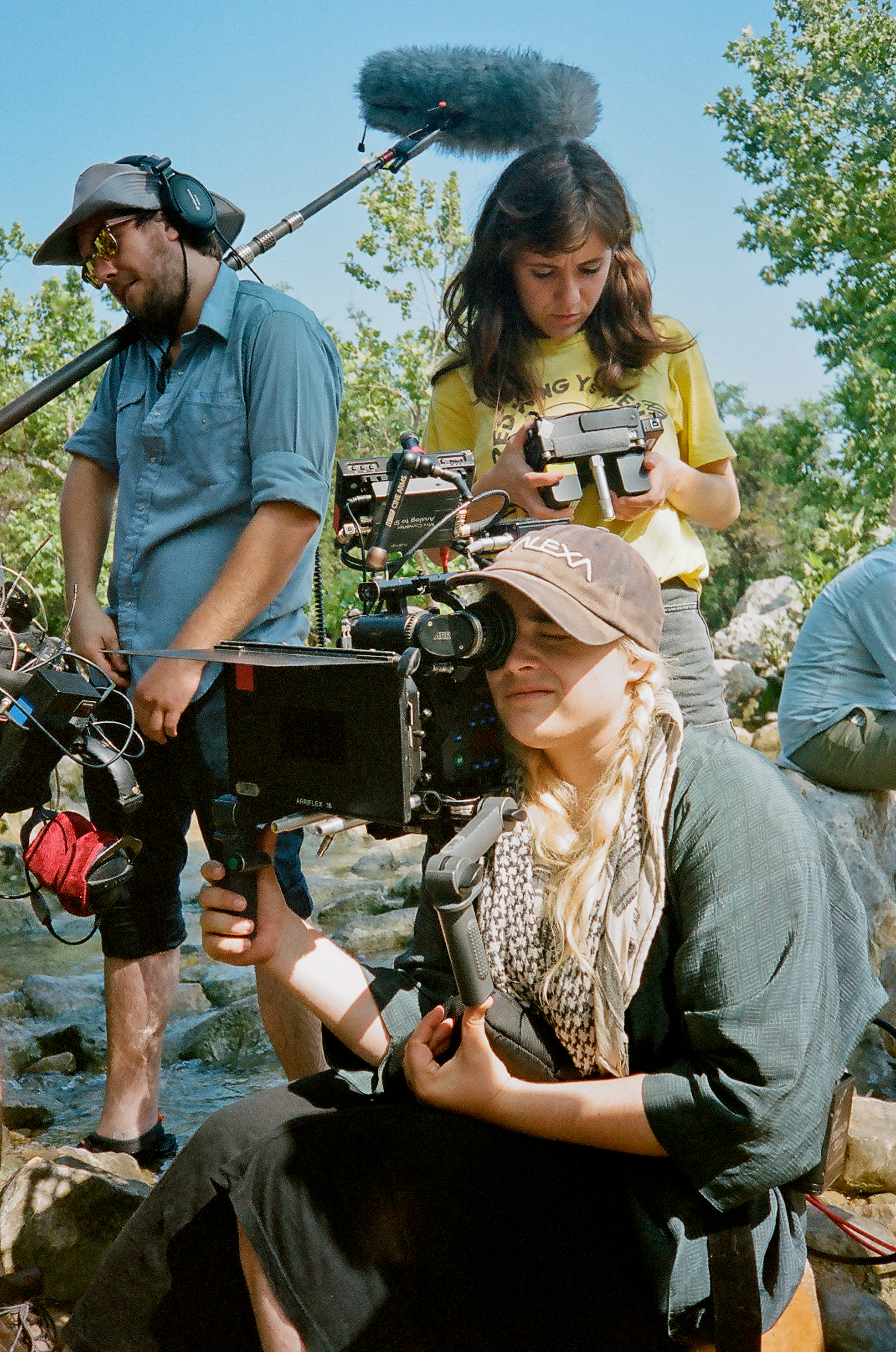
The female actors on the shoot were all really incredible, and they kept me going, and my cinematographer Dagmar Weaver-Madsen was my rock through the shoot. She totally understood the spirit of the film from the beginning, and is also incredibly perceptive about the pressures and roadblocks that women face day-to- day on set. Anytime I would get discouraged, she was there pumping me up and supporting me unconditionally.
Do you feel supported by Hollywood?
Hollywood isn’t really one thing or one entity. I will say I have found my people in the city of Los Angeles, and I’m working to find my creative partners as well. Like anything in life, it’s a journey trying to find where you fit in.
Do you feel stronger doing something on your own?
I’ve always been one to do things on my own, but this has shown to me you really could take everything away from me, put me on a desert island with nothing but some stick and some sand, and I’d still figure out a way to put on a show. But also, I don’t WANT to be on an island alone, I’m really sick and tired of doing everything alone. I want to make things with people.
What type of roles are you most interested in?
I like looking at people’s darkness, the thing that makes someone tick, and also the things that make them lovable even if they’re outwardly being bad or insufferable.
We recently talked to Zoe Lister-Jones who employed an all-female crew, which we found incredibly inspiring. Who have you recently been inspired by?
I’m really impressed with a lot of my female friends as of lately. After Trump was elected, it’s been a year where everyone is looking inside and at themselves and figuring out what they can do to change themselves so they can be of service to the world. I have friends who are hosting salons at their homes, organizing writer’s groups, spear-heading political fundraisers, getting us together to volunteer across Los Angeles, and creating content like I’ve never seen before. No woman I know is content with despairing for too long, we’re all figuring out how to come together.
Given the recent exposure of sexual assault stories in Hollywood, what would you like to see change in the industry?
I just think I’m exasperated by the abuse on all levels. I am here to make art, and I wish more people were into the creation process rather than the fame or money or accolades. That may not change, so I think just rooting out abuse in all forms is what I’d like to see. Outside of sexual harassment, there are a lot of bad bosses yelling and screaming and abusing their employees, and there are people who commit a lot of creative “crimes” to get ahead. I wish more people would operate from a place of integrity and accountability.
Have you experienced situations that have made you uncomfortable and how did you handle it?
All the time. I’ve never gotten it quite right. I’d say about 50 percent of the time I stand up for myself in violating situations, and 100% of those times it initially appeared to backfire on me. But as time is playing itself out, I see now that defending myself or leaving a bad sexual situation or standing up to bullies was the right thing to do, and that will hopefully empower me to do that always. It’s better to be ejected from toxic environments than to stay and be eaten alive.
"It’s better to be ejected from toxic environments than to stay and be eaten alive."
What’s coming up next?
A lot of writing, a lot of percolating. Hopefully more directing and acting.
To check out Mr. Roosevelt, click here.
Top photo credit: Beachside
MORE FROM OUR BLOG

Links From Our Group Chat: How to Stop Sexism Early & the Daily Hell of 2017
We promise, there is an escape.

What are you digging into this Sunday?
Got anything good to share with us? Add links in the comments below.
Leandra Medine's brave and different kind of pregnancy announcement.
Interesting theory on men not trusting women. And the kind of trouble it causes.
How to escape the daily hell that is 2017.
Is gendered medicine good medicine? And what does that mean?
How to raise a son who respects women.
MORE FROM OUR BLOG

I'm Good With Whatever: The High Price of People Pleasing
Whatever's not working.
Photo credit: Arielle Vey
I’m good with whatever. This phrase has been a mantra for the majority of my life. When I am at my best, I can be adaptable, spontaneous, and free-spirited. At my worst, I am a relentless people pleaser.
In my work as a counselor, few clients come to me with the primary goal of working on their people pleasing. And yet, I see its fingerprints on the lives of nearly every woman I work with. On the surface, it often presents itself as a fog of emotional fatigue resulting from the constant work of balancing the needs, wants, and expectations of others. It fuels many struggles with depression and anxiety. It colors relationships with underlying bitterness and resentment.
At its core, people pleasing is rooted in fear. We worry about how our choices might impact or inconvenience others. Instead of asking the people in our lives for what we need and desire, we say no for them. We find ourselves settling for a role as a background character in others’ stories because we’re scared — often for good reason — to show up in our own.
My people pleasing journey began early. Like many young children of divorce, I entered elementary school with an extra dose of insecurity. To top it off, I was a super sensitive kid who did not cope well with even the mildest disapproval or casual mistake. Classrooms and playgrounds provided the perfect environment for me to hone the skill of perception management to avoid that stinging shame.
"We find ourselves settling for a role as a background character in others’ stories because we’re scared."
Tweet this.
Today, my husband has most often been the recipient of my people pleasing efforts — which has only intensified since becoming parents. He works hard, is a wonderful, attentive father to our two little boys, and carries a big chunk of the household duties which keep our world functional.
When he checks in with me about doing things during a morning, evening, or weekend — going for a run, meeting up with some guy friends, getting some extra work done — I almost always say yes. No problem. I’m good with whatever.
Throughout the decade we’ve been married, I’ve begun to notice a pattern. It most often begins with feeling anxious and overwhelmed by the “Have-Tos” of life. I then respond by checking out emotionally when it all just feels like too much. This typically follows with passive-aggressive behavior, complaining, and — every once in a while —rounds out with a nice, tear-filled breakdown in which I spew blame upon my poor husband.
We recently had a conversation in which I bemoaned the lack of relational connection in my life. As I processed this, I found myself saying, I would have more time for friends in my life if YOU didn’t spend all of our free time running, working, and spending time with your friends.
The second these words escaped my mouth, I knew just how wrong I was. It wasn’t his fault. I was bitter that he had the courage and the forethought to ask for what he needed and wanted and I didn’t.
What I discovered was this — my knee-jerk yeses and whatevers often become excuses to not take ownership of my own life. Managing the expectations and anticipating the needs of others is a full-time job that has robbed me of a full life and meaningful relationships. It’s too high a price to pay.
"Managing the expectations and anticipating the needs of others is a full-time job."
Tweet this.
I also have learned that self-care isn’t enough. While I’m all for a good bubble bath and glass of wine, I think what we people pleasers need most is a supportive shove. We need people in our lives who will cheer us on as we commit ourselves to some of those things we always say we’d do if we had more time. We need to be held accountable to making space for those dreams that perpetually remain on the back burner. The fact that you are reading these words today is the result of a handful of people who have lovingly pushed me to take a risk.
The truth is, the people in our world will gain far more from our courage to live with authenticity and purpose than they would ever receive from our mere accommodation and fear of disappointing them.
It’s time to be done with someday. It’s time for the world to stop missing out on us. Let’s make some waves today.
Is people pleasing an issue for you? What do you think is at the root of it?
An original version of this article appeared on Darling Magazine. Written by Melissa Brownback.
MORE FROM OUR BLOG

How This Massive IG Star Handles the Haters
It's so simple, it's brillz.


She’s got jokes. Which also means, she’s got brains.
Arielle Vandenberg, who is on a first name basis (@arielle) with the digital world, has been making videos and thereby making people laugh for decades. She says she made her mom laugh all the time when she was little, but it was her grandma who thought Arielle was, “the funniest kid ever-- she even wrote everything I said down into a book,” the actress and comedian tells us.
It was also her grandma who told her “Don’t do drugs,” when she first thought about moving to LA. "I think that's pretty great advice,” she laughs. While GMA might have kept the digitally savvy star on the straight and narrow, it's her hard work, diligence, and “being true to myself,” that have really paid off.
In December of 2015 the actress and comedian was one of the most followed personalities on Vine, with a fanbase of almost 2 million. People tuned in to watch her goof off, ask life’s big mysterious questions, and upload videos with bestie and now boyfriend (AKA from Cutty to CUTIE) Matt Cutshall. Though the video app announced its shuttering in 2015, her feat of amassing such a loyal and large following can't be ignored. It comes down to creativity and precise comedic timing. If you can get people to laugh in six seconds or under, with an iPhone, you’re doing something right. She's transferred her following to Instagram, proving that it wasn't a one-off. She's good a social. Like, really good.
Calling herself “the professional Jim Carrey impersonator,” it was the funny man who got Arielle hooked on comedy. “I wanted to be a comedian because of Jim Carrey. I would sit in my room alone and just make faces in the mirror for hours. And also Tina Fey, well because she's a powerhouse of a woman!”
Growing up outside of Los Angeles, Arielle got the bug for acting when she was young. She’s had roles in numerous TV shows like How I Met Your Mother and Bones. She’s opinionated, telling Esquire, “If you don’t like animals, you’re not living,” not worried about fangirling out over Justin Bieber or dressing as the pop star for Halloween (a role she reprised this year), and says “internet bullies” have been challenging, but jokes, “haters gon hate.”
It’s easy for her to keep going, even in the face of Vine’s shuttering. She continues to build her career in the face of a tectonic shift in the digital landscape. “I’ve always loved making people laugh,” shares Arielle, “so I made it my job. And now I have the best job in the entire world!” She can also bust out “performance dance” anywhere and everywhere to keep her spirits up and her morning prayers “make the day a million times better.”
"I've always loved making people laugh, so I made it my job."
Tweet this.
The multitalented digital star preaches kindness— makes sense she’s BFF with last year's C&C 100 honoree Lauren Paul. “Teaching young girls to be kind,” she says, is immensely important. “Kids are the future and kindness is the way.”
In the last five years Arielle says she’s “gone to third base” with her career, which, guess what? means we can still expect her home run. What might that mean for her? Making Jim Carrey (who else?) a costar, creating her own show, and “purchasing a wiener dog.”
Alrighty then.
MORE FROM OUR BLOG
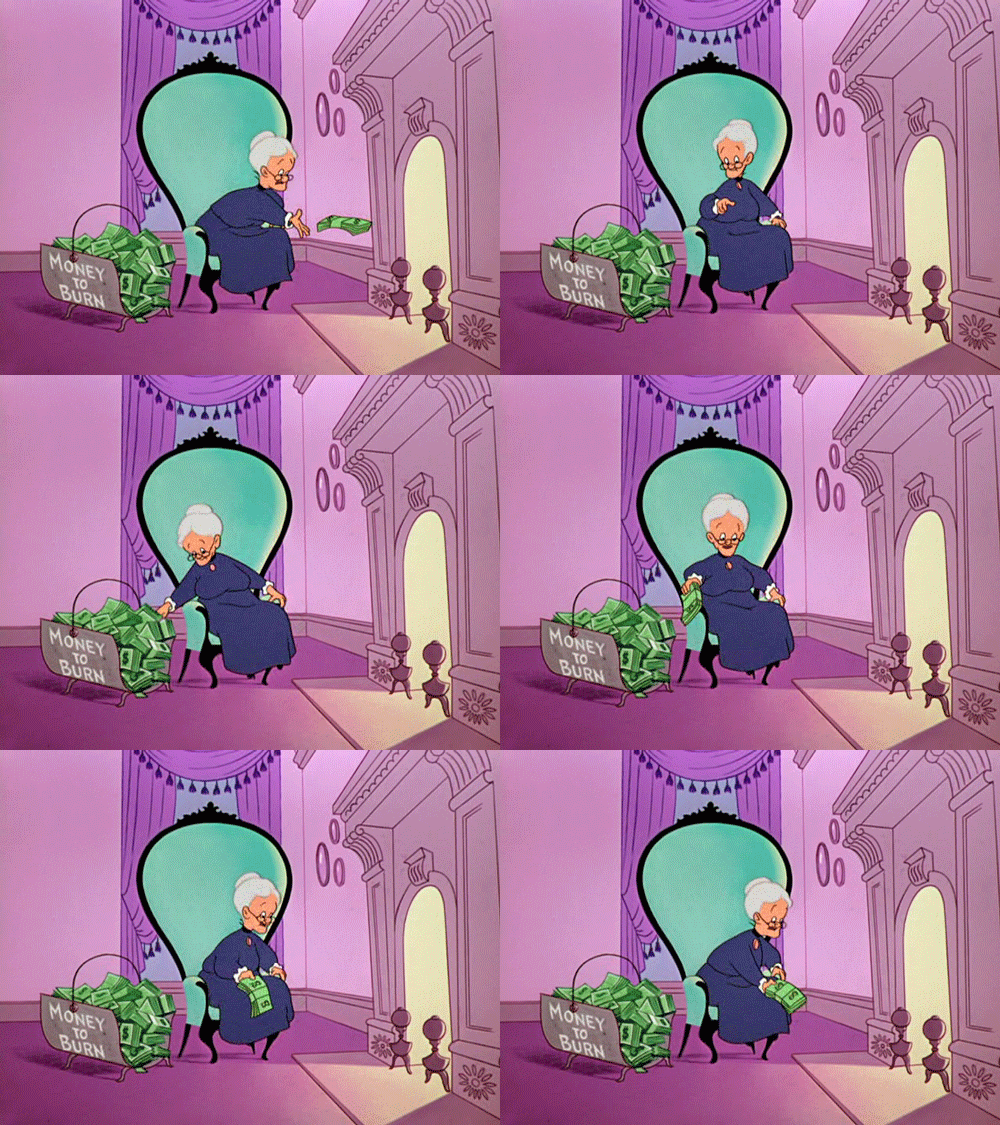
Help! The More I Make the Less I Save
Is your bank account up in flames?

Does it feel like with every passing year, and every (hopefully) subsequent raise and bonus, life's expenses keep going up to? It's not in your imagination.
According to Nerd Wallet, "the rise in the cost of living has outpaced income growth over the past 13 years. Median household income has grown 28% since 2003, but expenses have outpaced it significantly. Medical costs increased by 57% and food and beverage prices by 36% in that same span."
Since 2009, most Americans have said they prefer saving over spending, but the fact remains that the average overall U.S. household debt increasing by 11% in the past decade. Today, the average household with credit card debt has balances totaling $16,883.
To adjust to the growing cost of living, we have to re-examine our relationship to money. It's not the only source of wealth and it's not only for spending. Obviously, you should be spending less than you make. But old models don't apply to new costs. For example when it comes to rent: The general recommendation is to spend about 30% of your gross monthly income (before taxes) on rent. Therefore, if you'll be making $4,000 per month, then your rent should be $4,000 x 0.3, or about $1,200. Those numbers don't really work when rent has been steadily increasing across the country, while wages do not.
So what's a working woman to do? Changing your mind about money is one solution.
Laleh Hancock teaches people how to uncover their own unconsciously held beliefs about money to experience greater wealth. Some of her top tips include:
1. Be willing to explore your beliefs around money
If you grew up in a family that said money is evil, you have to work hard to make money, or men should earn more, you may have adopted it as your own belief, even if it’s not. Ask yourself: If I had no belief about money being good or bad, what are all the different areas money can come into my life or my business?
2. Write a list of things you do and don’t enjoy... and question it all
It’s possible the things you ‘don’t like’ are on the list because other people have said it’s a chore, boring or hard work. Things you thought you didn’t like, but do, could become an extra source of revenue for you. Ask yourself: Do I really enjoy this? Do I really not enjoy this? And what is it that I do or do not enjoy about this, and what would make it more enjoyable?
3. Allow the business to work for you instead of you working for your business
Your business has a consciousness. Instead of trying to control everything in the business, partner with its energy for guidance instead.“Most of us work a million hours thinking we have to control everything in the business,” Laleh says. “If we are willing to allow the business to work for us, however, the business will draw in clients and staff for you.” Ask the business questions every day: What do you require from me today? Who would you like me to contact today?
4. Be open to change every day
Your money or business goals and decisions are not set in concrete. Be open to making a different decision every day, every hour or even every 10 minutes. “You have to know when it’s time to change and be willing to move in a new direction,” Laleh says. Ask yourself: is this what I want to be working on?
MORE FROM OUR BLOG

Do We Have a Rape Accusation Double Standard?
What happens when we don't like what we hear?

Harvey Weinstein.
Jeremy Piven.
Louis CK.
Kevin Spacey.
James Toback.
Hollywood men are burning at the stake of their own creation. We’ve entered a news cycle that’s holding men accountable for their actions. Their shows are being cancelled. They're even being removed from completed movies. We're talking about actions, like those that comedian Louis CK stands accused of— as of today’s NY Times piece.
(Side bar: in light of this, we feel compelled to revisit Samantha Bee's Penis PSA sketch on Full Frontal a month ago. “Fellas," the host said, "I’m a big comedy star slash Hollywood executive, and I’ve found that it’s quite easy not to masturbate in front of my employees. In fact, it’s one of the easiest things I don’t do. Every day, I wake up, get dressed, take the subway to work, and then don’t masturbate in front of anyone.”)
But there is a name that’s been thrown in the accused mix that some are having a harder time accepting and/or reconciling.
Ed Westwick.
As of publication time, the former Gossip Girl star has been accused of rape by two women. Deadline writes, “A former actress has come forward accusing Gossip Girl star Ed Westwick of raping her in 2014. The allegation comes just days after actress Kristina Cohen claimed Westwick raped her in February 2014. Westwick denied Cohen’s claims on Tuesday, writing on Twitter, ‘I have never forced myself in any manner, on any woman. I certainly have never committed rape.’”
Today the actor Tweeted, “It is disheartening and sad to me that as a result of two unverified and provably untrue social media claims, there are some in this environment who could ever conclude I have had anything to do with such vile and horrific conduct. I have absolutely not, and I am cooperating with the authorities so that they can clear my name as soon as possible.”
Before Westwick tweeted his denial, his girlfriend Jessica Serfaty took to Twitter to defend him against the allegations. Writing, “I know you, I know the truth. Such sadness in my heart. I love your kind gentle soul. Bless.”
She then posted the below on Instagram, which at the time of publication has over one thousand comments.

The comments range from angered support in favor or the couple: “Just 2 stupid women who as last class actors and dont [sic] get the attention they think they deserve…so how could they get better publicity. Ur both better than this shit.” To victim blaming, “Yeah, right. I’m sure all these Women probably threw themselves at him to get a part in the movie, whores,” and “I believe he didn’t do it!! Too many woman crying wolf all of the sudden, with zero evidence and a half plausible story.” To those who support and believe the victim. “Thanks for discrediting a rape victim everyone, rape culture is your fault,” one commenter wrote.
The allegations against Westwick bring up a lot of interesting and difficult questions. Why is it easier to believe/support sexual assault allegations when they are brought against older, less ‘handsome’ men? Why do we choose to believe some victims and not others? What is the “right” way to support your partner when they are accused of vile acts?
Is it as black and white as saying #metoo and I believe all women? Are there people for whom we don’t want the allegations to be true? Certainly. Inherent biases abound when dealing with such highly charged conversations.
These are questions to which we hold no easy answers.
An often-cited Violence Against Women report states, “within the domain of rape, the most highly charged area of debate concerns the issue of false allegations. For centuries, it has been asserted and assumed that women ‘cry rape,’ that a large proportion of rape allegations are maliciously concocted for purposes of revenge or other motives.” Other motives in the case of Ed Westwick would be— fame? Notoriety? When faced with questions like these many women wonder why anyone who make up such a horrific story. According to the same report, the prevalence of false allegations is between 2% and 10%. Although false rape accusations are statistical outliers, they do exist.
In 2015, Donna Zuckerberg wrote this for Jezebel:
“Rape allegations also draw attention to an uncomfortable contradiction. One of the core beliefs of our legal system is that defendants are innocent until proven guilty. On the other hand, many people—after an entire recorded history that has often assumed the opposite—have a default response of wanting to support and believe those who say they’ve been sexually assaulted. So how do we handle the fact that these two stances are fundamentally irreconcilable? If we believe that alleged rapists are innocent until proven guilty, then on some level, we have to believe that victims might be lying until they can prove that they’re telling the truth. We don’t want to automatically assume that everyone accused is a rapist, but we also don’t want to assume that accusers are liars. There is no unequivocally safe ground from which to judge.”
That doesn’t take away from the fact that it’s an incredibly touchy subject for all sides, espeically when women are banding together more so than ever before. Thousands of women have broken their silence. On Instagram alone the #metoo has over 550,000 posts. But what happens when we don’t like the narrative or have a hard time stomaching the accused as "rapist?" Harvey Weinstein fits our internal descriptor of a rapist. He looks like a monster, we think. But what about when the curtain doesn't match the drag?
Dallas Clayton, the illustrator and author who is behind the “Stand Here and Think About Someone You Love” mural in LA, was accused of rape by Dawn Baston last month. Despite his popularity, at least on Instagram where he has 243k followers, there was no real backlash. Only a few reacted. Sophia Amoruso and Girl Boss took a bold stance, covering up one of his most popular LA murals. Vans pulled a shoe line collab from their website. Rudy's Barber Shop cancelled their a collaboration. However, he has his own book deals and a movie that he co-wrote with Sia, starting Kate Hudson (you know, the one for which she’s famously shaved her head) called Sister coming out in 2018. There is no news. No coverage. There are more stories covering Kate’s hair than Baston’s story. A Google search of "Dallas Clayton rape" turns up zero results.
Is it because Clayton, like Westwick, also doesn’t fit our idea of rapist? How could the guy behind “An Awesome Book!” do such a tremendously not awesome thing?
We don't have the answers, but we'd love to hear your thoughts below.
MORE FROM OUR BLOG
How Cold-Calling Chanel Landed One Woman Her Dream Job
Twist ending on this one.

Alyssa Wasko cold-called her way into a job a Chanel. For most, that sounds like a dream job. (And it was.) But after six years at the fashion house, the budding designer struck out on her own, launching DONNI (previously Donni Charm). Wasko named the brand after her late father, whom she lost during her time at Chanel. She started making scarves as a way to cope with his passing, but it quickly turned into something more.
Today, DONNI, is a collection of everyday essentials, each with endless ways to wear. Scarves, capes, and more are made in Los Angeles by women who are like family to the brand. Something her dad would certainly be proud of.
You started you career at an incredibly chic fashion house. How did you land the job?
Persistence. I called the head of Chanel USA’s Visuals and Image department every day for about 3 months leaving him voicemails until he finally called me back. I think he gave me the job so I would stop bothering him. He was my boss for 6 years and now one of my closest friends.
Where does that drive and ability to pick up the phone come from?
I think it was how I was raised. If you want something go and get it. But, above all, I am old fashioned and I believe that the best things happen from a phone call. Every day there seems to be a new means of communication and I just like to keep it classic. The phone leaves no room for misinterpretation.
What did you learn while working there?
So much. What to do, what not to do. Working for a big corporation, you learn about infrastructure and procedures, experience that have proven invaluable for running Donni. I think my biggest take away is how important it is for each team member to see how their work directly affects the outcome and the brand’s success. Every email, phone call, meeting, brainstorming session, or even mistakes, by a member at Donni directly correlates to our growth and I think that is such a rewarding feeling. And I hope what makes them happy and excited to come to work each day!
When did you decide to strike out on your own?
I had already started Donni when I was working at Chanel, there were a few years of overlap. I was very lucky that my bosses were so supportive of Donni from the beginning. My father passed away during my first summer working with them so they lived through it all with me in a sense. Because I was able to sustain both for a while, it was hard to figure out when made sense to focus fully on Donni. But, as they say, man plans and g-d laughs and it just kind of happened after a few big orders and trips to our factory in LA. It just became too hard to sustain both and I wasn’t able to put 100% into both anymore.
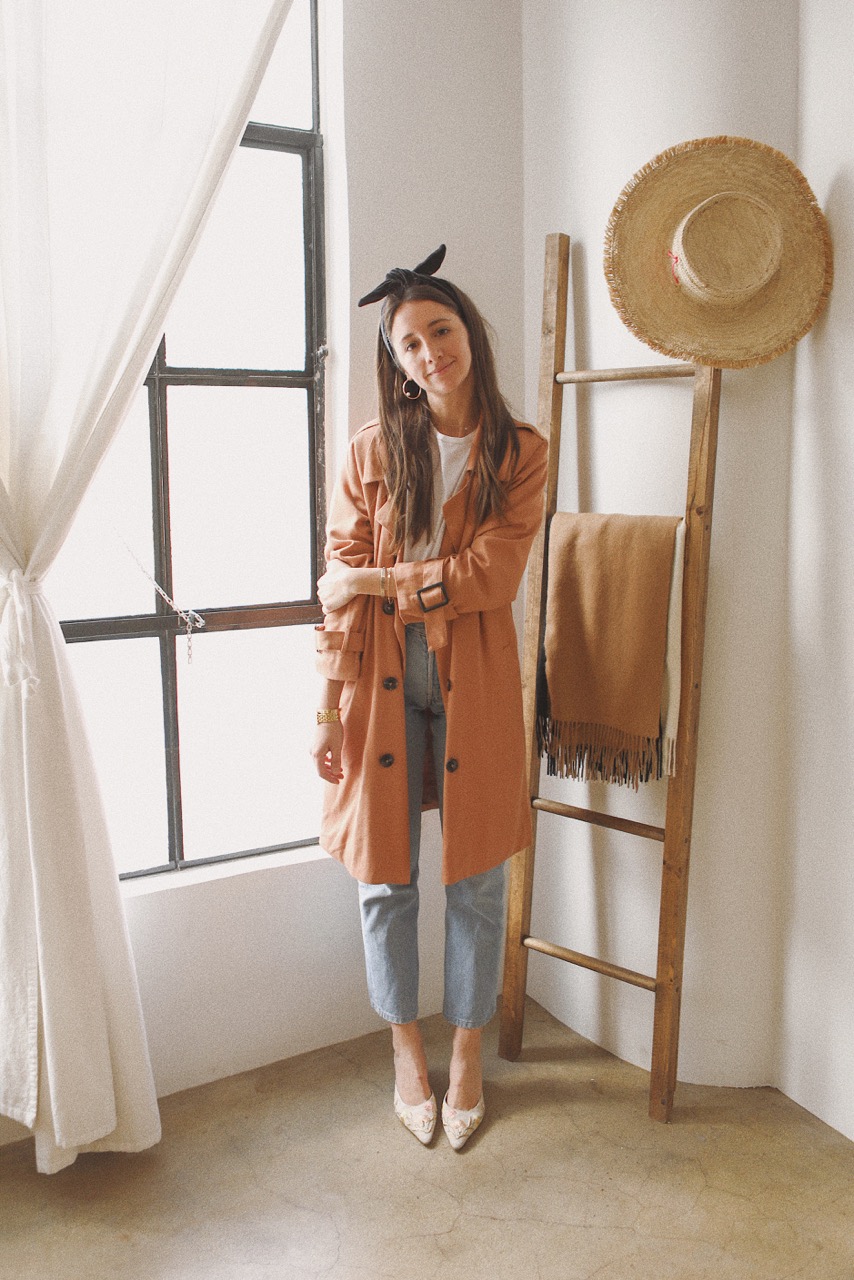
Sometimes it’s the hardest moments that lead to our greatest development. Can you chat a little about this and how the loss of your dad gave birth to a new chapter?
My mantra and truly my survival was constantly telling myself to act and make decisions that would make my dad proud. A lot of people told me to take a semester off of school to cope, and while I considered it an option I knew my dad would have laughed and said “get your tush in gear. Wasko’s don’t give up.” I not only went back to school, but I took on another 3 classes to my already full course load and a few odd jobs. When that wasn’t enough, on an afternoon that wasn’t sufficiently busy I decided to make a scarf for myself and a friend adding a good luck charm to each. I had always loved scarves and found them so to be comforting yet effortless. Before I knew it, my piers wanted these scarves, and I was so confused! I went to school in Arizona where it was 90 degrees daily. But that’s how I realized my product was a real business, because people wanted more than just the scarf, they were buying into the idea, and the feel good component that it represented.
What would you encourage young female entrepreneurs to test out before they dip their toes in the startup world?
It sounds cliché, but don’t just start a brand to start a brand, let the idea find you—make sure you are truly solving a problem or filling a need, and make sure each of your products goes back to your fundamental solution. But furthermore, anyone can have an idea, and it is execution that determines your success or failure.
"Don’t just start a brand to start a brand, let the idea find you."
Tweet this.
What do you think are some of the biggest misconceptions about starting a business?
That it has this glamour to it. It doesn’t. You are always on the clock, always schlepping, always thinking of how to make things better—even when they are great. There is always room for improvement. I think a lot of people think you start something and hire all of these people and you can go on vacation whenever you want. Couldn’t be farther from the reality, its hard work! And it never stops. Ever.
You did a slight rebrand this year. Can you chat about that decision and why now was the right time?
Who knows if it was the right time, but it just happened. I felt simply that we had outgrown the Charm. I started this brand in college, and I have grown up a lot since then, so I wanted the name to reflect the more sophisticated lifestyle brand that we have grown into.
How do you expect DONNI to grow and change?
Retail is changing a lot these days, so I do see expanding our Direct to Consumer business, but I also try not to worry about the future, and just keep allowing the change as it comes. So far all of our growth has been such an organic evolution. Each pivot and change coming when something presents itself. I hope that that is how it continues. For a very long time.
MORE FROM OUR BLOG

C&C Classifieds No 65: Clique Media Group, Ban.do, Golden World & More
Want to work for your fave CEOs?
Occasionally in the land of the job hunt, a spot opens up at one of your favorite companies to work for your favorite CEOs... like Ban.do's fearless leader Jen Gotch.
Or Katherine Power and Hilary Kerr, the media powerhouses behind Clique Media.
So disregard the old adage. We say in this case, you should meet your heroes.
Camron PR - NY, NY
Golden Word - Richmond, VA
Bando - LA, CA
Clique Media - LA, CA
Creative Circle - Washington, D.C.
Comcast - Philadelphia, PA

Guess Which First Time Female Director Broke Records This Weekeend?
Is that a double power pose we see?

Merie Wallace / A 24
You might know Greta Gerwig from indie-movies like Frances Ha and Mistress America, but this weekend the 34-year-old actor, writer, and first time solo director broke box office records with Lady Bird.
A coming-of-age story about a young woman in Northern Cali, Lady Bird, charts the ups and downs of teen Christine McPherson, who has a clunky relationship with her mother and requires people in her Sacramento town to refer to her as "Lady Bird," the nickname of LBJ's wife.
(Side bar: Claudia Alta "Lady Bird" Johnson was First Lady of the United States, as the wife of the 36th President of the United States, Lyndon B. Johnson. Notably well-educated for a woman of her era, she proved a capable manager and a shrewd investor.)
Speaking with Rolling Stone, Gerwig said, "Writing this character was an exploration of all these things I didn't have access to or I couldn't be. In that way, it almost felt like this fairy-tale invention of a deeply flawed heroine, but one who I admire. I think she shows courage and a lot of character even when she's flailing."
Gerwig wrote the script between 2013-14, stumbling through numerous drafts and titles. The hard work paid off. Lady Bird broke box office records last weekend.
The lead semi-autobiographical character is played by Oscar nominee Saoirse Ronan. The movie has been dubbed a smash success by critics-- "perfect" according to Rolling Stone-- and moviegoers, who turned out in droves this past weekend to see the film. Opened to limited audiences its first weekend, the movie showed in four locations, a "specialty box office opening." It grossed $375,612 in four theaters, with a theater average of $93,903. Those numbers blow typical small box office openings out of the water, making it the best speciality box office opening of 2017. Those numbers also make Lady Bird the best ever limited debut for a movie directed by a woman. With Patty Jenkins’s Wonder Woman breaking the record for highest-grossing live-action film directed by a woman in the world, it’s a landmark year for women in Hollywood.
Keep on soaring, LB. Keep soaring, ladies.
MORE FROM OUR BLOG
Bumble Queen Whitney Wolfe's Best Real Talk Advice
Plus, 7 other women give us the truth on National STEM Day.

Written by: Tyeal Howell
Nearly all of the fastest growing occupations in the U.S. are within the STEM/STEAM industries. The gender gap in these industries is unreal. #NationalSTEMDay was created to celebrate, inspire and encourage the younger generation to explore their interests in the Science, Technology, Engineering, Art and Math fields. To join the celebration, we talked with 8 Women in STEM to get the best “real talk” advice they’ve ever received:
Stay humble.
Know that your career path and your goals may change over time, but stay true to yourself along the way. - Latinas in STEM
Your close crew matters.
“Who you hang out with determines what you dream about and what you collide with. And the collisions and the dreams lead to your changes. And the changes are what you become. Change the outcome by changing your circle.” -- Seth Godin - Claire Burke
Breathe.
Take a deep breath and move on! You will realize that you are a lot stronger than you think. - Leura Fine
Honestly, be authentic.
Answer honestly, support authentically, share resources and share other women's work. - Heather Lipner
Get thick skin.
The bigger the risk, the more likely the failure. You have to develop thick skin if you want to accomplish a lot in life. - Rachel Tipograph
Celebrate the small wins.
I've tried to actively start celebrating small milestones and successes, since I know that I'm really bad at recognizing how far we've come as a company. - Aarthi Ramamurthy
"A successful career is earned and requires sacrifice."
Tweet this.
A successful career is earned and requires sacrifice. It truly is done through dedication and a lot of hard work, nothing is handed to you. - Melissa Grillo
Don't sweat it.
Snap out of it! It always looks better in the morning. - Whitney Wolfe
What other women in STEM are you inspired by today? Comment below!
MORE FROM OUR BLOG

So You Started A Business... Now What?
Now the work starts.
If you're like us, Jen Gotch's Instgram stories are at the top of your must-watch list. Every. damn. day. The CCO and Founder of the fun-centric Ban.do has built a brand with cult-like following of millennials. #FORBES. While she might not like to admit it, she's pretty D.O.P.E. at this whole business thing. And when she's not making us laugh (and/or cry and/or laugh-cry) on IG stories, she shoots an advice series called Honor Roll answering fan-submitted questions about business-related things + more.
Watch her spill solid biz advice below and be sure to nab a ticket to Create & Cultivate LA, where Jen will be spilling even more on our "Never Not Posting" panel.