
Ask an Expert: How to Handle Your Money in This Crisis, According to a Wealth Advisor
“The best way to ease our fears and anxiety about money is to get involved. Ask questions. Know what you’re dealing with.”
We’ve been spending a lot of time at Create & Cultivate HQ discussing how we can best show up for and support our community during this uncertain time. Community is at our core, and connecting with others through one-of-a-kind experiences is what we love to do. While the world has changed, our mission has not. We’re committed to helping women create and cultivate the career of their dreams, which is why we’re proud to announce our new Ask an Expert series. We’re hosting discussions with experts, mentors, and influencers daily at 9 am, 12 pm, and 3 pm PST on Instagram Live to cure your craving for community and bring you the expert advice you’ve come to know and love from C&C. Follow Create & Cultivate on Instagram, check out our Ask an Expert highlight reel for the latest schedule, and hit the countdown to get a reminder so you don’t miss out!

“The best way to ease our fears and anxiety about money is to get involved. Ask questions. Know what you’re dealing with.”
—Roxana Maddahi, Wealth Advisor at Steel Peak Wealth Management
With money anxiety at an all-time high in the midst of the COVID-19 crisis, one thing is certain (despite the volatile state of the markets): We need to close the financial literacy gap for women. According to the 2019 Women, Money, and Power Study, commissioned by Allianz Life Insurance Company, 57% of women wish they were more confident in their financial decision making.
Enter Roxana Maddahi, a wealth advisor at Steel Peak Wealth Management who’s passionate about helping women take the lead in financial planning and helping us realize that it’s not as intimidating as it may seem. In this installment of our Instagram Live Ask an Expert series, we tapped Maddahi to weigh in on how we should be handling our money during COVID-19.
Scroll on for some highlights from the conversation and be sure to follow Create & Cultivate on Instagram to tune into the next one.
Q: I’m currently experiencing a lot of anxiety around money during COVID 19. What can I do to ease my concerns?
A: It’s normal to have anxiety around money right now—26 million people have lost their jobs, most businesses have slowed down, and we have no idea when this will all end.
My advice is: Get involved with your money. Get online access to your bank accounts, your retirement funds, your student loan providers—and talk to the people that help handle your money.
Call your CPA and tell them that you want to be involved and a part of the conversation. Call your financial advisor and let them know what you need, what your goals are, and what your desires are. Don’t be scared, don’t be nervous. There’s no harm in being aggressive and making sure that you’re part of the conversation.
The best way to ease our fears and anxiety about money is to get involved. Ask questions. Know what you’re dealing with.
Q: I’m not invested, where do I start? Is now a good time to be making investments anyway?
A: I do think it is the right time to invest if you’re not invested already. If you want to invest in the stock market, you want to have a timeline of at least five years because markets tend to go up and down and you want to allow for time if there is a pullback (like we’ve seen recently, for example.)
The great thing about investing that’s happened in recent years is that there are very few barriers to getting invested in quality investments. Exchange Traded Funds (ETFs) allow you to invest in a theme of stocks, making it easy to diversify your overall portfolio. I personally invest my own assets in ETFs because they tend to be less volatile.
Q: What about other future planning like retirement and education savings?
A: It’s a great time to explore what your options are if you’re looking ahead to retirement or starting to save for your kid’s education.
For saving for retirement, make sure you’re looking at a qualified retirement plan—a 401k, IRA, a SepIRA. The benefit is that they allow you to put money away before tax, so it’s subtracted from your taxable income. The money that you can put in it now, the more that it will grow and that can be very powerful.
For saving for a kid’s education, I like the 529 plans. They’re easy and accessible and allow you to grow your money without paying taxes on it. You’re able to invest your money, let it grow, and then not pay capital gains tax on it.
The caveat with the 529 plans are that they can only be used for education—for college tuition, books, room and board, and now even private school. If you use them for anything else (say, your kid decides not to go to college), then you have to pay a 10% penalty plus tax if you don’t use this money for education.
Q: Where is the most important area for small business owners to focus their financial energy right now and why?
A: Continue to invest in your employees. If you haven’t already, I would take advantage of the Paycheck Protection Program (PPP) to continue to pay your employees.
Everyone who owns a small business knows how difficult it is to hire people, to train people, and to have a group of people that works well together. If you can’t afford to pay your employees full salaries, think about what you can do to keep them onboard until we see that rebound.
You want to be able to crush it after this is all over, so I highly recommend investing as much as you can in your employees and doing all you can to keep them motivated and going during this process.
About the Expert: Roxana Maddahi is a wealth advisor at Steel Peak Wealth Management. She helps millennials plan their financial lives and invest for their futures. She’s on a mission to help women take the lead in financial planning and realize that it’s not as intimidating as it seems.
Tune in daily at 9 am, 12 pm, and 3 pm PST, for new installments of Ask an Expert.
Follow Create & Cultivate on Instagram, check out our Ask an Expert highlight reel for the schedule, and hit the countdown to get a reminder so you don’t miss out. See you there!








Set Aside 30 Minutes This Week to Do *This* and Keep Your Small Biz On Track
Money talks.

Photo: Christina Morillo for Pexels
Most people we know move gradually make the move from side-hustle to full-time gig. It’s a great plan to be sure that you’re able to support yourself financially while you’re laying the groundwork for your new business, but it can often lead to a bit of a messy overlap between your personal and business funds. (Trust us, we’ve been there.)
You may keep pushing off getting organized until the proverbial “tomorrow” and let the task of figuring it out fall to the bottom of your to-do list. You end up losing money because of missing receipts and not planning for tax deadlines. Follow the four steps below to make getting organized easier, painless, and maybe even a little fun, all in just 30 minutes.
Step 1: Open a separate bank account for your business ASAP
Is this something that you legally need to do for your business? Maybe. Is this something that you financially need to do for your business? Absolutely.
Even if you’re starting out as a sole proprietor, which is the default structure for anyone who earns income from self-employment, you should set up a separate bank account. Why? Because even if that’s the only thing that you do to get your money organized, you’ll be miles ahead of everyone else in the organization game. You won’t need to sift through a bunch of personal transactions to find business deductions and you won’t lose precious time looking through all of those same personal transactions to see if your client has paid you.
Don’t overcomplicate your business or waste any more time looking at a hodgepodge of transactions, hoping that you’re not missing something. Take 15 minutes to set up a separate account and you’ll be one big step closer to organized money management (congratulations!).
Step 2: Create a list of deductions you can take
There are so many deductions you can take, but it's hard to catch everything. Create a list of things you can deduct to ensure you're not missing anything. Tape the list to a folder and store your receipts in there until you can get them entered into whatever bookkeeping system you use.
Everyone will have different expenses, but a good list to get started with is:
• Web hosting
• Vehicle mileage
• Work travel
• Courses, seminars, licensing, and business-related books
• Shipping and packaging
• Office supplies and equipment
• Health insurance premiums
Step 3: Know what tax forms you need to file, and when
The first few months of starting a business will fly by and you’ll be left scrambling the night before filing deadlines if you don’t pay attention to some key forms and dates.
To get this started here is some basic information for sole proprietors:
Who has to file? Generally, anyone who has net earnings from self-employment of $400 or more needs to report this income at the end of the year. And anyone who is expected to owe more than $1,000 in taxes at the end of the year needs to make quarterly estimated income tax payments.
What form do I file? Most people start their business as a sole proprietor, and the forms that you need to file at the end of the year are Schedule C or Schedule C-EZ (profit and loss from business) and Schedule SE (self-employment tax).
When do I file quarterly estimated tax payments? Keep track of estimated payment deadlines or you’ll face a penalty come tax time. Deadlines for taxes on income received each quarter are April 15, June 15, September 15, and January 15 (of the following year).
Step 4: Set a weekly money date
This won’t be your most fun date, but it’ll probably your most profitable. Set a time to check in every week and make sure that your money is on track. If you do this weekly, it’ll become so easy and quick. Once you have this done, you've earned a glass of wine and a great stress-free weekend. Some things to do weekly are:
• Send any invoices that are due
• Look at who hasn’t paid and send reminders (+ cash any checks!)
• Pay any outstanding bills
• Pay yourself weekly salary/stipend
Bonus step: Set up a bookkeeping system
Look at you, you overachiever. You’ve got this organization thing down and you want a bonus step? You can feel even more legit and in control of your money by setting up an easy bookkeeping system. This doesn’t have to take a long time and it doesn’t need to cost a lot. There is a range of easy to use programs out there (some are even free!) that are better than that excel sheet you’re using.
Remember—better to get organized now than to create problems for yourself and your business in the future.
This post was originally published on February 7, 2018, and has since been updated.
MORE ON THE BLOG

5 Strategies for Working From Home With Children From a Successful Entrepreneur
You got this, Mom!

Photo: Courtesy of Karrie Brady
With working-from-home becoming a new norm around the world, many parents have had to transition to a whole new work-life balance.
Between daycares, nannies, and sitters now being unavailable, to schools transitioning to online classes, while others are canceling classes altogether—parents are left to navigate a whole new work-from-home balance with their children. With a lot more on everyone’s plate at home, this can cause a great deal of stress for your work and your little ones.
With the risk of increased burnout and stress navigating this new normal, I’m here to share a few of my favorite tips from my own experience as an entrepreneur and mom so you can come out on the other end, stronger than ever before.
Here are five tips for creating the space and strategy you need to build a successful work-life balance right now.
1. Make a Plan
Schedule and batch your work around your child’s napping and sleeping schedule. This will be a savior for when unexpected deadlines come up or for when you need dedicated time set aside to get some of your core projects done.
Batching your work also creates a healthy balance for the time dedicated to work and the time devoted to your family. For example, I try to avoid conference calls in the morning when my daughter is having breakfast. That way, I can stay present and be with her before I start my workday.
Also, don’t underestimate the power of getting up before your kids to start the day with some peaceful, uninterrupted work! Sometimes you just need some quiet time to get stuff done.

“
It’s okay to have help, you don’t have to do it alone, I promise.
”
—Karrie Brady
2. Create a Dedicated Work Space
It can be tough working from home while your children are also home all day. That’s why it’s so essential to have a dedicated room, office, or even a simple space for your work. This helps to remove distractions when you do have team or client calls, webinars, etc., and this can help create healthy boundaries with your little ones in terms of where they can “play,” and where you work.
3. Hire Help in Your Business
Hire help. Yesterday. Whether that’s a virtual assistant, copywriter, or operations lead, hire someone who can help you streamline your processes and give you back the time you need to spend on your business. Outsourcing is a very under-utilized tool by most people, but moms especially. It’s okay to have help, you don’t have to do it alone, I promise.
4. Create Non-Negotiable Boundaries
For a lot of companies that are navigating this work-from-home dynamic for the first time with their employees, lines can become blurry in terms of how “available” you’re expected to be and when you can and should “leave” work. This is when it’s crucial to create non-negotiable boundaries for yourself and your work. Try to create “working hours” around the time you want to have to yourself and quality time with your family. Not only will you and your family benefit from this consistent, quality time that you’re getting together, but your work will benefit, too.

“T
he best way to navigate this new norm is to welcome each day with grace. Not every day is going to be the same.
”
—Karrie Brady
5. Batch Your Work Schedule
Try to focus on relevant and specific tasks for a blocked period of time. I recommend batching creative projects on different days to stay in a creative energy and mindset. By batching your tasks, you’re able to stay in the same energy and mindset while accomplishing more because you’re not multitasking.
To balance the time I spend on my business and with my family, I have to make both schedules work together. So I organize conference calls around my daughter’s nap schedule, and once she goes to bed for the night, I continue my work until a set time to wrap up any loose ties before the end of the night. It’s not a typical 9-5 routine, but I get to devote time to successfully completing tasks in my business and spending quality time with my family.
To be honest, the best way to navigate this new norm is to welcome each day with grace. Not every day is going to be the same, but if you have a rough plan and routine in place, you’ll be in good shape to create a healthy balance between thriving in your business and your home life.
About the Author: Karrie Brady is a speaker, educator, and sales expert specializing in sales and marketing. She’s worked with over 500 entrepreneurs, helping them leave their 9-5s, build their savings to six-figures, and cumulatively make over $2,000,000 online. Karrie’s passion is helping entrepreneurs combine soul-level connection and radical profit. Raising babies and building businesses, this mama has sold millions in the online space and is ready to help you do the same.
MORE ON THE BLOG

Pro Tip: The Free Tools I Use Every Day as a Freelancer
Freelance isn’t free, but that doesn’t mean we don’t appreciate a free resource.

Photo: Create & Cultivate
Freelance isn’t free, but that doesn’t mean we don’t appreciate a free resource as much as the next person—especially when you consider that, when you’re a freelancer, you become financially responsible for all of your business expenses. We’re talking about your tech (your hardware and your software), your office space, your health insurance, your advertising and marketing—everything.
Ahead, Audrey Adair, a seasoned freelance communications professional and founder of The Scope, breaks down the free resources that she continues to use on a daily basis. From a free email service that’s so much more than just email to a stock image database that offers high-quality photography without a premium price tag, scroll on for free resources that’ll help you get the job done.
Gmail
Where would I be without Gmail?
More than just email, Gmail also provides access to 15 GB of cloud data storage, a calendar, a suite of office resources like Google Docs and Sheets, and the ability to converse with friends and colleagues through Hangouts.
My favorite tools are Google Docs and Sheets because they save updates in real-time and I don’t have to worry about whether or not I packed my drive with me when I travel because it’s all saved on the cloud. It’s also great for collaborating with others and allows you the capability to work on a single document in real-time through the internet.
Upgrade Options: $6 / $12 / $25 per month payment options give you access to even more storage space and the option to have a personalized email address.
Canva
I don’t know about you, but I could just never figure out Adobe Photoshop. I tried and tried, but never used it enough to remember all that goes into it. I’m also much better at creating with words than I’ve ever been at art.
Enter: Canva.
Canva is a free online graphic creating platform that provides you with access to thousands of templates and design ideas for anything you could possibly think of.
I’ve used it for YouTube thumbnails, Instagram posts and IGTV cover photos.
There are some features that are pay per use, meaning you can more than likely find a free option but if you want to use a specific art file you may need to pay for it. But most files I’ve seen are $1 to use so it’s still an incredibly affordable option and SO easy to use.
Upgrade Options: $12.95 per month per team member makes Canva a collaborative space for coworkers and unlocks access to artwork and customization features.
Planoly
I use Planoly to help plan and schedule my Instagram posts and absolutely love it.
It helps save so much time and hassle being able to save all of my IG content in a single place, write out the captions and schedule when content will go live.
I’ll spend an hour or so planning content in the app and then voila, it’s done and I can go about my business for the rest of the week.
Upgrade Options: Planoly has several payment options starting as low as $7 per month that covers management of multiple accounts and the capability to upload unlimited photos to your planning grid.
Mailchimp
I didn’t understand the importance and value of a solid email list until I started The Scope and Mailchimp is an awesome tool for anyone looking to grow and manage their list.
Free up to your first 2,000 email subscribers, Mailchimp grants access to different email templates and analytics like open/click rates and demographics.
Upgrade Options: Mailchimp offers two different payment plans: Grow and Pro. The Grow plan starts at $9.99 per month and increases as your list and needs for the platform grow.
Social Media
Facebook, Instagram, Twitter, Pinterest, LinkedIn and YouTube.
These are the five primary social media platforms I use on a daily basis to help promote my businesses and stay connected with fellow freelancers, entrepreneurs and potential readers and the best part - using them is absolutely free.
While we have all felt the woes of algorithm and home feed changes on these platforms over the years, we have to remember that they’re all free and it’s up to us to either adapt with the changes or find our audiences elsewhere.
Burst
There are so many stock image databases out there but Burst is the one I return to time and time again.
I don’t always have visuals to back the content I like to cover on The Scope, and Burst is easy to navigate and usually has exactly what I’m looking for. It’s also great to pull from for new client proposals or social media posts.
I also like that they provide photographer information on photos so you can opt to see more of their personal work.
About the author: Audrey Adair is a seasoned freelance communications professional and founder of The Scope, a platform providing resources and community to freelancers and the self-employed. Connect with The Scope on Instagram and join their email list to receive your free resource, The Freelancer Starter Kit.
This post was originally published on May 7, 2019, and has since been updated.
MORE ON THE BLOG

3 Zero-Cost Ways for Small Businesses to Stay Connected With Customers During COVID-19
Small business, big influence.


Photo: Smith House Photography
In times of crisis, businesses are put to the test—supply chains are disrupted and profit margins are compromised—and the COVID-19 pandemic is certainly no exception. By shuttering offices, canceling events, and clearing out public spaces like restaurants, malls, salons, and fitness studios, the coronavirus’ impact on businesses—especially those that don’t have the resources of Fortune 500 companies—can’t be overstated. In other words, small businesses need our support now more than ever.
That’s why we've partnered with our friends at Messenger from Facebook to share simple, zero-cost ways you can boost your business and drive sales by staying connected with your customers during the COVID-19 crisis. No matter the size of your company, whether you’re a freelance graphic designer or a local coffee shop owner with several employees on the payroll, Messenger is here to support you every step of the way with free, easy-to-use messaging tools.
Ahead, we're sharing some zero-cost ways you can amplify your small business right now, from providing customers with important information to setting up automated responses to frequently asked questions such as store closures, business hours, and more. In the coming weeks and months, we’ll be sharing more ways for small business owners to boost their business with Messenger, so be sure to keep an eye on this space for the next installment in the series. Trust us, you won’t want to miss it!

During these uncertain times, it’s crucial to let your customer’s know that you’re still available to connect with them virtually. To stay in touch, be sure to turn on Page Messaging. That way, you can easily chat with your community and field everything from customer service requests to questions about your products or services.
Pro tip: You can let your customers know that you're available to be reached by Messenger by creating a post on your page with the Send Message CTA. To do this, create your post and choose "Get Messages" before publishing.
For more tips and tricks, here’s a guide to Page Messaging.

While your brick-and-mortar may be closed during the COVID-19 crisis, leveraging Messenger Instant Replies is an easy way to virtually stay connected with your customers. With Instant Replies, you can let customers know that you'll get back to them soon or simply thank them for contacting your Page.
Not only is instant messaging convenient, but it can also help your small business build relationships and inspire trust with customers. In fact, a Facebook-commissioned study found that 66% of people said being able to send a message to a business made them feel more confident in the brand.
To get started, here’s a step-by-step guide to setting up Instant Replies.
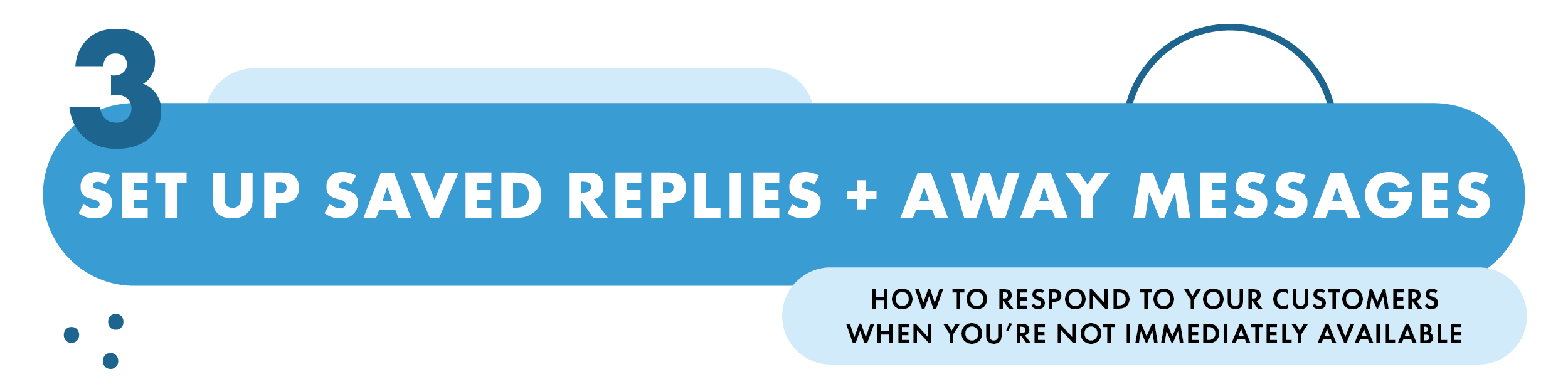
Communicating with customers is more important now than ever before—but seeing as we’re in the midst of a pandemic that has disrupted nearly every aspect of our every day lives, you may not be able to personally reply to each and every message that your business receives via Messenger (as much you may like to!).
To ensure that your customers receive a timely response even when you’re not available, you can set up Saved Replies to automatically (and immediately!) answer frequently asked questions like, “What time do you open on Monday?,” “Is your store currently closed?,” “What’s your phone number?” and more.
You can also let them know that you’re unavailable by utilizing Away Messages. Letting them know that you’re away will help will keep them up-to-date on your availability and manage their expectations for when to expect a reply.
You can schedule your Page's messaging status to match your business hours or manually change your Page's messaging status to away whenever necessary. You can also personalize your Away Message so that you can let them know when you’ll be back online and available to chat or answer any questions they might have.
To get started, here’s a step-by-step guide to setting up Saved Replies and utilizing Away Messages.
Want to learn how to get started with Messenger for your business? Take this free course from Facebook Blueprint for a deeper dive.
MORE ON THE BLOG

Ask an Expert: How to Develop a Content Marketing Strategy That Resonates During COVID-19
Social media usage and engagement have increased by over 30%.
We’ve been spending a lot of time at Create & Cultivate HQ discussing how we can best show up for and support our community during this uncertain time. Community is at our core, and connecting with others through one-of-a-kind experiences is what we love to do. While the world has changed, our mission has not. We’re committed to helping women create and cultivate the career of their dreams, which is why we’re proud to announce our new Ask an Expert series. We’re hosting discussions with experts, mentors, and influencers daily at 9 am, 12 pm, and 3 pm PST on Instagram Live to cure your craving for community and bring you the expert advice you’ve come to know and love from C&C. Follow Create & Cultivate on Instagram, check out our Ask an Expert highlight reel for the latest schedule, and hit the countdown to get a reminder so you don’t miss out!

Photo: Vlada Karpovich for Pexels
We’re in the midst of a pandemic, and there is no doubt that emotions are running high. As a marketing agency, it’s our job at Elevate My Brand to know when to adjust and pivot our own, as well as our client’s, marketing strategies. Because of all that’s happening with COVID19, you’ll likely have to adjust your messaging and be strategic in the way you approach your audience. Here’s how.
Step Up Your PR
While now may not be the time to be pushing sales, it’s a great time to step up your PR presence and get your name out there. Times are uncertain, but if anything is true, it’s that we’re all in this together. When COVID-19 started to unfold, the first thing I thought was, “How can I be of service to those who are struggling?”
As a small business owner myself, I saw it as my responsibility to use my expertise to help those around me. So, I wrote an article on 5 Marketing Tips to Stay Profitable During the COVID-19 Pandemic and our team worked their PR magic to push that article everywhere, with one goal: to reach and help as many people as possible during this difficult time. But one and done doesn’t cut it anymore, so we also penned the follow-up article, How to Elevate Your Brand, Strategize, and Execute in These Strange Days to give the next steps and a more positive future-looking perspective on how to approach things now that we’ve been in it for a few weeks. Things are changing rapidly, it’s your duty to support your community with whatever gifts you have. When you start there, you can’t go wrong and it’s clear that you aren’t tone-deaf or tackily selling.
With everyone shifting their focus to digital, now is also a great time to push your message out on socials via content collaborations. Instagram Lives have skyrocketed in popularity, with many large platforms hosting live takeovers, such as Create & Cultivate’s Ask An Expert series, which you have hopefully had a chance to see! Since we’ve all been #WFH, social media usage and engagement have increased over 30% so take advantage of this and reach out to as many sources as possible to see if they are willing to share your message.
Not only will you be helping your community, but you’ll be building brand awareness as well. This means that when things do open back up, you’ll have built some new top of mind awareness that will help you get back on top quicker.
Adjust Scheduled Content
Running on a schedule makes life so much easier, I know. But in a time like this when life is so unpredictable, it’s important to step back and take things day by day and that includes your marketing strategy as well. If you scheduled content to go out on your social channels and blogs, you’ll definitely want to take a look at it and see if it’s still appropriate for the times. At Elevate My Brand, we have had to pivot a little bit with our blog posts, pushing back topics to make room for content having to do with COVID-19. Sometimes, adjusting your content is as easy as changing a caption for a photograph. Want to post that picture of your product with a group of people? Be sure to let your audience know that this photo was taken pre-quarantine so your followers don’t get upset that you’re not following social distancing rules.
It takes a lot of work to properly plan and execute a successful marketing strategy, and you don’t want all that hard work to go to waste. While scheduled events and meetings may have been disrupted by COVID-19, that doesn’t mean that they should be canceled. We’re lucky to have technology on our side so that most of these scheduled events can be converted, rather than having to be canceled. Each year I host a women’s networking event called our Elevate Spring Salon, which is a schmooze and booze that supports a different non-profit each quarter. Obviously we can’t proceed as planned, but we have decided to convert the event to digital which should still give us a community feel, support the cause that we’re standing behind and, continue building brand awareness and visibility. P.S. fun isn’t canceled, it’s just converted.
Don’t Be Tone Deaf
As I mentioned earlier, emotions are running high right now. Everyone is reacting to the situation in a different way, so it’s crucial that you take note of your audience’s heightened sensitivity during this time. Listen to your community. What is it that they want and need right now? With social media and surveying tools like Survey Monkey, you can actually ask, what a concept!
Ultimately, you have to trust your instincts. Maybe it’s not the time to push that ad or sell that product. Now’s the time to be authentic and really showcase your brand values. Funny, positive and uplifting content is always welcome, just be sure that you’re being sensitive to the current situation and adding value, not just acting as if nothing has changed.
We’re going to be in this for a while, even after shelter-in-place orders are lifted. So the faster you can shift your messaging and positioning, the more successful you will be long term, and the less of an uphill battle you’re brand will have when this is truly over.
About the Expert: Laurel Mintz, J.D., M.B.A. is the CEO and founder of award-winning, Los Angeles-based digital marketing agency Elevate My Brand. Laurel’s gift is connecting with people and their stories. After all, companies are made up of people, and stories are just narratives that are the foundation of great marketing. Laurel’s energy has been the driving force behind the agency’s growth since it launched in 2009. Her awards include the 2017 Patrick Soon-Shiong Innovation Award, the 2016 Goldman Sachs 10,000 Small Businesses Company award, the Los Angeles Business Journal 2016 Women In Business Award, and more.
Tune in daily at 9 am, 12 pm, and 3 pm PST, for new installments of Ask an Expert.
Follow Create & Cultivate on Instagram, check out our Ask an Expert highlight reel for the schedule, and hit the countdown to get a reminder so you don’t miss out. See you there!

Ask an Expert: Why Tapping Into Consumer Sentiment Is Key to Success in COVID-19
“It’s not about pushing product right now.”
We’ve been spending a lot of time at Create & Cultivate HQ discussing how we can best show up for and support our community during this uncertain time. Community is at our core, and connecting with others through one-of-a-kind experiences is what we love to do. While the world has changed, our mission has not. We’re committed to helping women create and cultivate the career of their dreams, which is why we’re proud to announce our new Ask an Expert series. We’re hosting discussions with experts, mentors, and influencers daily at 9 am, 12 pm, and 3 pm PST on Instagram Live to cure your craving for community and bring you the expert advice you’ve come to know and love from C&C. Follow Create & Cultivate on Instagram, check out our Ask an Expert highlight reel for the latest schedule, and hit the countdown to get a reminder so you don’t miss out!

Photo: Courtesy of Jenny Gorenstein
As a brand, it is more important now than ever to listen to and connect with your consumers. We are all isolated and feeling alone in the midst of the chaos of COVID-19. Consumer needs are changing, the economy is heading for a downturn, and there is no way to get face to face with customers, so we have to step up our virtual communities.
In this installment of our Ask an Expert live series, we tapped Jenny Gorenstein, the chief growth officer at Foria, to talk us through how forging connections now can carry brands through COVID-19 and allow them to thrive on the other side. Scroll on to read some of the best advice from the conversation and be sure to follow Create & Cultivate on Instagram to join us for the next one.
Now Is Not the Time to Push Products
“There is no playbook for how to market through a pandemic. We are leading with compassion now more than ever about how we are showing up in people’s inbox and on people’s feeds.”
“It’s not about pushing product right now.”
“Don’t focus on your own brand’s initiatives, show up through goodwill.”
“People just want to know how they can feel more connected to themselves and others and that’s the content we’re putting out right now”
Digital Content Is Key
“We’re all always on our phones. We’re addicted to our phones. That is how we are connecting now. From a brand perspective, there’s a lot of ways to meaningfully connect. Don’t put out things that are overproduced, show up raw, and give things that allow that person-to-person connection. Let people into your homes. Tap into influencers who already have the trust of others and are helping people get through.”
“We scrapped all of our marketing plans, which hurt because you take months building those plans, but we want to create content in the moment. We’re working harder than we ever have because we can’t plan.”
“You want to show up in a way that is resonant with what people are going through and what their life looks like.”
“We have a really playful brand and are leaning into that.”
“We do a lot of content that allows people to pause and take notice of nature around them and that is doing well right now. This is nature’s greatest reset, were all feeling more connected to the outdoors than ever.”
Work With Influencers and Reach Their Communities
“If you don’t have a budget for influencers, that’s okay. I think the organic route is the way to start anyway.”
“Start with gifting product. First and foremost, you want to make sure they love your product and your brand before working together. Try: Affiliate networks and giveaways.”
“Think about promotions you can do that keep your profit margins but make your products more accessible. If people are curious that gives them a reason to try and once you have them you can get a consumer for life.”
Embrace the New Normal
“Success can come in so many forms you can use Instagram as a means to drive business, you can use Instagram as a means to drive engagement or you can use Instagram as a means to educate.”
“The world of tech has opened up the most amazing toolbox for brands to create dynamic conversations.”
“Lead with the people behind the brand. Lead with heart. Lead with compassion.”
About the Expert: Jenny Gorenstein has focused her career on building innovative and iconic brands and media companies. Prior to joining Foria, she spent 15 years launching InStyle.com's digital ad business from the ground up, helping to grow Refinery29 from $0 to $100M in revenue, and joining pre-IPO Snapchat to take it’s retail business to the next level. Always drawn to mission-driven and early-stage startups, Jenny is passionate about driving cultural currency and sustainable revenue growth. She is a people and idea connector.
Tune in daily at 9 am, 12 pm, and 3 pm PST, for new installments of Ask an Expert.
Follow Create & Cultivate on Instagram, check out our Ask an Expert highlight reel for the schedule, and hit the countdown to get a reminder so you don’t miss out. See you there!

Ask an Expert: How to Create Compelling Content and Grow Your Instagram, According to a VP Influencer Marketing
“The longer you wait, the harder it is to grow.”
We’ve been spending a lot of time at Create & Cultivate HQ discussing how we can best show up for and support our community during this uncertain time. Community is at our core, and connecting with others through one-of-a-kind experiences is what we love to do. While the world has changed, our mission has not. We’re committed to helping women create and cultivate the career of their dreams, which is why we’re proud to announce our new Ask an Expert series. We’re hosting discussions with experts, mentors, and influencers daily at 9 am, 12 pm, and 3 pm PST on Instagram Live to cure your craving for community and bring you the expert advice you’ve come to know and love from C&C. Follow Create & Cultivate on Instagram, check out our Ask an Expert highlight reel for the latest schedule, and hit the countdown to get a reminder so you don’t miss out!

“
The longer you wait, the harder it is to grow.”
—Rachel Zeilic, VP of Influencer Marketing at WhoWhatWear
With engagement on social up 30% since social isolation started, now might just be the perfect time to be growing your Instagram or finally figuring out wtf to do with TikTok. But in the midst of a crisis, creating good (and respectful) content can feel really difficult. In comes, Rachel Zeilic, VP of Influencer Marketing at WhoWhatWear, to answer all your questions.
Wondering what to post, when to post, what to pay for, or if TikTok is the right move for your brand? Rachel drops lots of advice on our IG LIVE on how to navigate social media in the midst of COVID-19. Tune into this Ask An Expert to make sure you don’t miss a single tip. We bet you’re already scrolling through Instagram, might as well scroll with purpose and grow your brand.
We Want Your (Respectful) Content
“Don’t make any assumptions. Don’t say, Now that we’re all working from home, because that isn’t true for a lot of people.”
“There really is a space for audiences to turning to influencers for comfort for information for distraction, they have a lot of time on their hands right now and time is a precious commodity so let’s serve them.”
“Stay away from anything that is like ‘this is a must-have’ because, if it’s not groceries or masks, it isn’t a must-have.”
“Some things that are performing really well right now is comfy chic, working from home outfits, beauty routines, anything affordable, people are still interested in spring trends, and they also want some escapism.”
“Now is also a time to give things away for free. Even if you’re a brand who could be doing well giving some at-home DIY recipes, people will really appreciate that and remember that when commerce opens up again. More than ever they will remember the brands who stepped up and are giving to the community.”
“This is the first time really in a long time where influencers’ lifestyles are really close to their followers’ lifestyles. They aren’t jetting around the world or wearing designer outfits. So this is a really great time for influencers to connect with their followers in a really relatable way.”
Get On TikTok
“TikTok is not like Snapchat or other platforms where they were popular but there was never really brand integration. TikTok is really different, the way it’s built is really engineered to be successful for brand campaigns. Particularly one feature, the hashtag challenges. That is incredible for creating UGC (user-generated content). To me UGC is gold. If your customer loves you so much that they are creating content, they aren’t an influencer, they aren’t getting paid, if they love the product so much they are creating content that is gold.”
“I think working with TikTok and ‘TikTokers’ absolutely should be part of your campaign given that the demographic aligns, it is a predominantly Gen Z audience. Also the KPIs of the campaign, you need to understand that currently TikTokers or influencers can’t link out anywhere, so if you’re expecting to see immediate sell-through from your campaign, TikTok is not the place to do it. But its great of awareness, you can reach massive audiences.”
“With regards to brands starting their own accounts on TikTok, it really depends if you can do it in a way that’s native to the platform. It’s really not going to work if you’re using the same kind of content you use on Instagram and other platforms. You should only be investing your time into growing a brand account on TikTok if you can do it in the way that is organic to TikTok.”
“The longer you wait, the harder it is to grow.”
Embrace Pay-to-Play
“Yes, it is a pay-to-play world. That being said, relationships and organic strategy are important to stretch your dollars.”
“It’s worth spending a little money on a consultant who can help you know how to spend your social budget.”
“Influencers assets on paid social perform so much better than campaign assets.”
“A lot of influencers have dropped their pricing or are more flexible on pricing right now.”
“Paid social pricing is down right now as well. You can make your budget stretch so much further right now.”
Insta Tips & Tricks
“We’ve been saying to influencers, Instead of getting a picture and then thinking, ‘Ugh what is my caption going to be?,’ why don’t you write the caption first and tell a story and then reverse that and think of an image that can convey that story?’ I don’t think they all have to be long, and they shouldn’t be long if you don’t have something to say. But every brand has a story to tell and every influencer has a story to tell and I think that can be great. It’s like micro-blogging.”
Tools to try:
“You should post as often as you can while creating quality content and without seeing a dip in engagement rate. The more you post the more your engagement will be spread out.”
About The Expert: Rachel Zeilic is an O.G. in influencer marketing, starting way back in 2007. She is currently the VP of influencer marketing at WhoWhatWear, running influencer campaigns for everyone from Walmart to Gucci. Before that she was creative Director of Majorelle at Revolve, and before that she founded two labels, Stylestalker and The Jetset Diaries.
Tune in daily at 9 am, 12 pm, and 3 pm PST, for new installments of Ask an Expert.
Follow Create & Cultivate on Instagram, check out our Ask an Expert highlight reel for the schedule, and hit the countdown to get a reminder so you don’t miss out. See you there!

Opinion: When Life Gives You a Pandemic, Scrap Everything
The founder of a DTC beauty brand on how she's adapted her business during COVID-19.

Photo: Courtesy of Curie
COVID-19 has had a never-before-seen level of impact on our lives. This pandemic is, literally, reshaping the world as we know it. As a CEO and small business owner, this has had a huge impact. Not only has my personal life changed overnight, but professionally, a year’s worth of carefully laid plans around product launches, brand strategy, and partnerships were completely turned upside down seemingly overnight. COVID-19 walked into our conference room and erased the whiteboard.
My company, Curie, is a direct-to-consumer brand that sells clean, performance-based body care products. Fitness studio partnerships were a huge part of our 2020 strategy. We were scheduled to announce a partnership with a major national fitness chain the week of April 1 and had another large partnership in the works. With gyms, fitness studios and retail stores all off the table, for the time being, we immediately shifted gears.
“Out went our entire social media and content calendar. In came an even deeper obsession with our customers and what they wanted.”
When life gives you lemons, you make lemonade, right? There’s no recipe for this situation. Scrap it, start over. Out went our entire social media and content calendar. In came an even deeper obsession with our customers and what they wanted.
Now is a good time to engage with your community in a way that isn’t strictly focused on selling products. People are home, relying on screens for work, connection, distraction and more willing than ever to share their thoughts. What our customers told us is that they wanted interactive digital content. Instagram Live workouts, how-to-tutorials, tips, and funny content simply meant to make them smile. I made a conscious business decision to focus on building relationships rather than growing sales.
If you rely on physical spaces, like we do with our retailers and fitness studios, this temporary shelter-in-place has had an even greater impact on your business. A solution is to move toward virtual partnerships and campaigns with other brands. These are a fantastic way to leverage other audiences with which you wouldn’t typically connect. This led us to Better Together, a community campaign we launched with 35 other female-founded brands that included a universal discount code, a charitable donation, and a massive giveaway. It was organized virtually overnight by Nichole Powell, CEO of Kinfield. Partnering with other like-minded companies is a great way to provide a benefit to existing customers while also tapping into new audiences. For Curie, the Better Together campaign contributed to over 50% of our revenue during the week it was live.
Right now, there are plenty of things that are going wrong in our businesses, but identify what is working, and invest your team’s time and focus on that. For us, our DTC website stayed relatively flat during the first week of shelter-in-place in California and other states, but our Amazon.com business was booming. We leaned into this shift, putting all of our SKUs (stock-keeping units) on Amazon.com. When Amazon lengthened their shipping times for what they deemed “non-essential products,” like deodorant, we pivoted our strategy. We made shipping free for all orders on our online store and started fulfilling Amazon orders out of our own warehouse to decrease transit times. Since we had previously used the low-cost FBA (fulfilled by Amazon) service for these orders, this meant a 30% increase to our shipping cost, which we decided was the right thing to do to keep our customers happy (and fresh!) during this time. Give yourself permission to throw out “the plan.”
“Things have changed, our world has changed, and the faster you can adapt to these changes, the better you will be able to serve your customers.”
Think about what your company has to offer. Does it still meet your customer’s needs? As COVID-19 spread in the United States, hand sanitizer, overnight, became an essential part of people’s daily routine. Coincidentally, we had just wrapped up the development of a new product: a moisturizing, natural hand sanitizer. We originally planned to sell this product to our fitness studio partners versus direct-to-consumer, but clearly, needs had changed. At the beginning of March, we got on the phone with our suppliers and were able to move the launch date for the hand sanitizer up six months. We will be launching this product in a few weeks and will be gifting 10% of our initial inventory to those on the frontline: delivery men and women, grocery store workers, doctors, and nurses. Things have changed, our world has changed, and the faster you can adapt to these changes, the better you will be able to serve your customers.
Lastly, never underestimate the impact of giving back in small ways. As Paul Graham once said, “Do things that don’t scale.” During this time, that especially rings true. I personally wrote 100 hand-written postcards to our most loyal customers. There were no marketing ploys and no offers involved. Simply short and sweet notes to show my gratitude and wish them well. My team also sent care packages to people who are stepping up in the community, such as fitness instructors that are leading virtual workouts online. Everyone could use a little extra love right now.
The economic uncertainty we are all experiencing right now is out of our control, but what you can control is your response. Keep your focus on doing right by your customers and don’t be afraid to throw out the plan.







MORE ON THE BLOG

Ask an Expert: How to Develop Your Brand Voice, Personification, and Tag Line
A digital marketing pro explains.
We’ve been spending a lot of time at Create & Cultivate HQ discussing how we can best show up for and support our community during this uncertain time. Community is at our core, and connecting with others through one-of-a-kind experiences is what we love to do. While the world has changed, our mission has not. We’re committed to helping women create and cultivate the career of their dreams, which is why we’re proud to announce our new Ask an Expert series. We’re hosting discussions with experts, mentors, and influencers daily at 9 am, 12 pm, and 3 pm PST on Instagram Live to cure your craving for community and bring you the expert advice you’ve come to know and love from C&C. Follow Create & Cultivate on Instagram, check out our Ask an Expert highlight reel for the latest schedule, and hit the countdown to get a reminder so you don’t miss out!

Branding is more important now than ever before with COVID-19. While it may not be the time to be pushing sales, it’s certainly the time to put your best foot forward and showcase your brand values in order to build a community. In order to market successfully during this time, you have to be able to connect with people and their stories. After all, companies are made up of people, and stories are just narratives that are the foundation of great marketing.
“Buyers make most of their decisions by relying on their two second first impressions based on stored memories, images and feelings.” This quote from Malcolm Gladwell’s book “Blink,” powerfully expresses how your customers think. In layman's terms, you only get one chance to make a first impression. To find out how to do it right, scroll on to learn more about branding, including developing your tag line and voice.
What Is Branding?
To begin, it’s crucial that you understand what branding is and what it is not. Branding is not telling people who you are, it’s managing what other people say you are. What will your audience associate with your brand? It’s up to you to create this emotional connection through your branding.
Specifically, branding is the look and feel of a brand, the characteristics, values, tag lines, logos, energy, etc. Branding includes all the ways your company shows up in the world and how you hope a consumer will relate and engage with it on an emotional level.
However, before you can even begin to market your brand out into the world, you must start by building a strong foundation. Here’s how.
How to Define Your Brand
Branding Exercise
When establishing your personal or corporate brand, it’s critical to begin by defining what you want your brand to be. This starts with developing a name and logo that speaks to your target market and evokes a specific emotion, adjective or sensory experience. You can go about this in many ways. When working with a new client, one of the first things we do is take them through a branding exercise that we call “word vomit” that looks a little bit like this:
1. Write down a list of words, potential names and/or concepts that you might want to start with (this is if you don’t already have your company name).
2. Write down a list of adjectives and emotions you want your potential client to feel when they see your logo or hear your brand name.
3. Go out and find 5-10 logos you like and 5-10 logos you don’t like and describe in detail why you do or don’t like them. The creative process is so subjective, so before we start throwing ideas at the wall, it's crucial that we know what your aesthetic is. Knowing what you don’t like is as important as knowing what you do like.
4. Similarly, determine a list of colors you like and don’t like and types of designs you do and don’t like e.g. I do like minimalist fonts, but I don’t like figures in logos.
This exercise allows you to get clear on your brand values, decide which words you want associated with your brand and, almost as importantly, which words and sentiments you don’t want associated with your brand. This type of exercise can help with buy in and can also spark creativity and should be a lot of fun.
At the end of the day you get what you pay for, so remember, this logo will live on your business cards, web site, and all marketing materials that you will create for your company, which are the first things a prospect sees, even before they get to know you. So putting your best brand effort first is key.
Brand Book
Let’s just get this out of the way—yes, you absolutely need a brand book. A brand book is a document that outlines every detail about your brand. It’s basically your brand’s DNA. At its most fundamental level, a brand book must include your mission and vision, your logo and colors, your typography, and sample imagery. The best brand book, however, has more than the basics.
As important as it is to define your brand, it’s equally important to define what your brand is not. What words or phrases are off limits? In order to stay on brand, you must know what it means to be off brand.
I said it once and I’ll say it again: Branding is not telling people who you are, it’s managing what other people say you are. In order to do this, you must know a little bit about your target audience. What do they like? With your target audience in mind, how can you shape your branding into something they can appreciate and recognize?
Ultimately, your brand is the foundation for all things marketing, so it’s critical that you get it right from the start and build a lexicon around it so that as you build and scale, the original ethos of the brand remains intact.
About the Expert: Laurel Mintz, J.D., M.B.A. is the CEO and founder of award-winning, Los Angeles-based digital marketing agency Elevate My Brand. Laurel’s gift is connecting with people and their stories. After all, companies are made up of people, and stories are just narratives that are the foundation of great marketing. Laurel’s energy has been the driving force behind the agency’s growth since it launched in 2009. Her awards include the 2017 Patrick Soon-Shiong Innovation Award, the 2016 Goldman Sachs 10,000 Small Businesses Company award, the Los Angeles Business Journal 2016 Women In Business Award, and more. Need help figuring out how to do this for your brand? I can’t wait to talk. Reach out today to get started.
Tune in daily at 9 am, 12 pm, and 3 pm PST, for new installments of Ask an Expert.
Follow Create & Cultivate on Instagram, check out our Ask an Expert highlight reel for the schedule, and hit the countdown to get a reminder so you don’t miss out. See you there!

The Do's and Don't's of Instagram Stories Engagement
Beat that algorithm.

Photo: Smith House Photography
We get it—the algorithm sucks. But that shouldn't deter you from perfecting your feed, going live, or posting to stories. As the old saying goes, if you can't beat 'em, join 'em. There are so many ways you can outsmart it or simply jump on their bandwagon and create content around trends and viral hashtags.
Ahead, we’re sharing the do’s and don’t of Instagram Stories engagement to help you create compelling content that will grow your audience and keep them there. Want more ways to outsmart the algorithm? Download our The Grow Your Instagram Bundle and discover everything you need to know to get your grid right from creating compelling captions to winning at Instagram stories.
DO have planned “features” that you roll out on a bi-weekly or weekly schedule with similar content your users can look forward to. DON'T post the same feature's constantly.
DO use thoughtfully designed templates and frames. DON'T rely solely on Instagram's formats.
DO experiment with IGS features such as: stickers, polls, questionnaires but DON'T Rely on them to carry your strategy.
DO post stories every day or at least three times a week.
DO post around five frames each time (more frames is too much and people are not watching until the end).
DO post content your followers like or need (“how to” tips, outfit inspirations, polls about products preferences, etc.)
DO mix up your post types! Video one post, perhaps a quiz the next, and follow it with a satirical chaser.
DO save your best stories with the highest engagement in your highlights, and use a consistent look for the cover.
DO re-share content that you’ve been tagged in. User-generated content is always a good idea. It shows your community that you are trustworthy and have a product that people love.
DO use hashtags and tag people/brands in your stories that pertain to it. Show behind-the-scenes because it usually garners a lot of attention. People want to know what it’s like at a photoshoot or at an event.
DO have fun with it. These only last for 24 hours so you don't have to be as polished. Show behind-the-scenes content. Instagram is always introducing fun new story features (questions, polls, GIFs, etc.) so use them! Ask questions and experiment.
DO show your brand/the team's personality and get personal. Maybe how the founder uses the brand's products or even a 'story takeover for a day by one of the team members to show what her day is like.
DO give them a reason to want to share your stories. Post something really helpful on Saturday, that is not sales-sy, but is in the spirit of genuinely wanting to help.
DON'T use the same template each time! Mix it up to keep it interesting. This is where you can be creative and see what works best. After all, they disappear, and you don't have to keep them in your highlights.
DON'T just use your stories for advertising. People like to be entertained by your stories, and might also mistake it for a sponsored story.
DON’T make stories too long. Stick to around 10-12 a day. Any more than that and it’s too much content to soak in and truly appreciate.
DON’T forget your audience and who you are sharing with. You want to keep your followers (or potential followers) intrigued to watch everything you’ve shared.
DON’T not use stories. It’s an amazing way to connect with your followers and bring on new ones!
DON’T just repurpose existing content. If you're filming a video for IGTV, use the BTS content on Instagram stories. Don't worry about being too buttoned up. Have more fun with story content that won't be as permanent. Don't make it too long, sometimes fewer frames is better.
DON’T post the same thing you post on your feed—people get bored.
Want to outsmart the algorithm?
Add our The Grow Your Instagram Bundle to your cart, or get unlimited access to our entire library of downloads and videos when you join Insiders.
MORE ON THE BLOG

Ask an Expert: How to Sell Through Video, According to a Business Coach
Lights, camera, conversion.
We’ve been spending a lot of time at Create & Cultivate HQ discussing how we can best show up for and support our community during this uncertain time. Community is at our core, and connecting with others through one-of-a-kind experiences is what we love to do. While the world has changed, our mission has not. We’re committed to helping women create and cultivate the career of their dreams, which is why we’re proud to announce our new Ask an Expert series. We’re hosting discussions with experts, mentors, and influencers daily at 9 am, 12 pm, and 3 pm PST on Instagram Live to cure your craving for community and bring you the expert advice you’ve come to know and love from C&C. Follow Create & Cultivate on Instagram, check out our Ask an Expert highlight reel for the latest schedule, and hit the countdown to get a reminder so you don’t miss out!

“It is an 80% higher conversion rate when you share services and products on video rather than standard text posts.”
—Tiffany Carter, founder of ProjectME
During COVID-19, you have to step up your social media game—and, according to business coach, Tiffany Carter, video is essential for engaging your followers. Whether you are going live on Instagram, pumping out some quick stories, or posting vids directly to your page, if you aren’t using video, you’re not making the most of your social channels.
In this installment of our Instagram Live Ask an Expert series, we asked the founder of ProjectME to walk us through her best tips for turning videos into conversions. If you’re afraid to go live, show your face on camera, or even just make your videos worth watching, scroll on for her best tips, and be sure to follow Create & Cultivate on Instagram to tune into the next conversation.
Video Is A Must!
“It is an 80% higher conversion rate when you share services and products on video rather than standard text posts.”
“You need to do video every day in your stories.”
“Its vulnerable to be our silly, goofy, awkward selves, but that converts the best.”
Use The EASE Method
E - Energy and Engagement
“You cannot fake energy. Get into the highest possible energy state you can get in for that moment. Do jumping jacks, put on fun music, call a friend to hype you up, whatever it takes”
“Look at the screen as though it is your best friend and use those same mannerisms you would use in real life.”
“The first ten seconds are crucial, especially for pre-recorded videos. It determines if someone will click on or off. Do not start a video with ‘hey, guys,’ it’s basic, it doesn’t work, it’s not engaging.“
A - Authority and Confidence
“You need to establish yourself as the authority in your niche.”
“What we tend to do [when we lack confidence] are weird things like looking down, not getting close to the video, or hair twirling. These nervous habits don’t translate.”
S – Storytelling
“Stories sell. People remember stories.”
“Have a story, it can be a mirco-story, but have a story prepared to share in your videos, something funny, or something that worked really well for you, have some kind of story.”
E - Execution
“You have to tell people what in the hell to do or they don’t do it.”
“If you want people to comment below, don’t only ask them a question but tell them to comment below, point to the comment section.”
“If you’re not so sick of yourself that you’re thinking I can’t say this again or I can’t listen to my voice anymore, then you’re not saying it enough.”
The 3 Es of Content
Good content should do at least one of these three things:
Educate your people
Enlighten them
Entertain them
About The Expert. Tiffany Carter takes the mystery out of making big money while doing something you love. She uses a magnetic combination of her clear-cut communication style that she developed as a TV news broadcaster for NBC and CBS, her business savvy and proven strategies as a multi-millionaire entrepreneur, and her intuitive ability to connect with women on a deeper level, to uncover what’s blocking you from achieving your dream life.
Tune in daily at 9 am, 12 pm, and 3 pm PST, for new installments of Ask an Expert.
Follow Create & Cultivate on Instagram, check out our Ask an Expert highlight reel for the schedule, and hit the countdown to get a reminder so you don’t miss out. See you there!

How 2 Best Friends Turned $1400 Into a Wildly Successful (and Profitable) Business
Grab a pen. The Witty Rentals co-founders have an amazing story.


We know how daunting it can be to start a new business, especially if you’re disrupting an industry or creating an entirely new one. When there is no path to follow, the biggest question is, where do I start? There is so much to do, but before you get ahead of yourself, let’s start at the beginning. To kick-start the process, and ease some of those first-time founder nerves, we’re asking successful entrepreneurs to share their story in our new series, From Scratch. But this isn’t your typical day in the life. We’re getting down to the nitty-gritty from writing a business plan (or not) to sourcing manufacturers and how much they pay themselves, we’re not holding back.

Photo: Courtesy of Witty Rentals
What would you do with $700? For most of us, especially right now, it would go into savings or paying bills, but it could also the beginning of a new business. Wait, what? Yes, you heard right. Chelsea Bradford and Tiffany Garcia only had $700 each when they had the lightbulb moment to launch their event rental company. Now, Witty Rentals is a super successful (and profitable) business—you’ve probably seen a lot of their stylish furniture at our Create & Cultivate events. Of course, it didn’t happen overnight but first, let’s give you a quick recap on how it all began.
After meeting as teenagers through a growth group, the pair became fast friends. Even with Garcia leaving to study abroad in her homeland of Sweden, and Bradford moving away for college, the pair kept in touch as long-distance pen pals. They were eventually reunited when they got married and served as each other’s bridesmaids. Now, fifteen years later, they have three little ones between them and a successful business between them.
Want to hear how they did it? Read on to hear more about how these best friends started their business from scratch with just $1400, the lessons they learned along the way, and advice for new founders on how to start a small business from scratch—because good news stories are exactly what we all need right now!

Photo: Courtesy of Witty Rentals
On their lightbulb moment…
Chelsea Bradford: When we dreamed up Witty six years ago; Tiffany had a bit of experience in the event industry working for a coordinator and saw a gap in the market she wanted to fill: modern furniture rentals in the San Diego area. I, on the other hand, had zero experience in the industry. I had a Fine Arts degree in ceramics and had my own small business of ceramics, but was interested in design so with our powers combined and a whopping $700 investment each, we started collecting furniture in the garage of Tiffany's parents' house and by some miracle, people actually rented our stuff.
On writing a business plan…
Haha! This would have been a great idea, but we were very ignorant about what starting a business actually meant when we started. We can say with 100% certainty, that we were winging it! I don't think either of us expected it to grow to what it is today, but we have been so happy with the slow and organic growth that we've had. Never taking out loans or taking on investors... the growth came as we were ready for it. Since we didn't have a business plan or any help in the first few years, the "take it as it comes" approach was what kept us sane.
On coming up with the name…
Tiffany found the name in a book and something about it stuck with her. I loved the name immediately, it was playful and unique at the time. Now there are a lot more “Witty” companies in the industry, but my advice for choosing a name now would be to try and be unique, do your research, and make sure there isn't something similar in your area—and try to stand out!
“We can say with 100% certainty, that we were winging it!”
On setting up the business…
The first thing we did was create an email address and it was definitely a Gmail account because we didn’t know any different. Instagram came next. I think we started with @w_i_t_t_y… haha not super professional. Next was probably a domain, website and business license. There's so much you learn during this process that no one tells you such as having to list your fictitious business name in the paper and random things like that.
Other than those few things though, we didn't do much else in those early years besides collecting furniture. If I could give a word of advice to a business just starting out, it would be to present yourself as a real business early on even if you don't even remotely have your shit together. The way you present yourself in the early days will help create the client base that will get you off the ground.
On doing the research…
We researched other rental companies in our area, there was really only two other boutique event rental companies at the time, so we reached out to both of them and visited their warehouses. We talked to them about how and when they started and got some great advice. We wanted to offer something different from what was available in our area, so being able to see what these companies offered helped us shape the direction we wanted to go, as well as build some valuable relationships for the future. One thing we’ve loved about this industry is that there’s plenty of events to cater to which makes it less competitive and we love how friendly our “competitors” have been.”
On finding the right space…
We started collecting in a two-car garage with $0 overhead which is really the only way we were able to start. After about a year and a half, we moved into our first warehouse, 2,200 sq ft, which felt massive. Scared of the cost, we asked some florist friends of ours (hey Bloom Babes!) if they wanted to split the space with us and they were happy to do so—it ended up benefiting both of us greatly. We eventually outgrew our portion and had to take over the whole thing and luckily the Bloom Babes were ready for their own space as well, so we split ways on great terms. Two years in that space and it was time to find something bigger. Now we're in about 6,800 sq ft and looking for another space! The growth has been fun yet sustainable which is the pace we needed.
“The two of us didn’t have huge aspirations or goals in the beginning and so starting small and slow is what we were capable of keeping up with. ”
On self-funding and boostrapping the business…
We were able to start Witty with a total initial investment of $1400 between the two of us and then two years of reinvesting everything that we made, not taking a cent for ourselves. We knew this would give the business the best opportunity for growth and we’re positive we wouldn't be where we are today if we would have tried to pay ourselves early on.
As for what we would recommend to a startup... this is such a personal decision based on what your goal is for the business. The two of us didn't have huge aspirations or goals in the beginning and so starting small and slow is what we were capable of keeping up with. On the other hand, we have friends in the industry who dumped $100K into buying inventory and they have far exceeded our growth in a short period of time.
From the beginning they have had different goals for their companies and that path has worked to help them meet those goals. Really digging deep and asking yourself what you're hoping to achieve, how fast are you wanting to recoup that investment, and what your overall long term goals are for the business will help shape this decision.
On paying themselves a wage…
After two years of not paying ourselves anything, then a year of only paying ourselves for the deliveries we did, we finally started paying ourselves... get ready... $1,000 a month. I know, we were loaded (please pick up on that sarcasm). After about six months of realizing that the business was still okay, we bumped it to $1500, then $2000, then $2500. At this point, we felt like we had really made it! We could justify paying ourselves a collective $5K a month, plus paying rent and paying our handful of employees… just out here living the American dream!
We've since increased our salary slightly but in full transparency, we still believe that making sure the company has the liquid funds to function is far more important than having more dollars in our pockets and the company becoming business broke. We've never put a percentage on it, we decide the number based on what we feel the business can offer as well as what our families can live on without struggling.

Photo: Courtesy of Witty Rentals
On hiring the right team…
We are a team of five, including Tiffany and myself. Neither of us has ever been a “boss” before, so this has been quite the adventure trying to learn how to hire, fire, and manage. To be honest, we don't like it, but it comes with the territory I suppose. We have been fortunate to have incredibly patient employees who give us grace through our struggles communicating, organizing thoughts, managing... and we are so incredibly fortunate to have them. A bit of advice we recently learned from an industry friend is to hire slow and fire fast. Meaning take your time with multiple interviews, then have a working interview... make sure the employee is a good fit with your existing team before bringing them on. Then if you feel that someone isn't a good fit, don't wait around, find someone else.
On hiring an accountant…
We have been incredibly fortunate in that Tiffany's mother-in-law is a CPA (certified public accountant) and has done our bookkeeping and taxes up to this point. She is an actual angel on earth. As of 2020, we have switched our bookkeeping over to Bench.com to take a bit off of her plate and it has been a great resource for us, super user friendly and great customer service.
On the biggest learning curve…
The biggest learning curve has been knowing where to spend money. Something that we've struggled with for a long time (and still do if we're being honest) is knowing that just because something is pretty or we like it, doesn't mean it will rent. We have to think about every item in our collection as if it is paying rent to be in our warehouse, so if it doesn't pull its weight, it's got to go! When sourcing, we try to keep this in mind: Will clients have a use for this? Will they like it? Does it fit with our existing aesthetic? If the answers are yes, then we can pull the trigger and purchase the item. And if not, well then we can admire it from afar.
“Save, save, save. Then you can really invest in what’s going to make a positive financial impact on your business.”
On having a business coach…
We've never had a business coach, but this is something that we have given some serious thought. I think it would help us in so many ways; from employee management to big picture goals, finances and budgeting. We do think it could help us organize all of the important things that race around our heads on a daily basis and implement ways to get each thing accomplished.
On PR and marketing…
Instagram. I mean, seriously... what business doesn't rely on that platform these days. Instagram is definitely how we got started, but then the dreaded algorithm had to go and eff everyone up. Among other avenues, we now rely a lot on word-of-mouth and testimonials. Reviews can do wonders for a small business so we've put a lot of effort into having overwhelmingly positive experiences with clients and requesting feedback from them after their event. We look at it like this—when was the last time you bought something important and didn't read the reviews on it? And if you did read the reviews, which ones helped sway you to purchase that item? Those are the reviews we hope to get from our clients and we feel like they have absolutely helped sway interested clients into booking with us.
On the one thing, they didn’t do (but wish they had)…
We did everything the hard way. You'd think that the first thing two lanky young girls would do when having to move insanely heavy furniture all the time would be to invest in some dolly's or some kind of straps to make our lives easier... but no. There's that cute saying "work smarter, not harder", let’s just say it took us a long time to work smarter. Another perfect example of this is it took us four years to implement canned responses in our emails. That’s four years of writing the same email over and over and over again, wasting countless hours when the answer was so simple. Our advice? Find ways to simplify and automate processes within your business. You'll thank yourself later.

Photo: Courtesy of Witty Rentals
On their best business advice…
Chelsea: We've learned over the years that it's not in our nature to be business owners. I am an introvert, I love my downtime, I can confidently say that I'm lazy by nature, it's hard for me to self-motivate, I procrastinate—give me four seasons of a show and a bag of chips and I'm your girl (as two loads of laundry currently sit unfolded in the basket (I'll get to them later, okay?). But I didn't let that stop me. I just found the perfect counterpart. Someone who encourages me and motivates me to be a better version of myself. And I hope she'd say that I balance her out in all of the right ways as well.
My advice would be, don't try to do it alone. Whatever it is you want to start, have a partner, find someone who has strengths that you don't have—the yin to your yang. I know for a fact that we wouldn't be here today if just one or the other of us started this alone. We've relied on each other heavily every step of the way and we still do today.
Tiffany: Yes, I agree. Finding a business partner who has different strengths and qualities than you is crucial. I would say that I am more of a dreamer/visionary type. I love to think about big picture ideas or steps we can take in the business to encourage growth. Put a spreadsheet in front of me and I literally shut down inside. This is why Chelsea balances me so well because she could create spreadsheets all day long and they bring her so much joy.
I also think part of why our business relationship works are because neither of us is super stubborn. If we disagree on things we are both willing to communicate and comprise easily. If you are considering starting a business I think it's important to take your time and be very selective with who you go into business with. Also, creating a partnership agreement and specific roles for each other is crucial so that you are both in charge of separate roles within the business.
On their one piece of financial advice…
Use your savings account. You never know when you'll have an unexpected expense or need to make a big purchase. One example for us was buying a large number of chairs unexpectedly. If we had to put $20k on a credit card that would have been our absolute last choice, but luckily, we had saved for just that. Save, save, save. Then you can really invest in what's going to make a positive financial impact on your business.
Oh, and another thing would be to charge for your services. Don't offer a discount just because you think you should. Make sure you're charging enough, not lowballing the market or being taken advantage of. Do your homework and see what others in your industry are doing around you, and hey even if you want to charge a bit more because that’s the quality of your work, go for it. You're worth it.

Photo: Courtesy of Witty Rentals
On the advice, they’d give themselves…
Save more! Our long term goal has always been to buy a property and be able to store our collection there instead of dumping thousands and thousands and thousands of dollars down the drain for rent. If we were really motivated, we could have done it already, but we haven't given it our all, so we're still renting.
On working with a co-founder…
Tiffany: People say never go into business with friends or family. I can understand why people say that—you don't want your relationship to crumble if the business does, or maybe you'll start to hate each other down the road—and trust me, I've seen that happen in this industry specifically. But for us, it's been all about communication. Our partnership is just like a marriage, you have to work at it and make sure that things are talked about and your feelings are being seen and heard. Again, this is where our differences have helped us monumentally. Chelsea despises confrontation.
Chelsea: Yeah, I'll do anything to avoid it, and it's in my nature to sweep it under the rug. Tiffany has been our saving grace in this area, forcing me to share how I'm feeling, telling me point blank if I've hurt hers. And because of that, we have been able to maintain a friendship above and beyond the business.
Tiffany: That’s true, but at the same time Chelsea's ability to compromise prevents us from getting into needless conflict, so she really does help us balance each other out. She’s definitely more than a business partner, like my second life partner, haha.
Visit Witty Rentals and learn more about their unique furniture rental company at wittyrentals.com.
MORE FROM THE BLOG


#SmallBusinessBigInfluence: A Live Discussion on How to Support Small Businesses During COVID-19
Necessary #realtalk on the art of the pivot
We’ve been spending a lot of time at Create & Cultivate HQ discussing how we can best show up for and support our community during this uncertain time. Community is at our core, and connecting with others through one-of-a-kind experiences is what we love to do. While the world has changed, our mission has not. We’re committed to helping women create and cultivate the career of their dreams, which is why we’re proud to announce our new Ask an Expert series. We’re hosting discussions with experts, mentors, and influencers daily at 9 am, 12 pm, and 3 pm PST on Instagram Live to cure your craving for community and bring you the expert advice you’ve come to know and love from C&C. Follow Create & Cultivate on Instagram, check out our Ask an Expert highlight reel for the latest schedule, and hit the countdown to get a reminder so you don’t miss out!

Photo: Smith House Photography
It’s safe to say COVID-19 has upended our lives in every possible way. Socially, emotionally, physically, and certainly financially. In times of crisis, businesses are put to the test—supply chains are disrupted and profit margins are compromised. But if there’s one industry that has been impacted the most, it’s small business—and they need our help more than ever right now.
The Shelter at Home policy has seen all our favorite restaurants, fitness studios, salons, and boutiques close shop across the country. These businesses are the backbone of our country, and we need to support them the best way we can. In times of great uncertainty, success comes down to how you pivot and respond—and now is the time to be swift, not reactive.
For some #realtalk on how to pivot in a crisis, lead with purpose, and promote small business through big influence during these challenging times, we asked three powerhouse female founders—Deepica Mutyala, founder and CEO of Live Tinted, Danielle Bernstein, entrepreneur and founder of We Wore What, and Amber Fillerup, founder of Barefoot Blonde—to join our founder and CEO Jaclyn Johnson for a special roundtable discussion (via Zoom, of course) on the state of the industry and how we can support it.
Scroll on for some highlights from the conversation and be sure to follow Create & Cultivate on Instagram to find out how to join our next roundtable discussion. If you want to join the movement and support small businesses right now, please visit @SmallBusinessBigInfluence on Instagram.
On accept and establishing a new normal…
“I think the toughest part is creating that sense of culture when you’re not together.” — Deepica Mutyala, founder and CEO of Live Tinted
“I didn’t realize how much we accomplished in in-person meetings” – Amber Fillerup, founder of Barefoot Blonde
“Having a morning routine and treating it like normal has been the only way to create a normal.” – Deepica Mutyala, founder and CEO of Live Tinted
“I keep telling myself that we are all human and that’s the number one thing that matters right now.” — Deepica Mutyala, founder and CEO of Live Tinted
On embracing authenticity on social media…
“Now more than ever, people just want to see human.” — Deepica Mutyala, founder and CEO of Live Tinted
“I’ve tried to have the right balance of content that can distract with content that can educate with content that is actually helpful and useful.” — Danielle Bernstein, entrepreneur and founder of We Wore What
“It’s been an opportunity for us to do weekly newsletters where we profile people from the community who are doing heroic things.” — Deepica Mutyala, founder and CEO of Live Tinted
On leaning into charitable contributions…
“Everything has meaning behind it and I want my followers to feel better about their purchases and feel like they are really going to help someone.” — Danielle Bernstein, entrepreneur and founder of We Wore What
“No matter how much I do, no matter how many people I’m helping right now, I’m still getting hate thrown my way.”— Danielle Bernstein, entrepreneur and founder of We Wore What
“Every sponsorship I have coming up I’m asking them if we can donate to a charity in need.” — Danielle Bernstein, entrepreneur and founder of We Wore What
On pivoting during this unprecedented pandemic…
“We’re sold out of two shades and can’t get that back in stock, so its forcing us to get really creative, and something we’ve always wanted to do is merch and there are manufacturers in LA that are still working.” — Deepica Mutyala, founder and CEO of Live Tinted
“At C&C, our whole business is events, so were thinking how can we bring things online.” — Jaclyn Johnson, founder and CEO of Create & Cultivate
“Social media views and engagement have increased by over 30% in the last two weeks. Everyone is spending a lot more time on digital and social media.” — Jaclyn Johnson, founder and CEO of Create & Cultivate
“More than ever, it’s a great time to work with influencers, you just have to be sensitive to what’s going on in our current landscape.” — Danielle Bernstein, entrepreneur and founder of We Wore What
On putting your employees first…
“I’m trying to feel out my employees because this is really taxing on our mental health, too, and I don’t want to push my employees too much. So, were being really sensitive and taking things slow.” — Amber Fillerup, founder of Barefoot Blonde
“Every morning, we get on a FaceTime call and have our coffee and do a morning ritual where we do our rose and thorn for the week.” — Danielle Bernstein, entrepreneur and founder of We Wore What
“Transparency has been key for us.” — Deepica Mutyala, founder and CEO of Live Tinted
“I think there is solace in the fact that its everyone and it’s not industry-specific.” — Jaclyn Johnson, founder and CEO of Create & Cultivate
MORE ON THE BLOG

Ask an Expert: How to Be Innovative as a Small Business Right Now and Remain Profitable
The youngest black woman to ever launch a line at Sephora shares her insight.
We’ve been spending a lot of time at Create & Cultivate HQ discussing how we can best show up for and support our community during this uncertain time. Community is at our core, and connecting with others through one-of-a-kind experiences is what we love to do. While the world has changed, our mission has not. We’re committed to helping women create and cultivate the career of their dreams, which is why we’re proud to announce our new Ask an Expert series. We’re hosting discussions with experts, mentors, and influencers daily at 9 am, 12 pm, and 3 pm PST on Instagram Live to cure your craving for community and bring you the expert advice you’ve come to know and love from C&C. Follow Create & Cultivate on Instagram, check out our Ask an Expert highlight reel for the latest schedule, and hit the countdown to get a reminder so you don’t miss out!

Photo: Courtesy of Trinity Mouzon Wofford
If there’s one thing we’ve learned from our Ask an Expert series, it’s that innovating will be crucial for small businesses to come out of the COVID-19 crisis stronger than ever. “Pivot,” “shift,” and “adapt” are buzzwords that have popped up in nearly every conversation we’ve had with founders in nearly every industry, ranging from events to skincare to fitness.
Naturally, we could think of no one better to speak to the topic of innovation than Trinity Mouzon Wofford, the youngest black woman to ever launch a line at Sephora and a Forbes 2020 30 Under 30 honoree. Keep scrolling to read a few highlights from our conversation with the forward-thinking co-founder and CEO behind the wellness-meets-skincare brand Golde, as told by Wofford to Create & Cultivate.
Check-In With Your Community
If you’re wondering how to talk to people right now about your business, ask your community. Instead of racking your brain trying to figure out what’s appropriate, ask them. It all comes back to thinking about your community and what they’re looking for from you right now.
Does your product or your service provide value for people right now? At Golde, we’ve found that our products provide a lot of value and service to people who want to practice wellness at home right now. What is it you’re selling and does it resonate with what people are going through right now?
Prioritize Word-of-Mouth Product Recommendations
No one wants to be sold to right now. More than ever, those micro-influencer relationships, those one to one product recommendations that are coming from friend to friend, are what’s resonating with people right now.
Lean Into Digital to Acquire (and Retain) New Customers
If you’re seeing increased traffic to your site and increased conversion rates, this is an opportunity to develop an acquisition strategy that brings people into your retention strategy.
We’re shopping online way more than we were before, and although consumer patterns have shifted due to a temporary situation, these shifts may last longer than the crisis, if not permanently.
Again, it comes down to having honest conversations with your community and what they want from you. You have to figure out what your voice is and what your opinion is and couple that with who’s listening and what they want to hear from you.
About the Expert: Trinity Mouzon Wofford was raised in New York's Hudson Valley by a single mom with an autoimmune disease. When she was a teenager, her mom started seeing a holistically-minded physician and saw an incredible improvement in her symptoms, which inspired Wofford to study pre-med at NYU. When Wofford’s mom had to stop seeing her doctor because she couldn't afford it, Wofford abandoned her plans for med school, frustrated by the lack of accessibility to holistic care, and fell into a marketing career in New York. She absolutely loved it, but she knew she wanted to come back to wellness somehow. That's the mindset Golde was born from in 2017.
Tune in daily at 9 am, 12 pm, and 3 pm PST, for new installments of Ask an Expert.
Follow Create & Cultivate on Instagram, check out our Ask an Expert highlight reel for the schedule, and hit the countdown to get a reminder so you don’t miss out. See you there!

Ask an Expert: How to Elevate Your Brand, Strategize, and Execute in These Strange Days
Marketing from every angle.
We’ve been spending a lot of time at Create & Cultivate HQ discussing how we can best show up for and support our community during this uncertain time. Community is at our core, and connecting with others through one-of-a-kind experiences is what we love to do. While the world has changed, our mission has not. We’re committed to helping women create and cultivate the career of their dreams, which is why we’re proud to announce our new Ask an Expert series. We’re hosting discussions with experts, mentors, and influencers daily at 9 am, 12 pm, and 3 pm PST on Instagram Live to cure your craving for community and bring you the expert advice you’ve come to know and love from C&C. Follow Create & Cultivate on Instagram, check out our Ask an Expert highlight reel for the latest schedule, and hit the countdown to get a reminder so you don’t miss out!

Photo: bongkarn thanyakij for Pexels
Marketing can be confusing, but even when it feels like the sky is falling, it is not a dirty word and, in fact, often makes the difference between a three- or a six-month uphill battle to recovery.
Trust me, I know a lot about both marketing and dirty words! And if the recession in 2008 showed us anything, it’s that now is the time to amp up your digital marketing spend. At Elevate My Brand, our creative experts are good as hell in all the many and multifaceted elements of marketing that support your business’ visibility, awareness and sales.
Ahead, I’m breaking it down in two broad categories: digital and experiential. While these two forms of marketing may sound like they’re on opposite sides of the spectrum, they are integral to brand success (yes, even now!). They amplify each other’s effectiveness, so it is crucial that there’s synergy between the two. Enter, the mind map!
So, what is a mind map session?
Strategy is extremely valuable because of what is discovered in the planning process. It uncovers truths, areas of opportunities, blind spots and outlines the answers to necessary questions about audiences, goals, and budgets. This session is the starting point on any brand journey. It’s an opportunity to play, visualize and map out a strategic go-forward plan. Here’s what this could look like for you.
Digital Marketing
How do your customers find you online? This includes everything from your website and your social channels to your email marketing campaigns. We live in a digital world where people can access information fast and on every possible platform. Plus, people are more digitally literate and brand-minded than ever before, which is why brand consistency across all platforms can increase company revenue by 23%. Your digital footprint is a critical starting point. See if you can map it out like this for your brand.
Now, let’s break it down.
Your website
Let’s be clear. It’s 2020, so there is no excuse for a sub-par website. A website is basically a digital brochure of your brand. It’s your online headquarters. Making sure your website represents your brand through visual storytelling and quality content is critical. It’s often the first and only impression you make with a potential client, so make sure that you spend the time and money to create a stunning, interesting, information-rich and user-focused platform for your company. Think through the most important marketing elements of your site, such as forms, e-commerce API, mailing and database integrations, etc., to make the most of your customers’ online experience.
Your social media presence
Social media can be a great brand-building tool for your business if you use it the right way, especially right now where people are bored and looking to engage more than ever before. In your mind map session, make sure you’re outlining the social media platforms that will provide the most impact for your brand category and ones that you will be able to maintain activity on.
There’s nothing worse than seeing a brand social page whose content is spotty or non-existence. That doesn’t build brand loyalty and trust. If business development is your priority, consider LinkedIn or Twitter; product development or customer research, consider Twitter or Reddit; sales and UGC, consider Instagram, Facebook, or Pinterest; and for general education or content, consider Facebook. Your social network of choice matters. Develop a social media strategy that aligns with your business plan and KPIs. What are the general goals for your quarter, your year? Don’t try to be everything to everyone.
In developing your social media strategy, it’s important that you stay updated on current news and trends. There’s no doubt that COVID-19 has caused several businesses to alter their social media strategy. You probably won’t be posting the same content, but that doesn’t mean you should lay off on posting all together. In fact, social media content is more important now than ever, with engagement up nearly 30%!
During times like these, your social media content is probably going to be less about showing your product, and more about showing your values. How is your company remaining positive and helping the community during COVID-19? Showcasing your values and how you treat your employees will help build brand loyalty and potentially put you ahead of your competitors when budgets open back up.
Your advertising strategy
Once you’ve developed a plan on your social network(s) of choice, it’s time to carve out a social ad budget and create some campaigns. Sadly, organic social alone won’t grow your audience or build brand recognition these days. You absolutely need ads to reach more eyeballs and increase your follower count.
In a mind map session, we guide potential clients in choosing the right ad platforms, whether that’s Facebook, Instagram, LinkedIn or even TikTok. You may think that advertising during the COVID-19 pandemic isn’t the best idea, but it’s actually the perfect time. Think about it: with other advertisers and competitors pulling out their ad spend, you have more opportunity than ever to grow your market share and rise to the top at a lower CPC, that’s a huge potential win.
Social isn’t the only ads platform. There’s also Google, have you heard of them? Whether you like it or not, Google Ads are a necessity. Recent updates to Google Ads’ algorithms have made it so that, if you want to be on the first page of a search engine results page (SERP), you have no choice but to pay to play. At a minimum, you need constantly running, highly targeted search ads to increase your SEO.
Your content development
Content is queen! Many people are surprised to hear that you should be posting content at least twice a week, which translates to 104 pieces of content for the year. How will you come up with this content? Our secret sauce, and something you can definitely execute while in quarantine, is a once-quarterly session where we spend one whole day to create content for three months or about 26 pieces. And rather than writing blog posts, we record vlog posts.
Why? Because YouTube is the #2 search engine after Google. In other words, video content with written transcriptions play nicely with the top two engines. The best part about content development? It’s low-risk and high-reward. You can set up some lighting and a good camera and record great content on the fly. Right now, while businesses are coping with COVID-19, is the perfect time to fill out your content reservoir. In our mind map sessions, we share with you some ways to create content “pillars” and build out a strategy from there.
Experiential Marketing
Whereas digital is the online experience of your brand, experiential is the offline experience. This includes events such as pop-ups, product launches, activations, trade shows, conferences, and even field marketing efforts. When planning and hosting events, it’s wise to use a little bit of your budget to bring on a photographer and a videographer so you can tie the experiential to the digital side as well.
A recent event series we did with the fabulous Tamara Mellon is a great example of how the two work synergistically. We partnered with the luxury shoe brand to create, fabricate and execute an event concept for the Create & Cultivate conferences. While we worked hard to fabricate their event, we also worked on the digital side to execute a hashtag that was unique to the event. It was #FlashYourMellons. It was a little salacious, and the brand wasn’t sure about it at first, but on the first day of the conference, Tamara Mellon got more social engagement through that hashtag than in the entire history of the brand!
Obviously, in-person experiential marketing is temporarily on hold thanks to COVID-19. But that doesn’t mean all experiential is on hold. Convert, don’t cancel. If you can, convert in-person events to digital hangouts. Rather than reveal a new product in-store, go live on social. In just one week, Facebook and Instagram Live views doubled. Use this bizarre time to build brand loyalists by converting your events rather than canceling, and creating even more intimate and engaging moments online.
Right now, Elevate My Brand is offering complimentary strategy sessions to any brands in need. Shoot them an email at info@elevatemybrand.com or ping them on Instagram or Facebook.
About the Expert: Laurel Mintz, J.D., M.B.A. is the CEO and founder of award-winning, Los Angeles-based digital marketing agency Elevate My Brand. Laurel’s gift is connecting with people and their stories. After all, companies are made up of people, and stories are just narratives that are the foundation of great marketing. Laurel’s energy has been the driving force behind the agency’s growth since it launched in 2009. Her awards include the 2017 Patrick Soon-Shiong Innovation Award, the 2016 Goldman Sachs 10,000 Small Businesses Company award, the Los Angeles Business Journal 2016 Women In Business Award, and more.

Thinking of Turning Your Hobby Into a Business? Read This First
The hustle is real.

Photo: Anna Shvets for Pexels
Many people have hobbies they believe could be successful business ventures. Dreaming big is great, but sometimes we have to be practical. Starting a business is harder than it seems and requires lots of planning and risk-taking. Lots.
Unfortunately, no matter what products you create or services you can offer, you can’t predict the future. Before turning your hobby into a business, it’s important to sit down and think about all of the things that go into creating a successful company.
Here are a few things to consider before starting your own business…
Funding
Before you begin your business, you have to think about how you’re going to fund it. While you may not need lots of money right away, you need to be prepared for growth and potential emergencies. Whether you have investors or you’ve saved your own money, you’ll need to have funds readily available for anytime you may need it.
You can keep your day job in the beginning. This will ensure you have something to fall back on should your endeavor not pan out as you had expected.
Motivation
You have to be able to take the initiative and keep yourself motivated every single day if you’re going to turn your hobby into a business. Expect daily work and long hours—building a brand is hard work.
You’ll also have to learn the ins and outs of business—from account management to marketing initiatives. If you’re starting with less funding, you’ll need to teach yourself all of these different aspects. You might even consider taking a business course at your local college to get started.
If you can afford to hire a professional team, first hire people who can help you with marketing. Then, hire people to help you with whatever your weak spots may be or the areas where you have the least experience.
Branding
Your brand is what will make your products stand out from the crowd. Who you are is important to the public. It’s what helps them decide whether or not to work with you and buy your products. This is where your company mission is important. It shares your goals and values with prospective customers and employees.
Branding is also what helps people recognize and remember you. The images and designs you use on your products, website, business cards, and other marketing materials will make people recognize your brand. Be consistent in designing your website, marketing collateral, and other representations of your brand.
Networking
It’s important to network and meet people in your industry. These people will help you strengthen and expand your business.
While networking, you can find public relations contacts and media professionals to help market your business and manufacturers who can help you develop your products for less. You can also meet buyers face-to-face, which is always an advantage for fostering new wholesale relationships.
Networking takes communication skills, so it’s important to work on getting comfortable with public speaking and to learn how to talk to other professionals. If you’re initially uncomfortable in social situations, don’t worry. It gets easier. The more experience you have, the sooner you’ll develop these skills.
Professional Support
You’ll probably be working alone when you launch. However, as you expand and start to make a profit, it will be time to hire professionals like lawyers and accountants to help keep your business afloat.
Your attorney will be one of your most important resources in business. Your lawyer will help with trademarks, contracts, copyrights, incorporating your business, and more.
An accountant will also be vital, especially when tax season comes around. Your accountant can help you save money with exemptions and make sure all of your accounts are up to speed. He or she can also provide solutions should any financial issues arise.
Patience and Commitment
You have to be committed and patient to sustain a successful business. You can no longer treat your new business like a hobby- you have to work every day. Once you’ve launched, you’ll be working on this business full time, every day… for years. You have to be excited, prepared, and completely devoted to find success.
That said, we’re human! It’s normal to get frustrated sometimes when you’re running your own business. Stay level-headed when issues arise and remember success doesn’t happen overnight.
About the Author: Syama Meagher is a CEO and retail strategist who works with startup, growth stage, and enterprise retail businesses. The Scaling Retail founder has worked for Gucci, Barneys New York, Macy’s and more. For more information, visit Scaling Retail or email hello@scalingretail.com.
This post was originally published on May 18, 2019, and has since been updated.
MORE ON THE BLOG

"How Should I Handle This Crisis?"—What to Do When It's NOT Business as Usual
All the Ask an Expert IG Lives you need to watch RN.
We’ve been spending a lot of time at Create & Cultivate HQ discussing how we can best show up for and support our community during this uncertain time. Community is at our core, and connecting with others through one-of-a-kind experiences is what we love to do. While the world has changed, our mission has not. We’re committed to helping women create and cultivate the career of their dreams, which is why we’re proud to announce our new Ask an Expert series. We’re hosting discussions with experts, mentors, and influencers daily at 9 am, 12 pm, and 3 pm PST on Instagram Live to cure your craving for community and bring you the expert advice you’ve come to know and love from C&C. Follow Create & Cultivate on Instagram, check out our Ask an Expert highlight reel for the latest schedule, and hit the countdown to get a reminder so you don’t miss out!

Photo: Polina Zimmerman for Pexels
It’s safe to say that nothing feels normal right now. In the infamous words of Ross Geller, it’s time to “pivot” in both our personal and professional lives. As part of our Ask an Expert Instagram Live series, we’ve tapped some amazing women—spanning CEOs, lawyers, fitness instructors, and more—to help ease the transition for us all.
If you missed their conversations live, don’t worry. It’s not too late to catch them all on C&C’s IGTV. Below, we’ve compiled a few of our favorite segments for you to watch (or rewatch!). Spanning a conversation with a lawyer about force majeure clauses to a chat with a small biz owner on how to unite a remote team, there’s something on this list for everyone.
We’re all spending the better part of our days on Instagram, so we might as well spend that time learning something, right? Scroll on to get started.

“Have the difficult conversations—don’t avoid them.”
—Jamie Lieberman, attorney and founder of Hashtag Legal
If You Want To... understand what COVID-19 means for your contracts.
Watch... How to Review a Contract for a Force Majeure Clause (and What to Do If You Don’t Have One)
What You'll Take Away... Most of us ignore the force majeure clause in our contracts, but they are super important in a time like this. Jamie Lieberman, attorney and founder of Hashtag Legal, talks us through what it means when it is impossible to carry out contracts in place. Can I cancel? Can I postpone? Do I have to give my client their money back? Jamie is here to answer all these questions and more. If you’re not exactly Elle Woods and you need a little legal advice, this is a must watch!

“Fear is something that you have to embrace as an entrepreneur.”
—Cyndi Ramirez, founder and CEO, Chillhouse
If You Want To... chill out!
Watch... How to Stay Chill During a Stressful Time
What You'll Take Away... It is stressful to be a business owner right now. Cyndi Ramirez, the founder and CEO of Chillhouse, walks us through the ways that COVID-19 has effected her business and how her self care centric business is staying afloat. Cyndi is #relatable for anyone struggling to find their place in the middle of a crisis. Watch to see the ways she is pivoting, embracing fear, and supporting businesses doing the right thing.

“Regardless of how talented you are, if someone can’t look at your resume and see how you’d be a good fit for the role, your resume is not going to be effective.”
—Michelle Lando, certified professional resume writer, personal branding expert, and founder of Write Styles
If You Want To... spend your downtime updating your resume.
Watch... How to Update Your Resume and Find a Job When You've Been Laid Off
What You'll Take Away... If you’ve been laid off, there are still things you can be doing to make yourself hirable. Michelle Lando, a certified professional resume writer, personal branding expert, and the founder of Write Styles, joins us to share all the ways you can be using your time off to expand your resume and find a job. Michelle recommends using this time to learn new software, get new certifications, take on small projects to show off your skills, and tailor your resume to your dream job. Take a look at all the tips on how to make the most of your time off.

“Know that, when you are feeling anxious, the anxiety will end. It’s okay to be uncomfortable right now.”
—Lo Bosworth, founder & CEO, Love Wellness
If You Want To... ditch your anxiety.
Watch... How to Take Care of Yourself and Reduce Anxiety
What You'll Take Away... Anxiety is at an all-time high right now as we face an unprecedented change in our lives, but that doesn’t mean there’s nothing we can do about it. Lo Bosworth, the founder and CEO of Love Wellness, walks us through her best self-care tips and ways to calm anxiety. Lo recommends sticking to a schedule, meditating, moving your body, and, above all, leaning into the anxiety and acknowledging and accepting your feelings. “Don’t be afraid to help yourself,” by watching for more tips from this wellness expert!

“What I would encourage you all to be thinking about, more than thinking about growth right now, is sustainability.”
—Gretchen Jones, strategic business advisor and keynote speaker
If You Want To... carry your business through this crisis.
Watch... How to Understand the Needs of Your Business During a Crisis
What You'll Take Away... This is anything but business as usual, but we aren’t throwing our goals out the window. We hear from Create & Cultivate founder and CEO Jaclyn Johnson’s business coach, Gretchen Jones on how we can adjust our business strategies in this crazy time. She talks through lay-offs, sustaining your business, budgeting, and being a good virtual boss. If you’re trying to keep your business afloat and adjusting to a new economic reality, DO NOT skip this must-watch IG Live.

“Think back to when fun was your number one boss, your number one motivation.”
—Grace Harry, joy strategist
If You Want To... find joy in isolation!
Watch... How to Discover Joy in Turbulent Times
What You'll Take Away... It may feel like the world is lacking joy, but that is far from the truth. While joy may not look the way it used to, Grace Harry, a joy strategist, joins us to share all the ways you can find joy while stuck inside. Whether you want to shake out the “sillys,” think back to your favorite childhood activities, or turn your house into an adult playground, joy is everywhere. Time to tap into the collective experience we are all having and bring on the joy!

“If necessity is the mother of invention, then COVID-19 is the mother of creativity.”
—Cindy Eckert, founder & CEO, The Pink Ceiling
If You Want To... use downtime as dream-time.
Watch... How to Be Innovative in a Time of Isolation
What You'll Take Away... We’re stuck at home, and as tempting as Netflix may be, we are using our downtime to dream big! Cindy Eckert, the founder and CEO of The Pink Ceiling, is sharing her tips for getting innovative. Whether you’re problem-solving for your business or trying to develop your skills, an hour a day of “creative time” is the number thing Cindy recommends for isolation time. Make time for yourself, your ideas, and to watch this video!

“Let’s get our bodies moving, let’s feel good together.”
—Megan Roup, celebrity trainer & founder of The Sculpt Society
If You Want To... have a lunch break sweat sesh from your living room.
Watch... 30-Minute Live Stretch and Sculpt Session with Megan Roup
What You'll Take Away... Fitness is more important than ever these days. Not just because we can’t stop snacking, but because movement is self-care. Megan Roup, a celebrity trainer and the founder of The Sculpt Society, brings us a quick work out that everyone can do from home. Put the computer down for 30 minutes and refresh your mind and body.

“Make sure you’re giving your audience and customers only what they want.”
—Vanessa Lee, cosmetic nurse, skincare specialist, and founder of The Things We Do
If You Want To... make use of digital and master the pivot.
Watch... How to Jump on Digital Even If Your Business Isn't Online
What You'll Take Away... Pivot is THE hot topic for business owners right now. Businesses everywhere are trying to figure out how to stay connected and make money as our routines have shifted. Vanessa Lee, a cosmetic nurse, skincare specialist, and the founder of The Things We Do, is sharing her quick shift to digital and tips on how to make it all work. Its time to get creative people! Whether it’s online consults, extra social media content, or offering new services, the pivot is essential.

“Being positive and optimistic yourself is really important. You set the bar. Even if you are freaking the eff out on the inside, you need to be as cool, calm, and collected as you can for your team.”
—Sonja Rasula, founder, Unique Markets
If You Want To... connect with your team and be the leader they deserve.
Watch... How to Unite a Remote Team
What You'll Take Away... Isolation can be really, well, isolating. But socializing at work and feeling like a part of the team is essential to WFH productivity. Sonja Rasula, Founder, Unique Markets, shares her tricks for staying connected and spreading positivity in our new digital workplace. It’s time to start a Slack channel for water-cooler talk, remind your employees that you too are a human, and avoid freaking the eff out!

“Use your values to determine what expenses are important, protect your company culture, and trim where you can without hurting your core business.”
—Sallie Krawcheck, CEO & co-founder, Ellevest
If You Want To… be wise with your $.
Watch… How to Make Smart Money Moves During COVID-19
What You’ll Take Away… For small business owners, money matters are stressful on even the best days, but now the pressure is on more than ever. If you’re feeling paralyzed, Sallie Krawcheck, the CEO and co-founder of Ellevest, is here to be your guide through this turbulent economy. Her first tip: control what you can control and stop thinking ‘what if?” Watch on as she breaks down budgeting, layoffs, and why you need to keep your eye on D.C. right now.
About The Author: Cassie White is an editorial intern at Create & Cultivate. She's a senior at Chapman University majoring in Marketing and minoring in Leadership. Cassie is from Denver, Colorado and is excited to be pursuing her passion for supporting women in business.

Ask an Expert: What Does the Small Business Stimulus Package Mean for You?
The editor-at-large for Inc. Magazine and Inc.com talks us through it.
We’ve been spending a lot of time at Create & Cultivate HQ discussing how we can best show up for and support our community during this uncertain time. Community is at our core, and connecting with others through one-of-a-kind experiences is what we love to do. While the world has changed, our mission has not. We’re committed to helping women create and cultivate the career of their dreams, which is why we’re proud to announce our new Ask an Expert series. We’re hosting discussions with experts, mentors, and influencers daily at 9 am, 12 pm, and 3 pm PST on Instagram Live to cure your craving for community and bring you the expert advice you’ve come to know and love from C&C. Follow Create & Cultivate on Instagram, check out our Ask an Expert highlight reel for the latest schedule, and hit the countdown to get a reminder so you don’t miss out!

“
To speed up the process, you want to apply with a bank where you already have a relationship. I’d suggest trying your local bank first because they’re viewing this as a way to get new customers.”
—Kimberly Weisul, editor-at-large for Inc. Magazine and Inc.com
It’s no secret that small businesses are hurting right now. Local restaurants, salons, and fitness studios across the country have closed their doors in order to help flatten the coronavirus curve and contain the spread of COVID-19, and needless to say, closing shop has put untold financial strain on these businesses.
In previous installments of our Ask an Expert series, we’ve covered how to get financial relief as a small business owner, how to pivot to digital even if your business isn’t online, and how to support small businesses right now (even if you can’t afford to spend a dime). In today’s segment, we tapped the editor-at-large for Inc. Magazine and Inc.com, Kimberly Weisul, to talk us through what we need to know about the small business stimulus package so far (note: information is still forthcoming from the government on when payments will be released, how independent contractors can apply, and more).
That said, here are some key takeaways from the conversation, including a breakdown of the Paycheck Protection Program and the Economic Injury Disaster Loan Emergency Advance.
The Paycheck Protection Program
Who can apply?
“Almost any business with less than 500 employees is eligible to apply. If you’re self-employed, an independent contractor, or someone who receives 1099 tax forms, you can apply starting this Friday, April 10. Small not-for-profits and faith-based business are eligible to apply as well.
What are the details?
“This loan is designed to be used especially for paying employees. It’s a loan that has the potential to turn into a grant if you use 75% of the money for payroll expenses and you keep your employees on for at least 8 weeks after getting the loan
You can apply for up to 2x the amount of your payroll for the previous year. It’s a two-year loan with a 1% interest per year. You don’t need to put up collateral or a personal guarantee and you don’t need to show that you tried to get credit elsewhere and failed.
More information will be available for independent contracts on how they can calculate their income this week—this information is not yet available.”
How do I apply?
“The loan is guaranteed by the U.S. Small Business Association (SBA), but you’ll need to apply through a bank. That said, banks aren’t set up for this yet. On the first day, Bank of America received 800,000 applications.
To speed up the process, you want to apply with a bank where you already have a relationship. I’d suggest trying your local bank first because they’re viewing this as a way to get new customers.
If your bank has told you they’ve already closed applications, keep in contact with them because they might open applications up again, but I would suggest that you start bank shopping. Keep in mind that the interest rate for this loan is fixed, so if you find interest rates higher than 1% that’s illegal.”
What else do I need to know?
“Be careful when you apply that you know what you’re signing up for. If you’re using an intermediary, you should read the fine print on all the documents. You’re sharing a lot of financial information so you want to be clear on what you’re signing up for.”
When can I expect to receive funds?
“The most optimistic projection I’ve heard for the release off funds is one week. We’re thinking at least two weeks.”
The Economic Injury Disaster Loan Emergency Advance (EIDL)
Who can apply?
“Almost any business with less than 500 employees is eligible to apply.”
What are the details?
“If you apply in good faith, you can ask for the $10,000 to be granted to you immediately, and if you eventually declined for the loan, that $10,000 is forgiven. So it’s well worth the time to apply for this loan.
It can only be used for working capital. For example, say you’re a restaurant, you can keep the employees on using the Paycheck Protection Program loan, but you can use the working capital to pay for inventory that’s spoiled.”
How do I apply?
“You can apply directly through The U.S. Small Business Association (SBA). Only about half the application form is up, meaning it’s really easy to apply for this lean quickly. This money would come directly from the SBA, in other words, you don’t need to have a relationship with a bank, unlike the Paycheck Protection Program.”
When can I expect to receive funds?
“The most optimistic projection I’ve heard for the release off funds is one week. We’re thinking at least two weeks.”
**”If you do apply for either of these loans, you need to make sure your bookkeeping is up to speed. Be very careful. If you do get one of these loans and you’re ultimately looking to have it forgiven, you will need to have the documentation to make sure that happens.”
**”If you already have an SBA loan (you may also know this as a 7A loan) through your bank, they’re offering deferment on payment for up to six months so that’s cashflow that you can have coming in right now. Talk to your bank—keep in mind that they’re very overwhelmed—and set this up.”
About the Expert: Kimberly Weisul is the editor-at-large for Inc. Magazine and Inc.com, where she writes features, opinion, and news stories about entrepreneurship, women, and technology. Before joining Inc., she was a senior editor at a BusinessWeek, where she directed all coverage of small business and entrepreneurship and was the founding editor of a spin-off publication, BusinessWeek SmallBiz. She is also the creator of The Fundery, the only searchable database of venture funds that have a mandate to invest in women.
Tune in daily at 9 am, 12 pm, and 3 pm PST, for new installments of Ask an Expert.
Follow Create & Cultivate on Instagram, check out our Ask an Expert highlight reel for the schedule, and hit the countdown to get a reminder so you don’t miss out. See you there!

8 PR Pros on How to Stand Out in a Sea of COVID-19 Headlines
“It’s important that we’re compassionate and socially aware during these uncertain times.”

Photo: Ekaterina Bolovtsova for Pexels
Unprecedented. Uncertain. Extraordinary. It’s safe to say you can’t scroll through your news or social media feeds without coming across at least one of these coronavirus-related buzzwords. Of course, these terms are completely justified seeing as we’re in the midst of a global health crisis of unparalleled proportions, however, it does beg the question, how do you stand out amid the coronavirus headline saturation to get your brand’s message heard?
To gain insight into how brands can lead with humanity, stay relevant, and be of service during the COVID-19 crisis, we tapped some of the leading public relations and digital marketing pros in the industry and asked them to share their #1 tip for cutting through the noise. From setting up virtual desksides with media editors to re-engaging existing customers in new ways, keep scrolling for their innovative and mindful tips—you’re going to want to write these down.

Melissa Davis
Founder & Co-Owner, Ruby Press
Experience: 19 years
The Tip: Make it relevant and solve a problem. Many of us are working from home, many of us are concerned about finances, and we are all concerned about staying healthy. While my agency represents lifestyle brands, there are many stories we can share with the media and influencers that are very relevant to the current situation.
Why It Works: While we are all keeping up with the news about the pandemic, we need some good news too. It's a balance. Those fun, light-hearted features are also important right now—but they need to be sensitive to the current state of the world. The best results we have seen from outreach over the best couple of weeks have been surrounding positive, problem-solving stories.

Benjamin Almeter
Founder & Managing Director, Dispatch
Experience: 7 years
The Tip: Lead with authenticity.
Why It Works: Speak to what's most authentic to you and your brand, that's where you'll organically resonate and find the most success in growing your community, standing out and driving conversion. Now, more than ever, we're surrounded by brands pushing product and leaning into a timely conversation where they're not always the most relevant. That's off-putting to consumers, easy to spot, and can have long term negative effects on your brand’s perception.
The Tip: Don't undervalue your existing community.
Why It Works: We're always focused on ways to engage and acquire new customers—now's the time look back and reengage your existing customers to do just that. Utilize your existing customers as a tool to share your brand’s story and introduce the product to their community. Consumers highly value the opinion of those within their direct communities.

Kamari Guthrie
Founder & CEO, Kamari Chelsea
Experience: 15 years
The Tip: If you're looking to make headlines right now, your brand has to tell a story about one of the following: novelty, altruism, practicality.
Why It Works: I use the acronym "NAP" to help people remember this, but don't be fooled by the name. You'll have to put in work.
Novelty: Is your brand saying or doing something new right now that no one has ever heard of? For example, are you offering a unique service to help women-run small businesses survive? Or, are you launching an at-home manicure kit that creates salon-perfect results right at home for half the cost? Be honest with yourself about whether your brand offers something new, unique, and essential that people need during these times. And if so, pitch it as a novel solution to the many new challenges people are having.
Altruism: Maybe you don't have something to offer that fits within your business model, but you have extra cash to donate or a robust and influential network. Mine your business for resources that you can give to those who have lost everything. For example, you can start a new campaign with your brand's influencers or extra cash to help fund and inspire those who are struggling. Then, pitch it to the media to get the word out that you're offering support.
Practicality: If your brand has a utility or a good use that can be applied to support those impacted by COVID, double down on telling stories about that thing. For example, if you're a designer and you can design masks—talk about it! Or, if you're running an accounting business, offer to write an op-ed or pitch a podcast interview, where you will provide tangible advice to companies and employees who've lost revenue and income.

Meghan Donovan
Founder, mmd communications
Experience: 13 years
The Tip: My goal is always to be a helpful resource for editors, and now is no different. I am, however, being extra sensitive in my pitches and also more cautious in follow up. There's so much more at play in the world right now than beauty and wellness, and so I think the majority of publicists are trying to be more in-tune with the stories that make the most sense given the current climate.
Why It Works: I got into PR because I value communication and relationships. Now, more than ever, we need to be resources for one another. I always tell the brands I represent that my style is not mass-pitching or trend pitching but rather I want to meet the editors where their needs are and try and tell the best stories.
This is more important than ever as—work aside—we're all human and we're all trying to manage both stress from working under new constraints but also managing our new normal in the world. I think we all feel stress and anxiety at how our lives are evolving and no one needs overly zealous or tone-deaf pitching in their inboxes. (I've seen a few horror stories circulating that exhibit that!)

Jaspre Guest
Founder & CEO, NOISE 784
Experience: 9 years
The Tip: At NOISE 784, we are focused on keeping positive momentum through this uncertain period. I believe you need to be open to shift strategies by changing the narrative. When everything changes the ability to pivot quickly is almost the surefire way to be still standing when the dust settles.
Why It Works: During this unprecedented time, consumers are craving direction. We are meeting a need. One of my mantras is to find the hole and go through it. Currently, there are a ton of holes. You just have to reframe the situation. We are highlighting how our clients' expertise can provide guidance to consumers on how to thrive despite the circumstances.

Simona Rozhko
Founder & CEO, evna media
Experience: 8 years
The Tip: My number one tip for standing out during this time involves a two-step approach. First, you have to quickly let your clients know you're aware of the climate and that things are rapidly changing (for them and for you). Setting up a dedicated call and agenda regarding the situation is crucial so that the next steps can be created to navigate together.
It's an important time to let the world know that brands are still okay, given the circumstances, and that we're in this together. There are many questions that arise week after week, so the client-publicist conversation should remain a two-way street—what changes are we experiencing in PR should the client know about? What changes is the client experiencing that PR should know about?
This leads me into the second step, which is to identify that a pivot has to be made as well as a plan to restrategize for the next TBD period of time featuring new goal-oriented programming for the client. For evna media, it was moving current and future initiatives into a digital-first protocol and making sure we could support our clients beyond PR if need be.
Some initiatives were easily applied to a digital version while others needed more definition and finesse. These initiatives included meetings, product launches, events, desksides, social media, and of course pitching-- heavily monitoring the news cycle and checking in with editors. We were able to quickly create meaningful moments with media while connecting with widespread communities and supporting our clients through this unusual adjustment.
Why It Works: Relying on digital tools and virtual workshops has worked pretty seamlessly for us because the majority of the world is checking the news, universal updates, stats, government regulations, etc. on our smartphones already. We're creating content in real-time while everyone's user-activity is surging.
On top of that, we are working from the comfort of our own homes, which creates much less physical effort for someone to attend a virtual event or make time for a digital meeting. I think there are going to be many permanent changes post-COVID-19, not only in the PR but across all industries. Some of the tools we're using now that maybe didn't have a place before—because of the forces of innovation—will carry over when we're all back in our offices.

Megan Bell
Senior Account Executive, Sharp Think
Experience: 7 years
The Tip: Be human! It’s important that we’re compassionate and socially aware during these uncertain times.
Why It Works: The current COVID-19 crisis has impacted all of us on both a personal and professional level, causing us to rethink how we’re communicating with our clients and the media. A sense of compassion for all and sharing relevant, impactful news are the driving forces for our current strategy. We’re checking in with our media contacts to see how they are holding up and asking how we can be most helpful with their editorial plans—after all, we’re all in this together!
This way, we can be sure that we’re sharing the most relevant, topical news to meet their needs. We’re providing solutions for their readers to help tackle everyday issues, from financial anxiety and coping with the changes to our everyday routines to providing a temporary escape through virtual experiences that readers can enjoy from their living rooms. We’ve seen great success in highlighting these much-needed topic areas and feel that our media contacts appreciate this approach.
With the state of the media landscape changing on a daily basis, my team has made it a priority to check-in with our clients regularly. We’ve shifted our status calls to video conferences for some much-needed face time, which allows us to have a more open and organic dialogue while strategizing. We’ve been nimble and thoughtful in providing creative recommendations for clients, with a primary focus on consumer and community needs. My team is implementing virtual experiences in lieu of in-person meetings or events, and we are crafting solution-based pitches for our product-focused brands.
Now more than ever, we need to prioritize collaboration with our client partners and journalists, as we’re all working towards a collective goal!

Beth Bassil
Co-Founder, b.good PR
Experience: 7 years
The Tip: Keeping it real. It's not about being self-serving right now and worrying if your brand is making sales or included in every single story. We are encouraging our clients to focus on rebuilding community, take this time to network and collaborate with one another.
Connecting with your network on another level. B.good PR has been hosting virtual coffee meetings where we ask for 15 minutes to meet with our media contacts to learn more about them, the work they do and to pump some fun into our days—it's not all business.
We consider our media relationships like an extended family. In exchange, we share virtual gift cards to their favorite coffee or juice shop to help support local businesses during this time. The response has been so positive—it's really nice to see we're lifting people's moods during this time.
Why It Works: Through the virtual meetings, we're able to connect on a whole other level—learning fun personal quirks about each other, too. We're able to share what our clients are doing during this time to help spread positivity and bring communities together… by keeping it real we've actually landed a lot of opportunities for clients through these meetings.
Up next: How to Adjust Your Media Strategy and Connect With Customers in a Crisis
MORE ON THE BLOG