
How Years of Working as an Assistant Trained Me to Think Like an Executive
"You always have to hope for the best and plan for the worst."

“You always have to hope for the best and plan for the worst.”
—Morgan McLachlan, Co-Founder, Chief Product Officer, and Master Distiller, AMASS
After working in the film industry as a camera assistant for nearly a decade, in 2012 I co-founded The Spirit Guild, one of LA’s first craft distilleries that specializes in making a variety of spirits from California’s diverse flora. From there, in 2018 I went on to co-found AMASS, a Los Angeles-based botanics brand that utilizes the power of plants to transform the social and self-care rituals of modern life.
In my role as chief product officer and master distiller at AMASS, I oversee product development across categories, from spirits to hand sanitizer to candles and work to finetune the flavor and scent profiles using natural botanicals for all of our products. While my experience as an assistant in the entertainment industry may seem like an unlikely match for a career in spirits and self-care products, I’ve found that the two have more in common than they do differently.
Here’s what I’ve learned from years of working as an assistant, and how I’ve channeled those experiences into becoming a successful executive.
Always be proactive in anticipating your boss’ needs.
I think a lot of people get into an assistant position and think their job is just to take orders. While that could certainly be true, the fact of the matter is, planning, managing people, and delegating is a lot of work for executives, so a truly good assistant will see what is coming down the pipe, and step up to help before they are asked. They’re always three steps ahead of their boss.
When I was 19 and just getting started in my career, I was surprised to find that my bosses liked me being proactive. It seems obvious now, but at the time I was far more passive and nervous to overstep boundaries. By the end of my career as an assistant, however, I was giving insight and instruction to the executives that I was assisting. In short, I was often telling them what to do, not the other way around. Of course, they had to trust me, but decision fatigue is a very real thing. By taking care of the tasks that I thought were appropriate for me to handle and make decisions on, I was taking a lot off their plate.
In my experience, the most important thing you can do is gain situational awareness, and begin to anticipate your boss’ needs before they are even aware they have those needs. There doesn’t need to be a lot of fanfare or pageantry; simply taking care of them is enough. Fundamentally, by stepping into a proactive mindset, and anticipating both planned undertakings, and elements that could be potential obstacles, I developed my strategic and derivative thinking skills.

Photo: Courtesy of AMASS
Develop fail-safes.
I worked in the entertainment industry, which is challenging in that the hours are long and there are a lot of personalities. Things are changing constantly; it’s not like you’re working at a big corporation where you clock in at 9 am and out at 5 pm every day. There is a lot of interdepartmental communication that has to happen constantly, and the stakes are very high.
Since a lot of my assistant work was in the camera department, we’d get the production schedule of the movie or the episode of television and only have four hours to shoot at one particular location. If I didn’t have every single piece of equipment and the right personnel, my little oversight could cost the production tens of thousands of dollars. Developing fail-safe confirmation systems was imperative.
Take the job seriously.
Today, I see a lot of people in junior and assistant positions who don’t necessarily value the job, see assistant work as below them, and are focused on getting experience in the industry and networking for their own career advancement. Assistant roles are often seen as stepping stones to bigger and better offers, but by committing to doing an exceptional job as an assistant, I believe that these roles offer the opportunity to develop the mental discipline and strategic thinking that is necessary to navigate larger or entrepreneurial entities in an executive capacity.
When I really committed to being a great assistant—switching into a proactive mindset, anticipating my boss’ needs on every level, and developing fail-safes—I think that’s when things unlocked for me.
In my role as AMASS’ chief product officer and master distiller, I always look at everything I do from a 360 perspective. Usually, in my mind, there’s a production schedule detailing what the next steps are. In managing a company and continuous product development and production, there is a lot of operational planning required to bring a product to market. You never want to do things last minute, since there’s an 85% chance that it won’t happen since things never show up on time. For me, I think that’s the most important lesson learned; to always have a long term strategy and attempt to anticipate everything that can go wrong.
At AMASS, we’ve seen that play out through the pandemic. In March, we were one of the first brands that transitioned from producing spirits to hand sanitizer. Foreseeing this need in the market before other brands were even considering developing sanitizing products was crucial for us as a business. While we’ve encountered hiccups along the way, developing systems to succeed and staying three steps ahead—just as I did as an assistant—has been a large part of our success. You always have to hope for the best and plan for the worst.

Photo: Courtesy of AMASS
About the Author: Morgan McLachlan grew up in the Canadian Pacific Northwest, where she spent many afternoons exploring the forest, forging what would become a lifelong fascination with nature and botany. After a decade-long career in the entertainment industry working as a camera operator on motion pictures, Morgan shifted her creative and technical abilities to a new craft: distilled spirits.
Morgan has now been distilling for over ten years, and is known for her experimental methods and focus on botanical-based spirits and fruit distillates, having distilled everything from cantaloupes into eau-de-vie, to terroir-driven gins. Her passion for plants extends to personal care, where she combines her expertise in botanicals and spirits to formulate hand sanitizer and other natural body care products, from soaps to hand lotions.
This unique culmination of professional experiences coupled with Morgan’s sincere interest in plants led her to build AMASS into a line of modern, botanically-driven products that defy category.
MORE ON THE BLOG








Why You Need to Take Planning Your Roadmap Seriously (and How to Do It Efficiently)
It shouldn't be about "how" you're going to get there but more about "why" you want to get there.

Photo: Color Joy Stock
A key challenge for small businesses is to come up with a practical roadmap and maintain focus. When you're just starting, it's easy to get excited about business ideas and try a few different things without needing an actual roadmap, but how do you keep moving the needle, enabling fast decisions, stay profitable or grow the company when there's always too much to do without having enough time to do choose what to do?
When I started my tech career, I gained instant access to how technology companies in silicon valley planned their roadmaps. I was fascinated by how much effort went into planning and making every part of the puzzle align with the company's big mission. As I grew my tech career and sought new challenges, I became a product manager at Uber Headquarters in San Francisco during the company's high-growth stage. In that role, I led the product efforts that solved core user problems and owned product roadmaps for features that were used by millions of users across the world.
I didn't know this critical role at a billion-dollar company would be the best learning experience for my journey as an entrepreneur. Since leaving Uber, I have utilized all of that experience to launch my own products and turning them into big successes.
Roadmap planning has now become one of my favorite day-to-day conversations with other entrepreneurs, especially early-stage or early-growth companies. I know how easy it is to make roadmap planning way too complicated and potentially squeeze the fun of having a business or your company's potential for significant results. No one wants that.
Here’s why you need to take planning your roadmap seriously and how to do it efficiently.
Tip #1: Gain Roadmap Clarity
To me, roadmap clarity is about having a well-thought-out vision, strategy, articulation of key metrics, and how you're going to move them. Roadmap clarity also makes it very easy to say "no" to stuff, which is as important as saying "yes" to things. As entrepreneurs, we might feel like we can do anything, but we certainly can't do everything, at least not all at the same time.
Tip #2: Consider Quarterly Roadmap Planning vs. Yearly Planning
I know yearly planning gets a lot of attention, especially during the last quarter of the year or in January, but I highly recommend prioritizing quarterly planning, especially for early-stage companies or small businesses with less than five people.
A three-month period is not too long, unlike yearly planning, where it's easy to lose focus and for the priorities become irrelevant over time. 3-months is also not too short. The milestones you can achieve in 3-months are meaningful. Quarterly planning also enables failing fast and making pivots easier when things don't go well.
Tip #3: Start With Your Vision
One of your most important jobs as an entrepreneur is to have a hard-to-copy vision that translates into your roadmap. Take a break from all the typical tasks that take up your time and focus on nothing other than your big vision for at least an hour.
Where do you ultimately want your company to be?
What do you want it to look like?
What do you need to accomplish to be drastically closer to where you want to be?
Your vision should both energize you and scare you. It shouldn't be about "how" you're going to get there but more about "why" you want to get there.
Tip #4: Declare Your Numbers
When you (and your team) feel clear about your vision, move on to declaring your numbers! Whether it's your revenue or gross profit or the number of users or another metric you care about, link your big vision to a big, bold metric as your ideal goal. Then celebrate it with your team. The act of declaring a big bold number itself is something worth celebrating.
Tip #5: Get Serious About Your Strategy and Metrics
After you get clear on your vision and communicate it with everyone on the team, you need to define your strategy, tactics, and metrics for each one of your primary initiatives.
I suggest creating a "one-pager" that fits in a one-page google doc, one slide, or a piece of paper. The one-pager is the foundation for each of your quarterly goals and should always be linked to specific metrics to measure success.
If you or people on your team are not clear on the strategy and metrics for any of these initiatives, that would be a leadership fail you'll need to pay attention to and fix before proceeding any further with your roadmap planning.
Tip #6: Reflect on the Past and Decide on Your Non-Negotiables
No planning will be complete without reflecting on what worked/didn't work in the past quarter, six months, or year and setting new intentions.
This reflection needs to be brutally honest to be effective.
What did you hate doing inside your business last year?
What made your business flow intuitively?
What felt forced and didn't align with your overall vision?
What are you willing to invest more time in to have a wildly successful year?
What excuses are you making as a team to avoid trying something new but uncomfortable?
What metrics do you need to get more serious about?
What hypotheses do you need to experiment with that you neglected during the last cycle?
So much of what has already happened inside your business (the good, the bad, and the ugly) influences how you'll operate in the future. So get honest, ask questions, and adjust your roadmap accordingly.
Tip #7: Break the Planning into Three Different Phases
Effective planning should start with the "What," then discuss the "How," and end with putting things on the calendar.
I find companies get too obsessed with "how to build something" and "how to market what we built" instead of focusing on the “what should we build?”. The “what” question needs to happen before figuring out the “how”.
The "what" question should feel challenging and uncomfortable. It should make you (and your team if you're not a solo entrepreneur) question the decisions you've made in the past. Your "what" can be driven by your bigger why, your mission, and/or your gut feeling but it should also be measured and validated by market research and quantitative metrics.
When you become clear on your what, proceed to spend enough time on the "how" and practical milestones with deadlines. Don't call your planning "done" until you've taken care of all these three steps.
How long should an efficient roadmap planning take?
Depending on the size of your company, you may need to spend a few hours to multiple days planning your roadmap. The length also depends on how many business or product goals you're setting and whether you plan your quarter or a more extended time. Keep your planning as short and practical as you can but make sure you walk away knowing exactly what your priorities are for the next couple of months. And remember, if you have too many priorities, you can't call all of them priorities.
If you have a large team, you might find yourself struggling with who to involve and not involve in your roadmap planning. But too many people in the room can prevent you from having fast-paced discussions. Avoid including every single person in every single meeting just for the sake of team transparency. There are better ways to practice transparency than involving everyone in everything. Be selective about planning meetings and try to break the planning into multiple conversations with fewer people involved.
What about solo entrepreneurs?
Planning as a solopreneur can feel lonely, but it doesn't have to. I've been personally there, and I relate to the resistance you might feel about dedicating time to proper planning when you’re doing it alone. It might feel like a waste of time to go through detailed planning without a team, but it's really the opposite. When you're just starting, you literally can't afford to waste time and energy on stuff that doesn't move the needle, and having a crystal clear roadmap will help you prevent that.
To make your roadmap planning feel less lonely, plan with someone who knows your business well, or someone who knows you well. Whether it's your virtual assistant ( if you have one), a trusted colleague or even your significant other or best friend, present your roadmap to them and ask for feedback.
Keep in mind that if you plan with someone who's not experienced enough, you might have to be a little skeptical about their suggestions. This, however, doesn't make their feedback invalid. They might actually surprise you with their unique ideas or the amount of excitement you can get out of simply presenting your ideas to someone who cares about your company's success or you as an entrepreneur.
What does success looks like?
A good roadmap planning should feel like a drama movie with a happy ending. There should be ups and downs, disagreements, confronting conversations, and debates with eventual resolution.
Your job is to stay focused on your critical goals through all of it.
As a leader, you need a mix of innovative ideas (example: an idea for doubling your revenue with only 20% increase of resources), optimism (for what you and your team are capable of achieving with the right mindset and focus), and healthy skepticism (to question every single priority).
Encourage everyone involved to prepare for the planning and stay highly engaged. You don't need to go over every single detail; focus on the things that matter.
Find your perfect balance, and don't be scared of taking some risk to enjoy a higher reward potential. One way to do so is to dedicate 10% of your team's time (or your own time as a solopreneur) to a "big bold bet" every quarter.
On the flip side, ineffective roadmap planning doesn't give clarity on the "what" and "how", doesn't focus enough on metrics and data, and involves too many people with not enough contribution.
Don't spend your time creating fancy slides or showing off your organization skills. Be organized enough to function but not too organized to make your planning about how nice everything looks.
Your job as a leader is to constantly think about "what will customers think" rather than "what my family/peers/mentors/competitors think". Whether you run a 7-figures consulting company, sell digital courses, own a local bakery, or are a venture-backed tech startup, obsess over the needs of who's using what you're creating and who's paying for what you're creating over everything else. Sometimes these two are the same, and sometimes they're not -- but what you need to keep reminding yourself of is that the opinion of those who's not a part of your businesses should be the least of your focus.
Encourage everyone who's a part of your planning to participate aggressively during pre-planning, the actual planning, and post-planning conversations. There shouldn't be any room for passive attending because that's a lose-lose situation for everyone.

“It shouldn't be about ‘how’ you're going to get there but more about ‘why’ you want to get there.”
—Aria Massoudifar, Entrepreneur
About the Autor: Aria Massoudifar is a serial entrepreneur and product manager in tech mostly known for her role as a former product manager at Uber. Aria’s portfolio of her businesses and projects are: Her work as an online educator, course creator, and mentor is followed by thousands of people globally. She uses her platform to empower her 100k+ community all around the world. She is the founder of a newly launched health and wellness app Vito to help busy millennials take charge of their health. She is the owner of a popular mid-century vacation rental and photoshoot house in the heart of Joshua Tree. Aria is a multi-hyphenate and passionate entrepreneur who refuses to limit her pursuits and inspires others to celebrate and pursue all of their passions too! Connect with Aria on Instagram @ariamsfar.
Love this story? Pin the below graphic to your Pinterest board.

MORE ON THE BLOG

How This Relationship Expert Went from $100K in Debt to Building a 7-Figure Empire
“I bought into the lie that I had to grind my way to the top, teetering on burnout in the process.”

“Success isn’t about proving your worth, it’s about owning it.”
—Lucy Shahjahan, Founder of Soul to Soul Global and Author of “Don’t Sh*t In My Vortex”
When I was 31 years old, I barely recognized myself. From the outside, it looked like I had everything. The job, the apartment, the luxurious vacations, but—while I was counting down the days until my next blissful week on a tropical island—I felt like I was dying on the inside. I was stuck in a vicious cycle of dating toxic men, drinking too much, and relying on a week of vacation to revive my battered soul, when, in reality, once the shine wore off my vacation tan, I was lost.
Over the course of my entire life, I’d always been told that the secret to getting what I wanted—success, the perfect career, my soulmate—was toning my “too big” personality down. I felt like I needed to restrain myself to fit in a perfect little box, and I was miserable, exhausted, and attracting all of the wrong men in the process. No longer certain of who I was, I saw a picture of myself from a friend’s birthday party and knew right away that something needed to change. I couldn’t survive another ten years of forcing myself to be something I’m definitely not, so I went for it.
I packed my bags and left Sydney, Australia—putting 10,000 miles between myself and the life I no longer wanted—and threw myself into creating something new. I started with coaching events in New York City, charging $20 to $30 per person, and hustling hard to make things work. On top of working to pay the bills, I spent an average of 30 hours per week focusing on building my business—which was making less than $10,000 per year—but no matter how hard I tried, no matter how much I pushed myself to hustle, it wasn’t working.
I bought into the lie that I had to grind my way to the top, teetering on burnout in the process, until I found myself $100,000 in debt even as I tried to do things the so-called “right” way. I wasn’t happy, and it wasn’t working.
It wasn’t until I realized that I could choose joy—enjoying the process and even prioritizing rest—and be just as successful, if not more so than I was when I was forcing myself to inhabit the diehard “girl boss” energy. I didn’t need to work that hard, and I didn’t need to please everyone. In fact, it was better when I narrowed my focus—concentrating on my strengths and my true talents in helping single, professional women attract the soulmate relationship they deserved—and trusted in my own self-worth.
I started experimenting with different pricing models and business structures, eschewing the traditional coaching strategy and worked with a business coach to design a group coaching structure that suited my energy and my goals. My business exploded, and within three months I was making six-figures. Eighteen months later, I broke my first million.
While my journey to success has been anything but linear, it has taught me a few valuable lessons—things I couldn’t have picked up anywhere else—that have helped me not only transform my own business but also the lives of the women I work with.

1. You don’t have to prove your worth.
Like so many other women entrepreneurs, I knew I was capable of big things, but I thought I had to push myself—and show my worth—in order to get there. I was trapped in a cycle of fighting and grinding for more that was really just a mask for my fear.
I was afraid I wasn’t enough. I needed another certification, another course, another degree, anything to get me to the point where I could prove that I was worth taking up space. When, in reality, my worth is inherent.
Because success isn’t about proving your worth, it’s about owning it. Own what you want, who you are, and what you’re capable of—and release the imposter syndrome holding you back—so you can step into the unapologetic version of yourself who is capable of so much more.
2. You can’t skip mindset.
I’ve seen so many people with higher degrees, allow mindset to become an afterthought. And I was one of them. I thought if I worked hard enough, if I had a strategy, if I just pushed myself then I would achieve all of my goals in record time.
Unfortunately, your strategy doesn’t matter if you don’t believe that you deserve to do well. For me, unlocking my mindset and doing the inner work was the key to my business’ success. It gave me the courage to step into my power and raise my prices, and it allowed me to stop playing small. Without that shift? I never would’ve made it this far.
3. You need to put yourself first.
As a relationship coach, I use an unconventional method to help my clients attract the soulmate relationship they desire: by learning how to make yourself your number one priority and becoming your own soulmate first. For years, I thought I needed to focus on my ideal partner or relationship. I was waiting for Mr. Right to show up and complete me when, in reality, by learning to embrace myself unapologetically, I complete myself.
You aren’t broken or lost. You have everything you need within you right now. It’s about committing to your mindset work and big visions every day, then becoming that version of you a little bit more every day, and celebrating your growth along the way. Because when you celebrate the little things, they become the big things.
Once you learn how to embody what you deserve, then I truly believe you can have it all: happiness, success, a beautiful soulmate relationship, whatever you want. Don’t be afraid to connect with who you are and what you want. As you build your own confidence, visualizing, and feeling the person you want to be, you’ll find yourself stepping into that reality. It’s about learning to ask yourself, “Who do I need to be right now to attract the life I want? What habits need to be created and kept?” It’s all about rigor, discipline, clarity, and that underbelly of passion fueling the way. It’s about embodying your magnificent essence fully and owning who you are.
Because you already deserve it but it’s not about saying you’re worthy, it’s about feeling that worthiness deep in your soul. It’s about giving yourself permission right now to own your full power unapologetically, embodying your sublime feminine energy, and accepting yourself on every level.
About the Author: Lucy Shahjahan is the founder of Soul to Soul Global and author of “Don’t Sh*t In My Vortex,” coming out on January 28, 2021. An expert on love and relationships, her passion is helping high-achieving single women embody their feminine power, connect with their true selves, and attract their soulmate relationship in the process—all in a matter of months. You can follow her on Instagram at @lucyshahjahan.
MORE ON THE BLOG

Can Live Chat Increase Sales for Small Businesses During COVID? She's Banking on It
How founder Sabrina Zohar is connecting with customers from afar and converting sales in the process.


Although nothing can replace face-to-face interactions with customers, live chat is the next best thing during the coronavirus pandemic. And it’s certainly having an impact on small businesses. The more personal and direct form of communication live chat offers helps create deeper customer relationships that, in the long run, become stronger and more loyal, generating more revenue. Take it from small business owner Sabrina Zohar, the founder of Softwear who has seen a dramatic increase in sales conversions since she started using Messenger from Facebook to live chat with her customers in real-time.
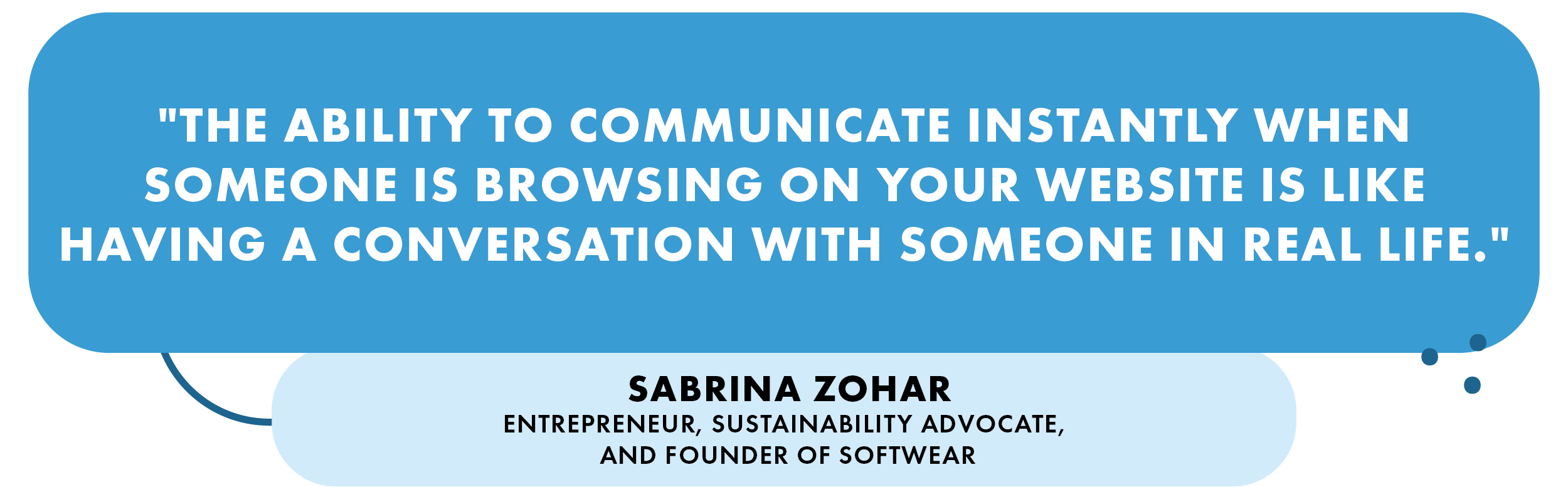
According to the small business owner, the immediacy of Messenger has been crucial to the success of her business through COVID and, ultimately, changed the way she interacts with her customers for the better. “The ability to communicate instantly when someone is browsing on your website is like having a conversation with someone in real life, except COVID locked us up and took that fun away from us,” Zohar tells Create & Cultivate. “We have mere seconds to catch someone's attention and answer that question, which could be what closes the sale—you can't lose that opportunity.”
Here, Zohar shares how she’s using Messenger to cultivate deeper relationships with her customers amid the pandemic, why it was the right platform for her business, and how she’s keeping up with the influx of messages and DMs during COVID.
CREATE & CULTIVATE: What are some of the factors you considered when choosing the best platform to communicate with your customers, and why was Messenger the right fit for your business?
SABRINA ZOHAR: Accessibility, ease, and immediacy of the platform. It's 2020—everyone we know and their mothers (literally) have Facebook. Instead of making my client acclimate to a new way of doing things, I am meeting them where they are with something they are familiar with and comfortable using. Facebook pops up instantly on my phone and within seconds I’m having a full conversation with someone.
Have you seen a positive impact on your business as a result of using Messenger?
10,000%, yes. During COVID, I was tie-dyeing for 12 hours a day, packing orders, moving the factory into my apartment, and planning for a future collection with the hopes this would all work out. Having Messenger allowed me to chat with clients all over the world who had questions or wanted help ordering. It allowed me to create a relationship with my customers and a dialogue I think so many of us have missed.
What are some of the most common customer questions you receive through Messenger and how has your ability to answer them quickly boosted your business?
Sizing is probably the most popular question, but during COVID, I got lots of questions about the custom tie-dye! Softwear products can be specific with fit and sizing, so being able to give a quick answer and help the client understand, leads to their satisfaction and, ultimately, a sale on my end. The questions evolve as the seasons pass, but the ability to answer instantly allows the boost in business to continue.
Have you experienced customers asking questions via Messenger leading to sales? If so, what percentage of engagements would you say are converting?
Absolutely! I have seen almost 65% of the clients I speak to on Messenger become customers. The best part? We also become friends! I’m able to chat with them anytime and we develop a rapport, I love it.
What advice can you share on how to keep up with the influx of messages and DMs during this period?
Get it done. If you have an influx of messages and DMs, that means you’re doing something right, that's something you should be stoked about! The more eyeballs on your website, product, social the more sales and growth you’ll see. I answer instantly because I know a sense of urgency ultimately yields the best results.
Are there any Messenger tools or features that have helped you better manage this increased volume? What tips and tricks can you share?
I have Messenger alerts on my phone which makes it really easy and efficient to reply quickly. Having the alert allows me to be immediate in responding, which is what will ensure you’re giving the best customer service possible.
How have you approached marketing and messaging to resonate with consumers but also sell products and keep your business alive during COVID?
I am super transparent and honest with everyone that follows either my personal Instagram or the Softwear IG page. I believe that being authentic with your audience will resonate versus pretending to be something you’re not. I struggled over COVID and I didn’t hide that from anyone because, guess what, we all struggled. I made videos to show how I was pivoting and really let everyone into my world to help lay a brick with me on the foundation of the business.

What advice can you share for leveraging social platforms and customer service tools like Facebook, Instagram, and Messenger to help drive e-commerce sales? What learnings can you share?
Social media will change your business if you know how to utilize it. The only way to learn is to try. We have changed and tweaked so many things about the brand as a result of social media and will continue to evolve the brand that way. Instagram is a free look book that is direct to the consumer, utilize that. Put your chat front and center so that guests learn to interact with the chat and truly utilize every aspect of what Facebook is offering.
What advice can you share for fellow small business owners on building strong customer relationships virtually?
Be real. That's it, honestly. Just be real. Being authentic and warm with your clients shows how much you care. I always say, “If you own a piece of Softwear, you have a piece of me,” and that follows through beyond just wearing our hoodie. I handwrite thank you cards for all orders. Is it sustainable in the long run? No, but right now, I’m building a brand, so I have to go above and beyond while I still can do those things. It will change your relationships since virtual is all we have right now.
How do you ensure that your consumers feel seen and heard and what advice can you share for how small biz owners can replicate your success?
I answer every email/DM/inquiry to ensure everyone feels like they're important because they are! There is nothing worse than reaching out to a brand just to get a generic email that goes unanswered or a customer service rep that repeats the same thing over and over after a two-hour wait on hold. This is your business, and no one knows your business like you do. Make sure you’re there for your customers and offer that knowledge.
How is COVID driving innovation in customer communication and what are your predictions for the future of the space?
It’s no surprise that COVID has changed the way things will be for a long period of time. Things we became accustomed to are shuttering and it is paving the way for new brands to rise from the ashes. I think social media and direct chats will be the new norm and offer even more immediacy than email. Every day, we as consumers, grow more impatient and want immediacy (remember dial-up modems?) Now more than ever, and with so much competition, you have to do everything you can to stand out and offer what the bigger guys CAN'T.

Sentence Finishers:
In three words, customer communication is…
Immediate, authentic, helpful.
My #1 tip for small business owners is…
Crawl before you can walk and learn to ask for help. You can't do it all alone (trust me, I should know) so don't be afraid to ask for help and understand it takes time.
The best way to support small businesses right now is by…
Sounds harsh, but try to not ask for a discount. Ultimately, every dollar spent keeps the brand going and it’s all appreciated.
A fellow small business owner I admire is…
Kate Davis of Knockout NY. Kate had a dream to help women feel safe and empowered through her jewelry. She inspires me every day with her mission and perseverance.
COVID-19 has taught me…
I am stronger than I ever thought I was.
To learn more about Messenger From Facebook, head to their Marketing with Messenger page and their Business Resource Hub.
MORE ON THE BLOG

5 Strategies for Building a Business That Can Weather the Ups and Downs
#1 Don’t compromise your brand.

Photo: Courtney Jones Photography
It goes without saying, but 2020 has been a challenging year. As a business owner, there's no go-to “playbook” on how to survive a global pandemic. Our company, like many others, was impacted when much of the world went into lockdown in mid-March. When sales suddenly take a hit, it's hard not to start rethinking everything. Don’t do it. Resist the temptation. Instead, this is the time when you really need to focus on solidifying the fundamentals of your business.
Over the last decade-plus, I’ve learned a lot as a business owner and entrepreneur. COVID-19 is certainly one of the greatest challenges we’ve faced as a business. However, it’s not the first hurdle, and it definitely won’t be the last. After a challenging early spring, we’ve managed to turn the corner and are expecting a strong holiday season. We didn't press the "reset” button. Instead, we doubled down on our long-term goals. No matter what comes your way, here are a few words of advice for weathering the ups and downs and coming out stronger on the other side.
Don’t compromise your brand.
Now is not the time to completely rethink who your customers are and what your brand stands for. I personally care a lot about authenticity. Early on in the pandemic, we took the time to look back at our mission statement and brand values. We’ve allowed them to guide us through this challenging period. Leatherology’s mission is the redefine simple, everyday luxury and celebrate the everyday. What does this mean for us today? We’ve always had a large gift business and we realized more than ever, customers wanted to send meaningful gifts to loved ones far and wide. We leaned into this and created a “Gift Joy” campaign. This holiday, we’re collaborating with four partners to create unique gift sets featuring some of our most popular items. 50% of net proceeds from each sale will go to a non-profit organization of the partner’s choosing.
Diversify opportunity and risk.
Never put all your eggs in one basket. While direct-to-consumer online sales have always been core to Leatherology’s business, we consider ourselves more than just a DTC brand. Consumer shopping behaviors are constantly evolving, so we’ve challenged ourselves to think beyond just direct-to-consumer. We have invested in a variety of customer acquisition channels and diversified our marketing mix. As a business, your growth should never be solely reliant on a single channel, such as paid social advertising, where rising costs can quickly deteriorate profitability over time.
Drown out the noise.
When the going gets tough, you start looking around to see what your competitors and peers are doing. While it’s always important to have a pulse on your industry, don’t do something simply because you see others doing it. Avoid the FOMO. What works for someone else may not work for you. Even though we've seen huge demand for PPE, we resisted the urge to suddenly offer new products like facemasks when they just didn’t fit our brand strategy. We also felt that the market would be incredibly crowded and prohibit us from being a leader. Instead, we made iterative changes. We planned up inventory in our home accessories line to meet increased customer demand while scaling back our travel accessories category.
Learn from the positives to prepare for the negatives.
How you get through a downturn is largely dependent on what you do when things are going well. Don’t get carried away by great sales. Business is cyclical, and you can’t assume things will always remain on an upward trajectory. Use this time to dig into the mechanics of your business. Track everything and gather as much data as possible to help you understand why things are going well. This will also help you uncover potential blind spots and get ahead of warning signals you may not have noticed otherwise.
Take care of your people.
This is arguably my biggest piece of advice. Building a great team is the hardest but most important part of the job. Great people are the backbone of any successful business. Take the time to understand what motivates each individual and how to support them through ups and downs. Never ask them to do something that you wouldn’t do yourself. David and I are fortunate to work with an amazing and diverse team of creators, analysts, artisans, innovators, and entrepreneurs. Leatherology wouldn’t be where it is today without our team.

“How you get through a downturn is largely dependent on what you do when things are going well.”
-Rae Liu, Co-Founder and Creative Director of Leatherology
About the Author: Rae Liu is the co-founder and the creative director of Leatherology, a direct-to-consumer brand of beautifully crafted, personalizable leather accessories, built on the premise of providing attainably priced luxury. Rae graduated from Columbia with a BA in Political Science. She worked for several years at the World Bank before making a complete career pivot to pursue her passion for product design, studying accessories at FIT. in 2008 she helped Alexander Wang launch his accessories and footwear business.
During her years working in fashion, Rae was struck by the fact that as a young woman living in New York, she could not afford the very products she spent her days creating, and that the ones she could afford did not have the level of design thoughtfulness, craftsmanship or quality of materials she knew was possible. Thus in 2011, she moved from New York back to her hometown, Dallas, to build Leatherology. She lives in Dallas and has two young children.
MORE ON THE BLOG

How This Company Is Turning Downloads to Dollars and Making Podcasters Bank
It’s all about growing your listenership and building an engaged audience.


It’s safe to say podcasts are here to stay. As of November 2020, there are over 1 million active podcasts and more than 30 million podcast episodes available in more than 100 different languages across Apple Podcasts, Spotify, Stitcher, and more. But despite the stiff competition, when done right, podcasting can become a very lucrative side hustle that allows you to pursue your passion while making a profit.
So what’s the secret to turning podcast downloads into dollars and cents? According to Lizzy Pollott, the Global VP of Brand at Acast and the host of the TV and film podcast, “After School Culture Club,” it’s all about growing your listenership and building an engaged audience. “The creators who flourish the fastest are those who enter podcasting with the right attitude and a real love of their subject area,” she tells Create & Cultivate. “If you’re looking to create a passion project, or find and share your voice around something you really care about, or simply want a creative outlet, then you’re in the right place. If you build it, they will come!”
Ahead, Pollott fills us in on what it takes to stand out from the competition, why 25 minutes is the ideal episode length for newcomers to the medium, and how to turn a podcast into a revenue stream by leveraging Acast and the platform’s new partnership with Patreon.
CREATE & CULTIVATE: Why did you choose to launch a podcast side-hustle in addition to your career as Global VP of Brand at ACAST?
LIZZY POLLOTT: As a complete podcast addict (and fan of talking), I had always had ideas for podcasts I’d like to make but until I joined Acast nearly three years ago, I didn’t really know where to start. As soon as my eyes were opened to all the behind-the-scenes magic that Acast puts into podcasting, I decided I’d jump in feet first. The origin story sounds like something from a Kate Hudson rom-com from the 2000s. I had been struggling to map out an idea for my podcast and it came to me like a vision during the “find yourself” track in a candle-lit spin class… who do I think I am?
What are the first steps people should take when mapping out a podcast strategy and what are the most common things people often overlook?
It might sound obvious, but the very first thing to nail is your idea. “Shooting the breeze with my friends” simply won’t cut it unless you actually are, say, Chrissy Teigen. Reports show that there are more than 1.5 million podcasts out there in the world today. You need a hook, a reason why people should listen to yours above all others, and therefore an easy one-line way to sell it and draw people in.
For example, the hit show “Forever 35” talks about being “a podcast about the things we do to take care of ourselves. We’re not experts but we are two friends who like to talk about serums.” Or the brilliant “90 Day Gays:” “Jake Anthony and Matt Marr are two Southern Queens who absolutely love TLC's 90 Day Fiancé. If you've been looking for your gay BFFs to dish this show… well, you're welcome.”
The second is, then, thinking hard about—and testing—a format. Each episode needs a regular and familiar shape. Podcast listeners are creatures of habit and look forward to a regular format each week. So again, rather than thinking, “OK we’ll just talk for half an hour each week and see how it goes,” think about how you might put features, or a structure into it; the same three questions you address each week, or listener feedback, and so on.

Can you share some mistakes you made in those early stages that our audience can learn from today?
Building an engaged audience for your podcast takes time and dedication. There is no silver bullet to grow your listenership, and more often than not, it’s a mix of many different strategies that will help build up those numbers. I certainly had the opposite attitude when I started, “Well, I’ve done all the hard work and this thing is live so come listen everyone!” But it takes regular grinding, thinking about promotion on social, doing your own PR, networking with other like-minded podcasts for guest swaps, and so on.
What advice can you share for newcomers to the podcast medium who want to stand out from the competition? Are there any holes in the marketplace? What content is the podcast space missing? Where can you fit in?
The good news is that podcast listening is booming. More and more people are turning to podcasts (especially during the pandemic) as a source of education, entertainment, or distraction. And with that comes even more opportunity for new podcasts to find their voice, and create shows which speak to an even broader section of society.
What’s even more exciting is we’re seeing new formats being born and becoming really popular. Scripted audio is one, essentially an audio drama, comedy, or similar in podcast form. And there’s no doubt that as the pressures of 2020 have hit home, people are turning more and more to wellness shows with things like guided meditation becoming a rich vein of content. But the best advice we can give is: find a genre that you really care about, and it will be far easier to create a show you’re proud of.
What’s your advice on podcast length? Is there a magic number that works best?
For a new podcast, we would always recommend that shorter is better. If people are going to invest time in trying out a new show, you want to give them something manageable they can easily get into. Generally, around 25 minutes would be a great starting point. It’s long enough to make something fully fleshed out for people to get into but not so long that you risk losing them too early in your podcast journey. This will also of course depend on the format of your podcast which might actually dictate that you need to start at a bit of a shorter (or longer) length. Editing is your friend. Podcasts should be as long as they need to be, and no longer, so be self-critical when editing and be mindful of making the best use of your listeners' valuable time.

What are some tools that both newcomers and podcasting pros alike can use to generate income?
There are two core ways that people make money from podcasts. One is becoming part of an ad monetization marketplace, just like the one we have at Acast which is now open to creators of all sizes. Here, you’ll have audio ads placed in and around your show, which in turn translate into revenue for you. It sounds obvious, but the bigger your listenership, the more money your show will be likely to generate. Then, once your podcast becomes really established, you might start working with sponsors too, who will pay for live read-style endorsements from you as hosts.
Another way is through membership-led platforms. Podcasts are, of course, free to listen to, but loyal listeners will want to pay for exclusive and additional content, not least because they recognize the time and care that goes into creating it. Patreon is the leading light in this area, giving you the ability to offer exclusive content (and much more) to paying subscribers (“patrons”). We have just launched a brilliant partnership with Patreon which makes it easier than ever to create and share both private and public podcasts with your fans—across every podcast player and app.
What tips and tricks can you share on how to monetize a podcast?
The most valuable advice we can give is to focus first on building up your audience. Once you have loyal listeners, ready to become paid-up members of your show, you can look at starting, say, a Patreon. And then once you reach a significant size of listenership, that can eventually lead to ad revenue.
How did you find brand partners to come on board and advertise on the podcast?
If you join Acast, you will be given the option to join our Marketplace, and this pretty much does all the work for you. We have teams dedicated to bringing advertisers into the Marketplace, and connecting them with suitable shows to run campaigns across. Bear in mind, though, that it might take time to start to see ad revenue come through for your show, again, the more listeners you build up, the more likely that will be.

Be honest, how much work is it to plan, produce, and launch a podcast every week? Tell us about the hustle behind the scenes.
I won’t lie: it takes real dedication and commitment! Putting the effort into firstly getting your show ready for launch, then producing it each week, recording it, editing it, publishing it, and then marketing it can turn into a real full-time side-hustle. Everyone will be slightly different, and the actual time spent making it will also depend on the format of your show.
For example, my TV and film podcast, “After School Culture Club,” relies on watching a film or show first, to talk about. Then the research might be another hour, actual recording another hour, editing nearer 90 minutes, and then marketing can be as much effort as you’re willing to put in. Like any passion project or side hustle, you have to put the hours in to see a return. But if you’ve chosen something you truly love then that won’t matter.
What tools and resources do you rely on to streamline the process? Are there any automated solutions that make your life easier?
I use the free editing software Audacity to edit; it’s simple to use and does the job. My favorite find to make life easy is Levelator, a free program that instantly evens out the volume of your audio which is massively helpful if, say, one person on your show tends to be louder than the other. (Don’t tell my current co-host, my sister, but it’s her.)
On the promotion front, tools like Headliner and our own Snipper tool allow you to quickly and easily make “audiograms,” short videos for social which clip up and make pretty videos from your episodes to encourage people to listen.
Can a podcast’s success helped your brand in other ways? Can you share what and why?
We work with thousands of podcasters at Acast who are creators in other areas at the same time, and often their podcasts really help strengthen their other endeavors, and vice versa. We find, for example, that podcasts make great marketing tools for authors when launching new books. Other examples include people like Nike running coach (and my running coach!) Cory Wharton-Malcolm who launched his podcast “The Tub Hub” on Acast during lockdown, which offers him the chance to connect with his audience on a different level to just exercise each week, as he goes deep into topics including mental health and race with a whole range of inspiring guests.
Anything else to add?
At Acast, we tend to find the creators who flourish the fastest are those who enter podcasting with the right attitude and a real love of their subject area. Birthing a podcast takes time and effort; growing an engaged audience even more so. If you’re thinking of starting simply as a way of generating cash, then you might wind up being disappointed. But if you’re looking to create a passion project, or find and share your voice around something you really care about, or simply want a creative outlet, then you’re in the right place. If you build it, they will come!
Learn more about Acast at Acast.com, and use the code "C&C" for six months free.
MORE ON THE BLOG

This Clean Beauty Founder Is Using Live Chat to Drive Sales During the Pandemic (and It's Working)
Here’s how you can too.


When it comes to providing great customer support in the midst of COVID, live chat is an indispensable tool to have at your disposal. By providing instant answers to customer inquiries, live chat boosts those all-important conversion rates and, in turn, increases revenue. In fact, a study found that more than 60% of consumers would return to a website offering live chat. Something that small business owner Gianne Doherty knows from experience. By using Messenger from Facebook, she’s successfully been turning customer inquiries into dollars and cents during the coronavirus pandemic.
In fact, the co-founder of the clean beauty brand Organic Bath Co. has seen the tactic work so well that she’s positioning it as a key strategy for continuing its rapid growth. “Skincare products are very sensory,” Doherty tells Create & Cultivate. “Being able to answer customer questions in real-time makes a difference when it comes to customer service, which improves both sales and brand loyalty,” she explains. “We typically convert over 50% of customers who reach out to us because we are able to answer their questions and create a great experience for them.”
Scroll on to learn more about how she’s using Messenger From Facebook to boost her business during COVID and beyond—and how you can too.
CREATE & CULTIVATE: What are some of the factors you considered when choosing the best platform to communicate with your customers, and why was Messenger the right fit for your business?
GIANE DOHERTY: We need to be where our customers are. Nearly all of our customers have Facebook accounts, so it’s a platform they are familiar with. It allows people to connect with us in a seamless way.
Have you seen a positive impact on your business as a result of using Messenger?
Using Messenger has allowed us to incorporate the element of speed into our customer service, which allows for better communication and a better customer experience.
What are some of the most common customer questions you receive through Messenger and how has your ability to answer them quickly boosted your business?
We use Messenger’s Chat Plugin on our website to answer a wide variety of customer questions, from questions about the products themselves to questions about orders that have already been placed. The ability to answer customer questions quickly allows us to answer pre-sale questions and helps us to provide a great customer experience.

Have you experienced customers asking questions via Messenger leading to sales? If so, what percentage of engagements would you say are converting?
Yes. When someone has a question about a product when they are already on your website looking to buy, being able to answer those questions immediately will have a positive impact on the customer experience and lead to more sales. We typically convert over 50% of customers who reach out to us because we are able to answer their questions and create a great experience for them.
What advice can you share on how to keep up with the influx of messages and DMs during this period?
Create a template for your most commonly asked questions. Also, take a deep look at the commonly asked questions. Do your product descriptions need to be updated? Do your FAQs need to be updated? Is there somewhere on your company website that needs improvement to minimize the amount or types of questions being asked?
Are there any Messenger tools or features that have helped you better manage this increased volume? What tips and tricks can you share?
The ability to integrate Messenger into other tools where we can use saved responses for commonly asked questions has been incredibly helpful. Messenger integrates with so many other tools to make it easier to manage communication in one place.
How have you approached marketing and messaging to resonate with consumers but also sell products and keep your business alive during COVID?
We are in a fortunate position to be selling products that people really need during this difficult time such as hand soap and hand sanitizer. We have made giving back an important part of our business and have donated products to organizations in need.

What advice can you share for leveraging social platforms and customer service tools like Facebook, Instagram, and Messenger to help drive e-commerce sales? What learnings can you share?
Lean in to what makes you different and unique. With the pandemic, more people than ever are online and online shopping. Your uniqueness is what will make you stand out in a sea of many many options. Answering customer inquiries quickly can be a key differentiating factor between your brand and others.
What advice can you share for fellow small business owners on building strong customer relationships virtually?
Customer service is everything. Customers want to know someone real is behind the brand. Communicating early on and effectively will make a difference to your bottom line.
How do you ensure that your consumers feel seen and heard and what advice can you share for how small biz owners can replicate your success?
Reply to every person who reaches out. When someone has a problem and you don’t respond, you will likely lose that customer. If you fix their problem, it gives you the opportunity to create loyalty. Respond, and respond with empathy.
How is COVID driving innovation in customer communication and what are your predictions for the future of the space?
COVID has pushed more and more communication online. Being accessible and approachable through platforms that people are already using will be vital to success in the future. We are going to see more ways for brands and customers to interact online from text-based messaging to audio and video solutions.

Sentence Finishers:
In 3 words, customer communication is…
Vital for creating trust and brand loyalty.
My #1 tip for small business owners is…
Over-communicate with your customers.
The best way to support small businesses right now is by…
Voting with your dollars and purchasing from small businesses you believe in.
A fellow small business owner I admire is…
Heather C. White from TRILLFIT. She is doing great things with TRILLFIT and making the fitness industry more inclusive and diverse.
COVID-19 has taught me…
To be flexible.
To learn more about Messenger From Facebook, head to their Marketing with Messenger page and their Business Resource Hub.
MORE ON THE BLOG

4 Ways Failure Led Me to Become a Solopreneur
When wrong turns ultimately lead to the right path.

“Had I ‘succeeded’ in my past endeavors, I’d probably be sitting in a corporate office racking my brain over some superfluous comment my boss made in our morning meeting.”
-Sarah Lempa, Writer, Entrepreneur, and Creative Media Strategist
I used to crack jokes about being the black sheep of my business school in college. Mingling with corporate recruiters, relentless internship hunting, networking events that were more awkward than an eighth-grade dance—none of them were quite my forte. “What am I even doing here?” I’d ask friends with a sheepish grin, in between classes where I wrestled to keep my focus. Under the jokes, however, there was a gnawing fear that I wasn’t good enough.
Me and failure? Oh, yeah. We go way back.
We’re old pals, really. Between wiping tears on the sleeve of my Ann Taylor suit (that I loathed) after career fairs and feeling like I got punched after yet another job rejection, we’ve gotten to know each other painfully well. What I didn’t know back then was that failure had a secret agenda the entire time: To align me in a direction congruent with who I really am.
Two-and-a-half years, one self-designed career, and 40+ countries later, I couldn’t be more grateful for my so-called failures. Without them, I’d probably still be taking lunch break naps in my car at an office job. Here’s how each blunder and botch catapulted me into becoming a solopreneur.
1. Each rejection prodded me to try something new.
Early in college, I chased big-name corporate internships. I never received a single offer. Taking everything far too personally at age 19, I’d stew in the sullen sting of failure, agonizing over why I didn’t make the cut.
After moving on to pursue advertising agencies, I was beside myself that I had ever attempted working in corporate America. My personality wasn’t suited for a “normal” office, I thought. I should work somewhere with colorful bean bag chairs, a place where people swear in their emails, I convinced myself. While it was comparatively better, the agency world offered little improvement when it came to freedom. Not even all of the Friday office beers in the world could make up for that. As fate would have it, none of my job prospects materialized anyway.
With each perceived screw-up, I gained insights about what would actually make me happy. It wasn’t freedom within the office—it was freedom from the office. I wanted to travel the world like a crazy vagabond, not spend 97% of the year daydreaming of a meager 10-day vacation. That revelation was scarier than any rejection, as I knew it would be much harder to achieve.
2. I learned exactly what I didn’t want for my career—much faster.
A fancy name tag, gargantuan skyscraper office views, glossy high heels that echoed in hallways... I used to think I needed these things to be successful. It turns out that was only what other people around me wanted at the time. Failure bopped me on the head like a Whack-A-Mole, time and time again, saying you don’t want any of that anyway. I lusted after their approval, mirroring others’ dreams that weren’t suited for me. I can only imagine how much longer this realization would have taken had I not gotten turned down from the start.
In a last-ditch effort to get a job that provided some semblance of freedom, I applied to be a flight attendant. I wanted to try freelancing while flying for a living, hoping I could figure out self-employment while on-the-go. I made it to the third round of the interview process and never got a callback. I sobbed at the news, thinking I had officially lost all chance at freedom in my career. Little did I know that crushing letdown would later lead me to take a leap into freelancing full-time, something I’d later look back on with immense gratitude.

“I wanted to travel the world like a crazy vagabond, not spend 97% of the year daydreaming of a meager 10-day vacation.”
-Sarah Lempa, Writer, Entrepreneur, and Creative Media Strategist
3. It made me a more resilient and courageous person.
Reminiscent of first heartbreak, those initial flops in your professional life can leave you feeling like you got dumped on Valentine’s Day. To make matters even worse, there probably isn’t any leftover chocolate laying around either. I used to put so much emotional stock into each application, meeting, and interview — forming lofty attachments that would only come back to bite me. As the years passed, I eventually learned to peel myself out of the pity zone a bit faster.
Don’t get me wrong: Sometimes I still feel heart-sinking pangs of disappointment when things don’t go how I’d like. I’m only human, after all. The difference nowadays is that mishaps feel less apocalyptic; resilience has taken the stage. I started to accept (and even embrace) the unknown. Risk-taking became commonplace when I realized I wouldn’t get high rewards by staying comfortable. Failure is the devious cousin of risk, and you have to invite ‘em both unless you want your party to be painfully boring.
4. Without other options, failure forced me to try that one “crazy idea.”
Jobless as a fresh graduate, I couldn’t find a single reason to hold back. Without these bumps in the road, I would’ve never hopped on a one-way flight to Vietnam in pursuit of building my own location-independent career. I would have never felt the goosebump-raising thrill of building something that felt so authentically me in all ways. And I certainly wouldn’t have been able to manage the tumultuous roller coaster that comes with paving your own way as a solopreneur.
Had I “succeeded” in my past endeavors, I’d probably be sitting in a corporate office racking my brain over some superfluous comment my boss made in our morning meeting.
Like a friend dishing out tough love after a breakup, failure yanked my hand and swung me exactly where I needed to be. And while we’ve come a long way, this is a lifelong journey.

Photo: Courtesy of Sarah Lempa
About the Author: Sarah Lempa is a writer, entrepreneur, and creative media strategist covering the joys (and challenges) of freelancing, travel, and solopreneurship. Her work has appeared in Business Insider, Fodor’s, and SUITCASE Magazine, among others. Currently based in Indonesia, she’s called multiple countries home and has ventured across 6 continents along the way. When she’s not chipping away at a piece, you’ll find her jamming out to groovy beats or riding a motorcycle. Keep up with her on Instagram @travelempa.
MORE ON THE BLOG

How I Found the Courage to Quit Stable, Prestigious Careers to Become a Founder at the Age of 29
And my advice if you think you should, too.

“Starting a business is scary. It affects every part of your life. People think you’re crazy, and they’re kind of right.”
-Isharna Walsh, Founder and CEO of Coral
Are you thinking about starting your own business? Do you have a little voice in your head that whispers ideas and dreams about things you want to create? Are you unsure whether you should listen to that voice?
I had that voice, too, and for the longest time didn’t know what to do with it.
As a half South Asian woman, I was raised to get straight A’s, stay out of trouble, go to a prestigious school, and forge a stable career. I followed the rules, getting law and economics degrees, and spending my twenties working in government, management consulting, technology, and venture capital. Then, just before my thirtieth birthday, I quit my job without a safety net to start my company, Coral, which helps people improve their sexual well-being. (Can you imagine what my mother said?).
There’s lots of advice out there about whether or not to take a risk and run headfirst at a business idea, and the truth is that nobody can answer that for you. But looking back now, I can see two things clearly: The time I spent trying on different careers and identities taught me valuable lessons. It wasn’t wasted. Yet it’s also true that these highly demanding, great-on-paper work experiences were my way of stepping right up to the edge of what I really wanted to do before I found the conviction to close my eyes and jump.
Starting a business is scary. It affects every part of your life. People think you’re crazy, and they’re kind of right. It threatens your finances, your mental health, and your career trajectory. You’ll face judgment from your parents, your friends, prospective partners, investors, and strangers who read about you on the internet. And it’s more likely than not that your business will fail.

Stepping into that vulnerable space—and being comfortable there—is especially difficult if you haven’t been conditioned to embrace fear, and don’t have a model that looks like you. As a woman, I hadn’t been groomed in resilience since my first crush rejected me in the schoolyard, like my male classmates. I’d also rarely personally encountered women in positions of leadership, and had never had a female boss. Successful entrepreneurs, in my mind, were either men or celebrities—people who look and act nothing like me.
So what gave me the confidence to go for it? I had to create the space to acknowledge and examine that knowing inside of me, rather than drowning it out with distractions.
For me, this took meditation and introspection. I sat with my self-doubts and learned the subtle distinction between self-preserving fear and self-limiting fear. I let myself acknowledge the knowing that told me entrepreneurship was my path and identified the narratives that held me back as self-limiting and socially constructed, rather than real obstacles. (And in the meantime, I used my jobs as crash courses in high-growth startups, technology development, and the dynamics of venture-funded businesses until I found the business idea I couldn’t ignore).
So when the idea for Coral came, this time the voice in my head was so strong that not doing it felt harder than giving it my all.
If you’re considering whether entrepreneurship is the right path for you, spend time with yourself, in the quiet. Journal, meditate, go for walks, turn inward. Acknowledge the hurdles, personal and societal, and how they might be affecting you. Think through whether you have the self-belief, resilience, and determination to back yourself and push your idea forward through the obstacles—because it’s not easy, and you will want to give up.
When you stop and ask yourself what you want to create with your one short life, chances are that voice will shout.
And you’ll know what you have to do.
About the Author: Isharna Walsh is the founder and CEO of Coral, a sexual wellness app that offers evidence-based guides to better sex for all humans. Born in Sri Lanka and raised in Australia, Isharna worked for the Australian Prime Minister, Boston Consulting Group, and a Los Angeles VC firm before turning 30. After realizing that nothing that is so essential to our health and happiness is as neglected as sex and sexuality, she raised $3 million in seed funding to launch Coral in November of 2019. One year later, Coral is a sexual wellness pioneer that’s helped hundreds of thousands of people create their best sex lives.
MORE ON THE BLOG

How This Female Veteran Used Her Military Training to Build a Multi-Million Dollar Company
From an Air Force pilot to a health and wellness industry disruptor.

“As a combat-trained pilot, I am always thinking, ‘Miles ahead of the jet.’”
—Riley Rees, U.S. Air Force Officer and Founder of Sofia Health
I served in the Air Force both as an enlisted Aeromedical Evacuation Technician and an Officer turned C-17 pilot before launching Sofia Health, an online health and wellness platform.
The military isn’t the first place that most people think of for entrepreneurial training, but as it turns out, this experience provided an elite and unique education that has provided core fundamentals I still use every day. The military has a proven track record of teaching leadership, strategic planning, creative problem-solving, task execution, and resiliency—all traits that are essential to running a business or building a startup.
Below, I’m sharing three major takeaways that helped me and can be translated to help any entrepreneur as they startup.
Takeaway #1: Prepare
Gather data, make decisions, be strategic.
In a startup, you are building a solution to a problem and you are in search of a scalable business model. There is no checklist that can guarantee success. Even if you have been successful in the past, when you start a new company, you are in uncharted territory. This can truly be scary when you are spending your valuable time, energy, and money.
But in order to be as successful as possible, do your homework and be prepared. You need to understand the environment into which you are trying to build, do your market research, and understand your customers' problems intimately.
As a combat-trained pilot, I am always thinking, “Miles ahead of the jet.” You need to know where you are, what your capabilities are, and be able to handle any threats that may or may not happen. As an Aircraft Commander on the C-17, I was responsible for flying into combat zones. People’s lives were in my hands. We could spend days planning for one single moment.
In the early stages of a startup, you need to do the same planning. It’s necessary to gather as much information as possible on users, the problem you are solving, the market, investors, competitors, and potential partners. This information and preparation serves as your foundation and will help guide your strategy and execution.
As a flying target, I needed to be ready to handle any situation inside or outside my jet. The key in any of these situations is preparation. We know that no matter what situation we are in, we are prepared to handle it.

Takeaway #2: Collaborate
To achieve a specific objective, it takes a team of people willing to give their best effort in alignment with the mission.
Military leaders are effectively running companies. You might have five people below you as a new Lieutenant and thousands as you progress in your career. This exposure to leadership inherently teaches you how to take a group of individuals with a diverse range of backgrounds and turn them into an effective unit.
When you launch a startup, one of the first things you can do before you bring on any members is to establish your mission statement. This sets the direction for your company and helps create cohesion. Even in the beginning, this ensures every member of your team, from volunteers to employees, understands your company’s objectives, goals, and values.
This simple task creates unity and helps each team member understand how they can contribute for maximum impact. You’ll find that your mission statement significantly increases teamwork, progress, and can even help ensure you hire people who are aligned with your core values.
Overall, establishing your mission statement will produce huge dividends for your company.
Takeaway #3: Persevere
Entrepreneurship is not for the faint of heart.
Entrepreneurship requires unparalleled discipline, persistence despite challenges, and a special mental toughness that allows you to move from one failure to the next with positive, determined enthusiasm.
The military cultivates leaders who have the confidence to take risks. You are consistently pushed out of your comfort zone and develop a unique mental and physical toughness. Failure is not an option. Instead, you learn to figure it out. You become a disciplined, innate problem solver who is comfortable being “uncomfortable.”
When you launch a startup, you are going to face challenges. Every customer or user will not love your company and your alpha or beta product may not be the prettiest. The entire experience can be uncomfortable, but this is one of the most incredible learning experiences you can have.
To help overcome this, adopt a growth mindset, and keep going. Every single day you will be making astronomical progress, so don’t let any of the challenges get you down! The key to success is perseverance. As Wayne Gretzky has said, “You miss 100 percent of the shots you don’t take.”
About the Author: Riley Rees is a U.S. Air Force Officer. Soloing in an airplane before she was 18, she has flown a wide variety of civilian aircraft. She has flown the T-6, T-1, and the C-17 for the Air Force and most recently the B-757, B-767, B-777 for United Airlines. In 2019, with a mission of making holistic health and wellness care more accessible, Riley founded Sofia Health, an online platform making it easy to find, book, and connect to holistic health and wellness practitioners.
MORE ON THE BLOG

My Business Wouldn't Exist If I Hadn't Been Diagnosed With Breast Cancer
Well Told Health’s founder on discovering her resilience.

Photo: Courtesy of Monica Ruffo
We often make ourselves smaller than we are because it somehow feels safer. Maybe we’re afraid of being considered too ambitious or too confident. Maybe being strong doesn’t fit into a social construct of who we think we should be. Or maybe we’ve been belittled or not taken seriously in the past and playing small somehow feels right. Whatever the reason, can you imagine what a better place the world would be if we all came out from hiding and played to our full strength instead of hiding behind it?
A few years ago, I underwent treatment for an aggressive form of breast cancer. From the moment I heard the diagnosis—that very scary “C” word—I decided that it would not crush me, that I would thrive through the treatment, and that something extraordinary would come of it. I advocated for myself every step of the way and got second and third opinions for every option. I even researched a treatment that allowed me to keep all my hair through all 12 rounds of chemotherapy. I advocated to make this treatment available to myself, and then, eventually, for others at the hospital where I was treated.
This made a huge difference in my journey with cancer and allowed me to maintain some form of normalcy for myself and for my children. It also allowed me to keep my cancer private as I continued to work throughout those 18 months without telling anyone that I was sick. I also insisted on undergoing over 100 high-dose vitamin C infusions during that same time period, which I’m convinced helped me mitigate the side effects of both the chemo and the radiation. This too, I had to advocate for.
During this time, I started questioning everything that I was putting into my body, which is when I discovered that I couldn’t find 100% plant-based clean supplements or remedies. Ultimately, something extraordinary did come out of my breast cancer as Well Told Health was born out of that revelation.
Perhaps, because I felt backed into a corner at that time and had no choice but to step up, I tapped into my deepest strength. I discovered a well of inner power and resilience that I didn’t know I had. But the truth of it is that the inner power and resilience were always there, they were just concealed behind carefully constructed walls I had built around myself. While I’ve had many hurdles to overcome and triumphs to be proud of before that, it took my breast cancer journey for me to finally be willing to harness my strength and nurture it, and especially, to use it and love myself for it.
That was several years ago, and the incredible irony of embracing my strength is that it has made me feel so much more vulnerable today than I have ever felt before.
Yes, this has been very scary at times. But I think we often avoid tapping into our full strength because if we don’t put it all on the line, then technically, we can’t really fail, and perhaps—even more critically—we can’t get hurt. It’s hard work, but I no longer want to let myself hide inside a smaller version of myself. As Marianne Williamson famously said, “Our deepest fear is not that we are inadequate. Our deepest fear is that we are powerful beyond measure. It is our light, not our darkness, that most frightens us.”
Every day, I now work on putting all of myself out there, stepping outside of my comfort zone, voicing my opinions, and using every inner tool at my disposal. I won’t lie, it’s hard. And there’s no secret formula.
Some days, I feel like I truly have a magic wand because of it. Other days, I feel like I can’t seem to make things happen. But I have learned to take it in stride, let things go, and forgive myself through daily meditation and expressions of gratitude for everything around me including myself. That last part has been a real eye-opener, as being grateful for myself, my own gifts, and (the hardest of all) forgiving myself, were not things I had really considered before. The simple practice of daily self-gratitude and forgiveness has had a huge impact on my trajectory.
Today, I am determined to let my light shine through and not let anyone else decide what I can and can’t do or who I am. I will no longer live in fear of my strength. I’ll leave the fear of my strength to others.

“The incredible irony of embracing my strength is that it has made me feel so much more vulnerable today than I have ever felt before.”
Monica Ruffo, Founder of Well Told Health
About the Author: Monica Ruffo is a serial entrepreneur and award-winning leader with a long-standing passion for health and wellness. Unable to find 100% clean supplements after being diagnosed with breast cancer, Monica set out to create a modern source for natural supplements made with organic botanicals and nothing else.
MORE ON THE BLOG

We Talked to 5 Small Biz Owners About How They're Pivoting, Repositioning, and Resetting During COVID
“It’s all about your mindset.”


Photo: Smith House Photo
If there’s one word we’ve heard over and over again this year, it’s pivot.
When COVID-19 hit, small businesses were challenged to throw out the playbook and think outside the box, whether that meant pivoting to digital, driving sales through social media, or partnering with other small businesses in order to thrive.
Seven months later—with brick-and-mortar locations still temporarily closed and in-person events continuing to be canceled or postponed—it’s just as important as ever for small businesses to re-evaluate their business models, reposition their brands, and restrategize their revenue streams.
At our recent Small Business Summit presented by Mastercard, Ginger Siegel, the North America Small Business Lead at Mastercard, hosted a thoughtful discussion on how small businesses can pivot during COVID and beyond with Mattie James, the influencer behind MattieJames.com, Sonja Rasula, the founder of Care Package and Unique Markets, Marissa Hermer, the owner of Olivetta and The Draycott, Jess Rona, an actress, comedian, and the founder of Jess Rona Grooming, and Patty Delgado, the CEO of Hija de tu Madre.
Scroll on to find out how these five powerhouse entrepreneurs are skillfully navigating this unprecedented period and optimistically starting to plan for the “new normal” post-pandemic.
On experiencing COVID-induced delays or disappointments…
“We are all human beings, and we have ups and downs, and I think all of us entrepreneurs have to be gentle and kind with ourselves.” -Jess Rona
“It’s all about your mindset as a business owner.” -Jess Rona
On practicing self-care and staying positive…
“I focus on meditation and self-care because when you’re good, you can handle anything.” -Jess Rona
“When I focus on the things that I do have, even if they’re teeny tiny, that is the real pivoting for me. The pivoting is actively being a puppeteer with your thoughts and pivoting into a positive mindset.” -Jess Rona
On being a DTC business in the current COVID climate…
“COVID has really pushed us to be more responsible for our own in-house production.” -Patty Delgado
“I’m really listening to the needs of my customers and adapting our business model, and all-around business decisions, based around the current climate.” -Patty Delgado
On owning and operating a restaurant during COVID…
“It’s not just about health and safety, but trust in us—in any business.” -Marissa Hermer
“We’re just not a restaurant. We’re a face and a family, and we care.” -Marissa Hermer
On pivoting to digital during COVID…
“We cultivated our community online.” -Sonja Rasula
“I truly am a fan of email marketing, so we really cultivated our email list because those are people who have given us something of value. They have given us their email address.” -Sonja Rasula
“We started talking to our email list a lot more and we are going to have a very specific plan for holiday months.” -Sonja Rasula
On pressing pause and looking ahead…
“For the last month or two, I did take a pause on doing as many things virtually.” -Sonja Rasula
“For me, I pressed pause, so that I could really focus on what the business could look like in 2021 and start to put things into place for that.” -Sonja Rasula
On changing your content strategy as an influencer…
“I noticed that all we really had to shift our story and talk about home life.” -Mattie James
“I had to be really careful that I was authentic to my story and being truthful, first and foremost, but then make sure that anything I told my audience, whether it was organic content about what I’m currently doing or even in partnership with a brand, that I was really speaking to home life.” -Mattie James
“It was really important to me to make sure that I even pivoted the language I used day to day.” -Mattie James
On launching online business courses…
“So many more people want to take online courses, want an online masterclass. Again, they are making that space to learn because people are a little bit more still right now.” -Mattie James
On making cybersecurity a priority…
“I’ve been really active in making sure that I’m paying attention to little things like my passwords.” -Mattie James
“We definitely do spend a lot of time working with the best third parties to ensure our customer and business safety.” -Patty Delgado
On supporting small businesses during this time…
“The whole idea behind Unique Markets was to feature and support small and independent businesses—designers, artists, makers—who are usually bootstrapped, independent, and own their businesses. And because we can no longer do that, I thought about how I could support all of these small businesses in a virtual space.” -Sonja Rasula
“So, I came up with this idea. My mom sends me care packages. No joke, I am a woman in my 40s, y’all, and my mom sends me care packages filled with random stuff, but it’s the thought that counts.” -Sonja Rasula
“I could take all these small businesses that I support and love and put them into a box.”-Sonja Rasula
“The idea is that everything in these care packages is curated by me or small independent businesses.” -Sonja Rasula
“This year it became very clear to me that I wanted to really help all of my fellow female founders, women-owned businesses and BIPOC businesses.” -Sonja Rasula
“Over 75% of the brands that are in all of the boxes are minority-owned or female-owned.” -Sonja Rasula
On paying it forward in the midst of the pandemic…
“It’s been the silver lining to this pandemic for me and our teams to know that we are facilitating and have created a platform for people to give back to the heroes and front line workers.” -Marissa Hermer
“We’ve raised over $50,000 and it truly gives us such joy to be able to give back, but equally our heroes are more nourished knowing that people around the world are thinking about them.” -Marissa Hermer
“I think that community, even global community, now more than ever, when our country feels equally divided, it’s really really important.” -Marissa Hermer
“Spreading happiness now is the most important thing we can do when there’s just so much doom and gloom.” -Marissa Hermer
On being a source of happiness and joy…
“I play with iMovie a lot and make fun videos. I’ll buy music from iTunes and tinker and play around, and tap into my creativity. If you are finding joy through that and you are getting that little fun out of that, I think people want to follow any joy right now.” -Jess Rona
“If you’re posting something that’s joyful, people will be attracted to it.” -Jess Rona
On adapting your selling strategy…
“Since day one, we’ve always been very digitally aggressive across every channel.” -Patty Delgado
“What has changed is our messaging. It’s really important for us to be mindful of our customer’s mental health.” - Patty Delgado
“We’ve shifted our focus from selling content to more mindful and empathetic content, and I think that’s been extremely beneficial for brand awareness and just overall brand-customer intimacy.” - Patty Delgado
On building community…
“While the pandemic has been very intense for all of us, this has been a time where community really does just organically explode if you give people a reason to come together and congregate.” -Mattie James
On the future of in-person pop-up events…
“For 2021, for all types of businesses, I think creating in-person experiences that can be safe and responsible are going to absolutely thrive.” -Sonja Rasula
Psst… If you’re having serious FOMO, join Create & Cultivate Insiders to get unlimited access to all of our Small Business Summit Presented by Mastercard content including video recordings of every panel and workshop download in C&C history.
MORE ON THE BLOG

What Does It Take to Grow Your Business Successfully? 4 Entrepreneurs Share What's Worked for Them
“You need to build on where you’re going, not just where you’re at.”


Photo: Smith House Photo
So you’ve made the decision to grow your business—congratulations! If you thought that was tough, now the next big challenge begins: Scaling your business for growth. Even if you manage to sell like crazy, you’ll soon have another problem: you have to be able to deliver to all those new customers.
We all know that having a good business idea is just the beginning. It’s how you turn that idea on paper into a product that takes strategy and stamina. Building a brand from the ground up is no easy task, and building a team and culture to scale it is a whole other business entirely.
At our recent Small Business Summit presented by Mastercard, Marla Blow, the Senior Vice President of Social Impact for North America at Mastercard, hosted a conversation on what it takes to scale, grow a team, and stay on top of cash flow to see a business thrive with Arian Simone, the general partner and co-founder of the Fearless Fund, Morgan Mercer, the founder and CEO of Vantage Point, and Sharifa Murdock, the co-owner of Liberty Fairs and the CEO of ENVSN Fest.
If you missed the conversation, don’t worry, we have you covered! Scroll on to read the highlights. If you want to watch the entire chat, you’re in luck! Join Create & Cultivate Insiders to get unlimited access to all of our Small Business Summit Presented by Mastercard content.
On accessing capital as a minority entrepreneur...
“Right now, Black women are receiving .0006% of venture funds. Women of Color are still under a percent, collectively.” -Arian Simone
“There is also a lack of diverse investors. The industry is 80% white male.” -Arian Simone
“It’s going to take a lot of movement and collaboration and allies in order to move the needle.” -Arian Simone
On finding the right employees…
“I want to know that someone believes in my dream. That someone is really on top of it, and wants to be a part of it.” -Sharifa Murdock
“Bringing on the wrong people is just as bad as having the role open, if not, worse.” -Morgan Mercer
On fostering inclusivity and diversity…
“When you think about every single person on your team, they’re all an extension of your values, they’re all an extension of your mission.” -Morgan Mercer
On caring about employees…
“Once you find a good employee, you gotta keep them happy.” -Sharifa Murdock
“Be authentic about it too. Do it because you care and you really want to know how your employees are doing.” -Sharifa Murdock
“If employees feel like they can't actually voice their concerns with a project, they’re not going to voice their concerns with their role.” -Morgan Mercer
“The best thing to do is have an open-door policy.” -Morgan Mercer
On preparing to scale your business…
“You can’t just go out to find someone who will work for you for ten dollars an hour.” -Arian Simone
“You need to build on where you’re going, not just where you’re at.” -Arian Simone
On finding the right funding option...
“Make sure you have really strong allies and make sure you have really strong mentors.” -Morgan Mercer
“Whether it be VCs, whether it be startup programs and accelerator programs, whether it be grants, loans, pitch competitions, there are numerous avenues, and it’s really about finding people who align with you.” -Morgan Mercer
On having different revenue streams...
“The pandemic is a prime example of why we should have multiple revenue streams.” -Sharifa Murdock
“Have different ideas on how your one concept can do different things cause you never know what can happen.” -Sharifa Murdock
On having a mentorship program…
“People who can train you and teach you where they have been are key.” -Arian Simone
On staying on top of cash flow...
“I am the cheapest person when it comes to business.” -Sharifa Murdock
“Stay as tight as you can.” -Sharifa Murdock
On leading a team...
“Leading a team requires the desire to be a leader.” -Morgan Mercer
On finding success…
“Success is incompletion. You always want to get to that next level.” -Sharifa Murdock
Psst… If you’re having serious FOMO, join Create & Cultivate Insiders to get unlimited access to all of our Small Business Summit Presented by Mastercard content including video recordings of every panel and workshop download in C&C history.
MORE ON THE BLOG

This Female Entrepreneur Built a $500K Company Helping Women Grow Their Businesses on Instagram
Here’s how she did it.

“No one can do it alone. The most important part of entrepreneurship is knowing when to ask for help.”
—Madison Tinder, Marketing and Visibility Coach
As I write this, I’m sitting on the porch of my home, which I bought on my own at 25 years old. If you had told me a couple of years ago that I would be able to buy a home in a new city and not only be financially independent but thriving, I wouldn’t have believed you.
Back then, I thought my path was clear, a bachelor's degree, a master’s degree, then working in the sports industry in my dream city, Dallas. Things didn’t go as planned. I graduated with my masters and, despite internships, classes, and a 9-5 job throughout my program, when I graduated, I didn’t get my dream job at my dream team. I was crushed.
But I pulled myself together and got a job. It wasn’t “the job” but it paid the bills. I decided to start doing social media management on the side as a way to bring in a little extra income. I never thought it would grow into anything more than a side hustle. I quickly went from one client to eight and realized that maybe I could really do this.
Fast forward to today, I transitioned from social media management to marketing coaching online for entrepreneurs. For the past two years, I’ve been growing my business and helping women all over the world grow theirs. My business has become so much more than I ever imagined. I could say it was luck or any other cliché thing people attribute to success, but that’s not the truth.
The truth is a six-figure business doesn’t happen overnight, and there is no formula that you can follow. However, there are a few lessons I’ve learned along the way that I believe helped me reach $500,000 in sales in only one year and launch my first product-based business, Soulful Scrunchies.

Tip #1: Own Your Confidence
No one wants to buy from someone who doesn’t believe in what they are selling. If you don’t believe in your product or service 100%, you should reevaluate. I fell into imposter syndrome when I first started out, it’s normal. But, once I took a step back and looked at the results of my clients, it reminded me that not only are my skills valuable but that I deserve to be in this space.
For me, a huge step was realizing that I didn’t need to be someone else. When I first started as a marketing coach, I didn’t fit the mold of the other coaches in the space. I was younger, didn’t show up on Instagram with perfect curls and cute blouses, I was much more comfortable in a scrunchie and top knot. Being confident in yourself and your business is an ongoing process but it is one of the most important pieces to success
Tip #2: Trust Your Gut
You know how doctors say that you know your body best? Well, the same goes for business. You know your business inside and out. You might get to a point where you aren’t involved in every single aspect of your business, but there are always going to be decisions that fall solely on you. It can be easy to wobble back and forth on big decisions, second guess yourself, and let others' opinions influence you. You have to trust your gut.
A potential client is giving you red flags? Worried that someone on your team isn’t a good fit? You are probably right. Sometimes the best decisions for our businesses are not ones that we stew over, make pros and cons lists for, and are super logical.
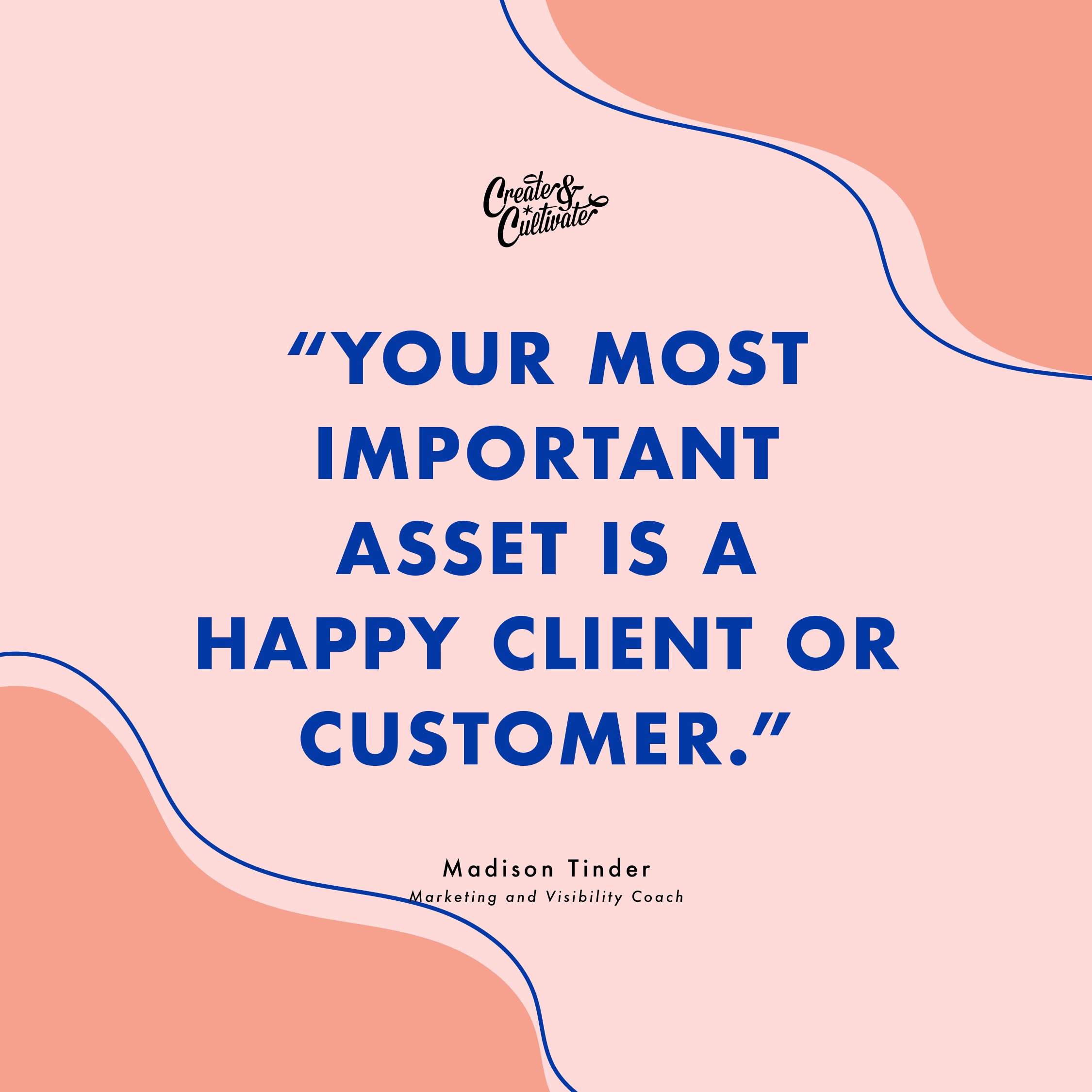
Tip #3: Know Your Audience
The key to growth is focusing on your target audience. You need to speak to your audience in a way that is aligned with where they are at. You need to know everything about your audience, beyond demographics. You are going to have to dig deeper to find their story, their struggles, what they are looking for, and their goals. If you don’t have that information, you might as well be speaking to a wall.
Tip #4: Serve First
So many people in the online space get caught up in the next sale that they forget your most important asset is a happy client or customer. They are a walking billboard for you. Showing up and giving them your all should be your number one priority always. Not the likes on your Instagram photo or the sales numbers on a launch but the questions people ask and going above and beyond for your people always.
Tip #5: Invest in Support
No one can do it alone. The most important part of entrepreneurship is knowing when to ask for help. The type of support will vary based on your business, but I suggest taking a look at where you are spending your time and reflect on what is draining you. This may mean deciding to hire help for social media, client management, accounting, design, etc. Or it could mean realizing that you need a mentor to get you to that next level. Having a community will help you prevent burnout, feel less isolated, and have people you can bounce ideas off of.
There is no one-size-fits-all model for building a six-figure business. If anyone tells you otherwise, run the other way. But, through my time as an entrepreneur I’ve learned how helpful and important the tips above can be. If you are feeling frustrated and like your business is not having the momentum that you hoped for, be patient, take action, and remember that no one’s entrepreneurial journey is the same.
About the Author: Madison Tinder is not like most 25-year-olds. Instead of stressing about finding “the job” or making rent, she is a homeowner and runs a six-figure business. She is a marketing and visibility coach based in Louisville, Kentucky, and helps her entrepreneur clients grow and market their brands through Instagram. She’s an Instagram story pro and launched her first product-based business this fall, Soulful Scrunchies.
MORE ON THE BLOG

Kate Hudson, Tika Sumpter, & More Embrace Authenticity in Business—Here's Why You Should Too
Read on for all the highlights from our Small Business Summit.


On Saturday, October 24th, we heard from some of the most innovative, forward-thinking entrepreneurs at our Small Business Summit presented by Mastercard on what small business looks like today and is going to look like tomorrow. Because if 2020 has taught us anything, it’s that there’s nothing that can’t be done when people come together with unequivocal support and compassion for each other.
While the chaos and uncertainty were—and are—a lot to reckon with, the silver lining is that it’s been a major conversation starter. The pandemic helped us realize that we need to take care of ourselves a little more; there is need for change and the fight for racial equality still has a long way to go; and the election season reminds us that our voices matter. When talking about the new normal in a post-pandemic world, it’s not just about how it will look like, but what do we want and need it to look like?
So go ahead, sit back, relax, and sip on that glass of rosé you’ve been saving for just the right evening while we serve you some of the highlights from your favorites like Kate Hudson, Tika Sumpter, Lauren Gores Ireland, Morgan Mercer, and more! From creating authentic content, rethinking what it means to be an influencer, fostering inclusivity in the workplace, pivoting to digital, abandoning perfection to building a community, no leaf was left unturned!
The Three C’s: How Tika Sumpter and Thai Randolph Are Using Content, Commerce, and Community to Create a Destination for Modern Moms of Color

“
This is not a sprint, it’s a marathon.”
—Tika Sumpter | Co-Founder, Sugaberry
Panelists:
Tika Sumpter | Co-Founder, Sugaberry
Thai Randolph | Co-Founder, Sugaberry
Moderator:
Jaclyn Johnson | CEO and Founder of Create & Cultivate
On being frustrated with lack of content about Black motherhood…
“There were an array of white spaces, but Black women and mothers were a second thought.” -Tika Sumpter
“When you Google ‘Black motherhood,’ when you think about images of Black motherhood, it’s so heavy, it’s so weighty.” -Thai Randolph
“Where was the joy? Where was the light?” -Thai Randolph
On finding each other and building a partnership...
“One of the things I told our mutual friends was, ‘Sure, I’ll meet with her, so I can explain to her why she should NOT go into this business.” -Thai Randolph
“The big differentiator for me was [Tika’s] emphasis on a tangible call to action.” -Thai Randolph
On marketing a brand for Black, women-identifying consumers…
“Black women make up 7% of the U.S. population but drive 40% of purchases when it comes to certain categories like baby food or packaged goods and juices.” -Thai Randolph
“We are very quick to point out that this isn’t about altruism. This is about business and really catering to a smart and capable and influential consumer.” -Thai Randolph
On putting community first...
“We are creating content that our audience and community actually cares about, and with that content, we’re creating commerce, funneling back into the community to live their best lives.” -Tika Sumpter
On launching a podcast about motherhood…
“What we want to offer to our community is the opportunity of joy through every realm of our verticals in our sight.” -Tika Sumpter
“We not only wanted to bring joy but to also bring real quality content about our bodies. We don’t really talk about IVF enough, we don’t talk enough about different ways to motherhood, different pathways.” -Tika Sumpter
On creating content that resonates with their audience...
“What has been resonating with our audience is the sweetness, and the joy, and the honesty about the interior lives of Black moms who're just mothering.” -Thai Randolph
“We’re not saying suffering doesn’t exist in our community. We’re saying our community deserves joy.”-Thai Randolph
“The idea that someone just carves out and cares so much for Black women and Black moms, and is just totally centered on them—without any sensationalism—is what’s really striking a chord. -Thai Randolph
On dealing with the challenges of the pandemic…
“A lot of wine. I’m kidding, but I’m not kidding.” - Tika Sumpter
“It’s made me realize how many things I don’t need—in life, in general—whether it’s physically or mentally.” -Tika Sumpter
“Connecting is what has allowed me to make it thus far.” -Tika Sumpter
On running a brand during the pandemic…
“It has made us truly digitally native. It has made us agile and adaptable and resourceful in a way that might have taken us longer to grow those skills otherwise.” -Thai Rudolph
“It’s made us think differently about what community means in this new context of a pandemic.” -Thai Rudolph
On supporting Black mothers during times of economic duress and racial injustice ...
“The mental premise of having to jump around from trauma to trauma to trauma is not living anymore—it’s just surviving. And we don’t want to just survive here. That’s the ultimate reason for Sugaberry: it’s to thrive and spread joy.” -Tika Sumpter
“Who stands between the gap of trauma and trauma? We want to be that. We want to stand in that gap for Black women.” -Tika Sumpter
On abandoning perfectionism...
“If you choose wrong, you can always choose again.”- Thai Rudolph
On being a mother and a business person…
“What this pandemic is showing us is that you’ll work it out.” -Tika Sumpter
On giving advice to new founders…
“Make sure you live what you do, chile! This is not a sprint, it’s a marathon.” -Tika Sumpter
“You can do it all! You just can’t do it all at once.” -Thai Rudolph
Plug & Play: How to Streamline Customer Communications for Your Business, Powered by Messenger

“The community you build online is the lifeblood of your business.”
—Danielle Nagel | Owner and Designer, Dazey LA
Panelists:
Danielle Nagel | Owner and Designer, Dazey LA
Sabrina Zohar | Entrepreneur, Sustainability Advocate, and Founder of Softwear
Gianne Doherty | Co-Founder, Organic Bath Co.
Moderator:
Jaclyn Johnson | Founder and CEO, Create & Cultivate
On being authentic with customers during COVID…
“Just being open and honest about what we’ve been going through has been huge for us.” -Danielle Nagel
“It’s important to tell your audience that you’re going through it too.” -Danielle Nagel
On building strong relationships with customers…
“I’m a big believer in asking your customers what they want from you.” -Gianne Doherty
“A lot of my clients have my cellphone number. They’ll DM and send photos, talking about how they love the product and how other people love it too.” -Sabrina Zohar
On attracting people to your business during a pandemic…
“Yes, you can go to all the big brands, but you’re not going to get someone who genuinely cares.” -Sabrina Zohar
On connecting virtually…
“We found that 90% of our customers were on Facebook, so Messenger just made sense. We can meet them where they are.” -Gianne Doherty
“Messenger allows us to chat with customers in real-time, which affects purchasing.” -Gianne Doherty
On implementing customer service…
“If I’m not prioritizing my customers and not giving them that sense of urgency that they’re number one, they’re gonna buy it from five thousand other brands.” -Sabrina Zohar
“As a business owner, once in a while, you get an unhappy customer, and you take it so heavy and so personally. Having a third party who can handle that for you so you can focus on growing the business is such a huge game-changer.” -Danielle Nagel
“Customer communication is vital for trust.” -Gianne Doherty
On using social media platforms to convert sales…
“I use the Instagram platform to show when I’m making something new to be released or launched.” Sabrina Zohar
“The community you build online is the lifeblood of your business.” -Danielle Nagel
On supporting small business...
“Embrace the fact that you’re a small business!” Danielle Nagel
From Pandemic to Profit: How to Pivot, Reposition, and Reset Your Small Business


“It’s really important for us to be mindful of our customer’s mental health.”
—Patty Delgado | CEO, Hija de tu Madre
Panelists:
Sonja Rasula | Founder, Care Package and Unique Markets
Marissa Hermer | Owner, Olivetta and The Draycott
Jess Rona | Celebrity Dog Groomer and Entrepreneur
Patty Delgado | CEO, Hija de tu Madre
Mattie James | Influencer
Moderator:
Ginger Siegel | North America Small Business Lead, Mastercard
On experiencing COVID-induced delays or disappointments…
“We are all human beings, and we have ups and downs, and I think all of us entrepreneurs have to be gentle and kind with ourselves.” -Jess Rona
“It’s all about your mindset as a business owner.” -Jess Rona
On practicing self-care and staying positive…
“I focus on meditation and self-care because when you’re good, you can handle anything.” -Jess Rona
“When I focus on the things that I do have, even if they’re teeny tiny, that is the real pivoting for me. The pivoting is actively being a puppeteer with your thoughts and pivoting into a positive mindset.” -Jess Rona
On being a DTC business in the current COVID climate…
“COVID has really pushed us to be more responsible for our own in-house production.” -Patty Delgado
“I’m really listening to the needs of my customers and adapting our business model, and all-around business decisions, based around the current climate.” -Patty Delgado
On owning and operating a restaurant during COVID…
“It’s not just about health and safety, but trust in us—in any business.” -Marissa Hermer
“We’re just not a restaurant. We’re a face and a family, and we care.” -Marissa Hermer
On pivoting to digital during COVID…
“We cultivated our community online.” -Sonja Rasula
“I truly am a fan of email marketing, so we really cultivated our email list because those are people who have given us something of value. They have given us their email address.” -Sonja Rasula
“We started talking to our email list a lot more and we are going to have a very specific plan for holiday months.” -Sonja Rasula
On pressing pause and looking ahead…
“For the last month or two, I did take a pause on doing as many things virtually.” -Sonja Rasula
“For me, I pressed pause, so that I could really focus on what the business could look like in 2021 and start to put things into place for that.” -Sonja Rasula
On changing your content strategy as an influencer…
“I noticed that all we really had to shift our story and talk about home life.” -Mattie James
“I had to be really careful that I was authentic to my story and being truthful, first and foremost, but then make sure that anything I told my audience, whether it was organic content about what I’m currently doing or even in partnership with a brand, that I was really speaking to home life.” -Mattie James
“It was really important to me to make sure that I even pivoted the language I used day to day.” -Mattie James
On launching online business courses…
“So many more people want to take online courses, want an online masterclass. Again, they are making that space to learn because people are a little bit more still right now.” -Mattie James
On making cybersecurity a priority…
“I’ve been really active in making sure that I’m paying attention to little things like my passwords.” -Mattie James
“We definitely do spend a lot of time working with the best third parties to ensure our customer and business safety.” -Patty Delgado
“I will admit that I have put the responsibility on the third parties and I guess I’m just crossing my fingers and hoping it’s okay.” -Sonja Rasula
On supporting small businesses during this time…
“The whole idea behind Unique Markets was to feature and support small and independent businesses—designers, artists, makers—who are usually bootstrapped, independent, and own their businesses. And because we can no longer do that, I thought about how I could support all of these small businesses in a virtual space.” -Sonja Rasula
“So, I came up with this idea. My mom sends me care packages. No joke, I am a woman in my 40s, y’all, and my mom sends me care packages filled with random stuff, but it’s the thought that counts.” -Sonja Rasula
“I could take all these small businesses that I support and love and put them into a box.”-Sonja Rasula
“The idea is that everything in these care packages is curated by me or small independent businesses.” -Sonja Rasula
“This year it became very clear to me that I wanted to really help all of my fellow female founders, women-owned businesses and BIPOC businesses.” -Sonja Rasula
“Over 75% of the brands that are in all of the boxes are minority-owned or female-owned.” -Sonja Rasula
On paying it forward in the midst of the pandemic…
“It’s been the silver lining to this pandemic for me and our teams to know that we are facilitating and have created a platform for people to give back to the heroes and front line workers.” -Marissa Hermer
“We’ve raised over $50,000 and it truly gives us such joy to be able to give back, but equally our heroes are more nourished knowing that people around the world are thinking about them.” -Marissa Hermer
“I think that community, even global community, now more than ever, when our country feels equally divided, it’s really really important.” -Marissa Hermer
“Spreading happiness now is the most important thing we can do when there’s just so much doom and gloom.” -Marissa Hermer
On being a source of happiness and joy…
“I play with iMovie a lot and make fun videos. I’ll buy music from iTunes and tinker and play around, and tap into my creativity. If you are finding joy through that and you are getting that little fun out of that, I think people want to follow any joy right now.” -Jess Rona
“If you’re posting something that’s joyful, people will be attracted to it.” -Jess Rona
On adapting your selling strategy…
“Since day one, we’ve always been very digitally aggressive across every channel.” -Patty Delgado
“What has changed is our messaging. It’s really important for us to be mindful of our customer’s mental health.” - Patty Delgado
“We’ve shifted our focus from selling content to more mindful and empathetic content, and I think that’s been extremely beneficial for brand awareness and just overall brand-customer intimacy.” - Patty Delgado
On building community…
“While the pandemic has been very intense for all of us, this has been a time where community really does just organically explode if you give people a reason to come together and congregate.” -Mattie James
On the future of in-person pop-up events…
“For 2021, for all types of businesses, I think creating in-person experiences that can be safe and responsible are going to absolutely thrive.” -Sonja Rasula
Click and Connect: How Technology Is Driving Community, Growth, and Innovation in a Digital World, Powered by Dell

“I know that we would not be where we are today without the mentors who helped guide us.”
Lauren Gores Ireland | Co-Founder, Summer Fridays
Panelist:
Lauren Gores Ireland | Co-Founder, Summer Fridays
Moderator:
Jaclyn Johnson | CEO and Founder, Create & Cultivate
On launching the business right away…
“We had the idea and, quite literally, that afternoon we were already taking steps toward creating a business.”
“We truly just started, and never really looked back.”
On tapping into your immediate network…
“Once you have an idea and you start asking people, even within your friends-and-family circle, a lot of times, they know someone who knows someone who can connect you, whether that’s to a lab or a manufacturing facility.”
On knowing when it’s time to bring on a team…
“You get to a point where you realize you can’t do everything.”
“Once you’re with a retailer like Sephora, you can’t operate without a proper team behind you.”
On seeking out mentorship opportunities…
“I know that we would not be where we are today without the mentors who helped guide us.”
“Jen Atkin of OUAI was significant for us. She’s the one that introduced us to Sephora. She guided us when we had big questions.”
“Jamie Kern Lima of IT Cosmetics very kindly sat down with us for hours one day and just gave us so much information and advice, which was so incredible.”
On investing in your own business…
“Before you’re making money, you have to put money into the business.”
On the power of social media marketing…
“It’s remarkable what you can do in the beginning, without a ton of money, on a channel like Instagram.”
“Trying to reach out to the networks that you have, doing gifting, sending things out to people, and investing in getting that product out to people is really helpful.”
“Now that we have grown, whether they’re our close friends or someone that we don’t know, we do pay influencers, and that is now part of our strategy.”
“What Instagram is best for is getting out the message so people can see it and it makes them want it.”
On networking with other brands…
“Reaching out to other brands that feel native to your brand is a really great way to grow.”
Building Big: How to Scale and Grow a Team and Business Successfully


“Leading a team requires the desire to be a leader.”
Morgan Mercer | Founder and CEO, Vantage Point
Panelists:
Morgan Mercer | Founder and CEO, Vantage Point
Arian Simone | General Partner and Co-Founder, Fearless Fund
Sharifa Murdock | Co-Owner of Liberty Fairs and CEO of ENVSN Fest
Moderator:
Marla Blow | SVP of Social Impact for North America, Mastercard
On accessing capital as a minority entrepreneur...
“Right now, Black women are receiving .0006% of venture funds. Women of Color are still under a percent, collectively.” -Arian Simone
“There is also a lack of diverse investors. The industry is eighty percent white male.” -Arian Simone
“It’s going to take a lot of movement and collaboration and allies in order to move the needle.” -Arian Simone
On finding the right employees…
“I want to know that someone believes in my dream, that someone is really on top of it, and wants to be a part of it.” -Sharifa Murdock
“Bringing on the wrong people is just as bad as having the role open, if not, worse.” -Morgan Mercer
On fostering inclusivity and diversity in the workplace…
“When you think about every single person on your team, they’re all an extension of your values, they’re all an extension of your mission.” -Morgan Mercer
On caring for employees…
“Once you find a good employee, you gotta keep them happy.” -Sharifa Murdock
“Be authentic about it too. Do it because you care and you really want to know how your employees are doing.” -Sharifa Murdock
“If employees feel like they can't actually voice their concerns with a project, they’re not going to voice their concerns with their role.” -Morgan Mercer
“The best thing to do is have an open-door policy.” -Morgan Mercer
On preparing to scale your business…
“You can’t just go out to find someone who will work for you for ten dollars an hour.” -Arian Simone
“You need to build on where you’re going, not just where you’re at.” -Arian Simone
On finding the right funding for your business...
“Make sure you have really strong allies and make sure you have really strong mentors.” -Morgan Mercer
“Whether it be VCs, whether it be startup programs and accelerator programs, whether it be grants, loans, pitch competitions, there are numerous avenues, and it’s really about finding people who align with you.” -Morgan Mercer
On having different revenue streams...
“The pandemic is a prime example of why we should have multiple revenue streams.” -Sharifa Murdock
“Have different ideas on how your one concept can do different things cause you never know what can happen.” -Sharifa Murdock
On creating a mentorship program…
“People who can train you and teach you where they have been are key.” -Arian Simone
On staying on top of cash flow...
“I am the cheapest person when it comes to business.” -Sharifa Murdock
“Stay as tight as you can.” -Sharifa Murdock
On leading a team...
“Leading a team requires the desire to be a leader.” -Morgan Mercer
On finding success…
“Success is incompletion. You always want to get to that next level.” -Sharifa Murdock
A Keynote Conversation With Kate Hudson

“The great leaders are the ones who listen to their team.”
—Kate Hudson | Actress, Author, and Entrepreneur
Panelist:
Kate Hudson | Actress, Author, and Entrepreneur
Moderator:
Aya Kanai | Head of Content and Editorial Partnerships, Pinterest
On finding the right vision for your business endeavor...
“I like being a part of something that everyone can be a part of.”
On connecting with Fabletics…
“It just spoke to me authentically.”
“It was affordable, cute activewear at a time when being involved in something that was affordable—as a celebrity—was considered not cool.”
On defining wellness…
“There’s no other beauty secret other than internally being healthy.”
“It starts with not putting too much pressure on ourselves.”
On creating the right wellness products for INBLOOM…
“How do you get people, in general, to feel excited about feeling good and not daunted by the things you need to do in order to be healthy?”
“We need to be able to educate people about wellness in a way where it feels like, ‘Oh, that’s easy enough. I can start there.’”
On being an authentic entrepreneur…
“I’d rather roll up my sleeves and get involved in the business.”
“I’d rather be proud of what I’m putting out there and fail than make money from something just because it’s an opportunity that I have. I like the long game.”
“I’d much prefer to build than just model.”
On being an empowering leader…
“The great leaders are the ones who listen to their team.”
“Anyone who’s gonna succeed leads with openness and availability in transparency.”
“You have to create a positive workspace.”
On being confident while running a business…
“I’m usually asking for business advice.”
“You gotta love what you’re doing cause people can feel it.”
MORE ON THE BLOG

Buzzy Skincare Line Summer Fridays Has Thrived During COVID—This Marketing Pivot Was Key
Co-founder Lauren Gores Ireland gives us the inside scoop.


“We truly just started, and never really looked back.”
—Lauren Gores Ireland, Co-Founder of Summer Fridays
Just because a market is saturated doesn’t mean you shouldn’t try to disrupt it. Let’s take the beauty industry for example. It’s a $532 billion market, which might seem too daunting to even attempt breaking into, but here’s the kicker: women are leading the way!
When it comes to gender equality at the highest level, the beauty industry comes out on top. In fact, it officially outranks every other profession in terms of the highest percentage of women seen on the board and in executive positions.
Unfortunately, that number is still only 29%, so clearly, we still have a long way to go. But the good news is that women aren’t waiting for the doors to open; they’re carving out their own niche and taking a slice of that billion-dollar pie for themselves.
Lauren Gores Ireland is one of them. The co-founder of the buzzy skincare brand Summer Fridays broke the influencer mold and turned her online community into brand ambassadors. But it’s the brand’s unique marketing initiatives during COVID that has really set them apart from their competitors.
Knowing that people would be stuck at home for summer Fridays this year, Lauren and her co-founder Marianne Hewitt decided to put the summer back into summer Fridays with comfort house calls.
We’re talking a cake collaboration with Sweet Laurel Bakery inspired by their Jet Lag face mask; a Craig’s Vegan Jet Lag-inspired ice cream called Vanilla Cloud, which comes with a mini mask; and a co-branded limited edition collage kit and photo filter with Tezza Barton. So smart!
At our recent Small Business Summit, Dell Technologies brought the co-founder of Summer Fridays and the founder and CEO of Create & Cultivate, Jaclyn Johnson, together for a conversation on how the beloved skincare brand has pivoted its marketing strategy due to COVID, why networking has been key to their wild success, and what the power of social media marketing can really do.
In fact, thanks to DWEN (Dell Women’s Entrepreneur Network), Dell is enabling women entrepreneurs across the globe to succeed by helping them navigate business challenges. DWEN has a proven ability to facilitate meaningful connections and bridge access to fellow entrepreneurs and advisors, technology, new markets, and resources needed to scale.
If you missed the conversation at our Small Business Summit, you’re in luck. Below, we’ve compiled all the most memorable quotes from the session. So, get out your notebooks because class is now in session!
On launching the business right away…
“We had the idea and, quite literally, that afternoon we were already taking steps toward creating a business.”
“We truly just started, and never really looked back.”
On tapping into your immediate network…
“Once you have an idea and you start asking people, even within your friends-and-family circle, a lot of times, they know someone who knows someone who can connect you, whether that’s to a lab or a manufacturing facility.”
On knowing when it’s time to bring on a team…
“You get to a point where you realize you can’t do everything.”
“Once you’re with a retailer like Sephora, you can’t operate without a proper team behind you.”
On seeking out mentorship opportunities…
“I know that we would not be where we are today without the mentors who really helped guide us.”
“Jen Atkin of OUAI was significant for us. She’s the one that introduced us to Sephora. She guided us when we had big questions.”
“Jamie Kern Lima of IT Cosmetics very kindly sat down with us for hours one day and just gave us so much information and advice, which was so incredible.”
On investing in your own business…
“Before you’re making money, you have to put money into the business.”
On the power of social media marketing…
“It’s remarkable what you can do in the beginning, without a ton of money, on a channel like Instagram.”
“Trying to reach out to the networks that you have, doing gifting, sending things out to people, and investing in getting that product out to people is really helpful.”
“Now that we have grown, whether they’re our close friends or someone that we don’t know, we do pay influencers, and that is now part of our strategy.”
“What Instagram is best for is getting out the message so people can see it and it makes them want it.”
On networking with other brands…
“Reaching out to other brands that feel native to your brand is a really great way to grow.”
Learn more about Dell's Women's Entrepreneur Network (DWEN) at DWEN.com.
MORE ON THE BLOG

Ever Heard of a Shmask? Meet the Hybrid Mask Kids Actually Want to Wear
50% shirt, 50% mask. 100% genius.

“I’m so motivated and so proud to make something that makes this super weird moment a bit softer.”
—Karine Nissim, Founder of Shmask
March 2020 was the month I cried myself to sleep every night.
Between tears, death tolls, and hilarious coronavirus memes, I stewed on about what would be. On how my children's lives would irrevocably change and how ill-prepared I was to parent them in this new normal.
It was out of despair and desperation that I wanted and needed to make this moment better for my children. I couldn't fathom mask-wearing in all its clinical glory as a reality for my family, so I created something better: the first-ever shirt with a mask attached for kids (and grownups).
It's called the Shmask! Shirt meets mask. It is super duper soft, breathable, adjustable, and just so easy to wear.
If you know me, you know I've traveled with a pack of sanitizing wipes in my purse for the last ten years. My elaborate cleansing of all airplane surfaces around my seat is a source of embarrassment to anyone who's traveled with me.
Suddenly, I felt validated.
If I had a dollar for every time I barked at my children not to touch anything in a public bathroom, I'd probably have an extra $30,000.

None of this eased my nerves. I stayed home. I quit my job as a film professor. I came up with the most elaborate routines to properly cleanse our Instacart groceries and Amazon packages. My hands were so dry that I even started to sanitize the sanitizer.
And turns out I hate Zoom. I especially hate it when the image freezes and my four-year-old daughter walks away from the screen but all her classmates get to see me in my pajamas. Without a bra on. I really hate it when it is the only means to console my grieving cousins on the loss of their father.
I put out a question on my Instagram story. "Would you rather send your children to school in a mask or keep them at home?" 70% opted to send them in masks. The thought was unimaginable to me. I resolved to keep mine home. Maybe. I might miss the world though, probably.
But then time went on, and well, it turns out I suck at being a school teacher. And, frankly, after cooking three meals and three snacks a day, doing all the laundry and dishes all the time, I'm not my most awesome self. Also, my kids needed other kids and other grown-ups who know the answers to things without asking Alexa first. Incidentally, Alexa knows a lot about space.
And then, we needed to renovate. A burst pipe left brown water stains across our ceiling which was a real eyesore in every single Zoom angle. Also, my kitchen was a relic of the ‘90s, and I couldn't fathom the idea of spending another six months home-bound cooking in that cave of a room.
An impromptu road trip meant we were suddenly doing things well outside my comfort zone. Hotels. Shared elevators. Public bathrooms. People. Lots of people.
The kids and their masks were such a source of stress. The little one dropped hers on the street and found it 20 minutes later with evidence of heavy foot traffic. My oldest kept playing with it despite touching every surface imaginable first. And my middle son had a habit of putting his on backward.

Photo: Courtesy of Karine Nissim
At this point, I'm out in the world, and I'm living the challenge of required mask-wearing with three young kids. I'm experiencing how that looks for my family of five and for my in-laws who were with us. And, it's a pain in the ass. It could be better, so I set out to make it so.
But here's the thing: aside from pouring over every Vogue issue my mom got in the 80s, and a brief stint as an intern at Harper's Bazaar, I had zero experience in fashion. I loved it though and always have. And I knew the idea was good. So good that I was afraid to tell people who could do it faster and better than me.
And then something supremely magical happened. I started asking "friends" on Facebook questions.
"Are any of you in the T-shirt business?"
"Does anyone know any patent lawyers?"
I peppered these in-between images of my dream kitchen and asking for advice on which oven range to buy. And you know what? People answered me! Lots of opinions on kitchen appliances, but also introductions. Offers of time chatting, getting into how they run their own business, and how I could create mine.
I would look to my husband at night—as we clacked away on our laptops with Friends reruns in the background—and I would say, "I'm not sure what good I've done in this life, but well it's nice to know people will help me when I ask." And they did.
My friends who have ever worked in fashion or who’s input I love would come over in the evening and sit six feet apart on my patio, in their masks, and watch my children model my first Shmask prototypes. They would chime in on the pros and cons of design.
I'll never forget the resounding theme of one of those wonderful conversations. They all agreed: comfort trumped all. A comfortable shirt meant compliance. Compliance with an otherwise alien behavior. If it was soft, breathable, and we could hear their little voices, then they would wear it. And they wouldn’t mind. Neither would we.
So began a slew of conversations with factories, brokers, consultants, and fabric mills. This was also a pain in the ass, and not what eight-year-old me dreamed being a fashion designer would be.

But then my kids would hear me say that they inspired me. I called them my business partners. Mostly, they were reluctant models. But really, they are my muses. It’s their soft cheeks and little noses I want to protect. It’s all of ours. I’m so motivated and so proud to make something that makes this super weird moment a bit softer. And now I hear my kids tell their classmates in Zoom that their mom created something. Something they are proud of too.
Shmask isn’t my first business, but it’s the first time I’ve felt so supported, not just by my family, but by a community of parents who love their children as much as I do. And as much as mask-wearing has been politicized, it’s also been required. And if it’s required, then I want the Shmask to make it easier.
I am a woman of many ideas. Many, many ideas. My husband, also an entrepreneur, will always say, “The idea is nothing without the execution,” which is true. But, also, execution can’t happen without motivation, and that motivation was ever-present as we navigated this new normal.
So during a baffling pandemic, in the middle of a stressful home renovation, on an unplanned road trip, I developed the Shmask: a shirt-meets-mask concept that guarantees a safe and hassle-free solution for families and their kids.
The shirt has an attached-face covering made of soft and breathable fabric with enough space in the nose and mouth area for kids to breathe and speak easily. There is a dip in the back, so it can seamlessly be worn or taken off. With the attached-face covering, Shmask helps eliminate the issue of kids complying with today's mask requirements. They can't lose it, drop it, trade it with their friends, or forget it at home.
About the Author: In addition to being a mom of three, founder Karine Nissim, is also a three-time entrepreneur, an award-winning filmmaker, and professor and the co-founder of DogVacay (which is now called Rover, the “Airbnb for pets”). Shmask started as a passion project to help keep her kids safe during this super weird time. This is the first product of a broader line of apparel for luxe family living called Karine. Super soft clothing that solves the hard problems of our new world. Think protective layers, breathable fabrics, clothes that we can all play and work in, from pick up and drop-offs, Zoom meetings, park play dates, to workouts! You and your fam can look Insta-ready and feel pajama-party good.
MORE ON THE BLOG

Here's Why You Should Diversify Your Product Range Before You Think You Need To
One product means you have a product, not a business.

Photo: Courtesy of Cathryn Lavery
My first year in business was a much bigger success than I’d expected.
My first real product, the Self Journal, launched on Kickstarter in August 2015. I’d set a funding target of $15,000, and by the end of the campaign, I’d raised $322,695 from a total of 6,531 backers.
It was a huge win that, not only validated the concept of a 13-week productivity and goal-setting journal but also launched BestSelf Co. as a business.
But it didn’t take long for this big win to morph into a problem.
If you’ve ever watched Shark Tank, you’ll know that the Sharks are reluctant to invest in a single product.
There’s a simple reason for this reluctance: one product means you have a product, NOT a business.
Even if you have a winning product, your business is vulnerable because all your eggs are in the same basket. You have a single point of failure, which leaves you vulnerable and wide open.
If something happens to that one product, you’re out of business. And so much can go wrong—2020 has been proof of that.
First up, you’ll have competitors snapping at your heels.
Back in 2015, the Self Journal was the only 13-week goal setting on the market. As the first-of-its-kind planning and productivity tool, it gained traction quickly, especially because it was backed by science and success psychology. Fast forward five years and the market is saturated with 13-week journals.
Add to that, potential supply-chain problems, inventory going out of stock, as well as alternative goal-setting solutions coming onto the market, and your steady stream of sales can soon hit a downward curve.
A single product offering also means you have to find new customers again and again. Finding customers is expensive, especially as the cost of paid ads continues to rise.
With the Self Journal accounting for 99.9% of our sales, I knew I had to diversify.
Plus, the benefits of diversifying are so many. With a suite of products, you:
Spread your risk
Unlock up-sell and cross-sell opportunities to increase your average order value and your customer lifetime value
Widen your potential market

“If something happens to that one product, you’re out of business. And so much can go wrong—2020 has been proof of that.”
—Cathryn Lavery, Co-Founder & CEO of BestSelf Co.
I remember Tony Robbins asking two questions: “What business are you in?,” and, “What business do you need to be in?”
BestSelf Co. used to be a product-first company that sold goal-setting journals.
We needed to become a problem-first company that understood our customers’ challenges so well, we could create products that resolved them. We began to interview our customers in our community for information to really understand their needs.
As we transitioned to a problem-first approach, we unlocked a new creative wave in the business. Initially, we stuck with our productivity and goal-setting core.
For example, we recognized some customers felt overwhelmed by the structure of the Self Journal. They wanted to be more productive and effective in their work and their life, but they didn’t want the day-to-day detail of the Self Journal.
We created the Weekly Action Pad in response, which remains one of our most popular products to date.
Not every product innovation was a winner. There was a time when we invested in a merchandise range. Tees and hoodies didn’t sell as we expected, but we learned from that experience and used the lessons to dive deeper into the core of who we are as a business.
Eventually, we began to think more laterally about the problems we wanted to solve.
We realized lots of our customers enjoyed journaling because, through the process of self-discovery, they got clearer on the goals they wanted to set and past the roadblocks that were in their way.
Market research revealed that writer’s block was a big problem for journalers, so we created a deck of prompt cards to spark creative thinking.
And this product launched a whole new line of prompt decks.
It’s tempting to stick to what you know, especially when your product is doing so well, but you’ll never regret diversifying before you need to. You can’t know how long it will take to find another winner. Sometimes the things you think will fly become the embarrassing flops [we’ve had our share of those too!].
The secret is to keep coming back to the core problems you’re trying to solve.
Solve a real problem, and you can’t go wrong.

“The secret is to keep coming back to the core problems you’re trying to solve.”
—Cathryn Lavery, Co-Founder & CEO of BestSelf Co.
About the Author: Cathryn Lavery is the co-founder and CEO of BestSelf Co., an organization dedicated to helping people become their best selves, fulfill their potential, and lead happier lives. As an Irish immigrant with zero business experience, no personal network, and little resources, Cathryn transformed herself into a serial entrepreneur creating multiple brands and even helping others bring their ideas to life. She is passionate about showing others how to make the change and have the tools to achieve their goals.
MORE ON THE BLOG

Hey Boss Ladies, Here’s What to Expect at Our Small Business Summit Presented by Mastercard
Kate Hudson, Tika Sumpter, and more.


With more than 30 million small businesses across the country employing over 47% of the country’s total workforce, it’s no wonder small business is known as the backbone of America. But in the midst of COVID, small business owners and entrepreneurs need our help more than ever as they transform their Main Street mainstays into thriving digital ones, which is why we’re taking our annual Small Business Summit presented by Mastercard online and making it free to attend. Yes, free!
On Saturday, October 24th, we’re partnering with Mastercard to host a day of immersive virtual workshops, insightful panels, and intimate mentor sessions. Prepare to walk away with the tools, tips, and tricks you need to build, launch, or take your business to the next level and open your digital doors. Scroll on to find out everything you need to know ahead of the big day (spoiler alert: Kate Hudson and Tika Sumpter will be there!) and RSVP to save your spot if you haven’t already.
THE DATE
Saturday, October 24th, 2020
TUNE IN FROM HOME
First things first! On Saturday, October 24th, you’ll receive an email with the link to access the exclusive Small Business Summit presented by Mastercard event site. Please note: All content will go live on Pacific Daylight Time (PDT), including the launch of the exclusive Small Business Summit presented by Mastercard event site. To find out what time a session is happening in your time zone, use this handy time zone converter.
The digital summit is made up of pre-recorded video sessions hosted via Vimeo and live video sessions streaming via Zoom and Messenger Rooms. We recommend that you have a strong WiFi connection and update to the latest version of Zoom for the best experience. The summit is optimized for desktop, so it is best viewed via a computer or laptop, rather than a tablet or phone.
While the live content is specifically designed to be watched in real-time, you’ll be able to access and view it until Friday, October 30th at 5 pm PDT (Insiders, you have all-access even after the cutoff via your C&C Insiders dashboard!).
THE SCHEDULE
Small Business Summit presented by Mastercard is built just like our in-person conferences, which, of course, you all know and love. We have a stacked schedule with an A-list line-up of speakers so we suggest taking notes along the way.
Want the full lineup? Check out the play-by-play schedule to map out your big day. Please note, all times are listed in PDT (Pacific Daylight Time) and EDT (Eastern Daylight Time). To find out what time a session is happening in your time zone, use this time zone converter.
It’s going to be HUGE so we recommend getting a head start on planning out your day now.
THINGS TO PREP AHEAD OF TIME
Here are a few things to prep before the big day so it goes off without a hitch:
Make sure you have a strong WiFi connection.
Install Zoom on your desktop computer or laptop and test it out.
Zoom tips:
Find a quiet place to tune in. Try to situate yourself in a small room that does not have an echo.
Try and stay away from noisy electronics and silence your cell phone and computer notifications for an optimal experience.
When possible, limit your internet connection to solely the device you’re using for the Zoom conference.
Set your phone to airplane mode, pause your television connection, ask others in your home to pause anything that may require a strong internet connection, etc.
We will be hosting three LIVE Messenger Room sessions on Facebook throughout the day, you will need to click the live link (which will be accessible via the exclusive Small Business Summit presented by Mastercard event site) at the time of the session to join:
This link will prompt you to view the live session.
Please note: You do not need to log into your Facebook account or have a Facebook profile to join the sessions.
Please use Google Chrome when accessing the link for the best user experience.
Be sure to like, comment, and ask questions during the live broadcast.
Be sure to download the workshop assets so you can follow along with the expert in real-time. Note: Your exclusive workshop downloads will be available starting Saturday, October 24th via the exclusive Small Business Summit presented by Mastercard event site.
Join the Mentor Power Hour Slack channel and peruse the list of mentors who will be answering questions in real-time in half-hour-long Zoom webinars and choose your mentor(s).
We have experts in everything from building brands to raising venture capital to attracting and retaining A-List clients.
If there’s more than one mentor you want advice from, don’t worry! You can hop from session to session over the course of the half-hour if you’d like.
Don’t forget to jot down any questions you have for the mentor sessions ahead of time! You’ll be able to ask your Qs in real-time by typing them into Zoom’s Q&A feature.
GET SOCIAL
Stay tuned for exciting announcements and updates by following along on our social at @createcultivate. Don’t forget to tag @createcultivate and use the hashtag #CCSmallBusinessSummit for the chance to be featured in our Instagram Stories throughout the day! (Psst… Search “Create Cultivate” on Instagram to use our custom GIFs.)
NETWORK
Networking is a huge part of our event and our C&C Small Business Summit Attendees Slack Workspace is a great place to mix and mingle with your fellow Create & Cultivators before, during, and after the big day. We’ve created channels for every workshop and panel, as well as channels for international attendees, networking, and more!
Attendees will receive a link to access our Create & Cultivate Small Business Summit Attendees Slack Workspace in our What to Expect newsletter on Tuesday, October 20th. This Slack channel will remain accessible until Friday, October 30th at 12 pm PDT. Not familiar with Slack? Here are a few tips to get you started:
Download the Slack app to your phone, computer, or both
Complete your account profile with a profile photo, your name, and what you do
Public conversations will happen in the channels (ex: #networking) and are located on the left-hand side of the app. You can also start direct messages with others in the Slack workspace
Hit send too early on a message? Slack has an edit feature! Click the three-dot icon located on the right side of the message to open the drop-down of message options
We’re all about GIFs at C&C! Here are instructions on how to integrate GIPHY into your Slack account.
Our Slack workspace is a busy, happening place on the day of the event. Streamline the notifications you receive by using the “mute” feature on channels that don’t pertain to you. To mute a channel, simply open up that channel, click the three-dot icon labeled “more,” and select the mute option
Most importantly, be kind and respectful of others. If you don’t follow this rule, you will be removed from the Slack group
If you have any questions on the day of the event about navigating the schedule, accessing the workshop downloads, or anything else, you can drop them into the customer service channel in Slack.
C&C INSIDERS’ PERKS
Our Insiders get a ton of perks at all our events—and this summit is no exception. As an Insider, you’ll have access to all of the workshops, mentor sessions, panels, and keynotes via your C&C Insiders dashboard. This content will be uploaded by November 6th, 2020. Not an insider yet? Well, don’t miss out—you can sign up here.
VIRTUAL GIFT BAGS
We know you want ‘em! Complete our post-event survey to receive an email packed with promo codes from some of your favorite brands, including Onekind, Hello Care Package, The Caker, Summer Fridays, and more. You’ll receive the survey in your inbox on Friday, October 30th, 2020.
TECHNICAL DIFFICULTIES?
Live chat with a C&C specialist on CreateCultivate.com. You’ll see a “Chat With Us” pop-up in the bottom right corner of your screen.
WE ARE SO EXCITED TO SEE YOU ONLINE! Who are you most excited to hear speak? Which workshop are you looking forward to most? Tell us in the comments below!
MORE ON THE BLOG

"Nothing Was Standardized"—How 2 Frustrated Moms Took On a $61.8 Billion Industry
“Let’s just do it ourselves!”

We know how daunting it can be to start a new business, especially if you’re disrupting an industry or creating an entirely new one. When there is no path to follow, the biggest question is, where do I start? There is so much to do, but before you get ahead of yourself, let’s start at the beginning. To kick-start the process, and ease some of those first-time founder nerves, we’re asking successful entrepreneurs to share their stories in our new series, From Scratch. But this isn’t your typical day in the life profile. We’re getting into the nitty-gritty details—from writing a business plan (or not) to sourcing manufacturers and how much they pay themselves—we’re not holding back.

Photo: Courtesy of Perelel
Did you know that one out of every 33 babies in the United States is born with a birth defect? In fact, birth defects are the leading cause of infant deaths, accounting for 20% of all infant deaths, according to the CDC.
So, when Tori Thain Gioia’s daughter was born with a cleft lip despite not having any risk factors or genetic link, “it really knocked me off my feet” she told Create & Cultivate. “I started looking for answers.” she continued. “I did a lot of research with my OB/GYN and learned that the type of cleft my daughter was born with is often associated with a folate deficiency.”
Shocked is an understatement because Gioia had been taking a prenatal vitamin with folic acid which she thought was the same thing as folate. “I later learned that folic acid is the synthetic version of the nutrient folate and some 60% of women cannot transform it into the absorbable format, known as folate.” What’s more, she learned that folate levels during the first nine weeks of pregnancy are crucial to development. “I was frustrated to find that so many prenatals had poor quality ingredients like folic acid and saddened that there was so little education out there about what and when you really in need your prenatal.”
So, she partnered up with friend and fellow frustrated mama, Alex Taylor to change the statistics. When they first met, they had both just given birth and as two people with a lot of startup experience, they were equally disappointed by the current offering for millennial moms.
Today, they’re taking on the $61.8 Billion supplements industry—it’s predicted to reach a value of $349 billion by 2026—with their own prenatal line, Perelel vitamins to be parallel to where our woman is in her journey, there to support her when she needs it most. These supplements have been designed to adapt to your body’s changing needs throughout your motherhood journey. Using only bioavailable, high-quality ingredients at doctor-recommended doses, their formulations offer targeted nutrients for each phase.
Read on to hear more about how Gioia and Taylor are disrupting the supplements space and sparking connection and community with new moms along the way.

On the lightbulb moment…
Alex Taylor: I had also recently given birth to my first child and felt frustrated with my prenatal vitamin experience. I’ve always been incredibly health-conscious, which was only magnified when I was diagnosed with a thyroid disease about seven years ago. I’ve been fortunate to have access to incredible practitioners over the years, so when it came to pregnancy I was especially privy to the nutritional nuances associated with each phase. In a nutshell, I learned that the timing of certain nutrients was paramount.
When I began my pregnancy journey, I supplemented my prenatal vitamin with CoQ10 and additional folate while we were trying to conceive. Once I finally got pregnant, I supplemented with added calcium and iron and tracked down a separate Omega that offered both high-quality DHA and EPA, and so on. I was chasing down vitamins from Amazon, Whole Foods, your name it, piecing together what I understood to be the optimal mix of vitamins. It was a haphazard experience, to say the least. Each morning, I’d line up my various pill bottles and sort out my daily dose, which my husband found very amusing.
What made things all the more confusing was the fact that there was very little credible information online about prenatal vitamin nutrition—nothing was standardized and most of the resources I found were on community forums, which just didn’t cut it. After putting together the puzzle pieces of our challenges, Tori and I knew there had to be a better way.
What we found were three major issues with the current one-size-fits-all prenatal vitamin market:
1. Poor quality ingredients
2. Timing the introduction of certain ingredients was vital
3. Lack of information from credible sources
Appreciating we weren’t MDs, we teamed up with Tori’s OB/GYN, Dr. Banafsheh Bayati, who eagerly validated our concept (and joined as a Medical Co-Founder). Along with Dr. Bayati, we also ran the idea by a handful of other leading OB/GYNs and maternal-fetal medicine doctors who were equally enthusiastic about the need for a more targeted prenatal vitamin with a holistic approach.
From there, we knew we were onto something special, and so, Perelel was born.

“There was very little credible information online about prenatal vitamin nutrition—nothing was standardized.”
—Alex Taylor, Co-Founder, Perelel
On writing a business plan…
AT: In our own way, yes! Instead of writing a memo, we used the exercise of creating a full presentation as a way to crystalize the brand, our product assortment, our mission, and what we hoped to accomplish. We used the deck as a roadmap for the concept, how we’d get it off the ground, and what the financial architecture would be. We built a financial model that contemplates a number of scenarios and strives to ensure a path to profitability. Both exercises have been invaluable tools for us and served as compasses that we often reference and discuss.
On coming up with the name…
AT: Naming was probably the toughest part! We created endless lists of ideas but never seemed to pull the trigger. Finally, Tori called me one evening as I was driving down the 405 and said that we had to pick a name so we could incorporate the business. As luck would have it, we both gravitated toward the same name on our long list of options: Perelel. We chose this name because our goal is to always be parallel to where our woman is in her journey, there to support her when she needs it most. Plus, we loved that our version of the spelling used the root word “pere-” which means “to produce”—a nice wink to the goal of taking our products: to produce a healthy pregnancy.
As soon as we locked in the name, we secured the web domain, social handles, and applied for the trademark. From there, jumped into the formulation process with our doctors while also interviewing manufacturers that met our high quality and production standards.

On finding a trustworthy manufacturer…
TTG: While the FDA does not approve dietary supplements, we manufacture our products in accordance with the FDA’s current Good Manufacturing Practices (cGMPs) to ensure quality and safety. And for good measure, we test all of our products for heavy metals, microbes, allergens, and contaminants. To find our manufacturers, we teamed up with a supplement consultant who has 20 years of experience in the space to help us find the right partners while also working hand-in-hand with our team of doctors and Medical Co-Founder, Dr. Bayati, to formulate the perfect product.
Due to COVID-19, we encountered some hurdles as many supply chains were disrupted and manufacturing lines were backed up due to the shutdowns. Eventually, we found an amazing partner who met our long list of requirements. We did many reference checks and Zoom interviews. If you’re looking for a manufacturer, we suggest pulling in a consultant with a deep category experience. There are so many nuances you need to be aware of, and unless you’re an expert yourself, it helps to have the reassurance an insider can offer.
On funding the company…
TTG: We raised a small friends-and-family round, but because we’re focused on proving our concept and establishing the brand, we decided to primarily bootstrap through launch. We have plans to raise a small institutional seed round in early 2021 from the right partners who believe in the mission of the brand and an efficient path to break-even.

“
We chose this name because our goal is to always be parallel to where our woman is in her journey—there to support her when she needs it most.”
—Alex Taylor, Co-founder, Perelel
On paying themselves a wage…
TTG: Right now we’re not paying ourselves, but hope to someday soon! When we reach an appropriate scale, we will both look to take a salary, but as we bootstrap through launch, we’re not.
On the building a team…
AT: We have two primary co-founders along with an OB/GYN who is our medical co-founder. Additionally, we have two full-time employees, an amazing intern, and we have a panel of 9 experts and advisors who support us with content, community building, product review, and development.
Both Tori and I have managed larger operations and teams in the past, so hiring and building out the infrastructure came second nature to us.

On staying on top of the financials…
AT: Tori has a finance background, which spans investment banking, investing, and operations. She also has an MBA from Harvard Business School and a lot of experience building financial plans for very early-stage businesses, so we’ve leaned heavily on her savvy there for sure. That said, strategic finance and operations are a different beast than accounting, so we’ve onboarded a great partner to help us there. We want to be buttoned up and organized from the start so we don’t have to undo (or redo) a lot of work there.
On the biggest learning curve…
AT: There’s never a dull moment, especially when you’re dealing with third-party operators and have supply-chain dependencies. We’ve had to block-and-tackle as we go, making tough decisions. But honestly, the process has helped us build a strong foundation as partners. We trust one another implicitly and deeply respect each other, too.

There are so many nuances you need to be aware of, and unless you’re an expert yourself, it helps to have the reassurance an insider can offer.
—Tori Thain Gioia, Co-founder, Perelel
On having a business coach…
AT: I’ve worked with an incredible coach on-and-off for the past five years or so. He’s helped me build a resilient mindset, grow as a leader, make leaps in my career to better align with my personal values, and has equipped me with tools to not only make better decisions but also insights that have helped me become a better person, too. I am deeply grateful to him. If you can, I highly recommend finding a coach or a mentor you can regularly check in with.
On creating buzz around the brand…
AT: I come from a content, marketing, and strategy background where I’ve built many brands you might know and love today, so building Perelel came second nature to me. Part of it was pulling the more obvious levers such as social media and building our email list ahead of launch through compelling programming, but what’s been especially fun are all of the new and unconventional strategies we’ve been pursuing! Consumer habits are shifting a mile-a-minute so we’ve been focused on understanding fresh ways to engage our customers and pull her into our universe. Think outside the box!
On advice for small business owners…
AT: In the very early days of starting Perelel, I was chatting with a mentor of mine and he shared a story with me: He told me about a dinner he had with Elon Musk, who said being an entrepreneur is like waking up every morning and chewing glass. I laughed it off at the time, but it’s true. You have to be prepared to deal with a whole new set of challenges each day. And these challenges don’t ever go away, no matter how successful your business. Starting and running your own company is not a cakewalk. And it’s definitely nothing like the “girl boss” fantasy you often see portrayed in the media or founder press out there.

On the #1 piece of financial advice for new business owners…
AT: Loaded question! The first is spending the time upfront to do an honest assessment about what capital is required to break-even, even if it’s a range. Forming a point of view as to what your cash needs are in the near and long-term is crucial given there is no business if there isn’t cash. The second piece is being thoughtful about what KPIs you’re targeting to determine what success looks like. We’re trying to identify the metrics that we’ll need to achieve and not fall into the trap of cherry-picking data points to make strategic choices.
On developing a solid working relationship as co-founders…
TTG & AT: We are launching this business while also expanding our families (Tori just had a new baby and Alex is due in December). Fortunately, we are not first-time moms and fully understand what is involved in coming home with a newborn. We have great respect and understanding of what each other is experiencing, and because we are a small, nimble team, we can flex when the other needs to retreat to be with family, but we still feel fully supported by each other. We also knew we would need to have some support, so we brought on two full-time team members to Perelel to help keep the day-to-day rolling when we need to focus on family.
MORE ON THE BLOG