
How to Cultivate Confidence and Self-Love Inside and Out During the Social Media Age
Some of the biggest forces in beauty share their thoughts.


Photo: Create & Cultivate
Despite the fact that it’s 2020 and the beauty industry has made major strides in ditching unrealistic standards, our appearance and our mental health are still very much intertwined. Of course, in the era of the selfie, it’s no surprise that social media has a lot to do with it.
In recent years, frequent use of social media has been linked to increased feelings of loneliness, depression, anxiety, and envy. In fact, according to a recent survey, 60% of people using social media reported that it has impacted their self-esteem in a negative way.
But there’s good news: Beauty brands like OGX are putting out positive messages and prioritizing not only self-care but also self-love. With their campaign “Uncap the Love,” OGX is inspiring people to remove their self-imposed limits on love and let go of the things that are holding them back.
So, how exactly do you “uncap” your self-love and cultivate confidence inside and out during the social media age?
To help us answer that question, Create & Cultivate along with our friends at OGX brought together a panel of powerhouse women for a candid conversation on uncapping self-confidence and self-love at our recent Digital Summer Camp summit.
Ahead, we’re sharing all the mic-drop moments from the conversation with Jessica Franklin, Kandee Johnson, and Melissa Alatorre. Prepare to write these down.
On tapping into your voice on social media...
“Always talk like you’re talking to your best friend. When you’re your most comfortable, when you’re your quirky, weird, unique, different self, that is going to be the you that people will fall in love with.” - Kandee Johnson
On getting real with your audience…
“Other people are going through it too.” - Jessica Franklin
“From posting my struggles, I realized everyone has them and people want to relate.” - Jessica Franklin
“People can relate and feel like they’re not alone.” - Jessica Franklin
On being vulnerable with your followers...
“As long as my content is helpful, I’m willing to share it, even if it’s embarrassing.” - Melissa Alatorre
“I recently started opening up about my struggles with IBS and the response has just been incredible. I don’t mind sharing something embarrassing as long as it helps someone.” - Melissa Alatorre
On having grace for yourself during COVID-19…
“Go easy on yourself. If you have a day where you’re not productive, that’s okay.” - Kandee Johnson
“It’s okay to feel stuck. It’s okay to feel some type of way about this situation because we’re all going through it together.” - Melissa Alatorre
On monetizing your account without alienating your audience…
“I have to genuinely like and use the product.” - Jessica Franklin
“If you don’t love the product and it’s not a genuine review and something that you would actually use, it’s not going to resonate with your audience.” - Jessica Franklin
On dealing with negative comments…
“You can get thousands of people saying wonderful things to you all day long, and it’s the one awful one that just gets to you.” - Kandee Johnson
“A miserable person—whether they’re upset, stressed out hurt—whatever the content of their heart is, that’s what’s going to spew out of them.” - Kandee Johnson
“If I’m going to reply, it’s going to be a reply with a lot of love. It’s never going to be a snapback or a clap back.” - Kandee Johnson
“It’s usually better to ignore it and leave that alone and go about your day and focus on the people that love you and do have positive things to say.” - Kandee Johnson
“If you’re following me just to be negative and give negative energy to my page, there’s no point. If I can, I’ll just ignore it, block, and just keep moving.” - Jessica Franklin
“You need boundaries on social media because everyone thinks they have privilege and access to you and that they can say whatever they want and that you’re not human.” - Jessica Franklin
“Your platform is like your house, and you wouldn’t invite these people to come into your house and say these disrespectful and rude things.” - Kandee Johnson
On finding the silver lining…
“When you’re at your worst, at your most rock bottom, you have nothing to lose, so you can start any new ideas.” - Kandee Johnson
On cultivating confidence…
“Confidence comes from knowledge.” - Melissa Alatorre
“Knowledge is power and that gives you confidence.” - Melissa Alatorre

MORE ON THE BLOG







How to Be an Emotionally Intelligent Leader
Real-time feedback is key.
Photo: Create & Cultivate
Being an emotionally intelligent leader means cultivating self-awareness, being able to identify your flaws, and understanding how others perceive you. As an emotionally intelligent leader, you’re transparent and speak the truth to those around you—in fact, you're the first to acknowledge your own mistakes. It also means you are perceptive and allow others to be heard first before responding—all necessary characteristics to leading a strong and productive team.
Does this sound like the kind of leader you want to be? If so, read on to find out how. Ahead, we’re sharing four tips to be an emotionally intelligent leader so you can cultivate a healthy company culture—even if you don’t have an HR department. Psst… looking for more tips for leading a team? Download The HR Bundle and discover an onboarding checklist for new employees, a template for providing performance reviews, a guide for preventing workplace bullying, and more.
Be Open to Exposing Vulnerabilities to Help Better Connect
During 1:1 meetings, focus on feedback and be very open about what you’re struggling with. Oftentimes, people try to hide that, but being open helps everyone feel a little more comfortable sharing.
Include Feelings in the Conversation, Which Can Help People Feel Heard
For example, ask “How are you feeling?” rather than, “How are you doing?” As a leader, be open to sharing when you feel frustrated or overwhelmed.
Give Employees Constant and Real-Time Feedback
After a meeting, share feedback either in person or over Slack. Make it a point to seek feedback by asking, “Do you have any feedback for me?”
Do Not Make Assumptions or Jump to Conclusions
It’s important to be curious and take an inquisitive approach. For example, ask, "Can you clarify what you meant when you said X so I can better understand your intentions?
Ready to take your company’s leadership to the next level?
Add the Create & Cultivate Marketplace The HR Bundle to your cart, or get unlimited access to our entire library of downloads and videos when you join Insiders.
MORE ON THE BLOG

12 Questions You Should Ask to *Really* Nail Down Your Life Mission
Life with a capital “L.”

Photo: Create & Cultivate
"What’s your overall goal?”
It's the first question I ask any entrepreneur, client, friend, (just about anyone) who is in the midst of a career transition or looking to start or grow a venture. I follow it up with, “Where do you see yourself in five years? 10 years? Life-wise.” The question is basic and BIG.
But answering that question, or at the very least attempting to answer that question, creates clarity; crystal clear or not, it's an important step in the right direction to figuring out Life with a capital "L." And guess what? Your business is part of that Life. So before nailing down a business mission, start with your life goals.
You don’t have to have the destination 100% set (if you do, awesome) but you do need a map so that when you get lost or head down a path less traveled and find yourself in parts unknown (which, is inevitable and healthy) you have a map to consult—to help you redirect and continue on.
Answer these 12 big life questions and you'll find that in the process you'll get further clarity on your business mission as well:
1. Visualize yourself in 10 years. What do you see for yourself? What/who do you see yourself surrounded with? What do you see yourself doing?
2. What do you feel the most fearful of right now?
3. What are you willing to sacrifice to stay true to you? What are you okay saying “no” to?
4. What areas of your life are humming?
5. What areas of your life do you want to make changes in?
6. What do you wish you were doing more of that makes you happy?
7. What kinds of problems do you enjoy solving the most?
8. What about you makes you uniquely you?
9. What are your values?
10. Who are some other people in your life that you admire? Why?
11. What are some commonalities in the people that you are drawn to?
12. What aspects of who you are do people find energizing?

Alison Gilbert is a business coach and consultant. She’s helped over a dozen owners and entrepreneurs grow profitable businesses quickly and efficiently, including such companies as Well+Good, Levo League, Maiyet, and Plum Alley. Prior to building her consultancy, she was hire number four and COO of food media company Tasting Table where she grew it into a forty person team reaching a readership of millions. Visit her site and schedule a free consultation.
Love this story? Pin the below graphic to your Pinterest board.

This story was originally published on April 22, 2019, and has since been updated.
MORE ON THE BLOG

How Small Businesses Can Create and Maintain Meaningful Connections With Customers While Remote
Staying apart, together.


Photo: Create & Cultivate
Small businesses everywhere are stepping up and doing their part to help flatten the coronavirus curve, temporarily shutting the doors of their brick-and-mortar shops, pivoting to curbside pick-ups, implementing contactless deliveries, and setting up in-store social distancing guidelines to help contain the rapid spread of COVID-19. Of course, by now, we all know that pivoting a brick-and-mortar business strategy to an online one in the midst of an ever-evolving global health crisis is easier said than done.
To help small business owners enhance their online presence and stay connected with their customers remotely during these challenging times, we’ve partnered with Messenger from Facebook to share simple tips for keeping the lines of communication open. Not only is messaging convenient, but it can also help your small business build relationships and inspire trust with customers. In fact, a Facebook-commissioned study found that 69% of people reported that being able to send a message to a business made them feel more confident in the brand.
Ahead, we’re sharing ways to create and maintain meaningful connections with your customers, bring new customers to your virtual storefront, and more. In the coming weeks and months, we’ll be sharing more ways for small business owners to boost their business with Messenger, so be sure to keep an eye on this space for the next installment in the series. (Psst… if you missed the first story in this series, discover three zero-cost ways for businesses to stay connected with customers during COVID-19.)

According to Facebook data, over 90% of Facebook business admins currently use Messenger to connect with their friends and family. In an effort to help small business owners manage all their messages in one place, Messenger recently launched the business inbox feature, which allows you to toggle between your personal and business accounts within the Messenger app. In other words, you don’t need to download and manage multiple apps in order to chat with your loved ones and your customers. (Win win!) ICYMI, Messenger’s business inbox is already available via the Messenger app on iOS and will be coming to Android soon.
According to a Hubspot survey, 90% of customers rate an "immediate" response as important or very important when they have a customer service question. Right now, in the midst of COVID-19, many customers have timely questions about updated store hours, product availability, no-contact delivery and pick-up options, and much more.
Messenger’s new business inbox feature makes it easy and convenient for you to respond quickly and easily to your customer questions, which is imperative when you consider that 60% of customers define "immediate" as 10 minutes or less. You can also choose to receive notifications in the Messenger app to help remind you to get back to customers.
In Messenger’s press release for the new tool, small business owner Matt Volpert of Kern River Outfitters shared his experience with business inbox: “We are currently seeing a 250% increase of messages from guests who need to reschedule their trips due to COVID-19. This makes it difficult for my small team to get back to these guests in a timely fashion. The business inbox in Messenger is a fantastic tool that will help me quickly respond to each and every one of my guests, whether I’m in the office or on the river.”
Pro tip: Messenger’s business inbox tool also complements the Page Manager App, where you can manage your Facebook posts, create ads, and view Page insights to help you make informed decisions as you continue to pivot and adapt your business during this time.

Once you’ve established your business online, of course, attracting potential customers to your virtual storefront is just as crucial to your success as bringing them into your IRL brick-and-mortar location. With Click to Messenger ads, you can reach potential customers virtually while maintaining social distancing measures.
Within the app, you can choose between two ad templates: Start Conversations or Generate Leads. The Start Conversations template provides a menu of prompts within a Messenger thread for a potential customer to choose from to start a conversation with you, while the Generate Leads template offers a question-and-answer style conversation to help you better identify potential customers.
According to a study conducted by Messenger, a small business based in Thailand called Organicwa created a successful Click to Messenger ad campaign when they decided to offer a delivery option during the COVID-19 pandemic. After 30 days, they received 11,000 orders and a 6X increase in return on ad spend with ads that click to Messenger, compared to previous campaigns.
Click here for more information about Organicwa’s successful campaign and here to learn more about getting started with Click to Messenger Ads.
For additional resources, head to the Marketing with Messenger page and Business Resource Hub where you can learn more about our business tools, grants, and other ways to keep your business running during this time.
Are you currently using Messenger for your business? If so, let us know how it helps your business in the comments section below for a chance to be featured in one of our upcoming spotlight posts.
MORE ON THE BLOG

What We're Reading: The Links the C&C Team Can't Stop Discussing, Pondering, and Slacking Each Other About
A bi-monthly series, sharing the most talked-about links in the C&C Slack channel.

Photo: Create & Cultivate
Introducing What We’re Reading, a bi-monthly series in which we share the most talked-about links from the Create & Cultivate team Slack channel. Scroll on to find out what the C&C team is currently discussing and please feel free to join in on the conversation by sharing your thoughts in the comment section if you’d like. This week, the most-buzzed about topics around the virtual water cooler spanned a historic ruling by the U.S. Supreme Court to protect LGBTQ+ rights in the workplace to a renewed momentum toward finally make Juneteenth a nationally recognized holiday.
When outraged commenters are your employees.
An Essence poll found that nearly half of Black women (45%) say the place where they experience racism most frequently is in the workplace.
Square, Twitter, Nike, Target, and a growing number of companies are observing Juneteenth as a paid holiday for employees.
But too many companies are engaging in “performative allyship.”
Seven months pregnant and furloughed.
Land O’Lakes CEO Beth Ford—and fellow LGBTQ+ business leaders—on the hard work that led up to this week's landmark Supreme Court ruling.
Melinda Gates and MacKenzie Bezos unveil a $30M gender equality initiative.
Bon Appetit’s test kitchen staff is demanding equal pay.
12 ways to get reenergized on your midday break. (We highly recommend #3!)
ICYMI, Kim Kardashian West landed a podcast deal with Spotify.
And a special thank you to our Instagram followers for recommending black women-owned small businesses to add to our ever-growing list. Keep those recs coming!
MORE ON THE BLOG

10 Diversity & Inclusion Thought Leaders Who Are Transforming The Workplace and Beyond
Follow their lead.
Diversity is so much more than a buzzword but we’re going to let the stats do the talking. According to a recent study, diverse companies produce 19% more revenue than companies that don’t value diversity. In fact, the study found that "increasing the diversity of leadership teams leads to more and better innovation and improved financial performance." And yet, a disheartening study found that white men account for 72% of corporate leadership at 16 of the Fortune 500 Companies.
If we know that diversity increases the bottom line, then why aren’t we seeing more of it from the top down? Unfortunately, women of color still face more obstacles and a steeper path to leadership, from receiving less support from managers to getting promoted more slowly. Because of these workplace challenges, Black women are also more inclined to go out on their own. In fact, Black female-owned businesses make up 21% of all women-owned businesses, making it the largest segment of women-owned businesses after non-minority women.
So, why is progress on diversity so slow? Well, it’s as Juliette Austin, Senior Diversity Equity & Inclusion Strategist at Bill & Melinda Gates Foundation says, it’s going to take more than investing in human capital, progressive hiring practices, or HR policies to achieve true diversity and inclusion. “Inclusion is what makes diversity stick,” says Austin. “Inclusion makes diversity meaningful.” Because diversity isn’t just a “nice to have” it’s integral to our personal and professional development, innovation, and financial performance.
So, today, in honor of Juneteenth— the oldest nationally celebrated commemoration of the ending of slavery in the United States—we are sharing 10 diversity and inclusion thought leaders who are transforming the workplace and beyond. Please follow their lead, do the work, and take anti-racist actions so we can achieve equity and true inclusion for all.
Dr. Akilah Cadet, MPH, Coach, Consultant, Founder, Change Cadet, and Host, Change Cadet Podcast
After experiencing judgment, “isms,” and barriers in the workplace, Dr. Akilah Cadet decided to break down those walls and dismantle the bias that contributed to the inequality that exists for Black women and women of color. So, she launched Change Cadet where she prepares individuals and companies to be “soldiers of change in the workforce” so there can be more women and people of color at the top. This includes services that support diversity, inclusion, equity, and belonging (DEIB) including executive coaching, strategic planning, workshops, and problem-solving.
Cadet is changing the face of the stereotypical leader so that no one will feel how she felt most of her career. Her latest podcast episode title “For White Women” with Adrienne Kimball of The Melanated Soul and Chief Talent Officer at Rubicon Programs will help you gain a “better understanding of the work it will take to undo deep-rooted systems of discrimination and white supremacy and how you can participate.”
Candice Morgan, Equity, Diversity & Inclusion Partner, GV (Google Ventures)
With over a decade of experience in diversity strategy and practice, Candice Morgan has been at the forefront of inclusive initiatives that are shaking up Silicon Valley and fixing tech’s major diversity issue. Before her role at GV, Candice Morgan was the Head of Inclusion and Diversity at Pinterest where she led strategy and programs to enhance a diverse and inclusive company including how to bring diversity to tech products. She curated impactful D&I programs such as Pinterest Apprenticeship, Knit Con—candidates from non-traditional tech backgrounds can experience engineering at Pinterest with the opportunity to become a full-time employee—and worked with their product teams to develop features like skin tone ranges to make Pinterest’s search more inclusive. She also headed up the research, advisory, and practices for Catalyst—the leading nonprofit for women in business.
Randi Bryant, Sista-intendent of Inclusivity
After years as a diversity and inclusion strategist, Randi B. was tired of helping corporations simply “check the diversity and inclusion box” or be seen as "doing the right thing without addressing the often-uncomfortable topics of unequal pay, monocultural executive team, survey results, employee conflicts, microaggressions, and more. This is why she went out on her own.
Now, Bryant is focused on spearheading real change. As an author, speaker, and Sista•intendent of Inclusivity she’s cultivating conversations to tackle tough racial, gender, and cultural issues by equipping them with the right tools and resources to foster a real, open dialogue and to create spaces where everyone feels as if they belong.
Minda Harts, Founder, and CEO, The Memo and Best-Selling Author, The Memo: What Women of Color Need To Know To Secure A Seat At The Table
Minda Harts is a popular thought-leader and speaker on leadership, equity, and entrepreneurship that advance women of color. She is also an assistant professor of public service of NYU’s Robert F. Wagner Graduate School of Public Service and the founder of The Memo LLC—a career development company providing the tools, access, and community for women of color and the companies they work. She wrote a best-selling book by the same name, The Memo: What Women of Color Need To Know To Secure A Seat At The Table, and she speaks in-depth on these topics in her weekly career podcast Secure the Seat.
Juliette Austin, Senior Diversity Equity & Inclusion Strategist, Bill & Melinda Gates Foundation, and Founder, Orisa Tii
As an experienced diversity and inclusion (D&I) consultant, Juliette Austin has one mission: To be a “conscientious change agent and disruptor in increasing representation and belonging in the workplace.” And she’s doing just that by managing and leading D&I initiatives across major global organizations including Ernst & Young, Canon USA, Buzzfeed, and currently at the Bill & Melinda Gates Foundation. A huge part of her role is moving companies from diversity to inclusion.
”Oftentimes organizations treat diversity as a hiring blitz to bring in as many women and black and brown faces as possible,” she told Forbes. “And they may do a really great job at bringing people into the building, but if they are not addressing inclusion, it becomes this revolving door—bringing them in, then spinning them out just as quickly. That's a huge cost for any company, the hiring and rehiring cycle is not cheap. Nor do you create really good brand ambassadors in the end. Inclusion is what makes diversity stick. Inclusion makes diversity meaningful.”
Follow her brand on Instagram.
Ellen McGirt, Senior Editor, Fortune Magazine, Co-Chair, The CEO Initiative

Award-winning journalist, Ellen McGirt has been diversifying the media landscape with her in-depth reporting on race, culture, and leadership. Her Fortune column, raceAhead focuses on racism and allyship. McGirt was formerly a senior writer at Fast Company and Editor at Large for Time Inc. She's also a regular on TV shows such as Good Morning America, NBC Nightly News, CNN, and others.
Watch her TEDx talk on The Importance of Showing Up.
Sign up for her raceAhead newsletter.
Myisha T. Hill, Author, Speaker, Coach, Founder, Check Your Privilege, and Brown Sisters Speak
Myisha is passionate about the mental wellness and empowerment of women. As a mental health activist, speaker, coach, author, and entrepreneur, she works closely with organizations and community groups to take “white people on a self-reflective journey exploring their relationship with power, privilege, and racism.” Her Check Your Privilege platform seeks to move white people beyond passive ally-ship to action-driven co-conspirators. This guided journey (and best-selling book, Check Your Privilege: Live into the Work) aims to deepen awareness around your actions and how they affect the mental health of Black, Brown, Indigenous, People of Color ( BBIPoC).
Download the Check Your Privilege workbook.
Learn more about Brown Sisters Speak.
Avery Francis, CEO and Founder, Build With Bloom and Sunday Showers, Diversity, Inclusion, and Equity Champion
While she is not an anti-racism educator, she is an HR leader, entrepreneur, and diversity, inclusion, and equity champion. Avery has spent her career working with leading startups to navigate the challenging world of talent, hiring and building creative cultures worth being a part of. She is the founder of the Bridge Program, A free code school for women-identified and non-binary people on tech. Formerly the Head of Talent at League and Director of Talent at Rangle.io, Avery specializes in helping the world’s best startups and most talented people grow their teams and their careers. She also shares mini-guides on Instagram on topics such as “9 Ways White People Can Spend Their Privilege” and “Things Not to Say to a Bi-Racial Woman" which “is a reflection of my learning and lived experiences as a Black woman.”
Join Sunday Showers—A Biz Shower.
Dr. Sarah Saska, Co-Founder, and CEO, Feminuity
Dr. Sarah Saska is the co-founder and CEO of Feminuity, a global strategy firm that partners with leading technology startups through to Fortune 500 companies to build diverse teams, develop equitable systems, design inclusive products, and company cultures. She has a Ph.D in Equitable and Ethical Tech from Western University and led pioneering doctoral research at the intersection of diversity, inclusion, and innovation which highlighted the need for companies, namely those in the technology and innovation sector, to embed diversity, equity, and inclusion into the core of their business. In 2018, she spoke on the TEDx stage about why “We’re On the Verge of a Diversity Debt Crisis.”
Follow Dr. Sarah Saska on Instagram.
Download her Indigenous Ally toolkit.
Mini Timmaraju, Executive Director, Diversity & Inclusion, Comcast NBCUniversal

With over 20 years as a professional leader and executive in the government, policy, political campaign, and advocacy space, Mini Timmaraju has an extensive background amplifying diversity and inclusion, gender issues, and community outreach strategies. As the Executive Director on the Diversity and Inclusion team for Comcast NBCUniversal, Timmaraju oversees corporate strategy and key initiatives supporting company-wide goals on diversity and inclusion.
MORE FROM THE BLOG


“Knowledge Is Your Power”—and More Memorable Moments From Our Digital Summer Camp Summit
The campfire was virtual, but our speakers were on fire.

Photo: Create & Cultivate
On Saturday, June 13, we hosted our second digital stay-at-home summit, Summer Camp. Thousands of attendees from all over the world joined us around the virtual campfire for a jam-packed day of networking (Slack was on fire!), learning new skills (hello, content marketing funnels), and listening to inspiring conversations from a diverse range of CEOs, entrepreneurs, content creators, small business owners, and experts in their fields.
We covered everything from launching a product to starting a podcast to jumping onto TikTok with some of the best in the biz. Trinity Mouzon Wofford, Farnoosh Torabi, Melanie Elturk, Brittany Xavier, Brad Goreski and more bosses dropped some serious knowledge throughout the day. If you missed out on the fun (or if you just want to relive the magic), you’re in luck because we captured the most memorable moments for you, so read on!
(Psst… If you’re having serious FOMO, join Create & Cultivate Insiders to get unlimited access to all of our Digital Summer Camp content including video recordings of every panel and workshop download in C&C history.)
How Danielle Fishel Karp Went From Entertainer to Clean-Beauty Entrepreneur

“
I really am behind the keyboard the way it appears that I am. It’s my picture, my name, and my voice—it really is me.”
—Danielle Fishel Karp
Panelist:
Danielle Fishel Karp | Actor, Director, Producer, & Entrepreneur
Moderator:
Sacha Strebe | Editorial Director, Create & Cultivate
On becoming a director...
“I didn't know I wanted to be a director until we went back to Girl Meets World and I realized I felt very, very protective of the kids on the show.”
“Kids relate to me in a way that they wouldn't a director that had never been an actor.”
On launching a transparent beauty brand…
“Authenticity is really important to me. It always has been, so anytime I've partnered with a brand it's either been a product that I really do love or use or it's something that really resonates with me.”
On her relationship with beauty...
“I was never really much into beauty. I'm just not. I have a few products that I love and I use them consistently and unless somebody really says, ‘No stop using that thing, use this,’ I'm going to keep using the same products I know and love. I don't like a lot of change in that regard.”
On launching a beauty brand...
“I didn't ever think I was going to do anything in the hair—or beauty world, for that matter—and then I got pregnant and I went to my first doctor's appointment and I heard my son's heartbeat.”
“All of a sudden, I really understood why women who are thinking of having a child start looking at everything they're consuming and start looking at it from the standpoint of is this good for me? Is this good for my child?”
“I went home and downloaded the Think Dirty app, and for the first time ever, I scanned all of my beauty products.”
“From the ground up, I have been involved in every step of the way.”
On being an entrepreneur...
“Acting and directing is an art form, so everything about them is subjective. It's not that way in business. Things aren't subjective.”
“I think I underestimated how much it really takes energy-wise and time-wise to launch a brand.”
On making a clean but efficacious beauty line...
“If I felt the need and a lack in the space, then other people did too.”“When I was trying to create the line, I wanted something that was as natural as it could possibly be, while also not losing any of the efficacy.”
On misinformation in the beauty world...
“Figure out what your comfort level is. Just because I'm comfortable with a product that falls somewhere on the three to four scale, doesn't mean that you are.”
On launching before COVID-19…
“We had planned five new products for this year. A lot of things have changed in 2020. I'm not sure how many of those products we’re going to be able to roll out now.”
On being close to the customer...
“One of the things I realized very quickly is that I wanted to hear everybody’s feedback, and I really wanted to take their thoughts into consideration because I'm not just making this product for myself.”
“I rely so much on being able to have a direct conversation with consumers about what to do.”
“I respond to a lot of comments and like comments through direct messages.”
"I have personally responded to I don't even know how many emails, so I am as involved as I can be without having to run every single aspect of it myself.”
“I like people to know that I really am behind the keyboard the way it appears that I am. It’s my picture, my name, and my voice—it really is me, and I think that goes a long way.”
Let's Grow: How to Build Your Following While Creating a Dedicated Community

“How can I get the right people who are very entrepreneurial excited about my brand from a very early point? And, hopefully, how can they continue to grow with the company?”
Panelists:
Trinity Mouzon Wofford | Co-Founder and CEO, Golde
Mandy Ansari | Digital Influencer & Entrepreneur
Jera Bean | Social Media Strategist and Creator, The Social Media Saloon
Aysha Harun | Content Creator
Chinae Alexander | Content Creator and Social Entrepreneur
Moderator:
Maxie McCoy | Author of "You're Not Lost"
On the phrase content is king or queen….
“What is going to get me to double-tap? We are all also consuming content as well, even if we are a content creator.” - Mandy Ansari
“Is my content inspiring? Is it empowering? Is it educating and is it entertaining? It doesn't need to be doing all of those, but the more it is doing at one time the better.” - Mandy Ansari
On identifying a need and mapping out a content strategy….
“Businesses need to think of Instagram as a business card. When a friend recommends something, one of the first things we do is go to Instagram. I like that Instagram shows more than just the highlight reel. It shows the journey and the process.” - Jera Bean
On building an engaged online community requires consistency…
“As a content creator, your personal life is your business in a sense, so taking the time to slow down is important to keep that consistency.” - Aysha Harun
“As a creator and as someone that works alone the majority of the time, to admit to themselves that, yes, I do need help.” - Aysha Harun
On building a social media following organically, without putting many resources toward marketing...
“How can I get the right people who are very entrepreneurial excited about my brand from a very early point? And, hopefully, how can they continue to grow with the company?” - Trinity Mouzon Wofford
“Surrounding yourself with those people who believe in it just as much—if not, some days, more than you do—was really my key to getting this far without taking much money.” - Trinity Mouzon Wofford
On growing your community and reaching a wider audience…
“Having a little prescriptive is helpful in moving past criticism.” - Chinae Alexander
“We can show up as humans. I haven't always had a perfect response to people who say rude things. I also have a zero-tolerance policy for it, but that's just how I am as a person. I’m just actually living my truth.” - Chinae Alexander
“My most successful content—and not in likes or comments, but in that it has moved the needle for other people—has been the days where I get up and I’m about to write something and I write it, look at it, and it makes my stomach hurt. It makes my stomach hurt because I’m scared to post it, I’m scared to say it, and I’m like, Oh, God, and I know I got something good. I know I went there, and I’ve never had someone negative attack when I went there. Because of its vulnerability.” - Chinae Alexander
Mental Health Meeting of the Minds: How to Tackle Your Anxiety and Live a Happier Life

“Rejection is objective. Rejection is from the outside. It comes from someone else saying no to you, but rejection is not failure—failure is what we think.”
—Stacy London
Panelists:
Erica Domesek | Founder, P.S. I Made This
Stacy London | Style Expert and New York Times Best-Selling Author
On collaborating...
“It's important, in my adult life, to make sure that the people around me aren't competing but are collaborative and supportive, and I think that we all need that—we need it for life in general, but we certainly need it now.” - Stacy London
On creating connections…
“To really be able to really create connection, I think it requires agency.” - Erica Domesek
On making self-care a priority…
“I just have to go back to the OG reference of when you’re on the airplane and the mask comes down and you put it on yourself before you can put it on anyone else. I just realized that I have to take care of myself before I can take care of other people.” - Erica Domesek
On dreaming big…
“This moment is the moment to dream big, in my opinion. The reason I feel that way is it does a lot to mitigate anxiety and depression—again, if you feel you have agency. Instead of feeling helpless, like the world is happening and there's nothing you can do to stop it, what I love to think about is what it's like to dream big, right now.” - Stacy London
On navigating social media right now...
“Social media has created moments of such anxiety, that is paralyzing—pre-COVID! You can mute people right now.” - Erica Domesek
On achieving personal success…
“Personal success—small, medium and large—is just as important to me.” - Erica Domesek
On handling rejection…
“Rejection is objective. Rejection is from the outside. It comes from someone else saying no to you, but rejection is not failure—failure is what we think.” - Stacy London
“We forget that rejection, for every door closed, means the door that we are supposed to go through remains open.” - Stacy London
On not comparing yourself to others...
“We forget that our scale doesn't have to be somebody else’s, and we forget our own lives because we get so involved in scrolling through other peoples.” - Stacy London
On finding real connections…
“Whether it's your business or your personal life, connection is essential, and it's not just networking to me that's not enough.” - Stacy London
“Real connection, people who you know you can count on regardless of whether you feel like a success or a failure.” - Stacy London
“Those people who see you for who you are—for the good, the bad, and the ugly and they don't turn away and they stick by you—those are the people who you are going to need throughout your life.” - Stacy London
How to Leverage Podcasting to Build Your Brand With Farnoosh Torabi

“
You have to be your biggest fan and your biggest advocate
.”
—Farnoosh Torabi
Panelist:
Farnoosh Torabi | Host of the Webby-Nominated Podcast, “So Money”
Moderator:
Sacha Strebe | Editorial Director, Create & Cultivate
On not needing to do it all…
“As someone who is in charge of your own brand, you have to think about it, I think it's worth experimenting, but you can't do it all.”
“There are a lot of things that I don't do. It feels like I do it all, but there are also so many things I don't do, which are conscious because it doesn't spark joy.”
On talking about money…
“Everybody has a story, and that story ultimately shapes how we relate to money.”
“I wanted to have bigger conversations about money that nobody would give me the bandwidth to have elsewhere because they just didn't think it was interesting, so a podcast gives me the opportunity to expand on topics that you really can't find elsewhere.”
On tapping into your audience…
“You don't know what you don't know so ask your audience, they will tell you.”
“You have to be your biggest fan and your biggest advocate.”
“That's the secret, don't pretend like you have to know the answer, your listeners will tell you what they want.”
On launching a podcast...
“You have to be really clear on your editorial hook, What is the voice? And part of that exercise is listening to a lot of other shows in your category.”
“The key to make this really easy is streamlining as much of the process as possible.”
On staying informed...
“Knowledge is your power. If you have answers to your questions, then you will know where to go next.”
On getting down to business...
“This is not just a passion project, it’s a growth engine for your brand and your business.”
TikTok 101—Everything You Need to Know About This Buzzy New Platform

“Do what you like to do. Don’t feel pressured to do what everyone else is doing.”
—Kiitan Akinniranye
Panelists:
Brittany Xavier | Global Style Influencer
Kiitan Akinniranye | Content Creator & Founder, Atarah Avenue
Blanca Garcia | Beauty & Lifestyle Influencer
Joyce Chun | Creator Marketing, TikTok
Moderator:
Reesa Lake | Partner and Executive Vice President, DBA
On following trends…
“You should pay attention to trends, but don’t let them rule your content creation.” - Kiitan Akinniranye
On jumping onto the platform…
“It’s an outlet for me to express different parts of my personality that I don’t express on Instagram and YouTube.” - Kiitan Akinniranye
On just having fun…
“Just have fun with it—that’s what TikTok’s all about.” - Kiitan Akinniranye
“I think the reason TikTok has taken off is because people are just being themselves, having fun, and not taking it too seriously.” - Kiitan Akinniranye
“Just have fun and don’t think too much about it.” - Blanca Garcia
On staying true to yourself…
“Anyone can tell the difference between someone trying to be someone else versus someone really being their authentic self.” - Joyce Chun
“Do what you like to do. Don’t feel pressured to do what everyone else is doing.” - Kiitan Akinniranye
“It’s really important to stick to what you want to do and show your personality. That way, whatever views a video gets, you’re still proud of that piece of work.” - Brittany Xavier
On creating content…
“The most important thing is that you enjoy what you’re creating.” - Joyce Chun
“No matter what anyone else does, you can have your own unique spin on it.” - Kiitan Akinniranye
“Create content that you enjoy, and most likely, other people will enjoy it as well.” - Kiitan Akinniranye
“When creating my videos, I try to have a take-home value or some resource that they can get from the video.” - Brittany Xavier
On turning TikTok into a revenue stream…
“Start creating content, and the revenue will come.” - Brittany Xavier
On checking metrics…
“I always remind creators that TikTok is a video-based platform. It’s built to democratize content so that anyone who has 0 followers to a million followers can have a chance to be seen no matter their size.” - Joyce Chun
“It really is a quality over quantity game.” - Joyce Chun
“Videos don’t ever expire, so you’ll notice that older ones are continuing to be spread and that’s a good indicator of what other content you can do going into the future.” - Brittany Xavier
“I check watch time to see when people are dropping off and that helps me figure out what I’m doing wrong in a video.” - Kiitan Akinniranye
“I try to take myself out of it, so that I'm not super invested in the outcome because it takes away from how I feel about content creation.” - Kiitan Akinniranye
Uncapping Your Self-Love: A Candid Conversation With Today's Top Beauty and Lifestyle Experts on How to Cultivate Confidence and Self-Love Both Inside and Out During the Social Media Age

“Knowledge is power and that gives you confidence.”
—Melissa Alatorre
Panelists:
Kandee Johnson | Creator, Beauty Authority, & OGXpert
Jessica Franklin | Lifestyle Influencer & OGXpert
Melissa Alatorre | Beauty & Lifestyle Influencer
Moderator:
Jaclyn Johnson | CEO & Founder, Create & Cultivate
On tapping into your voice on social media...
“Always talk like you’re talking to your best friend. When you’re your most comfortable, when you’re your quirky, weird, unique, different self, that is going to be the you that people will fall in love with.” - Kandee Johnson
On getting real with your audience…
“Other people are going through it too.” - Jessica Franklin
“From posting my struggles, I realized everyone has them and people want to relate.” - Jessica Franklin
“People can relate and feel like they’re not alone.” - Jessica Franklin
On being vulnerable with your followers...
“As long as my content is helpful, I’m willing to share it, even if it’s embarrassing.” - Melissa Alatorre
“I recently started opening up about my struggles with IBS and the response has just been incredible. I don’t mind sharing something embarrassing as long as it helps someone.” - Melissa Alatorre
On having grace for yourself during COVID-19…
“Go easy on yourself. If you have a day where you’re not productive, that’s okay.” - Kandee Johnson
“It’s okay to feel stuck. It’s okay to feel some type of way about this situation because we’re all going through it together.” - Melissa Alatorre
On monetizing your account without alienating your audience…
“I have to genuinely like and use the product.” - Jessica Franklin
“If you don’t love the product and it’s not a genuine review and something that you would actually use, it’s not going to resonate with your audience.” - Jessica Franklin
On dealing with negative comments…
“You can get thousands of people saying wonderful things to you all day long, and it’s the one awful one that just gets to you.” - Kandee Johnson
“A miserable person—whether they’re upset, stressed out hurt—whatever the content of their heart is, that’s what’s going to spew out of them.” - Kandee Johnson
“If I’m going to reply, it’s going to be a reply with a lot of love. It’s never going to be a snapback or a clap back.” - Kandee Johnson
“It’s usually better to ignore it and leave that alone and go about your day and focus on the people that love you and do have positive things to say.” - Kandee Johnson
“If you’re following me just to be negative and give negative energy to my page, there’s no point. If I can, I’ll just ignore it, block, and just keep moving.” - Jessica Franklin
“You need boundaries on social media because everyone thinks they have privilege and access to you and that they can say whatever they want and that you’re not human.” - Jessica Franklin
“Your platform is like your house, and you wouldn’t invite these people to come into your house and say these disrespectful and rude things.” - Kandee Johnson
On finding the silver lining…
“When you’re at your worst, at your most rock bottom, you have nothing to lose, so you can start any new ideas.” - Kandee Johnson
On cultivating confidence…
“Confidence comes from knowledge.” - Melissa Alatorre
“Knowledge is power and that gives you confidence.” - Melissa Alatorre
Design Darlings: How These Design Enthusiasts Are Inspiring Millions

“If your heart is pulling you in one direction, go for it.”
—Christina Martinez
Panelists:
Breegan Jane | Interior Designer
Monika Hibbs | Creative Director and Founder, Monika Hibbs
Christina Martinez | Life and Style Blogger, New Darlings
Angela Tafoya | Editorial Director, Lonny
Moderator:
Sacha Strebe| Editorial Director, Create & Cultivate
On diversifying your revenue streams…
“When you chase these passions with purpose, it can lead you to the openings that the universe is trying to create for you, even when the world says, Don't do it, put your energy here.” - Breegan Jane
“My life, and a lot of my goals, come from wanting to empower other people and being an employer.” - Breegan Jane
“It's really important to me to give other girls, women, men, anyone, the opportunity to try something, be good at it, fail at it, enjoy it.” - Breegan Jane
On taking a leap of faith…
“If your heart is pulling you in one direction, go for it.” - Christina Martinez
“It works as long as you are willing to put in the work.” - Christina Martinez
On growing an audience authentically…
“I think the honest voice is really the true voice of what people wanna hear and they wanna hear your story.” - Monika Hibbs
On how content strategy has pivoted…
“What can we offer people right now that feels like it's a definitive resource for what they’re going through?” - Angela Tafoya
“It's not solely providing aspirational content—which we still do, obviously—but thinking about how we can be there for our audience in a way that feels cognizant of what’s going on.” - Angela Tafoya
On staying true to who you are but also building a business that makes money…
“Look at your audience like a friendship. Some of your friends know everything, right? You’ve got that girlfriend you can call that you’re like, This is what's really happening. Then, you have other friends that are parents at school that kind of know your life and don’t know your middle name. And so, where your comfort level is with social media I think you can kind of filter it that way and each friend can be different. FB is different than IG, different than TikTok.” - Breegan Jane
On knowing when it’s time to make your first hire..
“I started to realize that I was missing partnership opportunities in my email because I just couldn't get to them. I realized really quickly that I was actually losing revenue and beating myself up and really working myself down.” - Monika Hibbs
“Once you release and know that you can't do it on your own, that's really where the growth comes in.” - Monika Hibbs
On the best design tip…
“Zero in on how a room makes you feel, even digitally when you’re looking at a space. Really try to dissect what it is that you like about that space.” - Angela Tafoya
Ready, Set, Launch: How to Strategize a Perfect Product Launch

“You have to think very long term on how you want the brand to evolve but also stay the same over the years.”
—Melanie Elturk
Panelists:
Dianna Cohen | Founder and CEO, Crown Affair
Janessa Leone | CEO and Designer, Janessa Leone
Abigail Cook Stone | Founder and CEO, Otherland
Éva Goicochea | Founder & CEO, maude
Cass Dimicco | Founder, Aureum Collective
Melanie Elturk | CEO & Co-Founder, Haute Hijab
Moderator:
Sacha Strebe| Editorial Director, Create & Cultivate
On launching a product...
“Anytime that you're looking to launch a business or a product, it's so important to know in your gut that you cannot be everything to everyone.” - Dianna Cohen
On building communities alongside customer bases…
“More than ever, we are realizing the power of niche audiences and people being genuinely passionate not only as a community member but also as a customer.” - Dianna Cohen
On reaching your target audience…
“I think the best things come out of natural, organic, real relationships with people” - Janessa Leone
On how to match an unmet need…
“The extra verve of the added touch is all about a little bit of extra effort that you put into something that takes it from good to great and elevates the everyday.” - Abigail Cook Stone
On the buying journey…
“We went through a really big exercise on who the audience was and how we speak, look, act, feel.” - Éva Goicochea
On validating and testing your audience…
“It's so important that you really can build an entire persona of what your brand represents—without even showing the product—months before you're about to launch.” - Cass Dimicco
“Your customer and your audience will tell you what's working and what's not.” - Cass Dimicco
On having a clear brand story…
“I know what the product is, I know that there is this highly underserved market, so what’s the brand story going to be around this product?” - Melanie Elturk
“We want this to be a legacy brand and not just spur of the moment, emotional decisions yet these are very important—down to color—that you have to think very long term on how you want the brand to evolve but also stay the same over the years.” - Melanie Elturk
On challenges…
“During challenging times and previous recessions, people do tend to go to brands that they already have an emotional connection with. That being said, in the land and world of new consumer brands, you don't have to scale back if you have not scaled.” - Dianna Cohen
On launching small…
“You want to see how your customers are buying things, so it's helpful to have an edit at first and then be able to iterate upon that.” - Éva Goicochea
“If founders are just trying to get their footing and understand if this is something they want to do, I suggest you really incorporate creative problem solving into every single roadblock that you see in front of you and smash through that to the next one. Use it as an opportunity to learn, to delegate, to outsource.” - Melanie Elturk
On building brand loyalty…
“At the end of the day, that is going to be what your business is: your customers, your community. If you can build that, they will buy whatever you're selling.” - Dianna Cohen
How to Lead With Resilience and Empathy

“Even if you’re afraid, speak up. Use your voice. Keep raising your hand.”
—Julie Smolyansky
Panelist:
Julie Smolyansky | CEO, Lifeway
Moderator:
Jaclyn Johnson | CEO & Founder, Create & Cultivate
On stepping into the role of CEO…
“Failure was not going to be an option.”
“I worked really hard. I used the business as a place where I could put my mourning and grieving pain and do something with it.”
“I wanted to prove to myself that I could do it.”
“Tough times are where you’re called to rise—and you either rise or you don’t. Sink or swim.”
On honing her vision for the company…
“Educating people around gut health has been my mission from day one.”
“You have to tell your story over and over again. You have to tell the marketplace over and over again.”
“We’ve doubled down on advertising and marketing during some of the more troubling moments of crisis like 2008 for example when the economy was flattering, we saw that as an opportunity and we doubled our advertising and that paid off. Some of our biggest growth happened during the recession.”
“We’ve adapted at every point in time and every point in our history.”
“We’re constantly learning and adapting and evolving.”
“What I know for sure is that what everyone wants is health. They want health, they want wellness, they want to feed their families good, nutritious food.”
On scaling a team…
“If I can delegate and let other people take the plan and execute it, it’s much more empowering for them and more fun, and then I can focus on the big picture.”
“It was a slow process of giving up that control because I was so used to doing it all myself.”
“It’s about working on your business, not in your business.”
On her advice for fellow female leaders...
“Even if you’re afraid, speak up. Use your voice. Keep raising your hand.”
“No one gives you power, you just have to take it.”
“If you’re not at the table, you’re the meal.”
“Keep being brave. Bravery is a muscle. It’s like your gut, it’s like your bicep—you keep using it, you keep getting stronger.”
On doing good during COVID-19...
“Lifeway was originally started with this idea to feed people.”
“My family survived war and famine and disease and all sorts of things in the Soviet Union during a painful time in history, so feeding people has always been super important to us.”
“30% of kids in the Chicagoland public school system are food insecure and rely on the school system’s lunch as their one nutritious meal a day—and suddenly they weren’t going to have it overnight.
“We immediately started unlocking and deploying our emergency response plan to reach those communities most impacted.”
“There is no more sacred purpose than to feed people and bring them wellness.”
“We’ve been working 24/7 just to keep food on people’s tables.”
On finding the silver lining through COVID-19...
“This crisis has shown us how vulnerable we are and how in-lock and connected we are to each other. Our safety and security and health depend on each other. We are interlocked with each other.”
“We’re starting to see that we are all really in it together and that we can show up for each other.”
On advice for anyone struggling during COVID...
“Don’t stop. Keep going. Hold your head up high. Find moments of joy for yourself. Trust the process, trust the universe. Trust that all of this is happening not to you but for you.”
Evening Keynote: A Conversation With Brad Goreski & Jaclyn Johnson

“
From my experience, starting at the bottom and learning everything was so valuable.”
—Brad Goreski
Panelist:
Brad Goreski | Celebrity Stylist and TV Personality
Moderator:
Jaclyn Johnson | CEO & Founder, Create & Cultivate
On falling in love with fashion from an early age…
“Fashion was my way of communicating who I was.”
On interning for Vogue and W…
“Interning was the most valuable experience I ever had.”
“From my experience, starting at the bottom and learning everything was so valuable.”
“I learned so much because I was responsible for so much.”
On starring on The Rachel Zoe Project…
“That show was the first of its kind. It was the first time that the curtain had been pulled back on the world of celebrity styling.”
“I almost didn’t take the job because I didn’t want to be on the reality show.”
“People were watching me learn the job.”
On taking the leap to start his own business…
“I got Jessica Alba as my first client, but there were two months where no one was calling, no one was asking me to style them.”
“One of the best pieces of advice I got was, ‘The only way you’re going to have a successful business is if you learn how to delegate.’”
“I literally didn’t make any money for my first two years.”
“Most of my business has been through word of mouth, so it’s always good to be easy to work with and it's always good to be available.”
On earning accolades and taking them in stride...
“In any job, you want to be on some sort of best-dressed list of whatever you do.”
On developing the traits to succeed as a celebrity stylist...
“You have to learn how to work under pressure really fast and you need to be a quick problem solver.”
On overcoming shyness...
“My shyness is overcome because I remember that kid who so desperately wanted to be here. Now that I’m here, I don’t want to squander any opportunity.”
On his best advice for his younger self…
“Continue following your heart no matter if you think it’s going to lead where you think it’s going to lead.”
“Let the script play out the way it was written and not try to interfere with it too much.”
Don’t miss Michelle Pfeiffer, Miranda Kerr, Beatrice Dixon, and More at our Digital Beauty Summit on Saturday, July 25.
MORE ON THE BLOG

16 Female Leaders Share the Most Unexpected Lessons They’ve Learned During COVID
Because there’s no manual for navigating a pandemic.
The word “unprecedented” has been used a lot over the past few months, and rightfully so—living through a pandemic of this scale is not something that we’ve ever done before. There’s no manual for navigating COVID-19, and everyone has been forced to tackle this new reality day by day.
But being stripped of all routines that make us feel like we are in control has revealed some unexpected, and valuable, lessons. For these 16 female leaders, this time has forced them to challenge their business processes, personality traits they thought to be true, how they get work done at home, and more. However, they each adhere to a clear pattern—starting with discomfort or unfamiliarity, followed by acknowledging the friction, and ultimately, leading to an important lesson that will far surpass this temporary season.
Their stories demonstrate that it’s not necessarily the problems we face or even the lessons we learn that are most significant, but rather how we intentionally integrate them into our lives as we inevitably fall back into familiar routines.

Amanda Aldinger
Founder of Antonym, a voice strategy and copywriting studio that conspires with beauty, culture, fashion, and lifestyle brands.
An Unexpected Lesson COVID-19 Has Taught Me: “Four and a half weeks into quarantine, I realized that I'd worked every day, all day, since New York City went into lockdown. My brain and creativity were completely tapped, I was exhausted and ultimately had to admit that the only person holding myself to this insane schedule was me. I set new boundaries with myself and clients, brought on extra support, created fresh weekend routines, and revealed in the new space to think and restore. Happiness, creativity, and energy returned instantly.”
How I’ll Take This Lesson With Me Post-COVID-19: “I've experienced the stressful effects of over-extending myself for years, but have struggled to live at a slower pace while scaling a growing business. This forced slow-down gave me no choice. I have found grace in it and will be nurturing a new pace of life post-COVID.”

Isis Nyong'o
Founder of MumsVillage, a content and ecommerce platform for parents in Kenya.
An Unexpected Lesson COVID-19 Has Taught Me: “I haven't left my house for six weeks and don't feel caged in at all. I'm really surprised by this as I've never been a "homebody"—preferring to step outside at least once a day during weekends.”
How I’ll Take This Lesson With Me Post-COVID-19: “I think I'll spend a lot more time at home as I don't have any desire to go anywhere. It's also given me permission to make all the "coffee chats" and meetings I didn't really want to have but did out of obligation into virtual meetings. That will be much more acceptable now and I'm so appreciative of this change as I can focus on what's important to me in terms of work and personal.”

Jessica Gupta
Founder and CEO of Taavi, a community platform that connects women in hand-selected small groups based on where they are on their pregnancy or parenthood journey.
An Unexpected Lesson COVID-19 Has Taught Me: “I've realized how much strength I get from meaningful conversations with my friends and family. The video chats and phone calls are deeper because we aren't focused on discussing or doing activities, but truly on talking about things that matter most—emotions, values, mental/physical well-being. What surprised me most about this learning is that it isn't profound or novel, but that it was just forgotten because I was always moving a million miles a minute.”
How I’ll Take This Lesson With Me Post-COVID-19: “I'm going to continue the slower pace and focus on what serves me more fully—meaningful conversations.”

Nathalie Molina Niño
CEO of O³, which invests and advocates for women and the planet.
An Unexpected Lesson COVID-19 Has Taught Me: “Everyone who has ever met me would probably place me on the far end of the extreme extrovert spectrum, but it turns out, that might not be true after all. I've had very little human contact in weeks and I'm surprised to report, I don't miss it. Could be I was just traveling too much and needed a break, but relative to other people I know, I seem to be really taking to this quarantine life!”
How I’ll Take This Lesson With Me Post-COVID-19: “I'll take more time to be alone and be better at cultivating and honoring my need for alone time.”

Caitlin Iseler
Founder and CEO of Happyly, which encourages families to spend less time planning and more time experiencing life together by providing active lifestyle inspiration for families across the U.S.
An Unexpected Lesson COVID-19 Has Taught Me: “I am capable of slowing down. As someone who runs hard in all things, it’s been healthy for my family, my business and my well being to slow down. I used to think of slowing down as a weakness but now I see it as a chance to let my brain recharge and address challenges with a level of new found creativity and grace.”
How I’ll Take This Lesson With Me Post-COVID-19: “I’m enjoying quiet time to be more present for myself, which in turn is good for everyone around me. It’s a new part of me that I’m embracing and plan to take with me!”

Wadeeha Jackson
Senior Director of Compliance at Blocx, a payment processing platform that utilizes block chain technology to increase the speed and efficiency in business transactions.
An Unexpected Lesson COVID-19 Has Taught Me: “COVID-19 has shown me that I cannot control everything and I have to manage the anxiety that comes from my inability to control external factors.”
How I’ll Take This Lesson With Me Post-COVID-19: “I will take the importance of being more grounded and focus on managing my internal well-being. Surrendering doesn't mean giving up — merely it's managing how you internalize and manage dealing with the loss of ‘being in control.’”

Jackie Ghedine
Business and Life Coach at The Resting Mind, which works with Gen X women who are at a mid-career crossroads, struggling with weight loss, or navigating their next move.
An Unexpected Lesson COVID-19 Has Taught Me: “My 11-year-old daughter has severe ADHD. Most sixth graders can go and do their work on their own, but unfortunately for my daughter, she will stare at something that needs to get done and it overwhelms her. Every day we break apart everything that needs to get done into small chunks, one step at a time. COVID has been a gift to me. This precious time, seeing how she learns, understanding her struggles first hand and finding ways to help her manage has helped me to reevaluate my expectations, something I hadn't done and couldn't do.”
How I’ll Take This Lesson With Me Post-COVID-19: “I am embedding in my memory, exactly the kinds of actions she takes when trying to do her work—from not being able to retrieve information to forgetting what she was doing four seconds after starting something—all so I can remember exactly what she struggles with every single time she opens a book or looks at a math problem. My expectations will not be how she did on a test and instead, reviewing the work together to ensure she just understands how to solve a problem.”

Nikki Bruno
Founder of The Epic Comeback, which helps high-achieving women in their 30s and 40s stage Epic Comebacks from divorce, illness, or loss.
An Unexpected Lesson COVID-19 Has Taught Me: “I've learned that quarantine conditions bring out massive surges of creativity for me, both personally and professionally. I used to think that creativity flourished with a lot of external stimulation, but it turns out the reduction in mobility and general noise freed up a fountain of ideas in my brain!”
How I’ll Take This Lesson With Me Post-COVID-19: “I'll honor my ideal creative set-up by sequestering myself in cozy places and eliminating distractions.”

Gabriella Ditalia
Founder of Mirror & Lens, which helps clients restore sacred balance by living in the space between their personal truth and the material world.
An Unexpected Lesson COVID-19 Has Taught Me: “I have weathered this experience with leadership and resilience, but in a way I didn't expect. I am philosophical and curious and I have always been able to connect those traits to real life experiences and actions. I built my business to help people wanting to make positive change in uncertain and transitional times in their lives using the tools I've always used to navigate challenging times in my own life. Sometimes uncovering the key to helping others is by learning to see your own unique qualities that are easiest to take for granted.”
How I’ll Take This Lesson With Me Post-COVID-19: “I am much more committed to the values of my business, allowing the strategies to shift and evolve. I know that wisdom is in connection, not in information and I continue to embody that in my work with clients.”

Marta Subko
Founder of subko&co, a boutique digital marketing agency.
An Unexpected Lesson COVID-19 Has Taught Me: “I have always thought that office space is one of the most important factors in building company culture. Also, I’ve always been a firm believer that people tend to be less productive while WFH. To my surprise, I’ve discovered that I and my teammates are very efficient as a fully remote team.”
How I’ll Take This Lesson With Me Post-COVID-19: “Our lease with WeWork is ending in May, and we decided not to extend it and to stay fully remote for the next few months. It’s cheaper, safer, and more productive in many ways. The situation forced me to be more creative as regards how I connect with my teammates so I came up with new ideas on how we can nurture our culture while working apart. Now we have regular weekly check-Ins, Office Vibe Surveys, edu-quizzes, and we even do pilates together via Hangouts once per week.”

Erin Halper
Founder and CEO of The Upside, a community and referral network of consultants and experts.
An Unexpected Lesson COVID-19 Has Taught Me: “I've learned that all businesses need to offer community and all professionals need to feel connected to like-minded people. The Upside was about to launch a membership cycle when COVID hit, forcing us to completely halt any and all well-planned promotions. What surprised me was how little our business was affected by COVID and the subsequent cancelled marketing campaigns, proving that people prioritize community and connections above almost everything else.”
How I’ll Take This Lesson With Me Post-COVID-19: “I'm doubling down on programming that adds value and creates an even stronger community for our members.”

Keira Kotler
Founder and CEO of Everviolet, which designs, engineers, manufactures and sells high-quality lingerie and loungewear for women’s bodies after medical procedures and other life-changing events.
An Unexpected Lesson COVID-19 Has Taught Me: “During this time, I've learned how much I thrive in moments of change. Instead of focusing on potential losses, I am feeling stimulated by the prospect of opportunity and ways of offering myself and my business for the good of others. I've always been an adaptive and giving person, but I'm surprised by how quickly and intuitively pivots and success from pivots are taking place.”
How I’ll Take This Lesson With Me Post-COVID-19: “The pivots I refer to are not just shifts in marketing or communications but actual changes in business practice and focus. I will maintain and expand upon those post-COVID. I've learned how authentic and smart consumers are, and I want to meet them in this place with transparency, benevolence and heart.”

Ellie Hearne
Founder of Pencil or Ink, a leadership communications agency that specializes in remote coaching, team workshops, and culture consulting.
An Unexpected Lesson COVID-19 Has Taught Me: “Leadership isn’t a title or a vocation, it’s present (or absent) in every decision I make—at work and at home. With the distinction between those areas of my life blurred, I'm recognizing that leadership wins look different than they did just a few months ago. For example, considering how to do something vs just what needs to be done is particularly important at the moment. And giving my children what they need to thrive on a given day might not mean a robust home-school curriculum—it might mean screen-time and a snack. And that's ok.”
How I’ll Take This Lesson With Me Post-COVID-19: “Mostly, this has been an exercise in patience, boundary-setting, and considering what matters most—personally and professionally. Those are evergreen.”

Lindsay Tabas
Startup Strategist at Lady Engineer, which helps founders design and sell the right product before spending too much with developers building the wrong one.
An Unexpected Lesson COVID-19 Has Taught Me: “As Vail Resorts closed and, with it, my winter snowboarding hobby that kept me busy, I thought because I was already 100% work-from-home for the better part of six years that I could #KeepItNormal. Each adjustment to daily life and news item brought with it a tiny prick, and as those pricks added up, I learned about sensory processing sensitivity. I always thought I was being careless and ignorant by avoiding the news or turning away from overly anxious people, but it turns out that I'm really a highly sensitive person, and it's a trait that I need to consider before engaging with others.”
How I’ll Take This Lesson With Me Post-COVID-19: “If a highly sensitive person beats herself up because she's being ‘too sensitive’ to daily life, then isn't that an unending circle of negativity? The diagnosis is always the first step, so now I can start setting boundaries with others when I feel my senses are getting overloaded.”

Michal Levison
Founder of Seasoned Moments, which shifts workplace culture and helps leaders build strong teams through food.
An Unexpected Lesson COVID-19 Has Taught Me: “I'm more introverted than I ever imagined. I was never a homebody before COVID-19. Turns out, I'm truly enjoying being at home, with my loved ones, with barely any action. I have been unpacking many of my issues in therapy this year, and I am more quiet and centered internally. I no longer need to run to the loud noise, the big to-do in order to escape my inner turmoil. I am much more at peace.”
How I’ll Take This Lesson With Me Post-COVID-19: “I will definitely make time for myself to be still. I may not ever be able to recreate this unique environment again, but I can certainly make it into a daily ritual of stillness, quietness, and inner reflection.”

Lily Scott
Founder of Lily's Ladle, which crafts frozen bone broths with ingredients sourced from Southern New England.
An Unexpected Lesson COVID-19 Has Taught Me: “As an entrepreneur, I have been trying to think of ways to reinvent the wheel in the retail food business. This is such an old and antiquated market with many middlemen and it's been making me crazy. How to change the food system when I also have to feed my own two young children AND keep my small business afloat, it means I have to depend on this system. COVID-19 has knocked the grocery store business on its head, and I'm seeing beautiful things emerge—local companies created to deliver farm fresh food to local customers, small retail businesses creating online shopping methods and contactless pickup points, and wholesale delivery services pivoting from restaurant supply to home delivery in order to keep employees working and bring good food into homes.”
How I’ll Take This Lesson With Me Post-COVID-19: “I think I'm going to pivot away from grocery store sales and focus more on partnering with grocery delivery services. It cuts out at least one full warehouse of people that touch my product before you buy it. And I'm going to try and get Lily's Ladle on more restaurant and cafe menus—sipping broth is healthy, nutritious, and delicious and supports the immune system. Why not have the opportunity to buy some from our favorite lunch spots?”
About the Author: Dreamers & Doers is a private collective for extraordinary entrepreneurial women supporting one another in achieving audacious dreams.
Up next: 36 Successful Entrepreneurs Share Their #1 Piece of Advice for 2020 Graduates
MORE ON THE BLOG

12 LGBTQIA+ Founders, Executives, and Leaders Who Are Shaping Major Companies and Shifting Culture in the Process
From Coolhaus to Beautycon to Netflix—and beyond.
Until now, over half (52%) of the people who identify as LGBTQIA+ in the U.S. were living in states where they could be fired, passed over for a promotion, denied training, and harassed in the workplace based on their gender identity or sexual orientation.
On June 15, 2020, the U.S. Supreme Court took a long-overdue step in ending these discriminatory practices by ruling that the Civil Rights Act of 1964, which prohibits employment discrimination based on race, religion, national origin, and sex, also applies to discrimination based on sexual orientation or gender identity. “An employer who fires an individual merely for being gay or transgender defies the law,” Justice Neil M. Gorsuch wrote for the majority in the historic six-to-three ruling.
In honor of this landmark ruling, which also just so happens to coincide with Pride, we’re using our platform to shine a spotlight on LGBTQIA+ entrepreneurs and leaders who are running cool companies and shifting culture in the process. Scroll on to meet just a few of the founders, executives, and leaders who are shaping some of the most influential businesses in our cultural lexicon—like Netflix, Facebook, and Reddit to name drop a few—and paving the way to the boardroom for the young LGBTQIA+ individuals coming up behind them.
Freya Estreller & Natasha Case
Co-Founders, Coolhaus

“When you are a true CEO, you are driving your own dream but you think of the company as a place for all of your employees to accomplish their dreams as well.”
—Natasha Case, CEO & Co-Founder, Coolhaus
It’s safe to say Freya Estreller and Natasha Case have successfully disrupted the freezer aisle. The co-founders of the women-owned, women-run ice cream brand Coolhaus, which is known for its innovative flavors (think street cart churro dough) and “farchitecture” ice cream sandwiches, have built a formidable franchise complete with a fleet of ice cream trucks, two scoop shops, and premium placement in the freezer aisle in over 7,500 grocery stores from Safeway to Whole Foods. Earlier this year, we shined a spotlight on the innovative founders as Create & Cultivate 100 honorees.
Jimena Almendares
Product Executive, Facebook
Jimena Almendares’ résumé is impressive, to put it mildly. Before she landed her current role as product executive at Facebook, she helped shape other major companies like Intuit, OkCupid, and Meetup. While at OkCupid, she led the company through its IPO, and ad Intuit, she led the expansion of Quickbooks into Mexico and set the record for the fastest global launch the company’s history in the process. Not to mention, she’s on the board of Out for Undergrad (O4U), an organization dedicated to helping high-achieving LGBTQ+ undergraduates reach their full potential.
Rachel Tipograph
Founder & CEO, MikMak

“
Invest in your voice. Your ability to be a powerful orator will get you much further than any other skill.”
—Rachel Tipograph Founder & CEO, MikMak
Rachel Tipograph is making marketing cool again. With a client list that includes brands like L’Oreal, Hershey’s, Unilever, and Estée Lauder, the founder of MikMak is leveraging social media for major profits, something the 2017 Create & Cultivate 100 honoree talked about at our recent Digital Money Moves Summit. It’s no wonder the innovative entrepreneur has been honored in Forbes’ 30 Under 30 Who Are Changing the World, Marie Claire’s 50 Most Influential Women in America, Fast Company’s Most Creative People in Business, and Entrepreneur's 50 Most Daring Entrepreneurs lists. She’s also an angel investor who’s passionate about funding women, POC, and LGBTQIA+ founders.
Jen Wong
COO, Reddit

“We share responsibility for the health and safety of the platform with our communities.”
Jen Wong’s career reads like a dream run on paper. Before joining Reddit, Wong served as president and COO of Time, Inc, where she was the highest-ranking female executive. Before that, she served as PopSugar’s chief business officer and even spent a stint as AOL’s global head of business operations. Under Wong’s leadership, Reddit is reportedly on track to reach $262 million dollars in ad revenue by 2021, which is more than double last year’s revenue.
Photo credit: @onewong
Leanne Pittsford
Founder, Lesbians Who Tech & Allies

“Power doesn’t give up power. You must create urgency around change. It doesn’t happen naturally.”
—Leanne Pittsford, Founder, Lesbians Who Tech & Allies
In 2012, Leanne Pittsford organized a series of happy hour networking events for lesbians in technology. Fast-forward to 2020 and what started as a small gathering of just 30 people has grown into Lesbians Who Tech & Allies, a veritable tech community of 40,000 members with chapters in 40 cities. Since then, the 2019 Create & Cultivate 100 honoree has founded two more companies to help underrepresented people in tech land their dream jobs: Include.io, a mentoring and recruiting platform, and Tech Jobs Tour, a series of networking events across the country to bridge the gap between tech companies and prospective job candidates.
Lydia Polgreen
Head of Content, Gimlet Media
Earlier this year, Lydia Polgreen resigned as HuffPost’s editor in chief—a role she took on when Arianna Huffington, the founder, stepped down—to become head of content at Gimlet Media. In doing so, the seasoned storyteller, who spent nearly 15 years on staff at The New York Times before joining HuffPost, validated what many in media already suspected: podcasting is on the rise. In fact, Spotify paid nearly $340 million in a combined deal to acquire both Gimlet and Anchor, a company that makes easy-to-use tools for producing podcasts, in 2019.
Arlan Hamilton
Founder & Managing Partner, Backstage Capital

“
It started with my mom telling me I deserved to be in any room and shouldn't shrink myself to make someone else feel better about themselves.”
—Arlan Hamilton, Founder & Managing Partner, Backstage Capital
Here are some startling stats: Only 12% of venture capital funds are invested in companies with at least one female founder, according to All Raise. Additionally, of the $425 billion raised in VC funding since 2009, a mere 0.32% went to Latinx female founders and .0006% to startups led by Black women. Arlan Hamilton, the founder and managing partner of the venture capital firm Backstage Capital, is on a mission to tip these statistics in the right direction. Since launching in 2015, Backstage Capital has invested over $7M in 130 companies led by underrepresented founders, according to the company’s website. It’s no wonder we included her on our 2018 Create & Cultivate 100 list.
Emma Mcilroy
CEO, Wildfang
Emma Mcilroy started a feminist revolution in 2013 when she launched her clothing brand, Wildfang—remember this Wild Feminist T-shirt?—dismantling the patriarchy and gender norms in the process. And it seems a lot of people want to join Mcilroy for the ride. Now a multi-million-dollar company, Wildfang is also a global community and a place for women to feel that they can conquer anything.
Denyelle Bruno
CEO, Tender Greens

“It’s easy to get caught up in the game of trying to be like others, but the best copying will result in a less good version of another person.”
—Denyelle Bruno, CEO, Tender Greens
As the CEO of Tender Greens, Denyelle Bruno is at the helm of a casual restaurant chain that serves over seven million customers across 30 locations in California, New York, and Massachusetts and, not to mention, brings in an impressive $100 million in annual revenue. But it’s not just about the bottom line for Bruno. In an industry where the gender gap is getting wider, not narrower, Bruno is leading the charge in gender diversity. In fact, by the end of 2020, Tender Greens achieved gender parity across the company’s restaurant leadership, from executive chefs to sous chefs, which is one of the many reasons we included Bruno on our 2020 Create & Cultivate 100 list.
Angelica Ross
Actor, Writer, Producer, Founder and CEO, TransTech Social Enterprises
You probably know Angelica Ross as Candy Ferocity on Pose, but she’s also a leading figure in the movement for trans and racial equality. When you consider the statistics—72% of trans homicide victims between 2010 and 2016 were black trans women and femmes—it’s easy to see why Ross wants to ensure that these women aren’t reduced to a statistic. As the founder of TransTech Social Enterprises, she’s is working to empower trans and gender-nonconforming people through on-the-job training in leadership and workplace skills. As a powerful speaker, she tours nationally to share her mission with business leaders, educators, and the President of the United States.
Cindy Holland
VP of Original Content, Netflix
As vice president of original content at Netflix, Cindy Holland, who has been with the company since 2002, oversees the production of the streaming giant’s binge-worthy original series and the multi-billion-dollar budget needed to bring that high-quality, programming to the platform’s 182 million subscribers and counting. Under Holland’s watch, Netflix earned 117 Emmy nominations in 2019, 17 Golden Globe nominations in 2020, and has secured deals with the likes of Shonda Rhimes and Janet Mock, who is the first openly trans creator to sign a major deal with Netflix.
Up next: 19 Powerful LGBTQIA+ Leaders on Instagram to Follow and Support Now and Always
MORE ON THE BLOG

Stop Being Color Blind: The First Important Step in Having Courageous Conversations
Five things to remember when entering a conversation as an ally.
Written by Mita Mallick, Head of Diversity & Inclusion and Cross-Cultural Marketing at Unilever.
“I’m color blind,” a colleague had confidently proclaimed to me several years ago while we were meeting. “I’m color blind, and I don’t see you as any color at all,” she boldly claimed again, sitting right across from me and staring me straight in the eyes. All the while slowly sipping her cup of coffee. I stared blankly at her “First Coffee, Then Slay” boss lady-style mug.
“I just don’t see color.”
Colorblind is the infamous get out of jail card, a free pass, a VIP status, to buy, pass go, and collect your $200 Monopoly-style and to let everyone know there’s no possible way that you see color. Along with phrases like;
“My dentist who I love is Indian.”
“My best friend from fifth grade is Black.”
“My grandchildren are half Asian. I don’t see color. How can I see color?”
“Did I mention my college sweetheart was Colombian? So I can’t possibly be a racist. And I am one of the most evolved, open-minded people you will ever meet. I live in Manhattan, after all.”
When you use the words “I am color blind” you have completely shut down any possibility of having a conversation with me around race. Because I am Brown. As a Brown person, I don’t have the privilege of saying I am color blind. I know when I walk into my workspaces and workplaces my brownness has entered the room before I have even had the chance to sit down and say hello. I wear my brownness every single day of my life.
Like many of you, I am in shock and in pain over the death of George Floyd—a pain compounded by Ahmaud Arbery’s tragic death in Georgia and Amy Cooper’s weaponizing of race in Central Park. As a Diversity and Inclusion leader and as a woman of color, I am trying hard to stand as an ally for the Black community.
Being an ally starts with acknowledging that race matters. And for Black and Brown people, race has defined us since the day we were born. Because for Black and Brown people, being color blind is a privilege we cannot afford.
To understand what’s happening in our country right now—emotions swirling, the flame reignited, the wildfire spreading again across the country—and to learn and understand about institutional racism, you must first see our Black colleagues. You must see that they are Black. Our Black colleagues must be seen and then heard.
Having courageous conversations on race is the first place to start as an ally for the Black community. Here are the 5 things I am reminding myself when entering into a conversation as an ally.

Photo: Retha Ferguson from Pexels
Please just listen. Allow the space for stories to be shared.
In a world that won’t shut up, it’s hard for us to just be present and listen because we want to talk and talk and talk. We just need to listen. Deeply listen to what is being shared. Sometimes when someone is sharing with you, it’s because of a recent racist experience they have had and they trust you to listen. They might be emotional. They may get quiet. Sit in the silence and emotion with them and to say, “I am here, I am here to listen.”
Other times, you might want to check in on how a Black friend or colleague is doing, particularly after a devastating event like the death of George Floyd. In that case, some might want to share how they are feeling; others won’t want to share. Maybe not at the moment, and maybe not ever. The pain and trauma are deep. The important part is that as an ally, you checked in. They know you are standing with them.
“We just need to listen. Deeply listen to what is being shared.”
Please don’t minimize their experience.
“Are you sure that happened? Maybe you misunderstood what she said? She’s the nicest person I ever met.”
“No way that happened.”
“You are joking, right? That’s not even possible!”
Please do not ask questions. Please do not make statements and question the validity of what is being shared. Now is not the time to be an investigative journalist. Accept that they are telling you to be true. Because it is true. Seek to understand and learn from what they are sharing.
“Seek to understand and learn from what they are sharing. ”
Please don’t time insert your own experiences.
Please don’t start telling stories about sexist or racist or homophobic experiences you have had in response to what they shared. After 9/11, it was the first time in my life I started to fear authority. I feared for my brother and my father and all the South Asian men in my life who could, for no reason, be dragged away and deemed a terrorist threat by police. My Black friends reminded me that this was the fear they have lived with all their lives.
Now is not the time to compare and contrast experiences or trying to show you understand their pain. Because if you haven’t lived in their shoes, you don’t.
When there are long periods of silence, and someone is emotional during a conversation, our instinct is to fill up the air to make it less comfortable. I try to stay present, ensure the person sees my eye contact. If this was an in-person conversation and I knew the person well, I would offer a tissue or lightly extend my hand on their hand or shoulder to show I am there for them.
I avoid phrases like “It’s going to be okay” or “It will get better” or “Progress takes time.”
Instead, I focus on phrases like “I am here for you as an ally” and “I am here to listen, there’s no rush, please take your time.” And “I can’t imagine how painful this is for you and thank you for trusting me and sharing” and “Please know you can trust me to share anything you like” and “I haven’t walked in your shoes, and I can’t imagine what pain you are in, and I am working hard to understand and educate myself on experiences that aren’t my own.”
“Now is not the time to compare and contrast experiences or trying to show you understand their pain. Because if you haven’t lived in their shoes, you don’t.”
Please don’t try to problem-solve.
As leaders, we are trained to problem solve. The most difficult part about conversations on race I have found is the non-closure. You have left the conversation feeling like you couldn’t help; you didn’t brainstorm an action plan; you didn’t provide a solution. It was a failed conversation.
If it was so easy to end institutional racism, we would have collectively eliminated racism a long time ago. So it won’t be solved in one courageous conversation. You need to keep engaging. You need to keep learning.
“It won’t be solved in one courageous conversation. You need to keep engaging. You need to keep learning.”
Please do continue to educate yourself.
Courageous conversations on race are an important place to start. When ending any conversation, please thank the person for trusting you to have the conversation. And that you are here for future conversations and that will continue to educate yourself. Please ask them how you can continue to be an ally for them.
Please also know that you cannot continue to emotionally burden every Black person you know to share with you their daily experiences, living, and being impacted by institutions of racism. There is so much content out there to start educating yourself as an ally; please don’t continue to ask all the Black people you know.
When I first started working in Diversity & Inclusion, my husband gifted me the book Between the World and Me by Ta-Nehisi Coates. I went on to read White Fragility: Why It’s So Hard for White People to Talk About Racism by Robin Diangelo. I am taking free Yale Open Courses and learning about African American History: From Emancipation to the Present. I still have my work to do, and it’s a start.
Please stop being color blind. Please start to see color. Start to see every Black person in your life. Please see them and hear them. Because we need you to start seeing color now. Because I need you as an ally to stand with me for the Black community.
“There is so much content out there to start educating yourself as an ally; please don’t continue to ask all the Black people you know.”
About the Author

Photo: Courtesy of Mita Mallick
Mita Mallick is a corporate change-maker with a track record of transforming businesses and cultures. Mita is a passionate storyteller who believes in the power of diversity to spur creative strategic thinking which can ultimately transform brands.
As the Head of Diversity & Inclusion and Cross-Cultural Marketing at Unilever, Mita’s efforts to build an inclusive culture are being celebrated. Under her leadership, Unilever is gender-balanced at manager level and above. Unilever was named the #1 Company for Working Mothers by Working Mother Media in 2018. Mita also co-created the first of its kind Cultural Immersions series to increase the cultural competency of marketers training over 5,000 marketers to date.
Mita has had an extensive career in the beauty and consumer products goods space. She was one of the chief lieutenants in launching The Vaseline Healing Project in the U.S., signing award-winning actress & activist Viola Davis as the brand’s ambassador to help set the brand back to growth.
Mita was named a Working Mother of the Year by She Runs It and named a Valiente Award Finalist at SXSW for her inspiring work in 2019. Mita has been featured in Forbes and quoted in The New York Times. She received the Inaugural Diversity Innovator Award from the National Association for Female Executives in 2018, and was on the “50 People Under 40 Shaking Up Beauty” Youthquake List by Women’s Wear Daily2017. Mita is also a columnist for Swaay and a contributor for FairyGodBoss and her writing has been published on The Good Men Project, Scary Mommy, The New York Post, and The Riveter.
Mita has a B.A. from Columbia University and a M.B.A. from Duke University.
MORE FROM THE BLOG

10 Tips On How to Be an Ally in the Workplace
“The first step to anti-racism in the workspace is to acknowledge the power of allies.”
Written by Aisha Marshall, VP of branding and digital marketing, and Destinee Dickerson, VP of public relations and digital marketing, Creative Label.
Systemic oppression and racism have thrived within professional spaces for decades. Even as black entrepreneurs who have their own business, we still encounter racism. Dangerously subtle or overt microaggressions have plagued people of color in various professions. It is only now that accountability is slowly seeping into corporate systems, causing a long-overdue shift in how we treat anti-racism within the workplace.
The first step to anti-racism in the workspace is to acknowledge the power of allies. An ally is someone who is not a member of an underrepresented group but who takes action to support that group. It is no longer enough to be passively anti-racist. Posting in solidarity on social media means very little when the racist systems go unconfronted. Trust us, as marketing and public relations professionals, black audiences see right through performative activism. True solidarity comes in the form of action.
Check out the tips below if you are searching for ways to become a better ally at work.

Acknowledge That You Can Be an Ally At Any Level
You do not have to be in high positions of power to make effective change. As a white person, if you feel you cannot affect change as a lower-level employee, you are not aware of the power of your privilege. The first step is to acknowledge that being a good ally means getting honest with yourself about your privilege. To be a good ally, you have to understand that your actions may go against people who look like you in supporting the underrepresented group. At times it will be uncomfortable, but you must remain active and consistent. Allyship is not a noun; it is a verb.
Educate Yourself
American activist Marian Wright Edelman once said, "education is for improving the lives of others and for leaving your community and world better than you found it." If you want to actively support your friends and co-workers of color, take the initiative to educate yourself on their culture, history, and movements. The Racial Equity Tools Glossary is an excellent resource for understanding different terminology and its relation to the movement.
Another step in education is breaking the echo chamber by diversifying employees at all levels, social groups, and personal and professional social media feeds. No, this does not mean enlisting one or two people of color to be peppered tokens within your mostly white circles. It means actively seeking knowledge, listening, and taking notes on others' experiences, even if they make you uncomfortable. If you are looking to expand your knowledge during your social distancing downtime, check out these excellent reading suggestions!
Understand Your Privilege
This one is a biggie! When you have privilege, equality can feel like oppression. It is important to note that when minorities ask white people to acknowledge their privilege, it is not an attack. Reject the victim mentality that hinders you from hearing other sides. Also, be conscious of your guilt and do not insert your personal experiences into a narrative that is not about you. Though your intent may be to show support through empathy, expressing your guilt prioritizes white feelings.
Don't Expect Praise
If you are expecting a pat on the back for standing against racism, don't. This is not about you, and awaiting validation for doing the right thing is the opposite of being an ally. True allyship is valuing impact over attention.
Keep That Same Energy
We live in an age of trends and challenges that often fade quicker than the seasons. It is crucial to be clear that fighting racial injustice is a matter of life and death, not a social media trend. When people go back to posting their "normal content," we need allies to keep the same energy in your home, at work, around your non-Black friends, and around your Black friends. Protests and death should not be the motivating catalyst for you to show your support. Continue to advocate and support Black art, media, charity, schools, business, etc. even AFTER the attention dies down (if it ever does).
Take Action
Research the entities or companies you support or work for and make sure they are aligned with your values. Expand your criteria and standards when job hunting. In addition to inquiring about health care and benefits packages, assess how many non-white positions of power are within the company. If the answer is none, consider speaking out or looking elsewhere. Taking the initiative to ensure you surround yourself with diversity is a significant step.
If you work for or own a company that values community outreach, consider tailoring your programs to Black organizations. If you cannot make monetary donations, donating time and resources can be just as impactful.
Speak Up
We know this can be easier said than done at times, but calling out injustice is necessary. Do not be afraid to check a co-worker or lose a friendship with someone who does not share the same allyship as you. Part of being an ally is knowing that you are contributing to a bigger movement than yourself.
Speaking up does not always have to be confrontational. Often ideas from certain marginalized groups tend to be overlooked or appropriated. If you see this happening, call it out by drawing attention to your Black colleagues' contributions. This approach not only offers credit but highlights your co-workers' value to the team.
Help Open Up Space in the Workplace
There are two ways we suggest supporting diversity in your workplace. One, if you are in HR or in an upper management position, hire a diverse team. What better way to have the representation of all races as part of your staff? Two, if you are an employee working in a predominantly white space, request your management/HR department to start diversifying your workplace.
Show Yourself Grace
Becoming a great ally does not happen overnight. It takes guts, dedication, and a commitment to learning. It is okay to make mistakes or be unsure. The important thing is to allow yourself grace and time to learn more about racism and becoming the best ally you possibly can.
Don't Be Afraid to Have Difficult Conversations
We live in a society that prioritizes white comfort. Drop the notion that the issue of racism is political, it is not. It is a human rights issue. To combat workplace racism, we have to be willing to have difficult conversations. It is all of our jobs to provide safe spaces for these conversations and spaces in which white privilege can be called out, and white people can ask questions. Many people in their hearts may not feel that they are racist, but there are ways in which they operate that are insensitive or at the expense of others. Though some actions may not be intentional, it is essential to acknowledge and understand the negative impact they have on the people around you. Having these conversations is the only way to encourage consistent education around privilege. The education that will spark change.
About the Authors
Aisha Marshall, VP of branding and digital marketing, Creative Label
Creativity and Aisha go hand in hand. Having worked in creative development and its impacts on digital strategy, she has adopted a special niche for finding the most unique visuals for clients. Aisha is an Arizona State alumni, having a BA in Journalism and Mass Communication and a Juris Doctor from ASU’s Sandra Day O’Connor College of Law. Aisha was also a former ASU Spirit Leader, and she still enjoys dancing in her free time.
Destinee Dickerson, VP of public relations and digital marketing, Creative Label
Des has an eye and a passion for production. She has worked behind the scenes of major TV shows and networks such as The Dr.Phil Show, Lifetime, HGTV, and YouTube. Des knows what is visually appealing to an audience. This is why creating successful marketing campaigns and visually appealing digital content is her forte. Podcast and video production is her niche, and she loves being able to bring a client’s vision into an audio/visual reality. When Des isn’t working behind the scenes, she loves kickboxing and photography.

36 Successful Entrepreneurs Share Their #1 Piece of Advice for 2020 Graduates
“Be persistent and don’t give up on your plan.”
The class of 2020 may not get to walk across a stage in their cap and gowns and accept their diplomas due to the current coronavirus pandemic, but their accomplishments are still cause for celebration. Even without the pomp and circumstance of a typical graduation ceremony on school grounds, all the late library study sessions, all the hours spent in the lab, all the unpaid internships deserve to be celebrated virtually.
Needless to say, this year’s graduating class faces a more uncertain future than most, so we asked some of the most successful entrepreneurs, founders, and CEOs we know to divulge their number one piece of advice for 2020 graduates. Ahead, Ariel Kaye, the founder and CEO of Parachute, Priscilla Tsai, the founder and CEO of Cocokind, Nicole Gibbons, the founder of Clare, Katerina Schneider, founder and CEO of Ritual, and more, share their wise words of wisdom for this year’s graduating class.

Ariel Kaye
Founder & CEO, Parachute
“Don’t be afraid to make mistakes! Especially now, give yourself permission to explore a new hobby or dive deep into a passion project. Maybe your artistic pursuits or great idea for a business can be the focus of this summer. If I could go back, I would tell myself that it’s ok to not have it all figured out. And really there isn’t a huge rush to get to the finish line. Enjoy the process.”

Sarah Paiji Yoo
Founder, Blueland
“Success doesn't have to be so rigidly defined. When I was graduating, success seemed to mean achieving a certain title or salary or having a huge recognizable impact on the world. Over time, I've realized that for me, I gauge success and professional happiness with questions like 1) Do I love what I’m working on? 2) Am I still learning and growing? 3) Do the people I’m spending time with continue to energize and push me to be better every day? I've loved getting older, as it's become doing less of what I or others think I should do, and having a much deeper understanding of what excites me and is important to me.”

Nicole Gibbons
Founder, Clare
“Don’t feel pressure to have your entire career road mapped out when you graduate. What you think you’ll be doing 10 or 20 years from now is highly likely not what you’ll end up doing. Your career will most likely be a long, winding journey with many detours. Stay curious, explore all of your interests, learn as much as you can and never lose your curiosity because following your curiosity will end up leading you to you venture down incredible paths you could never even imagined!”

Michelle Cordeiro Grant
Founder & CEO, LIVELY
“My advice is to be open-minded and not get in your own way. Immediately after graduating, I went into a three-month training program with Macy's (then named Federated) to learn every aspect of the process from the creation of the product to delivery, at the end of which I was placed in their lingerie category. I was completely heartbroken because I always dreamt of working in ready-to-wear, but after a couple of weeks, I fell in love with lingerie. I quickly learned that it was this amazing place just for women—it's the first thing you put on in the morning and you look at yourself in the mirror and it's this really powerful and confidence-inducing moment. Long story short is don't close the door on something that wasn't ‘your plan;’ be open-minded and true to yourself about what the actual experience is. I'd also warn against being fearful or playing it safe, which we tend to do a lot as women. Instead of fearing the unknown, which there is plenty of at the moment, fear not trying.”

Eunice Byun
Founder, Material Kitchen
“Don't settle for what you already know, but actively seek out experiences where you have to learn something new in order to succeed. It's easy to want to fall back on what you are good at, especially when you want to impress new bosses or colleagues. Putting yourself in those uncomfortable situations where you have to listen and learn will help you see things differently, build a source of confidence deep within, and ultimately help build empathy as you'll have more perspective than before.”

Jean Brownhill
Founder, Sweeten
“My advice to the graduates of 2020 is one of my favorite quotes from Howard Thurman, ‘Don’t ask what the world needs. Ask what makes you come alive, and go do it. Because what the world needs is people who have come alive.’”

Meha Agrawal
Founder & CEO, Silk + Sonder
“My best advice is to let go of self-inflicted pressure to have all the answers sorted out. Your first few years after college are merely an extension to learn, create, fail, and rise again. Remember, your first job will surely not be your last job and you always have the freedom to start something new. Be hungry, be curious, and most importantly, be yourself. Surround yourself by people, problems, and opportunities that energize you, and you will have the chance to carve your own path. Know that you can always tweak your resume to tell the story you want to tell—so always allocate time to gut-check how you're feeling in your career checks and course-correct as needed.”

Sustainable Stylist, Expert, & Consultant
“I think the biggest question to ask yourself, given the current landscape, is how to add real value to a company. Have a clear vision for who you are, the type of community you are looking to build, and who you want to surround yourself with. Find a job that not only keeps you busy but also keeps you feeling fulfilled and stimulated. You may not start out in your dream job, but be an active participant in your career path. No one is going to pave the way for you so you need to want it for yourself!”

Blair Armstrong
Founder, GILDED
“Completing your program and obtaining your degree is a wonderful accomplishment and important milestone. Try not to let the lack of an official commencement ceremony get you down. Celebrate your accomplishment in an unconventional way and look forward. Some things to work on while the world sorts itself out are learning new skills, finding a mentor, and considering volunteer work if you have the time. Be persistent and don’t give up on your plan.”

Chriselle Lim
Co-Founder, BümoBrain
“Your degree got you this far. Focus on building up your network and get as much experience as possible. You might not land your dream job right out of college but remember that your first job doesn't mean that it's your last. We all gotta start somewhere!”

Joan Nguyen
Co-Founder, BümoBrain
“Having worked in education for over 10 years, people actually never ask me where I went to school or what I studied. I think that more than your degree or major, the most underrated skills are people skills. Your ability to use the way you talk to people to get them to believe in you and trust in you and then backing it up by true action is one of the most important skills.”

Ara Katz
Founder, Seed
“Do not be attached to an outcome or any fixed idea of how your life should be. Instead, incessantly question, stay open to the evolution of your ideas, opinions and beliefs and un-think every assumption possible. Seek out those who will challenge you, not just align with you. Live expansively and with an endless curiosity about yourself, our world, and your agency within it. Practice health, honor your body, do not underestimate the importance of words and the power of good writing, and most importantly, be kind.”

Catharine Dockery
Founding Partner, Vice Ventures
“My best advice would be to optimize for future flexibility. Unless you're the sort of person who knows immediately what their five-year plan will look like in five years (I'm not, and wasn't then either!), it makes a ton of sense to focus on building a broad skill set and letting your interests and curiosity drive the way. Coming out of college, I had no idea I'd end up as a venture investor. I'd been an investment banking intern in my junior year and hated it, then joined a sales and trading desk after graduating. At the time, I thought I'd either end up in trading or going back to school to become a psychologist. That sales and trading program truly helped me build skills that I use today, and the last dollars from my bonus ended up going into my first personal venture investment.”

Priscilla Tsai
Founder & CEO, Cocokind
“I graduated during the recession, and the job that I had lined up at Lehman Brothers was no longer there by the time I graduated. I remember my mom telling me that regardless of where I ended up in my first job, even if it wasn't my dream career, the most important thing was to be at a place where I could learn. With that, I reached out to as many companies I could and ended up landing a job that allowed me to do just that. My biggest takeaway from this for recent graduates is to not take learning for granted. You have to know what you don't know and take initiative to build your knowledge base. Don't expect someone to hand this to you. Be hungry and appreciate every learning opportunity you have.”

Ann McFerran
Founder, Glamnetic
“Once you graduate, there is no schedule set by an institution anymore and you’re free to do anything you want. This amount of choice is overwhelming and I went through it as well. I think you should be asking yourself the very hard question of what is your ultimate goal in life, then work backwards from there to see what you need to do to get there. If you don’t have a clear picture of the ultimate goal, try to have a rough idea of the field you want to get into, then narrow it down even more to your desired lifestyle. Ultimately, life is all about learning from experiences. You have to be deeply honest with yourself to find true happiness and success, even if it’s a complete 180 from where you currently are. Don’t be scared! Start with this and commit to work really really hard and you’ll find yourself in your dream career.”

Dianna Cohen
Co-Founder, Crown Affair
"If you have an entrepreneurial spirit, now is a time to test into ideas, and as Phil Knight said: just do it. Send the email to the person you admire. Start the thing you’ve been thinking about in the back of your mind. Great things take time, so start in small ways telling the story or building the universe you want to create. If you’re looking at roles at companies or if the ‘dream’ first job is on hold for a moment, this is the time to say yes to opportunities that might be out of the box. Remember that every experience and relationship can lead to something great down the line, something that you can’t imagine now. Take on the odd project, reach out with a thoughtful email, and offer to collaborate. You never where something will lead. If not now, then when?”

Allison Evans
Co-Founder, Branch Basics
“Use this slow-down to your advantage and take this time to really self-assess. What are my passions? What gets me excited? What am I naturally drawn toward? Don't rush into the next chapter without really making sure it's the right one versus what you/others always expected you to do.”

Lindsey Taylor Wood
Founder & CEO, The Helm
“We are living in uncertain times. In the era of COVID, I’m guessing you’ve heard this a hundred times by now. But not only is it true, it’s also another reason to take a bet on yourself and the ultimate preparation for becoming an entrepreneur. Entrepreneurship is synonymous with uncertainty and every day is a new Rubik’s Cube. At this exact moment, life is giving you the ultimate masterclass in learning how to turn every obstacle into an opportunity. If ever there was a time to swing as big as you can, it’s now. You truly have nothing to lose.”

Kelly Love
Co-Founder, Branch Basics
“I know for sure, setbacks make you stronger. We've faced major challenges as a company (even came close to bankruptcy!) but we never lost our hope, our vision, or our determination. Remember that difficult times are really just opportunities to learn, be creative, and turn hard work into success. Focus on the bigger picture, and know that it will take time and the occasional failure to get there.”

Kristi Knoblich Palmer
Co-Founder, Kiva Confections
“Be prepared to pivot! You can’t force yourself into a career that just isn’t panning out. Think of school as a great place to grow up and gain life experience. Even if you don’t end up pursuing the career you thought you would, you gained incredible value just by being in a learning environment. Follow the opportunity, even if it isn’t in the field you had planned.”

Bethany McDaniel
Founder, Primally Pure
"With fewer job opportunities on the horizon, succeeding in making a living has become more of a necessity for this year's college grads than in years past. Brendon Burchard defines necessity as "the emotional drive that makes great performance a must instead of a preference". Necessity demands action, which can be a blessing and not a curse for those who choose to see it that way. So many great businesses have been born out of past economic downturns (Netflix, Airbnb, and Warby Parker just to name a few!), and my hope for 2020 grads is that they will be motivated by a necessity to succeed within the parameters of the current situation and find creative solutions to voids in today's marketplace."

Ariane Goldman
Founder, HATCH
“So much about business (and life, really) hinges on your ability to deal with the unexpected. Running several has taught me that if you're going to survive you have to figure out a way to adapt to things you can't control without freaking out or being reactionary. It's not easy. Deep breaths help. So does having a strong support system: your team, your family, your friends.“

Emily Bibb
Co-Founder, Curated
"It's a crazy time, but use it to your advantage. Create the 'unforgettable' addition to your resume be it a website or Instagram portfolio. DM the CEO you admire for a virtual coffee as their schedules may be more flexible. Learn the basics for the job you want, such as analytics or SEO. While it might not seem like it now, this time could turn out to be your greatest asset.”

Adiya Dixon Wiggins
Founder, Yubi
“You are graduating in scary, uncertain times. At the risk of sounding cold, lucky you! While canceled internships, delayed start dates and limited job options are frustrating setbacks, they also give you space to focus on creating something new and bigger for yourself and others. There are limitless, interesting problems waiting for you to solve in wonderful ways. Set out passionately in pursuit of solutions and get ready for more success than you ever dreamed possible.”

Genevieve Rudin
Co-Founder, Brass Clothing
"Your first job (and likely your second) will not be your last. Young people take so seriously, to the point of paralyzing themselves and adding stress to their lives, the search for the "perfect" job out of college. The truth is that finding the perfect job is a life-long mission. Learning what you don't like, how to work with others, and what workplace environments jive with your working style is a process. One that will take you through your 20's at the very least. Instead of aiming for the best name in your target industry or the highest salary, go with your gut -- a great boss and rewarding working experience that increases your value and the skills you have to offer is priceless. The big-name firms and lucrative opportunities will follow if you find people and a place that will invest in you early on.”

Lily Galef
Co-Founder, Hilma
"My best advice is, to be honest with yourself about what you enjoy and are good at. I spent a lot of time in my early career pursuing what I thought would be most ‘glamorous’ or ‘cool.' In my mid-twenties I realized that the things I enjoyed doing were not, in fact, glamorous or cool, which was a revolutionary insight that unlocked real growth for me personally and professionally. Look for companies that align with your values, and reach out to them--even if they are not hiring. Ask questions and learn about what it might be like to be a part of that business. If you’re interviewing for a job, ask questions about how an organization thinks about mentorship, and try to find yourself a position where your team will invest in your growth. And if the job you find is not perfect—remember that no job is, and use it to learn as much as you can."

Kendall Bird
CEO & Co-Founder, Frame
“We’re taught in college that the world is filled with endless career opportunities. Then after graduation, you start to realize that your first job is hardly your dream job. This happens to everyone, and my advice to you is to not get discouraged. Try to focus on specific skill sets you are developing and mastering. Whether it’s taking meeting notes, developing processes through excel spreadsheets, or growing the conversational skills needed to deal with customers and clients. These are the skills in your tool kit and on a resume that will get you to your next job or promotion.”

Jess Mulligan
Founder, Winged
“My best advice is to be as relentlessly curious and engaged as possible. There are so many opportunities to learn and network, lean into all of them! You never know if the CEO sitting next to you on that flight might be someone you tap three years down the road for an opportunity. Remember that your education is not even close to being over—it’s only just beginning! Spend everyday asking yourself what makes you want to pop out of bed in the morning. I asked myself that question early on and that self-discovery led me to a career where I can share my passion with the world through natural health supplements and clean beauty products. I wake up every day excited to learn more and help others. Success followed, not because I struggled to push through a work day, but because I had the energy and drive to excel in an industry that reflected the essence of who I am.”

Tai Adaya
Founder, Habit
"Especially in downturn times, it's tempting to go for the 'sure thing' or 'safe career path' but I believe we ultimately always gravitate towards our passions. I initially went into a 'safe' corporate job after graduating from college, but I hated it. I eventually went to work for startup companies in health and consumer products. My side hustles were always in e-commerce and content. I spent a lot of time being afraid of pursuing my passions but kept coming back to them. You have to eventually let go of the fear. Try to take the view that our time on Earth is limited time, is a limited resource. There are no guarantees. What are you going to do with your limited resource?”

Marisa Zupan
CEO, United Sodas
“Never stop asking questions or learning as graduation is just the beginning of your real-world education. You are entering the workforce at a time where we need your generation’s insights, creativity, ideas, and enthusiasm in order to challenge us in the best ways possible. Embrace it. Enter this next phase of your life with courage and hope, taking risks when you can and leaning into the unknown.”

Alix Peabody
Founder & CEO, Bev
“Starting a career is a massive undertaking—but it's one that is built by a series of baby steps one after another. The trick is to simply start walking, and don't stop until you are where you wanted to go, knowing that where you want to go might change. If I could give myself one piece of advice, it would be exactly that, just start. And by continuing to work hard when things seem impossible or get tough, you will learn things not only about your business but about yourself. With every passing day, and every passing year, you will build something more important than the career or the money or the excitement, you will build a foundation in who you are and what you're capable of. That is something no one can ever take away from you. So my advice? Just start.”

Katerina Schneider
Founder & CEO, Ritual
“Don’t get stuck on any one path. Give yourself permission to try things out and find out if they are not for you. And if you do feel like it’s not for you, let go of it quickly. I studied applied mathematics in college, quickly learned I was bad at finance, and now I run a health and wellness company.”

Sarah McDevitt
Founder, Core
“Don’t make decisions based on fear and short-term needs. Be intentional and practical about the work you need to do to achieve your long-term goals. Build your personal life Board of Directors/team of go-to friends or family that know you well and can be a sounding board for big decisions. Go after what you want and try not to compare yourself to others. Celebrate their success and find your own. Resist the pressure from society, family, etc. to choose a certain path if it doesn’t feel right to you. It’s ok to not fully know or understand your dreams and career goals. It’s ok to change your mind and is natural as we learn and grow. It may not always feel like it, but you always have options—choose wisely, or at least recognize things that feel like obligations as choices and you will look upon them more favorably.”

Melanie Travis
Founder & CEO, Andie
“I graduated three months before Lehman Brothers collapsed. With the world in turmoil, I decided to move to Europe and travel. By not rushing into a career path, I left room to explore opportunities, which has paid off in spades. Everything in the world is in flux right now, which creates room for new opportunities to seize. I would encourage recent graduates to look around, don't feel pressured to jump into anything too quickly and make the most of this crazy period. They might end up being the best-prepared class of graduates ever for the world to come!”

Zara Terez Tisch
Founder, Terez
"Growing up, I thought I had my whole life figured out. But life doesn’t always happen exactly the way you expect it will. A few months after I delivered my graduation speech, my boyfriend tragically died while trying to save his friends from drowning at summer camp. The life path that I had known so far, and the life path I thought I would follow, disintegrated. I was broken. My entire perspective on life changed that summer. Instead of convincing myself I was on a surefire path, I started worrying less about what I would accomplish, and more about what I was passionate about.
After finding myself in a West Village leather shop that made custom handbags, my sense of creativity was piqued and that night, I told my parents that I was going to start my own brand and that it would be about self-expression and making people feel good. At the time, I didn’t even know why I wanted to do it. Or why those were my pillars. I just felt a need to. Enduring unexpected loss and grief helped me learn how to pick myself up, move forward, and look for the good in the world. It also helped me embrace the unknown and remember that time is precious, which is why we shouldn’t put off our dreams. We should chase them down, as soon as they come to us.
So in 2008, I quit my job and started my own company out of the basement of the house I grew up in. I quickly realized that I didn’t know everything or basically anything, and that I had to accept learning as I went. But I also found that if you’re determined, you can figure out anything. And that’s exactly what I set out to do."

Shelley Sanders
Founder, The Last Line
“My biggest advice is to be open to newness. Maybe it's not your dream first job, but take the opportunity to watch, listen and learn—then act. I worked for other companies for almost 18 years before I started my own line, and in the end, it was the best decision for me. When you surround yourself with smart people, especially those with different skills from your own, you will be challenged and probably surprised by what you learn and maybe like! I’ve experienced too many risks to even name, but regrets of not trying are far worse, so go for it. And finally, never be afraid of a pivot: if it's not working, move on and always take the opportunity to look back and learn from what happened.”
MORE ON THE BLOG

C&C Classifieds: The RealReal, ShipStation, & Casper Are Hiring!
Looking for a career change? Check out these new listings

Looking for a career change? Check out these new listings.
FEATURED JOBS
Associate Account Manager, Snappic- Remote
Creative Director , Avenue 8- San Francisco, CA
Project Manager, KT Merry Photography- Remote
Brand Manager, ShipStation- Austin, TX
Employee Communications Manager, The RealReal- San Francisco, CA
Content Strategist, Asana- San Francisco, CA
LOS ANGELES
Sr. Growth Marketing Manager, Happy Returns
Content Marketing Specialist, ChowNow
Strategic Partnerships Manager, Almost 30
Digital Marketing Manager, SoFi
Manager, Brand Marketing, Pluto TV
Social Media Manager, OSEA Malibu
NEW YORK CITY
Studios Marketing Lead, Spotify
Offline Media Manager, Casper
Influencer & Partnerships Manager, Eva NYC
Associate, Social Media Marketing, Book of the Month
Head of Social Media, Shake Shack
Marketing Strategist, CVS
REMOTE
Content Marketing Specialist, Pandable
SEO Strategist, Kinsta
Copywriter, Italic
Writer, NerdWallet
Copywriter, B12
Blog Editor, SEMrush

Show Me the Money: How to Get Funding and Scale Your Creative Business
From understanding capital to the prerequisites for funding.
Arielle Loren is the founder of 100K Incubator—the first business funding mobile app for women in both Apple and Google’s app stores. The story was part of her “Show Me the Money” workshop held at the Create & Cultivate Vision Summit in Miami.

Photo: Courtesy of Arielle Loren.
UNDERSTANDING CAPITAL AND HOW IT WORKS
(aka why your creative business needs money to scale!)
There are three categories of funding: grants, equity-based investments (what most investors require), and debt-based funding (business loans, lines of credit, etc.)
Let’s talk about debt though… there’s a difference between consumer debt for vacations and clothes—and strategically using a business loan as working capital for your business.
For example, if you charge a bunch of clothes on your credit card, those clothes can’t make you money and help you pay that back. You have to go to work and actually do that.
But if you invest the $5,000 you received from a business loan and turn it into $15,000 in sales, that means there’s a $10,000 gross profit. Now that’s worth considering a business loan, and it’s that mindset that you need to have when considering all funding options for your business.
PREREQUISITES FOR FUNDING
(aka what you need to get your money!)
Funding Budget
50-70% Advertising or Direct Revenue Generating Activities
30-50% Infrastructure—Sales Funnels, Photo and Video Shoots, Websites, Consultants, etc.
Average Personal Credit Score
Minimum 620 and up
Register Your Business Entity With Your State Government
LLC, S-Corp, C-Corp
Save money by registering directly on your state government’s website
Register Your Business for an Employer Identification Number (EIN) with the IRS
This is 100% FREE at irs.gov
Open Your Business Bank Account
Your Personal Finances and Business Finances Cannot Be Co-Mingled
File Your Taxes and Annual Report
THE 3 LEVELS OF FUNDING
(aka figure out where your business stands for the highest approval rates!)
Level 1: Zero (aka pre-revenue) to $3,000 per month in sales
Business Credit Cards
Personal Loans
Home Equity Loans or Lines of Credit
Crowdfunding
Level 2: $3,000 or more per month in sales
Pitch Competitions
Business Grants and Government Contracts
Government Small Business Loans
Payment Processor Loans
Private Business Loans
Business Lines of Credit
Level 3: $9,000 or more per month in sales
Angel Investing
Venture Capital

About the Author
Arielle Loren is the founder of 100K Incubator, the first business funding mobile app for women in both Apple and Google’s app stores. She’s helping 100,000 early-stage women entrepreneurs get funding for their businesses and scale to 100K+ in yearly sales. She is also a graduate of Harvard University, where she holds a master’s degree in Management and graduate certificate in Strategic Management. Additionally, she also holds a graduate certificate in International Business Management from Georgetown University and a bachelor’s degree in Social and Cultural Analysis and a certificate in Producing from New York University.
Visit 100kincubator.com for more information, download the app, and start your free trial.
MORE FROM THE BLOG

3 Black Female Founders on How to Be a True Ally
“You have power. You have so much power, so use that power for good.”
Beyond posting messages of solidarity on social media, true allyship means acknowledging your privilege, holding space for your Black colleagues, friends, and community, and striving to be actively anti-racist. “It’s about amplifying the voices that are most impacted,” activist Tamika D. Mallory recently told Vogue. “A good ally places themselves in between the system and those people the system is harming, using their privilege to allow the voices of the impacted folks to be heard and protected.”
In order to do just that, we passed the mic to three Black female founders who generously offered to share their thoughts on allyship with our community as part of our Ask an Expert Instagram Live series. Ahead, we’re sharing just a few of the many takeaways from our conversations with Jasmine Marie, the founder of Black Girls Breathing, Devi Brown, a wellness educator, energy healer, author, and the founder of Karma Bliss, and Nikia Phoenix, a self-love advocate and the creator of Black Girl Beautiful.
Scroll on to learn more about how you can show up for Black-owned small businesses, hold space for Black colleagues, friends, and communities, and approach allyship with heart, humility, and kindness, according to these founders.
If you missed any of these insightful conversations, you can watch them in full via our Create & Cultivate IGTV channel, here, here, and here.
How Allies Can Show Up for Black-Owned Small Businesses Right Now

“I
t’s going to take more than the month of June to make an impact.
We need you to be consistent in your efforts and keep it going.
—Jasmine Marie, Founder, Black Girls Breathing
Get Local
“The biggest point I want to make is get local. It just takes you opening your eyes a bit to identify those businesses that could use your support and impact your local economy.”
“If you Google African American festival in your city, I guarantee you that there are some bands that have been highlighted that have been doing working in your city and you may not have heard of them.”
“One way that I like to look for Black-owned brands for myself is the Nile List. It’s like a directory for Black-owned businesses. They’re currently building what would feel like a Google for you to search and support Black-owned businesses.”
Be Consistent
“It’s so important to keep it going. Keep your actions consistent. This is not just a one-off.”
“Black people are hundreds of years behind in terms of financial wealth, so it’s going to take more than just the month of June to make an impact. We need you to be consistent in your efforts and keep it going.”
“Go share that message with other people within your circle that are looking for ways they can be active with how they combat against overt and systematic racism.”
Commit to 360-Degree Advocacy
“Take a look from your seat of privilege—and the title or the job that you hold—and say, How can I further impact service-based Black-owned businesses or initiatives that could use my voice and use our corporate dollars?”
“If you are at a major corporation, lots of major corporations have what is called a supplier diversity team. This team’s job is to source Black-owned, minority-owned, and women-owned businesses to put them into the supply chain, so it’s not just the same network of people and agencies and businesses that are receiving support from corporate dollars. Get tapped into your supplier diversity team.”
“Maybe you’ve started [a business,] how diverse is your team? Is there a way for you to be very specific in seeking out talented Black professionals and freelancers who need a platform and opportunity to showcase their art and not do so for free? We know how Black culture has impacted mainstream culture, however, a lot of Black creatives are not being paid for their services at the rates that they should be.”
”If you are contracting Black-owned vendors, be more of an advocate. Look at the numbers and make sure you’re paying them the same amount as you would a white-owned agency. Are they selling themselves short? How can you show up for them? As an ally and industry insider, let them know they need to up their rates before getting more business or taking on more clients.”
If you missed our conversation with Jasmine Marie, the founder of Black Girls Breathing, you can watch it in full here.
How to Hold Space for Black Colleagues, Black Friends, and the Black Community

“
Holding space is to be with someone without judgement, to practice active listening, and to really hear someone’s truth, no matter what it is.”
—Devi Brown, Wellness Educator, Energy Healer, Author, and Founder, Karma Bliss
Make This a Journey
“This is a journey and you have now signed up to dedicate the rest of your existence to being the most expansive, elevated version of who you are to show up as your highest self to show up in wholeness and to actively serve the world, not just people who look like you.”
“It’s important that you realize that your own unlearning and your own path to expansion and enlightenment is going to be a journey. This is not something that you are going to understand by binge-watching every documentary about the Black experience or listening to every podcast, this is also going to be an excavation of self.”
“It is a journey for you to unlearn all the belief systems that we now as collective consciousness outgrown. All the belief systems that can no longer serve you because they were not equally serving everyone.”
Commit to Continued Education
“It is not a Black person’s job to explain the entirety of their experience—the entirety of their generational trauma—in a way that you understand so that their feelings can be validated. That is your journey. That is your homework. You do not need to add to the work or emotional processes of a Black person.”
“This is going to be a constant life’s education. It is not just a documentary you’re watching this weekend, it’s also really realizing that this is collectively our human story. So, what are the ways that you are going to elevate your education and knowledge and your heart in service to others and knowing other people’s experiences?”
Show Up in a Supportive Way
“For all of us, that’s going to look different. Really see what impact do you want to have on the Black community now that you're aware of the challenges that are faced, the privilege that you’ve lived, and the inequality that is a part of every day for people.”
“As you’re doing this great unlearn, you also have the opportunity to be invested in the Black community, in your human being brothers and sisters, in a way that can supersede just this dismantling that we’re doing now.”
“How can I use my unique gifts, my unique calling, to be of service not just to myself but all underserved communities? Where can I best be used? How can I really show up in a way that’s uniquely mine and in a way that best serves other people? Where exactly do you want to make a difference?”
If you missed our conversation with Devi Brown, a wellness educator, energy healer, author, and the founder of Karma Bliss, you can watch it in full here.
If you’re looking for ways to continue your education and this process of unlearning, we’ve put together a list of 11 Books to Continue Your Growth in Being Anti-Racist.
How to Be an Ally With Love and Kindness

“
You have power. You have so much power, so use that power for good.
”
—Nikia Phoenix, Self-Love Advocate and Creator, Black Girl Beautiful
Acknowledge Your Privilege
“Acknowledge that you have been able to move in and out of this world in ways that others have not. There are certain privileges that come with being a white woman. You are able to be ignorant to the truths that people of color experience every day. This is a hard fact.”
Listen to Your Heart
“Breathe into your heart and exhale through your heart. So often we are listening to try to formulate a response, to try to formulate a rebuttal, instead of genuinely acknowledging that the person in front of us is a human being acknowledging their humanity.”
“When we’re able to listen with our hearts, we’re listening, we’re feeling, and we’re seeing through those eyes of compassion. We’re not trying to be right, we’re listening, we’re seeing through those eyes of compassion. Listen with your heart.”
Be Humble
“As an ally, specifically an ally to people of color, you are not aware of the microaggressions and the prejudice, the systemic racism that people of color experience on a daily basis. You don’t experience that.”
“Be humble, hold your tongue, and don't try to whitesplain a person of color’s feelings and a person of color’s emotions.”
“You have to listen. You have to humble yourself to learn and realize that you don’t get kudos you don’t get any brownie points for being an ally.”
“People of color have been in this fight for a long time and so much of what we’ve been saying has been falling on deaf ears.”
“Be humble enough to silence yourself when a person of color is speaking and sharing how their feeling because their feelings are just as valid as your feelings.”
”Part of being humble means confronting the part of you that allows your ego and your privilege to speak instead of your heart.”
Have Grace
“Have grace for yourself in your quest to be a true ally. Take those Ls, take those losses, because those are ways for you to learn.”
“You don’t have to show up and be perfect. Practice is not about being perfect. It’s about learning. Be okay to take those Ls.”
“It’s okay to make mistakes—because guess what? When you make those mistakes, when you open yourself up, when you’re vulnerable, you open yourself up to the truth and the work that you need to do.”
“Have grace for yourself and have grace for the people that you are an ally to. The person that you are attempting to be an advocate and an ally to, they may not be able to vocalize how they’re feeling.”
Be a Helper
“We are always looking for the helpers. If you have acknowledged your privilege, you’re listening with your heart, you can be a helper by using your privilege for good.”
“Make sure that you are using your privilege to open doors for people of color, and when you open those doors for people of color, make sure that you are listening to them.”
“When you see that a person of color is not being treated fairly, speak up.”
“Being an ally means being able to acknowledge that maybe you haven't been doing enough and that you can do better.”
“Seat at the table, pass the mic. Make sure that I have a plate to eat off of and that that plate is full. You cannot say that you are giving people of color opportunities if you are not paying them accordingly.“
Check Yourself
“You can always take time to check yourself. Check how you’re feeling, check and see if your ego is speaking or if your heart is speaking.”
“Check yourself about your intentions. Before you post something, before you write something, before you react to someone, check yourself. Get in touch with your heart and how you’re feeling and why you’re feeling that way. Check yourself, it’s a saving grace.”
“Even though you may believe that you are one person, you can positively change your community, positively change your environment, positively change your world. You have power. You have so much power, so use that power for good and help change some of these racist systems.”
If you missed our conversation with Nikia Phoenix, a self-love advocate and the creator of Black Girl Beautiful, you can watch it in full here.
Editor’s note: The book recommendations Nikia Phoenix shares during this IG Live are, The Body Keeps the Score by Bessel Van Der Kolk and Post Traumatic Slave Syndrome by Dr. Joy Degruy.
Tune in daily at 9 am, 12 pm, and 3 pm PST, for new installments of Ask an Expert.
Follow Create & Cultivate on Instagram, check out our Ask an Expert highlight reel for our weekly schedule, and hit the countdown to get a reminder so you don’t miss out. See you there!
MORE ON THE BLOG

How to Deal With Imposter Syndrome, According to Psychologist and Executive Coach, Lisa Orbé-Austin
It’s time to own your greatness.
This is an exclusive excerpt from the book, Own Your Greatness: How to Overcome Imposter Syndrome, Beat Self-Doubt, and Succeed in Life written by Psychologist and Career & Executive Coach, Lisa Orbé-Austin, PhD, and Richard Orbé Austin, PhD.
Watch Lisa's workshop on Create & Cultivate IGTV to learn more and discover the steps to overcoming imposter syndrome.

AN OVERVIEW AND ASSESSMENT OF IMPOSTOR SYNDROME
In the 1970s, two psychologists, Pauline R. Clance and Suzanne A. Imes, were working in the college counseling center at Georgia State University when they first observed this phenomenon in the women that they were treating. Drs. Clance and Imes noticed that they were working with very outwardly accomplished women, both students, and faculty, who felt that they had acquired these credentials and opportunities in a fraudulent manner and that at any moment they could be found out. They wrote a paper in 1978,[1] coining the term “impostor phenomenon.” The paper outlined the characteristics of this syndrome, presented their first observations on the interventions that worked best to eradicate it and listed the factors contributing to its development.
Impostor syndrome is the experience of constantly feeling like a fraud, downplaying one’s accomplishments, and always being concerned about being exposed as incompetent or incapable. As a result, people with impostor syndrome engage in either overworking or self-sabotage. Impostor syndrome affects high-achieving professionals who are seemingly successful. However, when experiencing impostor syndrome, you are unable to enjoy your success and believe that this success is precarious. Research indicates that 70 percent of all people have experienced the Impostor Phenomenon at some point in their lives.[2] Impostor syndrome is not a diagnostic classification but rather a group of thoughts, behaviors, and feelings that cluster together to create this syndrome and have a significant impact on your emotional functioning. This syndrome can feed feelings of anxiety, low self-esteem, depression, and frustration due to the thoughts and behaviors that result.[3]
Signs of Impostor Syndrome
Here are the signs that you may be struggling with impostor syndrome.
You are high achieving.
You engage in The Impostor Cycle (see page 2).
You desire to be “special” or “the best.”
You deny ability and attribute success to luck, mistake, overwork, or a result of a relationship.
You discount praise, feeling fear, and guilt about success.
You fear failure and being discovered as a fraud.
You do not feel intelligent.
You have anxiety, self-esteem issues, depression, and frustration from internal standards.
You struggle with perfectionism.
You overestimate others and underestimate oneself.
You do not experience an internal feeling of success.
You overwork or self-sabotage to cover the feelings of inadequacy.
Initially, Clance and Imes thought that the impostor phenomenon would be found predominantly in women because of societal stereotyping that leads women to feel that they are less competent in certain domains (e.g., math, science, leadership). However, the research has been inconsistent and often finds that it is represented equally in men and women, although the findings suggest that women and men with impostor syndrome may behave differently in response to it.[4] It seems that men may be more prone to avoid situations where they might be exposed as a fraud and tend to compare themselves to peers with fewer qualifications. This allows them a protective mechanism that buoys their self-esteem, although it also leaves them underachieving.[5] Women with impostor syndrome, on the other hand, choose to remain in situations where they are constantly plagued by the fraudulent feelings.[6] We will explore these differences further in Gender Differences on page 6.
Impact on Education and Career
Clance and Imes noted that there were four particular hallmarks of impostor syndrome in the women they studied: 1) diligence and hard work; 2) intellectual inauthenticity; 3) charm and perceptiveness; 4) seeking mentorship for the purpose of external validation.
1. Diligence and Hard Work
In their seminal paper, Clance and Imes found that the women that they had observed used hard work and diligence as a cover-up for their perceived inadequacy. The women would engage in a cycle that looked like:
The Impostor Cycle
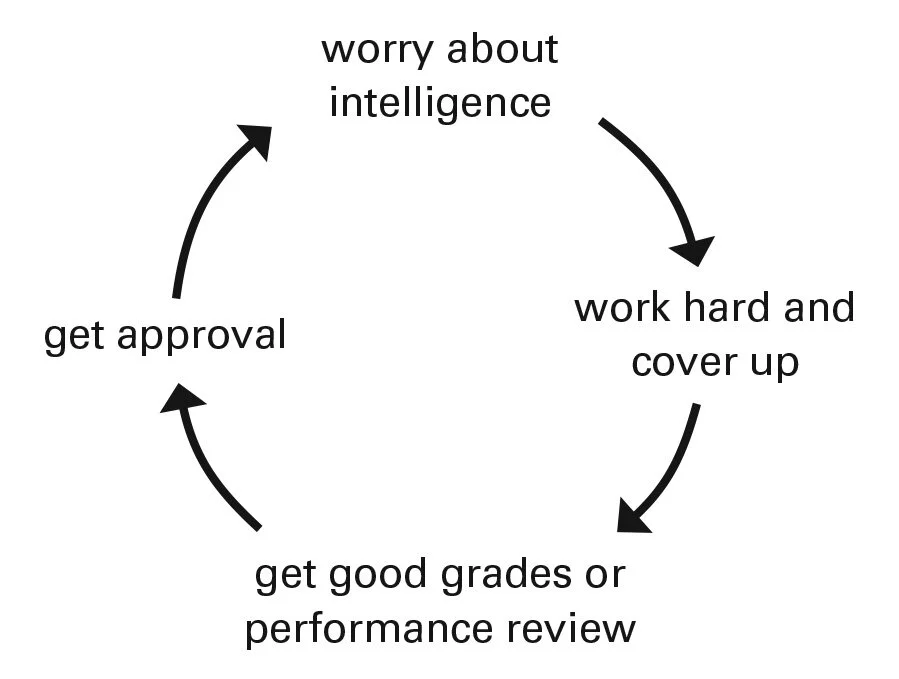
Receiving the praise would result in temporarily feeling good and at that point, once the good feelings subsided, they returned again to worrying about intelligence or ability to perform. Within this cycle, there is no internalization of the successful experience. The accomplishment isn’t accepted as part of their identity or attributed much value, so the next time they perform, it’s as if the previous accomplishments never existed. Thus, the cycle begins again. In more recent research, it has been revealed that people do not only engage in hard work in that second stage but can go in the opposite direction with self-sabotage. This is most commonly seen when someone with impostor syndrome procrastinates, usually due to anxiety about performance and perfectionism, as they attempt to unveil themselves as an impostor.[7] The belief is that the procrastination serves as a method to expose their status as an impostor, perhaps in hopes of releasing the stress and strain of it. However, they usually still perform well. But any mistake is interpreted as proof of their inadequacy due to their perfectionism, rather than as an artifact of being human, or of not giving themselves enough time to review the work.
The experience of self-sabotage can sometimes be hard to detect as it’s often connected to the performance anxiety, and this anxiety makes it difficult to tease out what has occurred. It can be seen in spontaneous and impulsive decisions to go against a plan, trouble organizing for high-stress events, or other subtle behaviors that affect preparedness, confidence, and performance.
In this example of Brenda, a school teacher, you will see how tiny choices influenced by anxiety serve to reinforce the performance issues and the impostor experiences:
Brenda is a fourth-grade math teacher who sought counseling due to her unhappiness with her current job of five years. She wants to explore other job options. In fact, she dreads going to work every day.
During our first session, Brenda was very tearful about her dissatisfaction but believed that she did not have many options. Although she has received countless positive performance reviews, Brenda did not regard herself as a good teacher. Rather, she thought that because she was so good-natured, people really liked her and gave her positive scores on her performance reviews.
As our work progressed, we were able to identify Brenda’s impostor syndrome and her self-sabotage tendencies that result from it. For instance, on the day of her teacher observation, Brenda covered a different lesson, one that should have been taught in three weeks, rather than the one she had prepared for the observation. As might be expected, the students were a bit lost and were not able to keep up. Brenda was certain that her observation went poorly and she would finally be revealed as an unskilled and incompetent teacher. However, the teacher who conducted her observation was highly impressed with Brenda’s poise and her ability to engage her students despite the material being a bit advanced. She gave Brenda a positive review.
In another instance, Brenda had to call in sick on the day of her interview for another role. The school where she was to interview, however, wanted to meet her so badly that they immediately rescheduled her interview based on her availability. Brenda went on the interview and was offered the role. Unfortunately, she turned it down, because she did not yet feel ready to leave.
2. Intellectual Inauthenticity
The second characteristic of impostor syndrome that Clance and Imes illustrated is intellectual inauthenticity, or the downplaying of knowledge, skills, or abilities, or not revealing true opinions of a situation in order to protect someone else’s feelings or preserve the relationship. When someone with impostor syndrome behaves like this, it only furthers their belief that they have engaged in some form of deception, exacerbating the feelings of being fraudulent. The kind of relationships that this intellectual inauthenticity might preserve are those with people who demonstrate narcissistic characteristics (e.g., needing excessive praise and not being able to tolerate critique or dissent) and/or have a fragile sense of themselves and their accomplishments. These can be dangerous people for those with impostor syndrome to connect with. You can see this as illustrated in Elise’s ongoing experience at the company where she has been a longtime employee:
Elise has been an office administrator at the same institution for 25 years. She has watched leaders come and go and has a significant level of understanding of the company’s history as well as an unusual expertise in the subject matter, for her position, because she has been so intimately involved in the company’s evolution. Every time another CEO is hired—and there have been many—she struggles to share her content and cultural knowledge because she senses their fragility and notices their desire to be the most knowledgeable person in the room, even though they are brand-new. In each experience with a new CEO, she becomes terrified that she will be fired because she will be seen as incompetent and outdated in her knowledge and skills.
3. Charm and Perceptiveness
Intellectual inauthenticity is often combined with a third behavior, which is utilizing charm and perceptiveness. In their ability to get people to like them and potentially advocate for them, those with impostor syndrome can feel like their ability to fool people extends beyond their intellectual capacity.
People with impostor syndrome can also exhibit high emotional intelligence. They are particularly keen at understanding what others need to make them feel valued and connected to them. They may utilize these skills, especially with mentors and senior leaders to generate positive evaluations of their behavior. However, a mentor who is not benevolent, and perhaps narcissistic as mentioned earlier, may exploit their yearning for connection and praise to maximize their performance. The potential for a truly dysfunctional relationship is highly likely in these cases. The person with impostor syndrome can find themselves in a situation where the mentor or supervisor makes them feel like they ARE truly an impostor and must constantly and unendingly prove themselves. These types of relationships become very hard to break because the person with impostor syndrome may feel as if their ineptitude has been found out, so they continually seek some sort of validation from someone who will never or very rarely provide it, because it keeps the person with impostor syndrome working hard for them.
4. Seeking Mentorship for the Purpose of External Validation
The final behavior that maintains the impostor syndrome is seeking a mentoring relationship from someone, who is well respected in their field, industry, school, or office, in order to gain external validation. But this relationship may be fraught for the person with impostor syndrome for the reason discussed above, or because it can feel inauthentic if the person with impostor syndrome believes they charmed the mentor into positive feedback because they think it has been acquired through duplicitous means (e.g., through charm).
In this example, Sam believes that his positive relationship with mentors and senior leaders has caused them to promote him unjustly, which creates fear and discomfort with his new role:
Sam just got his 3rd promotion at a technology start-up where he has been working since almost right out of college. He’s terrified about the new role and feels he is out of his depth. Everyone at his new level is at least 10 years older than him and have been at big impressive tech giants. Sam is convinced that he is sitting in this seat because he is just very good at getting along with his bosses. He feels like he may have accidentally convinced them simply with his social acumen that he can take on these new roles. In spite of consistent glowing performance reviews from different supervisors, which he believes are inflated, he is terrified of falling on his face in this new job.
In addition, it has been shown that people struggling with impostor syndrome have lower levels of job and career satisfaction, yet higher levels of organizational commitment. So, while people with impostor syndrome tend to be more unhappy in their jobs and careers, they are also likely to commit to these places that are making them unhappy, perhaps in an effort to create some sense of stability and predictability in terms of evaluation. Further, the research also indicates that people with impostor syndrome struggle with marketing themselves, which is critical for job searching or networking. Therefore, their salaries and promotions are usually negatively impacted, which can be seen in lower salaries and fewer promotions. It also shows up in being less optimistic about their career and being less adaptable when things go wrong. Moreover, those with impostor syndrome are likely to have a reduced knowledge of the job market, which makes taking a leap to a new role when they are unhappy even more difficult.
Throughout our experience working with impostor syndrome, we have seen it show up in the following ways that affect professional development:
Not understanding their worth (i.e., salary comps) in the marketplace
Fear of negotiating
Lack of motivation to leave stagnating roles
Reluctance to vie for promotion
Avoidance of high-visibility stretch assignments
Difficulty networking and communicating their accomplishments to others
Trouble envisioning their long-term career future
All of these behaviors of impostor syndrome have a significant impact on advancement, salary, and long-term earnings, but they can be reversed.
THE PROFESSIONAL IMPACT OF YOUR IMPOSTOR SYNDROME
What behaviors related to your impostor syndrome do you find yourself exhibiting? Give a concrete example of each to ground your response in an actual instance. List the behaviors and examples here:
-
-
-
-
-
Trait vs. State
People with impostor syndrome consistently ask, “Is this inherently who I am? Part of my character? Or can I really change this?” Impostor syndrome does not appear to be characterological (i.e., part of your personality) or a trait. It seems that there are certain experiences in family dynamics, beliefs about yourself, and roles that you tend to play that make it more likely for you to have the propensity to struggle with impostor syndrome. In other words, you were not born like this no matter what other people tell you or want you to believe.
You may struggle to let go of certain behaviors, thoughts, and feelings connected to impostor syndrome because of the belief that your current success or accomplishments are a result of these behaviors, and if you let them go, all will be lost. Behaviors such as overworking and perfectionism are the hardest to change—largely, we believe because they are reinforced in our environments. Today, it is very easy to “log back on” to your company’s systems when you go home and work inordinately long hours. If you do more work, get more done, push ahead of deadlines, certainly no one at work is going to reprimand you or tell you to work less, and you are likely going to get the praise you are seeking for being a good, worthy employee. However, it is exactly this behavior that reinforces the impostor syndrome and the ideas that you are not naturally talented and therefore, must give more to be on par with everyone else. Hearing that “mistakes are costly” and seeing colleagues and others around you criticized when they make an error also supports perfectionism. These behaviors can also feed on each other. When people are perfectionistic, they often struggle to delegate tasks and manage down well (i.e., manage direct reports or junior colleagues) because they are concerned about how their colleagues’ work product will reflect on them. Thus, they often overwork, doing their job as well as a ton of other people’s jobs, which often leads to burnout and resentment.
As we work on your impostor syndrome, you will have to constantly keep in mind that aspects of impostor syndrome, like overworking and perfectionism, are not badges of honor. Instead, they are blocks to fully appreciating all your skills and abilities. They are a mask covering your talents, skills, and experiences rather than the reason you have succeeded. Do not allow yourself, your self-esteem, or your personal life to be at their mercy.
Ways to Release Perfectionism
Focus on “good enough” not perfect.
Recognize that perfectionism hurts you and those around you.
Be proud and accepting of your humanity.
Only compare yourself to you.
Find comfort in choosing your own path.
Learn to accept the beauty of compromise.
Choose standards that feel reasonable.
Appreciate mistakes provide opportunity for growth.
Realize that perfection is unattainable and reaching for it makes you feel like a failure.
Gender Differences
While the research does not show that impostor syndrome is significantly more prominent in men or women, it does suggest that there may be gender differences in the way that it manifests. As discussed earlier, men demonstrate a tendency toward underperforming, avoiding goals and feedback, and using peers who are less skilled as a comparison group when they are struggling with impostor syndrome. This then affects them by decreasing the likelihood for promotions and advancement over their lifetime, and reducing salary.[8] Men may feel a pull to save face and to conform to gender norms by doing work that they know how to do and will be successful at, rather than take the chance of failing and suffering the resulting self-esteem blow. Coping with the impostor syndrome by underperforming also reduces the feelings of anxiety, fear, and discomfort that impostor syndrome induces because there are fewer chances of feeling like an impostor.
For women, it’s quite the opposite. Women seem to take the leap into the challenge, which often heightens the impostor syndrome. Women who struggle with impostor syndrome spend more time on academic tasks than those without impostor syndrome,[9] work harder when they receive negative feedback,[10] and have higher GPAs than men with impostor syndrome.[11] A 2018 study by Lauren A. Blondeau and Germine H. Awad,[12] found that having low self-efficacy and impostor syndrome did not impede a woman from pursuing a STEM career. Her GPA and interests were more influential to her choice. When men had high impostor syndrome scores in the study, they were less likely to pursue a STEM career. This shows a definite tendency for women to be counterphobic (i.e., facing fears directly) when it comes to impostor syndrome fears, which leaves them steeped in the constant experiences of feeling like an impostor.
In both ways of coping, the significant impact of impostor syndrome on your future and current functioning is pretty clear. Either you get the relief immediately by underperforming and avoiding or you are counterphobic and experience all the intense impostor feelings as you continue to accomplish, but don’t get the relief because you discount these successes, which leaves you constantly under the weight of the impostor syndrome. Hopefully, this makes it really clear why building your skills around dismantling the impostor syndrome is incredibly important to you and your future so that you can own your greatness, live up to your potential, and enjoy it.
WHAT IS YOUR TYPICAL IMPOSTOR RESPONSE?
In this space indicate whether you tend to avoid or engage the tasks that you fear due to your experience of impostor syndrome. Then consider if/when you notice the alternative response. For example, I tend to engage the tasks that prompt impostor syndrome, but if there is potential for conflict in the task, then I will tend to avoid it.
The Impact of Culture
Impostor syndrome becomes harder to cope with when the stereotypes about your cultural group reinforce the notion that you are not “good enough.” In marginalized communities, when your mere presence evokes concern that you have been given special treatment to be present in certain environments, the environment is telling you that you are an impostor. This makes overcoming your impostor syndrome particularly difficult because your accomplishments are actively disqualified (e.g., “you only attended that school because of affirmative action” or “they needed to diversify the team”). These are things you not only hear, but also experience when an organization further supports the idea that you are an impostor by over- or underutilizing you (e.g., not staffing you on important and internally visible teams or projects despite demanding your presence for public-facing pictures or for diversity initiatives). These types of microaggressions and microinsults at work can lead to entrenching the impostor syndrome because the external proof that you need to show yourself that you are not an impostor is harder to find.
Similarly, the concept of “stereotype threat” is useful to understand here as well. Stereotype threat is conforming to a well-known stereotype of a group you belong to when someone invokes the stereotype. In a very famous seminal study of stereotype threat conducted in 1995 by Claude Steele[13] from Stanford University and Joshua Aronson of University of Texas at Austin, these researchers found that Black college students scored significantly worse on standardized testing when they were told by an examiner that Black students would complete fewer questions and that it was an assessment of personal qualities. When the Black students were simply given instructions for the standardized tests, they scored similarly to the White students in the study. What Steele and Aronson, as well as hundreds of other researchers, were able to establish is that evoking a stereotype, sometimes even without words, can create diminished performance. Stereotype threat has been thought to contribute to gender and racial academic achievement gaps.
Now, imagine someone with impostor syndrome and from a marginalized group experiencing this stereotyping. This further impacts her performance as well as her anticipation of performing, perhaps further cementing the thoughts and insecurities that underlie impostor syndrome. Research has suggested that overcoming impostor syndrome for marginalized groups requires, besides the steps that we will cover in this book, a connection to and the ability to embrace the marginalized identity and the people who are similarly identified. It means not only connecting with those similar to you in this identity group, but also believing the counter narrative to the stereotype.
For example, if you are Black, the stereotypes that you are not academically capable have a long history of being ingrained in a cultural understanding of who deserves to be in the room and of meritocracy. Those beliefs are so perpetuated that often they are internalized by Black people, leading to beliefs that question other Black people’s worthiness, academic ability, and intellectual rigor. To overcome impostor syndrome, you have to work to connect with other Black people and the belief that their worthiness is not in question. When you question the competence of other people with similar salient identities, you challenge your own (even if only on an unconscious level). When you can believe in their competence and give them the benefit of the doubt, you can believe in your own.
Besides race and gender, various other identities (e.g., religion, immigration status, sexual orientation, economic, and veteran status), as well as the intersectionality and salience of particular identities, should be considered as you examine how identity has impacted your development of impostor syndrome. For example, if you are a recent immigrant, you may want to understand the relevance of your immigration journey on the experience of feeling fraudulent in certain circumstances, especially if you have felt that this identity impacts your ability to internalize your accomplishments.
In this chapter, we have outlined the characteristics that underlie impostor syndrome and examined how it may manifest differently based on gender. We have also laid out the additional cultural aspects of overcoming impostor syndrome and how it can apply to a marginalized group, where competence is questioned as a result of stereotypes. Now, it’s time to examine the important aspects of impostor syndrome that are most relevant for you.
THE KEY FEATURES OF YOUR IMPOSTOR SYNDROME
Review signs of impostor syndrome on page 1 as well as any other salient components of impostor syndrome that you have. This can include any potential gender, racial, ethnic, or other identity considerations. List them on the next page.
YOUR IMPOSTOR SYNDROME INTENSITY
After you have completed your own assessment of the features of impostor syndrome that are specific to your experience, take Clance’s test for impostor phenomenon, which you can find here.
Once you have scored your assessment, circle your current level of impostor feelings:
FEW MODERATE FREQUENT INTENSE
Reviewing your current level of impostor feelings is helpful in understanding the present impact of impostor syndrome on your life and career. If you score in the few to moderate range, this may be a great time to tackle the book because you are not feeling impostor syndrome in its most pressing state. This will allow you to look back at experiences when your impostor feelings were more powerful, and analyze and review them from a distance. If you are experiencing impostor syndrome at the frequent to intense range, this likely suggests that impostor syndrome is quite salient for you right now. You may have plenty of experiences that are coming up for you that you will be able to pull from and directly impact as you work through this book.
The 3 C’s Strategy to Overcoming Impostor Syndrome
Overcoming impostor syndrome can be a challenging proposition, especially when faced with a stressful work or personal environment. It may feel impossible to eliminate these thoughts and feelings of being a fraud, and you may always be on edge about being exposed.
Jocelyn was someone who constantly had such feelings. She was a management consultant who had worked in her field for several years and was on the partner track. Jocelyn worked long hours and traveled extensively. She had no social life and rarely saw her family, with whom she was very close. She came to seek coaching because she was thinking about making a career change. Despite receiving glowing performance reviews every year, Jocelyn felt like an impostor and was always concerned that she would be fired or be asked to leave her firm. Her manager would often tell her how well she was doing, but it did not convince her. She dreaded Mondays because she anticipated the miserable commute, the constant anxiety during her work hours, and the grind of the day. During the course of coaching, we identified that a good deal of her work stress was due to her impostor syndrome. Until we named it as such, Jocelyn thought these feelings of self-doubt were just part of her personality and could not be changed. She was relieved to find out that it was something that could be addressed and changed.
Fortunately, we developed the 3 C’s (Clarify, Choose, and Create) Strategy, which helped Jocelyn and can also help you alleviate fears and self-doubt, and vanquish your impostor syndrome. This chapter will provide a brief overview of the 3 C’s Strategy, and subsequent chapters will explore each phase of the strategy in more depth, with corresponding activities to help you master its application to live your best life possible.
We have used the 3 C’s Strategy as a framework during our more than 15 years in practice to help our clients overcome impostor syndrome. While impostor syndrome is not a diagnosable disorder, we have found that by using the 3 C’s strategy, our clients are able to diminish their impostor syndrome thoughts, feelings, and behaviors to improve the quality of their work and personal lives.
The 3 C’s Strategy involves reflecting on all aspects of your life, some of which you may not have considered (e.g., your self-constructed narrative), as well as clearly identifying factors that may have influenced the development of your impostor syndrome (e.g., family dynamics). It also prompts you to actively engage with others about your impostor syndrome rather than suffering with it in silent shame. While you may periodically have those impostor syndrome thoughts and feelings, applying the 3 C’s Strategy will cause them to occur less frequently and have less of an influence on your behavior.
Each of the three phases of the 3 C’s Strategy contains three steps, for a total of nine steps. When working with our clients, we tend to move through the phases in a sequential manner, with tangible activities to complete in each area. There is no set time period to move through the phases, but it is important to remain consistently focused on the tasks required for each phase. Such consistency will facilitate your ability to apply the strategy for its maximum effectiveness.
The 3 C’s Model
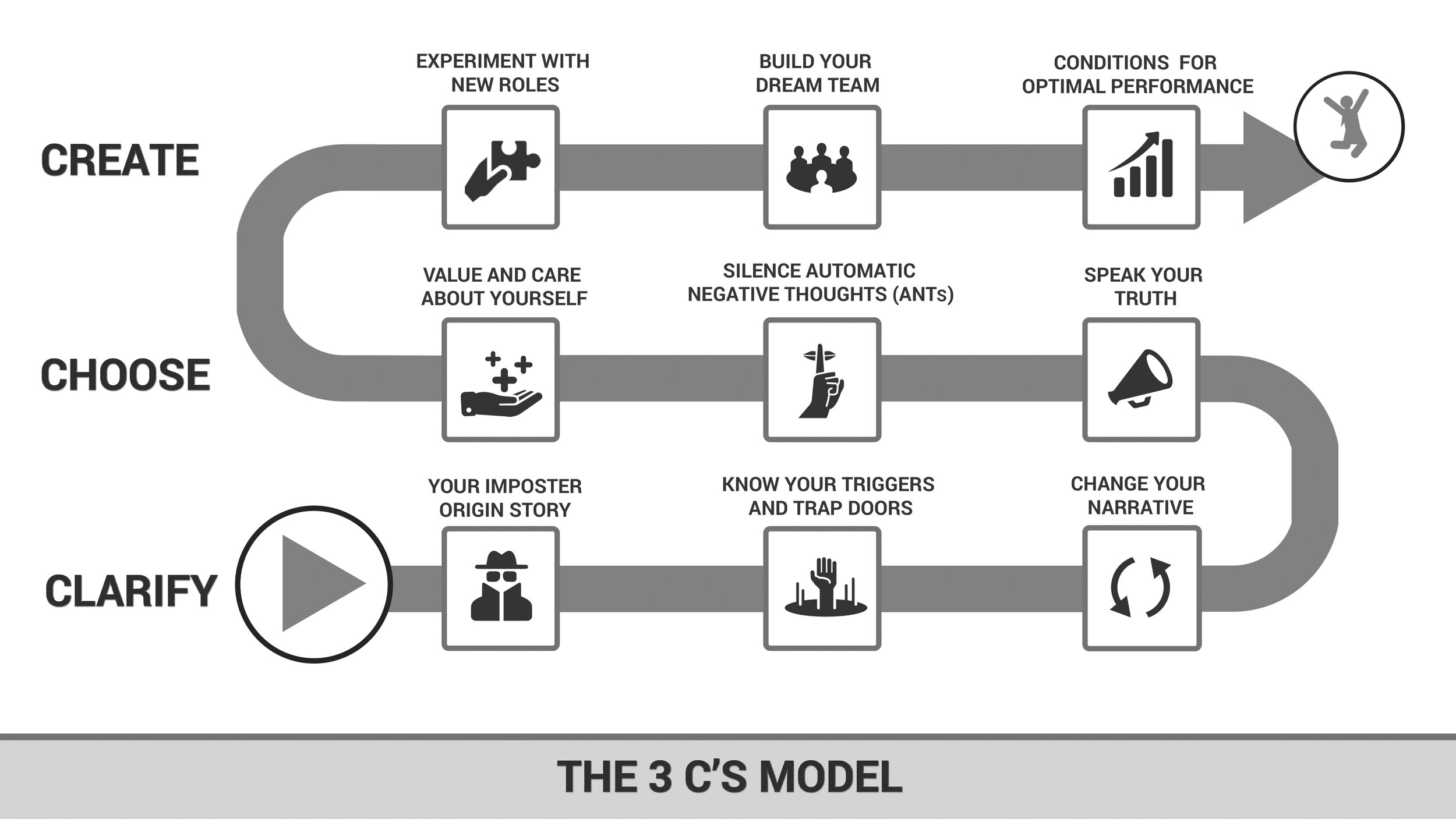
The 3 C’s strategy will be a key tool to help you overcome impostor syndrome. By progressing through each step within each phase, you will build confidence, change your thinking, create a more positive narrative, and finally own your greatness. When your impostor syndrome rears its ugly head, you will be well-equipped to spot it, neutralize it, and continue on your road to living in the glory of your accomplishments and excitement about your future.
Chapters 2 through 4 will review Phase 1 (Clarify) and the first three steps of the 3C’s strategy, which are knowing your origin story, identifying your triggers, and changing your narrative. Chapters 5 through 7 will examine Phase 2 (Choose) and the next three steps, which are speak your truth, silence automatic negative thoughts, and value your self-care. Chapters 8 through 10 will cover Phase 3 (Create), and the final three steps of the 3C’s strategy, which include experimenting with new roles, establishing your dream team, and understanding the optimal conditions for your success.
In these next chapters, we are going to outline our program for overcoming your impostor syndrome. We will lay out the 3 C’s Strategy to put an end to the way that impostor syndrome impacts your life, your view of your accomplishments, and your performance and advancement. We are going to help you to feel a sense of control and a reduction in fear of being revealed as a fraud. Once you can really own your greatness, you are going to be unstoppable!
KEY TAKEAWAYS
You understand the key components of impostor syndrome.
You comprehend its impact on career and work.
You have learned how gender may impact impostor syndrome.
You see how stereotyping around culture and identity can impact the perpetual impostor syndrome.
You have evaluated your own level of impostor syndrome.
You understand the brief overview of the 3C’s Strategy.
Sources:
[1] Clance and Imes, “The Impostor Phenomenon in High-Achieving Women,” 241–47.
[2] Gravois, “You’re Not Fooling Anyone,” in If I’m So Successful, Why Do I Feel Like a Fake? eds. Joan C. Harvey and Cynthia Katz (New York: Random House, 1985).
[3] Cozzarelli and Major, “Exploring the Validity of the Impostor Phenomenon,” 401–17; McGregor, Gee, and Posey, “I Feel Like a Fraud,” 43–48.
[4] Cromwell et al., “The Impostor Phenomenon and Personality Characteristics,” 563–67; Bernard et al., “Applying the Big Five Personality Factors,” 321–33.
[5] Chayer and Bouffard, “Relations between Impostor Feelings and Upward and Downward Identification,” 125–40.
[6] Tao and Gloria, “Should I Stay or Should I Go?” 1–14.
[7] Chayer and Bouffard, “Relations between Impostor Feelings and Upward and Downward Identification,” 125–40; Yuen and Depper, “Fear of Failure in Women,” 21–39.
[8] Kumar and Jagacinski, “Impostors Have Goals Too,” 147–57; Neureiter and Traut-Mattausch, “An Inner Barrier to Career Development,” 37–48.
[9] King and Cooley, “Achievement Orientation and the Impostor Phenomenon,” 304–12.
[10] Badawy et al., “Are All Impostors Created Equal?” 155–63.
[11] Cokley et al., “The Roles of Gender Stigma,” 414–26.
[12] Blondeau and Awad, “The Relation of the Impostor Phenomenon to Future Intentions,” 253–67.
[13] Steele and Aronson, “Stereotype Threat.”
Watch Lisa's workshop on Create & Cultivate IGTV to learn more and discover the steps to overcoming imposter syndrome.

Own Your Greatness: Overcome Impostor Syndrome, Beat Self-Doubt, and Succeed in Life
MORE FROM THE BLOG

The Top 3 Questions From Our Money Moves Slack Channel—Answered
ALLY financial gives you some tips that may help you prepare for your financial future.


Photo: Vlada Karpovich from Pexels
What is your relationship with money? Do you budget and plan ahead or do you live in the moment and spend more than you save? Either way, we need to get better at talking about it if we ever want to be better at managing it (and eventually having more of it)—especially when you consider that globally, women drive 70 to 80% of all consumer purchasing.
Now, more than ever, we need to help women plan ahead, to take ownership of their money, and to become masters of their own financial futures. To do that, we teamed up with during our recent Money Moves digital summit for a live discussion on how we can plan it forward and have confidence in our financial well-being.
After the chat with our CEO and founder, Jaclyn Johnson, we opened it up to a live Q&A so attendees could ask our panelists, Lindsey Bell, Chief Investment Strategist of Ally Invest and Emily Shallal, Sr. Director for Consumer Strategy and Innovation of Ally Bank all of their burning money questions—and you didn’t hold back. In fact, the questions kept coming even after the live discussion had ended in our dedicated Ally slack channel.
So, we decided to compile a list of some relevant questions we received and asked both Bell and Shallal answer them for you. Read on to learn more about how you can plan it forward and be sure to let us know what money topics you want to learn more about in the comments below.
1. What about social impact investing? Do you have recommendations on resources for this? How I might educate myself? I want to be able to dictate where my money goes and what types of businesses I’m supporting through my investments. Where do I start?
LINDSEY: This has become an important factor for many people as they invest. For sources of education, I like this guide CNBC put out (includes examples of different funds that focus on ESG investing). If you really want to really dig into the trend, check out The Forum For Sustainable & Responsible Investment, they have a ton of research and information you can dig through.
Just keep in mind that those resources are for informational and educational purposes only, and the information provided does not represent an investment recommendation or investment advice by Ally Invest.
“Reviewing your current situation as well as the risk of losing current income is the first step in making any decision. — Lindsey Bell, Chief Investment Strategist, Ally Invest”
2. Would you suggest re-adjusting your financial goals for the year or just figure out other ways to make your original goals?
LINDSEY: This is tough because it is a personal question. Reviewing your current situation as well as the risk of losing current income is the first step in making any decision. Instead of changing your goals or changing your life to meet those goals, it might make more sense to push those goals out while you weather the current storm. Writing out what your goals are and the options you have to reach those goals could be helpful in making the decision.
EMILY: If things haven’t changed for you and your income and expenses are still relatively the same, then keep your original goals. If your income has taken a hit and you think it’s likely to have long term consequences then you may want to readjust your goals. Sometimes with all of this uncertainty, working with shorter-term goals can be more manageable. Take your longer-term goal and break it down into monthly goals—what can you do in the next 30-days? This can be motivating and give you some emotional happiness that you’re still working on (and hitting) your financial goals.
“Paying off high-interest debt is usually always the right choice. But the right choice today has to factor in your job stability and your emergency fund. — Emily Shallal, Sr. Director for Consumer Strategy and Innovation, Ally Bank”
3. During these crazy times, do you think it's wiser to pay down your credit card debt or stick with the minimums and put money in savings?
EMILY: In these uncertain times, standard financial advice isn't always the best choice. Paying off high-interest debt is usually always the right choice. But the right choice today has to factor in your job stability and your emergency fund. If you have a large emergency fund, you probably want to pay down your debt. But if you don’t, you may want cash if you’re worried about job stability or are really uncertain about the future. The good thing is that if you don’t need those savings when we emerge from this crisis, you can use that money to pay down your credit card debt.
MISSED THE MONEY MOVES SUMMIT? WE GOT YOU!
READ THE TOP QUOTES FROM ALLY x MONEY MOVES FINANCIAL WORKSHOP BELOW:
On prioritizing yourself…
“If you don't pay yourself first, you're always going to feel like you’re a step behind.” — Emily Shallal
On having an emergency fund…
“You never want less than three months of income sitting in your savings account.” — Emily Shallal
On investing in the stock market…
“Research shows investing in the market may be a good way to get a return on your money.”
“Start small. You don’t have to put your life savings into the stock market on day one. Start with something that you know. You have to do your homework on the company.”
“You want to get used to what the market feels like, the daily ups and downs, and the volatility of the market.” — Lindsey Bell
On putting money into a 401k…
“Once you start small, you’re going to see this momentum, you’re going to see that balance start to grow and you’re going to get excited about it.” — Emily Shallal
On adapting during COVID-19...
“Innovation and iteration are part of the business process and it will take you places you never thought you were going to go.” — Emily Shallal
On finding the right financial advisor...
“Working with a financial advisor is like working with a therapist because you really need to get along with your financial advisor.” — Lindsey Bell
On finance resources to read...
“If you’re looking for just solid information, anything by Warren Buffett. The Wall Street Journal is also a great resource for building your financial acumen.” — Emily Shallal
“The Intelligent Investor by Benjamin Graham will give you a great perspective about the market.”
— Lindsey Bell
On the meaning of success...
“Success doesn’t have to be a destination. It’s about being a better version of yourself every day.”
— Emily Shallal
To see what Ally has to offer, visit Ally.com
MORE ON THE BLOG

Hey, C&C Campers! Here's What to Expect at Our Digital Summer Camp
Welcome to our version of a “working vacation.”

Photo: Create & Cultivate
Here at Create & Cultivate, we know the importance of some good old-fashioned fun—but we also know that you’re always looking for ways to further your career and build your business, whether you’re soaking up the sun on the beach or leading a meeting in the boardroom. That’s why we’re redefining the meaning of a working vacation with a jam-packed digital summit filled with real-talk panel discussions, impactful workshops, virtual networking with fellow C&C campers, and a mentor power hour with the best in the biz.
As you know, we always bring our A-game but our lineup for Saturday, June 13 is stacked. BK Yoga Club is kicking off the morning with a live yoga session, Danielle Fishel Karp is taking the virtual stage to talk about switching lanes from entertainer to clean beauty entrepreneur, Chloé Watts of cholédigital is leading a must-watch workshop on building content marketing funnels, Farnoosh Torabi is sharing tips for leveraging a podcast to build a brand, and Brad Goreski is pulling back the filter on the fashion industry. Not to mention, nostalgia-inducing workshops that’ll enable you to stretch those creative muscles, real-time digital networking opportunities, and so much more. You don’t want to miss this one!
Read on to discover everything we have in store for this jam-packed day, and if you haven’t already, be sure to buy your ticket ASAP!
THE DATE
Saturday, June 13, 2020
TUNE IN FROM HOME
First things first! On Saturday, June 13, you’ll receive an email with your link and password to access the exclusive Summer Camp site. Please note: All content will go live on Pacific Daylight Time (PDT), including the launch of the exclusive Summer Camp site. To find out what time a session is happening in your time zone, use this handy time zone converter.
Summer Camp is made up of pre-recorded video sessions hosted via Vimeo and live video sessions streaming via Zoom. We recommend that you have a strong WiFi connection and find a comfortable place to tune in from home. Summer Camp is optimized for desktop, so it is best viewed via a computer or laptop, rather than a tablet or phone.
While the live content is specifically designed to be watched in real-time, you’ll be able to access and view it until Friday, June 19 at 5pm PDT (Insiders, you have all-access even after the cutoff via your C&C Insiders dashboard!). Tickets will be available to purchase until June 19 at 5pm PDT.
THE SCHEDULE
Summer Camp is built just like our in-person conferences, which, of course, you all know and love. We have a stacked schedule with an A-list line-up of speakers so we suggest taking notes along the way.
Want the full lineup? Check out the play-by-play schedule to map out your big day. Please note, all times are listed in PDT (Pacific Daylight Time), as C&C headquarters is located in sunny Los Angeles. To find out what time a session is happening in your time zone, use this time zone converter.
It’s going to be HUGE so we recommend getting a head start on planning out your day now. Download this handy checklist to keep track of the pre-recorded video sessions and this checklist to keep track of the LIVE video sessions to make sure you don’t miss anything.
THINGS TO PREP AHEAD OF TIME
Here are a few things to prep before the big day so it goes off without a hitch:
Make sure you have a strong WiFi connection.
Install Zoom on your desktop computer or laptop and test it out.
Zoom tips:
Find a quiet place to tune in. Try to situate yourself in a small room that does not have an echo.
Try and stay away from noisy electronics and silence your cell phone and computer notifications for an optimal experience.
When possible, limit your internet connection to solely the device you’re using for the Zoom conference.
Set your phone to airplane mode, pause your television connection, ask others in your home to pause anything that may require a strong internet connection, etc.
Set aside your athletic gear and your mat (or towel) and fill up your water bottle for our morning moves session with BK Yoga Club. No equipment needed!
Gather the ingredients you’ll need to make an immunity-boosting smoothie during the breakfast workshop with Weelicious. Get the ingredients list and the recipe here!
Purchase the supplies you’ll need in order to follow along with the workshops in real-time if you’d like! You can find shoppable supplies checklists for each workshop here. Scroll down to The Schedule and click on the “Supplies Checklist” below each workshop to open up PDFs with shoppable links.
Download the workshop downloads so you can follow along with the expert in real-time. Note: Your exclusive workshop downloads will be available on Saturday, June 13 via the exclusive Summer Camp site, which you will gain access to on the day-of.
Take the What Is Your Instagram Content Creator Type Quiz prior to the Content Coordination: How to Plan Your Content and Build Instagram Workflows for Your Creative Type workshop powered by Tailwind.
Peruse the list of mentors who will be answering questions in real-time in hour-long Zoom webinars and choose your mentor(s).
We have experts in everything from raising money to creating engaging content to growing a dedicated following on social media. If there’s more than one mentor you want advice from, don’t worry! You can hop from session to session over the course of the hour if you’d like.
Don’t forget to jot down any questions you have for the mentor sessions ahead of time! You’ll be able to ask your Qs in real-time by typing them into Zoom’s Q&A feature.
GET SOCIAL
Stay tuned for exciting announcements and updates by following along on our social at @createcultivate.
To access our custom Summer Camp IGS filters, head to @createcultivate on Instagram and click on the smiley face icon beneath our bio, or open your camera in Instagram and click on “browse effects” and search with keyword “createcultivate.” You can also search “ccsummercamp” on Instagram to use our custom GIFs.
Don’t forget to tag @createcultivate and use the hashtag #CCSummerCamp for the chance to be featured in our Instagram Stories throughout the day!
NETWORK
Networking is a huge part of our event and our Create & Cultivate Summer Camp Attendees Slack Workspace is a great place to mix and mingle with your fellow Create & Cultivators before, during, and after the big day. We’ve created channels for every workshop and panel, as well as channels for international attendees, networking, and more!
Attendees will receive a link to access our Create & Cultivate Summer Camp Attendees Slack Workspace in our What to Expect newsletter on Wednesday, June 10. This Slack channel will remain accessible until Friday, June 19 at 5 pm PDT. Not familiar with Slack? Here are a few tips to get you started:
Download the Slack app to your phone, computer, or both
Complete your account profile with a profile photo, your name, and what you do
Public conversations will happen in the channels (ex: #networking) and are located on the left-hand side of the app. You can also start direct messages with others in the Slack workspace
Hit send too early on a message? Slack has an edit feature! Click the three-dot icon located on the right side of the message to open the drop-down of message options
We’re all about GIFs at C&C! Here are instructions on how to integrate GIPHY into your Slack account.
Our Slack workspace is a busy, happening place on the day of the event. Streamline the notifications you receive by using the “mute” feature on channels that don’t pertain to you. To mute a channel, simply open up that channel, click the three-dot icon labeled “more,” and select the mute option
Most importantly, be kind and respectful of others. If you don’t follow this rule, you will be removed from the Slack group
If you have any questions on the day of the event about navigating the schedule, accessing the workshop downloads, or anything else, you can drop them into the customer service channel in Slack.
C&C INSIDERS’ PERKS
Our Insiders get a ton of perks at all our events—and our Digital Summer Camp is no exception. As an Insider, you get free admission and you’ll have access to all of the panels and keynotes after Friday, June 19 at 5pm PDT via your C&C Insiders dashboard. Not an insider yet? Don’t miss out—you can sign up here.
VIRTUAL GIFT BAGS
We know you want ‘em! Get your inbox ready for gift bags and promo codes from some of your favorite brands, including The Sill, Janessa Leoné, Golde, Be Free by Danielle Fishel, Weelicious, Atarah Avenue, Style Rituals, and more.
TECHNICAL DIFFICULTIES?
Live chat with a C&C specialist on CreateCultivate.com. You’ll see a “Chat With Us” pop-up in the bottom right corner of your screen.
WE ARE SO EXCITED TO SEE YOU ONLINE! Who are you most excited to hear speak? Which workshop are you looking forward to most? Tell us in the comments below!
MORE ON THE BLOG
This Founder's Curly Hair Salon Is Helping Women and Girls Love Themselves Just As They Are
“Our goal is to change the world one curl at a time.”

We know how daunting it can be to start a new business, especially if you’re disrupting an industry or creating an entirely new one. When there is no path to follow, the biggest question is, where do I start? There is so much to do, but before you get ahead of yourself, let’s start at the beginning. To kick-start the process, and ease some of those first-time founder nerves, we’re asking successful entrepreneurs to share their stories in our new series, From Scratch. But this isn’t your typical day in the life profile. We’re getting into the nitty-gritty details—from writing a business plan (or not) to sourcing manufacturers and how much they pay themselves—we’re not holding back.

“
Marketing is important, but not more than the quality of what you’re offering and the customer service experience. Word of mouth is GOLD.
”
—Carolina Contreras, Founder and CEO, Miss Rizos
Disrupting an industry isn’t easy.
Just ask Carolina Contreras, who decided to open a curly hair salon in New York City the very same year that New York state legally banned discrimination based on hair texture at work and in schools. The law, which went into effect in 2019, marked a long-overdue step in defining mistreatment based on hair texture or style as racially discriminatory, especially when you consider that Black women are 1.5 times more likely to be sent home from the workplace because of their hair.
“Miss Rizos is a curly hair salon that helps women and little girls love themselves just as they are,” the founder and CEO explained during our Digital Money Moves Summit pitch competition, which awarded a $10,000 grant to the deserving small business owner. “We use not only our curly hair salons but also our social media presence to redefine beauty standards and create a more inclusive picture of what it means to be beautiful. Our goal is to change the world one curl at a time."
In this installment of From Scratch, Contreras shares the nitty-gritty details behind what it really takes to get a business off the ground, including what it took for her to self-fund the company at the beginning (spoiler alert: all her savings) and how COVID-19 has impacted her brick-and-mortar business.
CREATE & CULTIVATE: Did you write a business plan?
CAROLINA CONTRERAS: When I first started my business, I wasn’t sure what I was doing. I knew we needed a mission, vision, and values, so my little tiny team of two (my best friends, btw) and I took a two-hour car ride to our favorite beach town in the Dominican Republic, Las Terrenas. There, we hashed out all of our ideas and goals for a curly hair haven in a place where our hair wasn’t validated or celebrated. Before the salon, Miss Rizos was a blog, so we used this online platform as an inspiration for our space. I’ve written long- and short-term strategies for the business, but we are just now—five and a half years after opening—actually putting a real business plan together. I say, do it early if you, can because it will help you strategize and reach all of your business dreams.
How did you come up with the name Miss Rizos?
Originally, I named my blog Miss Rizos for a few reasons. First, there weren’t any curly hair beauty pageant winners, so calling it Miss Rizos (Miss Curls) was satirical. I also felt like my curls were adorning my head and making me feel powerful, sort of like a crown, and misses wear crowns at these pageants. The name Miss Rizos embodies this idea that I can make my own rules and define my own beauty.
What were the immediate things you had to do to set up the business? What would you recommend to new founders reading this?
I definitely trademarked the name first so that no one would use it. I registered the website the moment I thought of the name and created a social media handle I thought we could potentially use. Finally, defining the mission, vision, and values of a company is so important, and I recommend people actually spend time doing this because these principles will guide the way and help you make the best decisions.
What research did you do for the business beforehand? Would you recommend it?
I recommend benchmarking within and outside of your field. I love watching videos about digital marketing and really understanding the importance of the digital space in this very digital era. Finally, I would look at all of the administrative details of your company like permits, licenses, and tax information. Don’t let this stuff intimidate you from starting, just start!
“Insecurities, doubts, and fears will always exist, don’t let them paralyze you. Do it afraid. ”
How did you find the first hairstylists that you partnered with? Did you have any bad experiences? What did you learn and what advice do you have for other founders looking for trustworthy partners?
Omg, I’ve had my fair share of terrible experiences with business partners. USE CONTRACTS! Make sure agreements are legally binding and that you are incredibly transparent with all of the terms. Hire slow, fire fast. This means take your time hiring, do several interviews, and invite other people in the team or in your community to do interviews with you. Finally, hire and fire based on the values you defined for your company. It’s nothing personal, if someone doesn’t align with the values of your company, they will bring down team morale and potentially ruin a relationship with a client.
How did you fund the company?
I used a lot of my savings, actually all of my savings! I also pre-sold appointments and apparel using crowdfunding platforms. I have bootstrapped mostly, but a year ago, we acquired a new partner who also an angel investor. Again, this person’s values aligned with ours and our relationship has been incredible.
How did you determine how much to pay yourself?
I still struggle with this so much and hope to be able to make peace with it soon. I actually didn’t pay myself until like two years in. It’s really a symbolic payment more than an actual salary. I do have the business cover a lot of my expenses like phone, transportation, etc., and this is super important because it allows me to live a decent quality of life and be more present for my business.
I say, if you’re just starting, make sure you have savings that will support you for three to six months, so that you’re not putting a financial burden on the new venture. Then, it’s definitely important to create a salary or arrangement that will allow you to have peace of mind and concentrate on running the company. Finally, I say create a plan to get to that dream salary and work your way there.
How big is your team now, and what has the hiring process been like?
We started with the team of two, and now we are a team of nearly 40 people. As I mentioned before, hire slow, fire fast and let your values guide the way. I had lots of experience hiring from being a project manager in the nonprofit world for many years. Interviews should be a two way conversation and not an interrogation process.

Did you hire an accountant?
I hired an accountant late in the game and it cost me thousands if not hundreds of thousands! Get a CPA early in the game, learn the taxation system in your state and country. Get an online bookkeeping platform and keep all receipts and the books organized. When you can afford it, get a financial advisor who has experience with small businesses and can help you make sure your prices are right and identify what new strategies need to be implemented. Learn early what your point of equilibrium is, this is how much you need to make to break even. This will help you come up with a number of what you need to make a month, a week, a day, and even per hour. Be comfortable and in control of the numbers. It will empower you to make better decisions.
What has been the biggest learning curve during the process of establishing a salon business?
Definitely human resources. It’s not easy putting a dream team together.
How did you promote your company? How did you get people to know who you are and create buzz?
I created a community before I had a business and this helped tremendously. I also created a lot of buzz surrounding my activism, which got me a lot press. Social media has been instrumental, but more for my community-building than the actual random reach. Create good free content, give value to your potential clients. I’ve had a marketing team since the beginning. She worked for free for a while, now she owns 20% of the company. Hire a publicist as a consultant even if just for an event to get you in the media or for one to three months, if you can’t afford it. Marketing is important, but not more than the quality of what you’re offering and the customer service experience. Word of mouth is GOLD.
Do you have a business coach or mentor?
I didn’t for years. Get one when you can afford it, in the meantime there is Youtube.
“It’s important to have purpose and define it so that when things get really hard, you can always visit that “why.” ”
How has COVID-19 impacted your business operations and financials? What tactics and strategies have you put in place to pivot and ensure your business is successful through this period?
We had to close our stores. We pivoted by moving sales online and doing online consultations. We were very intentional about applying to as many grants and financial opportunities as possible, including pitch competitions, and I am grateful to have won the pitch competition for Create & Cultivate.
What short-term changes will be crucial to your business strategy long-term post-COVID-19 and what plans are you making for when we get back to “normal?”
We are definitely going to invest more on our online e-commerce experience. We plan on making sure we are generating revenue in lots of different ways and not just the salon experience.
What advice can you share for small business owners, founders, and entrepreneurs who are also reeling in response to COVID-19?
APPLY to everything! See what aspects of the business can be done online. Create a new product or revamp an old one that could be sold online. Give your community lots of free important content, with this you’re communicating how important they are to you. Check up on clients. Call your landlord and let them know what you’re doing to pivot and think of ways to negotiate the rent payments without being defensive. Honey pulls more bees.
For those who haven’t started a business (or are about to) what advice do you have?
Be curious. What do you love doing and would do for free because you love it so much? Now find a way to make this, or an aspect of this, your business.

“
Hire slow, fire fast, and let your values guide the way.”
—Carolina Contreras, Founder and CEO, Miss Rizos
What is your number one piece of financial advice for any new business owner and why?
Scale slowly, not too slowly, and listen to your clientele. Don’t get into a bigger store or buy a ton of inventory you don’t need. Cash is king, so don’t just go crazy on making your overhead bigger if you don’t know how it’s going to get paid. It’s not magic, it’s strategy and planning. Robin Sharma says vague planning equals vague results. Strategizing and planning in advance, allows you to make the best decisions about growing your business. Take risks, but smart risks.
If you could go back to the beginning with the knowledge you have now, what advice would you give yourself and why?
Get a CPA and make sure to always use contracts!
Anything else to add?
Being a business owner is scary! There are so many responsibilities. So it’s important to have purpose and define it so that when things get really hard, you can always visit that “why.” Insecurities, doubts and fears will always exist, don’t let them paralyze you. Do it afraid. The worst thing that can happen is that the business fails, but you’ll learn in the process and will gather tools, resources, and networks to do it better the next time.
Enter to win a $10,000 grant for your small business
We're dedicating proceeds from our Digital Beauty Summit ticket sales toward a $10,000 grant for a small business owner in the health and wellness industry, including beauty, health and wellness, and self-care. We'll be selecting three finalists to pitch their businesses LIVE to a panel of judges for a chance to win the grant. Want in? Click here to check out the official rules and apply by Friday, July 17, 2020 at 11:59 PM PDT.
Up next: 32 Black Female-Owned Brands and Entrepreneurs to Support Now and Always
MORE ON THE BLOG

Ask an Expert: The Three P's of Launching a Beauty Brand
The founder of Elle Johnson Co. breaks down what you need to know.
We’ve been spending a lot of time at Create & Cultivate HQ discussing how we can best show up for and support our community during this uncertain time. Community is at our core, and connecting with others through one-of-a-kind experiences is what we love to do. While the world has changed, our mission has not. We’re committed to helping women create and cultivate the career of their dreams, which is why we’re proud to announce our new Ask an Expert series. We’re hosting discussions with experts, mentors, and influencers daily at 9 am, 12 pm, and 3 pm PST on Instagram Live to cure your craving for community and bring you the expert advice you’ve come to know and love from C&C. Follow Create & Cultivate on Instagram, check out our Ask an Expert highlight reel for the latest schedule, and hit the countdown to get a reminder so you don’t miss out!
“When you cannot speak directly to the buyer, your product speaks for you.”
—Elle Johnson, Founder of Elle Johnson Co.
So you have a great business idea—now what? Between identifying a void in the market that you can fill, developing a quality product that you’re proud of, and defining your brand’s mission, aesthetic, and voice, getting from concept to launch can be overwhelming—especially when you’re entering a category as crowded as beauty.
To get into the nitty-gritty details of what it really takes to launch a brand in the beauty industry, we tapped Elle Johnson, founder of the botanical-based luxury skincare line Elle Johnson Co., for insight. In the latest installment of our Ask an Expert series, she breaks down the complicated process into the three p’s: purpose, product, and packaging.
Scroll on for some of the highlights, as told to Create & Cultivate by Johnson via IG Live. If you missed the conversation, you can watch it in full here, and be sure to tune into our next Ask an Expert conversation on Instagram Live.
Purpose
What is the fuel that is pushing you to launch this brand? What is the story behind your brand? Is there a void that you’re filling? Who are you helping? What need are you meeting?
The best beauty brands are the ones that are addressing a need for their consumer base. So, who are you targeting your product to? You want to know: Who are these women? Where do they work? Do they have children. Do they travel a lot? All of these things will help you learn how to market to your demographic and meet their needs.
Product
What is your product? What is it made of?
When it comes to creating a product, there are two options: Private label or manufacturing. With a private label, you go to a lab or a developer and they have an array of products that have already been created, deemed safe, and are ready to package. With a manufacturer, you have complete creative control, which can be extensive and expensive.
A few things to consider when developing your product:
Is it safe?
Is it clean?
Who are you selling to?
Is it a lifestyle?
Is there room for growth?
Packaging
How do you want to package and sell your product?
The packaging is so key. As you go into retail placement, you have to think about so many things: What does your packaging look like on the shelves? How does it compare to your competitors? Does it have an educational element?
When you get to retail, you are going to be on the shelf next to your competitors, and when you cannot speak directly to the buyer, your product speaks for you.
About the Expert: LaVonndra "Elle" Johnson is the founder of the botanical-based luxury skincare line Elle Johnson Co. She has a formal background in branding and became a skincare enthusiast after witnessing so many women struggle with skin conditions, oftentimes leading to lowered self-esteem and confidence, and a reliance on artificial beauty. Follow her on Instagram.
Tune in daily at 9 am, 12 pm, and 3 pm PST, for new installments of Ask an Expert.
Follow Create & Cultivate on Instagram, check out our Ask an Expert highlight reel for the schedule, and hit the countdown to get a reminder so you don’t miss out. See you there!
MORE ON THE BLOG