
Grow On: How to Double Your Revenue With Elyce Arons, Co-Founder and CEO of Frances Valentine

ABOUT THE EPISODE
Doubling your revenue is no easy task.
You need to set well-defined goals, create meaningful connections with your customers, and discover new distribution channels and marketing opportunities.
Which is something that Elyce Arons knows a thing or two about.
In the midst of a pandemic that has pummeled the fashion industry, the former Co-founder of Kate Spade has led the luxury lifestyle brand Frances Valentine to double (!) its revenue.
Needless to say, I can’t wait to chat with Elyce about how she’s grown the brand exponentially, including the old-school marketing strategy she tapped into to increase the brand’s sales by 40% (!).
EPISODE TOPICS
Her Second Act: Building Frances Valentine
Adapting to the New Online Retail Space
Why She Recommends a Mix of DTC, Wholesale & Retail
Why Pop-Ups Are the Best Way to Test New Markets
The Importance of Regional Retail Spaces
How She Doubled Her Revenue During the Pandemic
Where She Puts The Majority of Her Marketing Dollars
What She Pulls Inspiration From In The Design Process
Her Predictions on Major Fashion Industry Shifts
RESOURCES
To connect with Elyce Arons click HERE
To connect with Jaclyn Johnson click HERE
To learn more about Frances Valentine click HERE
To follow along with Create & Cultivate click HERE
To submit your questions call the WorkParty Hotline: 1-(833)-57-PARTY (577-2789)
LISTEN TO THE EPISODE
OTHER EPISODES YOU MIGHT LIKE . . .
THIS EPISODE IS BROUGHT TO YOU BY . . .
CDC Vaccine • Visit the CDC website CDC.gov for additional information you can trust about how COVID-19 vaccines can protect your entire family.
Shopify • Go to shopify.com/party for a FREE 14-day trial and get full access to Shopify’s entire suite of features.

"When You Are Doing What You Love, You Definitely Become More of a Morning Person"


Welcome to our series A Day in the Life where we ask women we admire to share the daily minutiae of their professional lives, from the morning rituals that set them up for success to their evening wind-down routines. In this edition, we’re chatting with credit specialist Tierra Jae. Below, the founder of New Beginnings Community Consulting & Restoration shares her daily routine, including what inspires her to wake up early each morning and how she stays motivated from 9-to-5 (hint: there's a Bluetooth speaker involved).
Tell us a bit about your business. What opportunity did you see in the market, and what need did you want to fill?
New Beginnings Community Consulting & Restoration specializes in second chances. We offer credit restoration services, bankruptcy assistance, non-violent criminal record expungements, and felon-friendly resources. We provide opportunities that allow individuals nationwide to enhance their overall quality of life. Recently, we launched The Credit Calendar, which is one of the first Black-owned credit management planners.
When I started my company in 2015, there weren’t many people in the finance industry that my demographic could identify with. Credit repair and criminal record expungements are personal to me because they are a part of my personal journey and what I’ve been able to overcome. I felt the need to share my knowledge and uplift my community because everyone makes mistakes but not everyone has the knowledge to positively move forward. Credit isn’t a topic that is taught in schools and most adults are embarrassed to discuss it—yet it affects some of the most important milestones that take place in your lifetime.
This is what also led me to create The Credit Calendar, a one-of-a-kind planning tool that helps individuals manage their credit score and ambitions. My goal when creating this company and The Credit Calendar was to help those who may not have the tools or knowledge to help themselves in this industry.
Now, let’s talk about your workday routine! First, are you a night owl or a morning person? When do you do your most important work and why?
I am definitely a morning person and that’s when I do the bulk of my important work. I like to wake up early and knock things off my to-do list before my clients, family, and friends start contacting me. However, I am known to be up until the middle of the night if I’m working on a task or project. Sometimes I really get “in the zone” and lose track of time. I hate not completing a task before it’s done, especially when my momentum is high and I’m on a roll!
What time does your alarm go off, and what’s the first thing you do upon waking?
I actually don’t have an alarm. I wake up around the same time every morning—around 7 a.m. It’s kind of ironic because prior to starting my business I couldn’t wake up early! It’s true, when you are doing what you love, you definitely become more of a morning person.
What does your morning, pre-work routine look like?
Every morning, I take a few sips of coffee or tea while making my first social media post of the day. Then I proceed to plan out the rest of my daily social content for all of my platforms. I glance over my weekly to-do list and cross out the tasks that I completed the day before. I always create a smaller list of things I need to complete by the end of the day. Once I have everything in writing, I begin knocking out the tasks.
Mark Twain said, “Eat a live frog first thing in the morning and nothing worse will happen to you the rest of the day.” What’s the first thing you do when you get to your desk?
As soon as I sit down, I turn on something to listen to! I have to work with music playing; it’s like my secret sauce. There is almost always a playlist or podcast blasting from my Bluetooth speaker. I always listen to something that will spark my intellect, educate me on something new, or anything pertaining to my profession and industry.
What are you working on this week?
This week, I’m working on client progress reports and marketing content for social media. I took some marketing advice and created a content calendar. I highly recommend it to anyone that struggles with social media material.
What’s been the most rewarding part of running your business? The most challenging?
The most rewarding part of running my business is the response I receive from my clients! When my clients thank me for how my business helped them achieve a goal, I can't help but smile and be grateful. Hearing how I helped a single mom qualify for a new home, a small business owner leveraging their credit to improve their business, or a previous offender being able to secure employment as a result of my felon-friendly job listings—that’s rewarding.
The most challenging part of my business is figuring out how to take a break and slow down because I truly love what I do. I find it extremely hard to take a personal day with no work involved. I have to force myself to avoid work or deal with anything pertaining to business on Sundays. Sundays are meant to be a personal day.
Do you ever reach inbox zero? How do you handle the constant influx of inquiries and communication entrepreneurs are so familiar with?
My inbox has never seen a zero that didn’t have a number or two in front of it! I would probably panic if I ever looked at my inboxes and didn’t have messages. I’m a huge multitasker and I’m almost always on my phone or laptop. Constant communication is easy for me, it’s second nature actually.
I have a booking tool for all new inquiries which helps delegate my daily schedule and my clients have direct lines of communication to me via telephone, email, and client portal messages. I tell my clients “I’m only a text away” and they utilize that a lot.
The only time I regretted nonstop communication is when I only had one cell phone and my business and personal communication clashed. I had 40 active clients at the time and many would text me with questions, concerns, updates, new problems to solve, etc. That was a bit much, but I handled it all with grace.
What is your go-to work lunch?
My go-to lunch is whatever DoorDash has to offer that my DashPass will give me a discount on. Usually, I will have a smoothie or sushi; that’s if I don’t work straight through to dinner. I’m not proud of that but I’ve been trying to get better at not doing it.
What advice do you have for balancing the minutiae of day-to-day tasks with big-picture planning?
My advice for balance is creating a to-do list! I live by these lists and I highly recommend getting in the habit of creating them. It’s so satisfying to me when I check off a task on my list. I feel accomplished and it helps me break down my tasks from a busy week into days so the tasks don’t seem as daunting.
What are some work habits that help you stay healthy, productive, and on track to reach your goals?
Healthy work habits can be challenging when sitting at a desk the majority of the day but one thing I do is drink plenty of water. I drink five or more bottles of water a day. I also find that my home office helps me stay on track because it’s equipped with all the tools I need to work. The décor in my office also consists of my business accomplishments, which motivates me to keep going!
Any favorite apps you use regularly?
My favorite app right now is Canva. It's a life hack for entrepreneurs! Having access to design my own graphics when needed makes life so much easier. I’ve most recently fallen in love with TikTok as well. I learn so much just by using the app and it gets my creative mind going. TikTok is very versatile and I love that I can find business tips, recipes, workout routines, and shopping recommendations all in one. Lastly, Instagram reigns supreme when it comes to social media in my book. It’s helped me build, maintain, and now scale a successful business over the years.
What are you reading, watching, or listening to right now to help you wind down at the end of the day?
After a busy workday, I don’t normally need much winding down before my bedtime routine. The moment I lay down in bed next to my partner, I fall asleep within minutes. He actually jokes about how fast I can fall asleep once I’m comfortable. Some days, running a business can be really draining. I cook dinner for my family every night on the weekdays then I watch TV during dinner and it's typically whatever series I’m binge-watching on Netflix.
When do you go to bed? What’s your “optimal” number of sleep hours?
On most nights, I’m usually asleep by midnight. I get about seven hours of sleep regularly. I don’t believe in depriving my body of sleep to be super productive. Getting rest is very important to me.
What’s the most rewarding part of your day?
The most rewarding part of my day is climbing in my big comfy bed next to my partner and reflecting on my day that was spent doing what I love, which is helping others achieve their financial goals.
Featured image: Courtesy of Tierra Jae

This Tech Founder Has Raised Over $3.5 Million in Venture Capital—Here's Her Best Fundraising Advice


You asked for more content around business finances, so we’re delivering. Welcome to Money Matters where we give you an inside look at the pocketbooks of CEOs and entrepreneurs. In this series, you’ll learn what successful women in business spend on office spaces and employee salaries, how they knew it was time to hire someone to manage their finances, and their best advice for talking about money. For this installment, we caught up with Kim Kaplan, founder and CEO of the video dating app Snack. Here, she shares the ah-ha moment that inspired her to launch a new kind of dating app, the reason she believes women should talk about money and business more openly, and the best advice she has for female founders currently seeking funding.
You were one of the earliest employees at Plenty of Fish, a dating site that eventually sold to Match Group for $575 million in 2015. What was the lightbulb moment for Snack and what inspired you to launch your business and pursue this path?
I was scrolling through TikTok one day and saw a video of a woman pointing to her name, age, location, and zodiac sign. I had this ah-ha moment and realized that she was trying to use TikTok to date. However, the platform wasn't built for it (there's no location, way to know who's single, what their age is, etc.). The song that went with that video trend had over 130,000 videos created that were all dating-related, and the hashtag single had over 13 billion views at the time—that was when I knew there was a massive opportunity.
You recently raised a $3.5M seed round from investors like Kindred Ventures, Coelius Capital, Golden Ventures, Garage Capital, Panache Ventures, and N49P—no doubt you’ve learned a lot along the way. What are three crucial elements everyone should include in a pitch deck when raising money and why?
A lot of emphasis is placed on the pitch deck when it comes to raising capital, I actually think the process for raising capital is just as important (if not more so). These are the three pieces of advice I would give:
1) Spend the time upfront to prepare a list of funds and partners at those funds that you want to speak to. Find which connections you have in common and see who can give you a warm introduction.
2) Think about what you can learn from the process, whether it’s the advice you're hearing from investors on how you can better frame your pitch or what you should change in the next pitch to pre-empt some of the questions you’re getting.
3) This is more COVID-19 related, but find a place where you feel the most comfortable. One benefit of pitching over Zoom is that you’re not racing from one location or office to another. Instead, you get to pick where you pitch from. I chose to pitch from my couch, inviting investors into my den instead of going into theirs.
What advice can you share for entrepreneurs on partnering with the right investors? What do investors need to bring to the table other than just money?
There are numerous investment options out there, but the three primary routes for startups are venture capitalist firms, private equity, and angel investors. By understanding your needs, you can narrow down which type of investment would suit your company.
My personal experience at Snack has been with venture capitalist firms and angel investors. From that experience, my number one tip would be to do your reference checks and talk to founders of other companies they’ve invested in to understand what they’re like to work with and what their expectations are. This will help you ensure you’re aligned with their values.
Women-led startups received just 2.3% of VC funding in 2020. Why do you think there is still so much inequality in the venture capital world, and what advice can you share for women entrepreneurs who are currently seeking funding?
I think part of the issue is approaching investors with confidence and the ways in which women present themselves. I was told to act overconfident when I was pitching. It wasn’t so much that I wasn’t confident in myself or my idea, but I need to exude that confidence in a way that I think is a lot more natural for men.
Where do you think is the most important area for a business owner to focus their financial energy on and why?
Time is your biggest resource, so how do you make sure you're directing it to the right parts of the business? It’s important to hire (if possible) to fill the areas that need attention but are not your areas of expertise. For example, I immediately hired an accountant to help with bookkeeping as I knew it would take an exorbitant amount of time and someone could do it better and more efficiently than I could.
What are your largest expenses every month?
Salaries. We want to make sure we have great people around the table and as such it’s definitely the largest expense.
Legal fees. We’re still in the process of fundraising and completing the company setup (such as trademarks) so there are lots of legal fees.
Do you pay yourself, and if so, how did you know what to pay yourself?
This is a hard question to answer because every founder is in a different financial situation; there’s no one size fits all. What I can say is, if you can afford to pay yourself less, you’ll be able to scale faster.
Do you think women should talk about money and business more?
Yes!!! Men have more open conversations with other men about money; how much they make, what they are investing in, and about new opportunities. These types of conversations not only help people learn about their financial worth but also open up opportunities. Additionally, I believe these conversations boost a person’s confidence to jump into the unknown and take a risk. Take startup investing or crypto as an example, there are fewer women in these industries so there are fewer people to go to discuss shared experiences, ask questions or simply learn.
Not only do we need men to be transparent about their finances, but women need to be speaking openly with each other as well. The more we engage each other in financial and business conversations, the more confidence we will collectively gain. Quite simply, we all need to talk about money and business more openly.
What money mistakes have you made and learned from along the way?
Oftentimes at the start of a business, it makes sense to bring on a contractor when you don’t have enough work or capital for a full-time hire. I hired a contractor that simply wasn’t delivering as expected. Looking back, I should have checked in with them more often, set very clear deadlines for deliverables, and cut ties much sooner.
What is your best piece of financial advice for new entrepreneurs?
For founders that are seeking investment, I would remind them that people invest in you as much as your idea. Communicate your passion and confidence in your business and think about how to build a relationship with your potential investors. Investors provide value beyond finances; it’s important to find ones that you connect with.
Featured image: Courtesy of Kim Kaplan

Candice Kumai Has a Genius Strategy for Managing Her Inbox (Seriously, We're Stealing This)


Welcome to our series A Day in the Life where we ask women we admire to share the daily minutiae of their professional lives, from the morning rituals that set them up for success to their evening wind-down routines. In this edition, we’re chatting with multi-hyphenate entrepreneur, journalist, author, podcast host, producer, director, and model Candice Kumai. Scroll on to find out how she gets it all done, including her genius strategy for managing her inbox and her delicious go-to lunch on a busy day (a.k.a. every day).
You're a journalist and six-time bestselling author who has been called "the golden girl of wellness" by Elle. How were you first drawn to wellness and what inspired you to pursue this path?
While walking through Union Square at 26, a friend in New York once said to me, “I don't think you chose this job, I think it chose you.” I come from a lineage of Japanese impressionist and tapestry artists on my mother’s side. My grandparents escaped the second atomic bomb in Kyushu by random chance during World War II. On my father’s side, my grandfather was a POW. While serving in Poland he was captured by the Russians, and he escaped death off a moving train on the other side of the world, roughly at the same time. If I’m carrying their legacy of survival, as one of the last and youngest members on each side of the family, I ought to serve them well. Each of our family members and their lineage lasts within us, and our family’s past shapes our present-day choices, our outlook on life and the opportunities that appear.
I had always felt that my calling was to be of great service to others and to help the only way I knew how. Wellness and communication were my strongest suits all the way through college, culinary school, and while writing at the top magazines in NY, penning multiple books with doctors, nutritionists and journalists, and through the insurmountable amount of struggle I have faced in my own career as a minority female. I suppose wellness, and the way I communicate it through different mediums (podcast, shows, books, news, magazines, journals, TikTok, Instagram, newsletters), is a cover-up to all of my own pain, and perhaps my lineage’s pain. Wellness is how I can communicate relief, grief, and support to others who also may need a little inspiration or comfort from a very real and relatable standpoint. Again, probably not a choice, rather a deep-rooted calling.
You're also the host of the podcast "Wabi Sabi," where you talk about all things wellness. What inspired you to launch this podcast, and what do you hope people take away from it?
When I wrote “Kintsugi Wellness,” my sixth book on Japanese wellness, people didn’t understand it. It was 2018 and nobody in my space had introduced this lens of Japanese wellness to the masses yet. I didn’t get booked on all the shows I normally did with my other books because it was such a “foreign concept” compared to the basic clean green eats books I usually wrote. Soon, I thought, I better explain what this book is about through a different medium: a podcast. By sheer luck, the smart ones got it. It clicked for many and the hashtags #goldenrepair and #kintsugi are TikTok faves seven years after I wrote “Kintsugi Wellness.”
The podcast “Wabi Sabi” is a love letter to every girl (and some wild men!) out there. If you need a pick-me-up, don't grab the wine. Instead, listen to the podcast and go for a run. I speak from my mixed, minority female, with immigrant parents background on business, love, relationships, spirituality, mental health, sex, and wellness as told through my experience with managing emotions and boundaries in my F-ed up life from NY to Tokyo, LA and beyond.
The “Wabi Sabi” podcast is free of ads, and I pay out-of-pocket to put it up myself simply to help others. It is public service journalism at its finest. It gets thousands of downloads each week and has 700+ five-star reviews. I could use much more help on it, so feel free to email me anytime at info@CandiceKumai.com.
Lastly, you ask “what do I want you to take away from it?” I have cheered on my many colleagues who have made it right beside me. I think what I want you to take away from the podcast is that I, too, belong here even if I never wanted to become “famous,” and if the public heard my story, they may discover a fresh, perfectly ripe, and unique bridge to culture, wellness, and spirituality they have been searching for. It's not the same, dated gross cup of coffee every basic person drinks, it's a Japanese-American bowl of fresh matcha.
What advice would you give to someone who wants to take actionable steps toward taking ownership of their wellness and leading a healthier lifestyle?
Baby steps, be gentle, but take action. Do these three things: Stop drinking sugar, stop eating out, and stop trashing the planet with at-home packaged meals or meal kits.
"Wellness is how I can communicate relief, grief, and support to others who also may need a little inspiration or comfort."

Image: Courtesy of Candice Kumai
Now, let’s talk about your workday routine! First, are you a night owl or a morning person? When do you do your most important work and why?
I am a morning person. I am obsessed with the sunrise and meditating with matcha for 30-60 minutes each morning. My best work always takes place between 6:30/7 am to 10 am, typically because there are fewer distractions.
What time does your alarm go off, and what’s the first thing you do upon waking?
I get to bed by 8 pm and wind down or read, no alarm unless I have an early am call time to shoot. My phone sleeps away from me. I wake at sunrise and I put on a cozy or sexy robe (depending on the feeling) while I boil water for matcha.
What does your morning, pre-work routine look like?
Boil water, make matcha, go outside on the patio, watch the sunrise. Then meditate for 30-60 minutes, undistracted on pillows. I feed Sisi, my chunky tuxedo cat, check emails (I open the best ones first), and don’t touch my phone for at least the first two hours of the morning.
Mark Twain said, “Eat a live frog first thing in the morning and nothing worse will happen to you the rest of the day.” What’s the first thing you do when you get to your desk?
I stay as organized on email as possible and send out emails that work for my business first. I’ve had to step back from helping everyone else and slowly learn to help myself first, for the first time in my career.
What are you working on this week?
To put things into perspective, I run one production company, one content-creation company, and one Japanese-American start-up. I still model into my late thirties and I still write every single book, recipe, and shoot, write, develop, direct, and produce all of my own work.
This week, I worked on three budget Excel sheets (we call them line sheets) for upcoming shoots. I’ve been planning out 2022, working on a new project for Shiseido, working on scheduled posts for Kora Organics, scheduling a shoot for Porsche and Goop, working on car selections, makes, models, red cams, drones, scouting shoot locations, interviewing crew, working on production schedules, crewing up/hiring and post-production deliverables. Organizing footage, contracts, editing tape, music selections, hitting deadlines, and making clients happy.
In terms of production, we shot Thursday, Friday, and Sunday for 12 hours each day. I worked the front and back of the camera. Sunday I was booked to cover the Goop 2021 In Health Summit and booked to shoot separately with a Porsche Macan for five days. I covered and shot the event from 8 am to 2 pm at the Porsche track. Then, went home, changed, prepped, and drove downtown to shoot late into the night with the car in DTLA and then returned the car by 8 pm (hence the 12 hour days).
I’m also writing my seventh book with Audible, and I commit to writing in the early mornings from 630 am to 8 am and Saturday or Sunday mornings with few distractions. I love my books so much. Each book I’ve written takes years to finish and I'm hoping, one day, someone will notice.
In terms of video content, I shoot and edit videos each day with my team and we curate highly stylized and integrity-based content that is useful and looks stunning. We keep all footage organized on hard drives and Dropbox.
Then there are the weekly essentials. Calls are organized on my Google calendar. We have a team call most mornings, followed by Zoom calls with new business development/clients, my legal council, and agents. I draft a new newsletter each Saturday, work on TheMatchaShoppe.com orders and record a new “Wabi Sabi” podcast each Sunday or Monday night. The podcast drops on Tuesday mornings all for free. Roughly 90% of my work is unpaid.
I also make time for IRL get-togethers each week. I have scheduled meet-ups organized on my calendar. For example, this week, I attended a Sculpt Society event to support my girlfriends Megan and Kelly, went to an Alo Yoga party with my friend Rosie, and went to the food bank to volunteer on Saturday for three hours at the local church. I talk to my besties from junior high and one from college (they make me happy!), I work out for 50 minutes daily (I think I said this 3x, I’m obsessed).
Lastly, the boring essentials. I comb through pitches and proposals from clients, publicists, ad agencies, and my agents each day. I check accounting items like bank statements, payroll, tax forms, work closely on bookkeeping with my CPA, and I pay bills and taxes on time. I keep my office organized with wardrobe, props, lighting, camera equipment, files, art, and work-related materials. I try my best to upkeep my websites, images, social, writing, and résumé.

Image: Courtesy of Candice Kumai
What’s been the most rewarding part of running your business? The most challenging?
The most rewarding: Helping others, being of great use to others, giving back all that I am able, creating jobs for hundreds of crew and staff in the US. Mentoring young women on how to run multiple creative businesses in different sectors, production, creative content, media, and wellness. Reading letters, emails, and DMs of thanks and gratitude, the iTunes reviews on my podcast are known to make me cry.
Most challenging: Outdated work models, working with a**holes, having a very dated, unstable playing field, discrimination, racism, restricting contracts, stale/old production, flaky people, non-communicators, unprofessional entitled individuals, those who culturally appropriate Japanese culture (educate yourselves). Mostly, I am working through my own challenges daily, as I am most certainly not perfect.
Do you ever reach inbox zero? How do you handle the constant influx of inquiries writers are so familiar with?
I use four separate email accounts, and they are color-coded. I like to keep organized this way.
I get spammed with non-stop PR pitches on email. I block unsolicited emails and I set big boundaries with texts, DM, emails, etc. Being available to everyone all the time is not my thing anymore. I return emails to work colleagues within 15 minutes of receiving them during work hours (8 am to 6 pm), and I write back to those who bring value.
My info email account is an open space where readers/listeners can write. The love letters are deep and passionate, and I often cry when reading them. I read them aloud on my podcast at times, with permission.
What is your go-to work lunch?
Matcha. Miso avocado toast. Lots of water with greens powder.
What advice do you have for balancing the minutiae of day-to-day tasks with big-picture planning?
When you run your own business(es), others have to remember you are the only person who will keep that company afloat. Your work schedule begins from the moment you open your eyes until you close your eyes at the end of the day. Period. You work on weekends, you work on vacay, you work on long flights.
I let go of friends who I felt deeply judged me; it is ok to do so. I let go of people who thought my social media was my real life and they never asked me how I was doing in person. If you need to do this yourself, allow yourself the gift. Suffering comes when we hold on to things that are no longer meant for us.
If we are a reflection of the five closest people to us, I stick to the wonderful, beautiful, and real friends who are with me when times get very dark. The friends who are warm, loving, compassionate, hilarious, weird, and keep me smiling. I hope I can do the same for them.
Volunteering at my local church food bank for a few hours each weekend has been my saving grace. The investment in giving to others has been wildly helpful to my health. I highly recommend volunteering at least once a week and learn how to serve others with nothing in return.

Image: Courtesy of Candice Kumai
What are some work habits that help you stay healthy, productive, and on track to reach your goals?
I work out for my mental health at least five days a week and meditate for at least 20 minutes a day; it makes a difference. I also set boundaries. I stay away from insubordinate or hard-to-work-with individuals. I choose to hire those who are a pleasure to work with and only the best at what they do. When anyone I hire begins to complain, I don't hire them again. I rehire those who work with integrity and a smile; teamwork makes the dream work.
Any favorite apps you use regularly?
I try to minimize all app usage. I am not a fan of electronic devices. I’ll recommend my podcast “Wabi Sabi.” It's free and it helps others to learn you are never alone. Otherwise, my advice is to read a physical book, go for a hike in the woods, a swim, or go for a surf. Apps and the phone are too much for your beautiful brain.
What are you reading, watching, and/or listening to right now to help you wind down at the end of the day?
“Born a Crime” by Trevor Noah is one of the best books I’ve read in my life. I am reading it again because it's hard to find a good book like that these days. I use a salt lamp at night, I use a noise machine, and I sleep with crystals. My bedroom is my sanctuary and sleep is my favorite part of the day. Invest in a quality mattress, new pillows, and fabulous sheets!
What’s your “optimal” number of sleep hours?
Eight to nine hours
What’s the most rewarding part of your day?
Great question! And yet it is so hard for me to answer.
Strong Work Relationships: Recently, I listened to a voice note from my DP (director of photography) in New York, Carlos. There are a few like him on my team Christina S., James H., Robert R. and they've worked with me for a decade, some longer. I feel so lucky to have them in my life to remind me the work we do is profoundly helpful, beautiful, and useful.
Pets: Being with my cat Sisi, who is now 19, is extremely rewarding. I only have a few more years with her. When you have a pet, there is a time when it will all end. It is profoundly sad, but true. It is the pathos of life. We call this “mono no aware” in Japanese.
Valuable Time: All of our time here is limited and a gift. I chose to spend it much more wisely than I once did, especially with the jobs I take, the books I write, and the people I choose to give time to.
The Girls & Flowers: Working with girls who don’t ask for a paycheck or a handout. Jacqueline, Raiany, Cecelia, Julianne—these are a few who enjoy helping the creative side of my business and, for their helping hands and heart, I am grateful. Mentoring young girls on the job is also extremely rewarding, similar to when I volunteer with those who cannot give back to me at the food bank. We hand flowers to the individuals we provide for at the food bank, and, watching their reaction, their eyes, as I reach over to hand them some flowers unexpectedly, each reaction is different and uniquely special. This little moment with a sparkle in their eyes is truly the greatest gift and I look forward to it each week.
Featured image: Kevin Kim

4 Steps To Define Your Brand Voice
Do you have a certain name for your followers, such as “posse,” “magic makers,” or “Insiders?” Do you love shortening the word “business” to the ever-so punchier “biz?” How about insisting your checkout page says “add to bag” over “add to cart?” If you’ve answered yes to any of these, you already have the makings of a verbal identity—aka brand voice. But if that's not you and you're looking to define your brand voice, don't fret!
So what is a brand voice and why does it matter?
A brand voice is how your personality is shown through language. It encompasses everything from your words to your tone, to even your grammar. Everyone has a personality online, and most entrepreneurs have a sound that’s based on their voice. But whether that’s a clear, conscious personality is a different story.
Developing brand recognition requires consistency and repetition to establish trust. So if your personality or messaging changes often, it’ll be difficult for your audience to know what you stand for.
At the end of the day, your customers want to connect with you on an emotional level—85 percent of people buy from companies they have a strong emotional connection with—so having a strong sense of self in your brand helps attract the right people to you, and plays an important role in cutting through all the noise out there. Whether you’re looking to create a memorable brand from scratch or gearing up to finally scale your content, here are four simple steps to flesh out a brand voice your audience will love, and one that feels authentic to you.
1. Use the W.I.L.D framework
This is the exact framework I use when documenting a client’s brand voice for them. Use it as a lens through which you’ll review your writing.
W - Words: The lingo, vocabulary, and terminology for everything, from your regional slang to how to call out your most coveted product.
I - -isms: Your quirks, traits, and all the little things that make you, such as your fav emoji, your favorite phrase, how much you mention your dog, and more.
L - Length: The rhythm of the sentences, such as a long, languid flow or choppy and to-the-point writing (or something in-between).
D - Delivery: The tone of your writing, as in excitable and filled with exclamation points, curious and always asking questions, or even rebellious and breaking all the grammar rules for emphasis.
2. Survey your audience
When you’re a one-person show, it can be tough to take a good, hard look at your style. In that case, turn to your audience. Simply send them a survey or post on your Stories to ask the following:
In one word, how would you describe our brand?
If our company were a person, who would it be?
In addition to or in place of their direct input, try auditing your high-performing content. Whether it’s an email to your list or even a podcast episode, your popular and successful pieces can provide insights into the messages and voice your audience likes best.
3. Look at competitors
If you’re brand new with no data to help you, or you’re feeling stuck and dont know where to start, ask yourself: “What don’t we want our brand voice to be?” Looking at others in your field, was there something that sparked you to start your own business? Is everyone saying the same things, and you know you were born to stand out? Use that fuel to determine how you will write your messages.
4. Document it all
Now that you’ve got the research and brainstorming section done, it’s time to distill that information into your brand voice DNA.
Besides price, voice is typically the number-one reason entrepreneurs don’t, or feel like they can't, hire a copywriter to handle their writing. So have an in-depth, well-defined brand voice and style guide to ensure whoever you hire gets your voice just right. That'll give you time to focus on what you do best. Here's some of the details you should include:
A personality type
This can provide an overarching sense of how you show up online. Are you the momma bear who’s fiercely protective of her tribe? Or are you the Monica Gellar of your industry striving for perfection? Have fun with it!
3–5 voice pillars
According to the adjectives your audience used to describe you, as well as the insights you’ve conducted, simply look for the common threads. Are you bold, savvy, witty, sophisticated, elegant, authentic, flirty, etc? Choose three to five that best describe you.
Changes per channel
As for tone, think: Does your authoritative self come out on Linkedin? Does your brand discuss sensitive or politically-charged topics that you’d want to be more sensitive about on social—but bolder on your email list? List out the channels where you are present, and how the tone may change.
Grammar
If you cringe at a missing serial comma or you’re a mega fan of the interrobang (‽), get it all down on paper. This not only makes your writing consistent and full of personality, but ensures you can cut down on editing time next time you want to hire a writer.
About the author: Kaleena Stroud is a conversion copywriter and brand voice strategist from California. She creates personality packed verbal identities for DTC brands that want to stand out and personal brands that need help defining their brand voice magic. Check out her website for more voice and writing tips or contact her to find out which of the nine voice archetypes YOU are.
This story has been updated.

4 Digital Strategies To Watch If You're a Small Business Looking for Big Growth
E-commerce has undergone a significant transformation in recent years, with the rise of more personalized, convenient, and engaging ways of shopping. eMarketer estimates that e-commerce sales will reach $6.39 trillion by 2024. However, the question remains: What's next for online retail innovation?
To get some answers, we turned to Karen Behnke, beauty industry veteran, expert in sustainability, and founder of Juice Beauty. In a recent interview on WorkParty, Behnke shared her insights on the future of e-commerce, and why she see’s it as one that's driven by personalized experiences and technology that enhances the customer journey.
Ahead, she highlights four emerging strategies that she believes will be game-changers for small businesses looking to drive growth.
1. Live shopping
Live shopping combines the power of video with the engagement of a live event to build deeper connections with customers and drive sales in competitive marketplaces. It's also a great way to build excitement while assessing interest and taking feedback in real time.
Recently Juice Beauty dipped its toe into live shopping by partnerning with Reach TV, the largest in-airport TV network, to launch a new shoppable video series titled Beauty on the Fly and featuring guests like Kate Hudson. "The early results look good," Behnke says. "It is driving traffic, and it's only been running for barely a month."
2. Artificial intelligence
AI-powered tools can help personalize the customer experience, automate repetitive tasks, and help business owners gain valuable insights into customer behavior. Juice Beauty recently upgraded to Shopify 2.0 to start working with new technologies like AI. "It was a big deal for us and our digital team,” says Behnke. “The capabilities for our customers are so much more rich.”
3. Video
Behkne also sees video as a tool that should be used across all channels to make content more engaging and informative. She believes video is the best way to showcase products and brand personality in ways that text or images can't do alone.
4. Digital partnerships
Juice Beauty launched 17 years ago as a retail-only brand focused on in-store activations. Today, its products are available on Amazon Luxury, Ulta.com, as well as Sephora.ca. And Behkne says brand partnerships like these with retail stores that have strong digital capabilities proved to be a smart way to expand reach and tap into new markets.
"Juice Beauty has been a [brick-and-mortar] retail brand from inception, so it was a little bit harder," says Behnke. "But, we're talking with our major retail partners about everything digital. Our team is doing a great job of moving more and more into the space."
Discover more small business technology solutions and digital beauty marketing tips by tuning into this week's episode of WorkParty.
RESOURCES
To connect with Karen Behnke click here
To follow along with Juice Beauty click here
To connect with Jaclyn Johnson click here
To follow along with Create & Cultivate click here
To submit your questions call the WorkParty Hotline: 1-(833)-57-PARTY (577-2789)
OTHER EPISODES YOU MAY LIKE . . .
Taking a Concept and Building a Brand with Dr. Roshini Raj, Founder of TULA SKincare

Daria Shapovalova on How Digital Clothing Can Disrupt the Fashion Industry
Imagine a closet filled with clothing that automatically fits your body, always looks good in photos, and is sustainably and ethically made. That’s what virtual fashion is designed to do: Blur the lines between fantasy and reality by creating digital garments to be worn by your online avatars using 3D technology or edited onto images of your body using augmented reality.
While the concept of selling virtual clothing is still relatively new, it’s not totally foreign. In May 2019, the world’s first piece of ‘digital couture’, an iridescent, translucent one-piece designed by Amber Jae Slooton, was sold at a New York charity auction for $9,500.
And 2023 CC100 honoree Dara Shapovalova, co-founder of DressX, the first multi-brand digital fashion retailer, predicts that in the future, every fashion brand will offer a digital collection regardless of style or price point—similarly to how high-fashion luxury brands branched out to offer perfumes or accessories when the industry saw a rise in those categories.
DressX was created as a “metacloset” for consumers and brands to easily access the Metaverse. Launched in 2020 by Shapovalova and Natalia Modenova, the digitally native company’s main goal is to offer every person in the world an infinite digital wardrobe for their online identity with no limitations on creative expression. The company just raised $15 million in Series A funding, which it plans to use to improve its app and NFT marketplace.
“Digital fashion offers a more accessible and eco-friendly way for customers to experience luxury fashion while still providing a sense of exclusivity and excitement that comes with wearing designer pieces in a digital space,” Shapovalova explains.
A few pioneering fashion houses have already begun to pave the way for luxury fashion in the metaverse: Gucci, already well-known for its experimenting, released virtual sneakers while Louis Vuitton launched a metaverse game where players can collect NFTs.
But the biggest hurdle, when it comes to digital clothing going mainstream, is understanding what the Metaverse is and how virtual fashion exists inside of it.
Waiting for ‘meta fashion’ to have its moment
Purchasing in-game “skins” and cosmetics, used to customize characters, is nothing new to the gaming world. And now the fashion industry and its consumers are starting to take notice—Morgan Stanley forecasts that the virtual fashion market could be worth over $55 billion by 2030.
“Meta fashion presents a great opportunity for the industry to reach new heights, open up new opportunities, create new markets, and become integrated into the digital creative economy,” says Shapovalova.
“The transition from traditional fashion to its digital form continues to take place in a natural way,” she adds. “It’s reflecting the overall shift in how we live and experience the world around us.”
She describes how within this rapidly changing landscape, we are increasingly becoming “the avatars of ourselves” on various social media platforms, gaming, messaging, and streaming services, adding that “digital fashion serves to adorn our digital personas.”
Like media, fashion will have to embrace digital to survive
For luxury fashion to thrive in the next decade, brands will need to release their collections into a digital world where most young consumers are already spending or gambling with the chance that contemporary artists who are already well-versed in the online world will release some sort of variation before them, which recently happened to the French luxury brand Hermés.
In December 2021, digital artist Mason Rothchild released an NFT collection of faux fur, colorful variants of Hermès iconic Birkin handbag dubbed “The MetaBirkin.” After being sued by the famed fashion house, the court ultimately ruled against Rothschild in February 2023 when a nine-person federal jury in Manhattan determined that he had infringed on the company’s trademark rights. The jurors also found that his NFTs were not protected speech.
Virtual fashion paves the way for a more sustainable future
With the fashion industry being the second-most polluting industry, it’s been widely debated whether or not virtual clothing is a definite answer to its long-existing environmental issues. According to TechCrunch, an estimated 30 percent of all manufactured goods end up as waste within months of rolling off the production line every year. In a survey commissioned by the credit card company Barclaycard, nearly one in 10 UK shoppers (9 percent) admit to buying clothing only to take a photo for social media.
Considering the current data combined with the continuous rise of fast fashion that only promises more waste to come, the benefits of digitally constructing fashion present a compelling opportunity for brands to reshape outdated business models and pave the way for a more sustainable future.
Shapolvalova says that the production of a digital garment produced by DressX emitts 97 percent less CO2 and saves 3,300 liters of water per garment on average, compared to a physical one.
“By replacing just one percent of physical clothing with digital garments, we could save five trillion liters of water and reduce the fashion industry’s annual carbon footprint by 35 million tons,” says Shapovalova, citing a report by the Ellen MacArthur Foundation.
The reality is that as long as physical clothing exists, the industry will still likely struggle with the damage done to the environment. But if digital outfits can be used as more sustainable alternatives when it comes to things like content creation or building, introducing trendy, one-off collections, and building hype around brands, that damage could be reduced dramatically.
Looking forward to digital fashion
As Shapovalova explains, meta fashion will definitely shape the future of the fashion industry. Even though digital fashion cannot fully replace physical clothing in its current form, what it can do, she says, is allow us to continue to enjoy the fun of fashion while also making a meaningful contribution to the environment.
And while an argument can be made that virtual fashion only exists in the digital space, robbing us of the tangible joy that physical clothing can bring—it isn’t any less real because of that. Virtual fashion opens up previously locked doors that lead us to very real experiences that are at the core of the traditional fashion industry: creativity and self-expression. While the clothing may not exist in real life, those feelings still do.

Rewatch the Keynotes, Panels, and Workshops from Future Summit
Create & Cultivate recently hosted our Future Summit in Austin, Texas, which brought together founders and entrepreneurs from some of the most disruptive brands in the tech and innovation industries. The conference aimed to help attendees stay ahead of the curve with emerging technologies such as Web3, cybersecurity, fintech, and customer acquisition.
Below, the keynotes, workshops, and panels provide actionable advice and resources from the speakers, who shared their firsthand experiences and expertise on timely topics and trends in the industry. Dive into the conversations below, and check out the next events to sign up for.
How To Be a Multifaceted Creator with Tinx
Tinx has continually innovated throughout her career to be in service of her audience, who consistently asks for her help with wide-ranging issues. In this talk, we'll dive into how she stays on the cutting-edge of trends and what's next.
How To Use Burgeoning Tech To Bolster Your Small Business with Victoria Mariscal
This conversation will focus on how small businesses can leverage Web 3 tactics to build stronger brands. The tenants of this talk will be about creating community, developing new ways to get your brand in front of customers, and utilizing NFTs to interact with your customers, etc.
Web3 and Beyond: What Every Entrepreneur Should Know
From open-source social media to the leaps made in AI, AR, VR, and beyond, 2023 will push forward how small business owners and entrepreneurs approach their digital footprint. In this panel, we’ll discuss a handful of these new technologies—what they are, how to use them, and where they’re headed.
The Realities of a Recession from Women at the Top
The economic downturn calls for new protocols from leaders at every level. In this panel, we’ll bring together leaders to talk about how they’ve pivoted given the looming recession, how they navigate during tumultuous times, and use technology to do so.
What EComm Looks Like in the Metaverse
Explore the intersection of e-commerce and the metaverse, including virtual storefronts and immersive shopping experiences. Follow along and fill out the corresponding worksheet here.
How To Grow a Quality Audience
Discover how to optimize business performance by incorporating AI and data science strategies into your operations—from Chat GPT to programs that help you dive deep into your company's analytics.

How to Write a Media-Worthy Pitch (Plus, an Email Template Guaranteed to Get a Reply)
Here’s how to grab an editor’s attention.

Photo: Smith House Photography
So, you've registered your business, the website is up, and your product is ready to ship, but no-one knows about it yet. Now is the time to reach out to publications (both online and off) and create some serious buzz. But how do you pitch yourself to media? We've all been witness to the major changes to the publishing industry, both digital and print, over the past year but there's one thing that stays the same: pitching.
Ahead, our C&C editorial director, Sacha Strebe, has outlined a few things you should consider before compiling that pitch so you get the word out about your amazing new business and the customers start buying.
Priority #1: Grab their attention.
Editors have limited time. They receive a ton of pitches so make sure yours stands out. Really think about your angle and who you’re pitching to. Condense your copy. Add bullet points to amplify the main points you want them to read.
Priority #2: Don’t write clickbait.
Keep it simple and relevant to the pitch. Write a subject line that stands out but isn’t over-promising. Consider a personal touch. Don’t forget to consider WHO you're pitching to!
Priority #3: Tailor your pitch.
Don't pitch the same thing to all publications en masse. Pitch a different angle for each publication. Make it very clear in the email if this is exclusive to their publication or not. If you have pitched it elsewhere, let the editor know and when the other outlet plans on publishing (if you know).
Understand the brand you are pitching to. Read their sites, reference stories or franchises that you love in your pitch. Commend them on the work they're doing and reinforce why you’d love to be featured on their platform. Pitch headlines. Check their site for examples and write a similar headline with your brand/story in mind.
Pro Tip: Make sure you’re calling out the right publication in your pitch. If you’re pitching to Vogue, don’t have a rival publication in your copy.
Priority #4: Don’t guarantee an exclusive if it’s not.
Be transparent. If you can’t guarantee an exclusive then make sure they feel special, too. Perhaps you can secure different parts of the interview or exclusive photos, too.
Priority #5: Make it personal.
Tap into sentiment and emotion. Provide a brief but detailed synopsis of what the pitch topic is about. Make sure you are clear within the first sentence. Two paragraphs are ideal but don’t go beyond three. Editors are busy so you want to grab their attention first, then once they express interest, hit them with detailed information.
Pitch Email Template
Subject Line: Make it short, succinct, and timely (if it's an exclusive, then add that here!)
Email Body:
Hi EDITOR NAME,
I hope you are well. I’m reaching out to pitch you a [EXCLUSIVE?] story around our [LAUNCH, COLLECTION, FOUNDER etc].
We [SHARE NEWS/INFO HERE IN SIMPLE, CONCISE FORMAT]. I’m sharing a few story ideas below that might work for a story on your site [AROUND THE LAUNCH/ABOUT OUR FOUNDER ETC]. We are happy to [COMPILE QUOTES, WRITE AN OP-ED, GIVE EXCLUSIVE IMAGES] and anything else that will help if these are of interest.
STORY TITLE IDEA (research their site and write potential headlines/story ideas that look like stories on their site)
STORY TITLE IDEA
STORY TITLE IDEA
I’d love for you to let me know your thoughts on the above pitches by EOD today if possible as we are holding this exclusive for you and would love to start pulling together the information and imagery you need for any of the story ideas listed. Let me know.
Kindest,
[FOUNDER NAME]
Business Credentials
Ready to pitch to the press and get online exposure?
MORE ON THE BLOG









L.A.-Based Restaurateur Marissa Hermer on How the Restaurant Industry Rebounds Post-COVID
This week, on WorkParty.

Photo: Courtesy of Marissa Hermer
Listen to the full episode here.
No industry was hit harder by the COVID crisis than the restaurant industry. More than 110,000 restaurants closed last year, either temporarily or for good, and more than 2.5 million restaurant industry jobs disappeared.
But, despite the devastating stats, restaurants have shown creativity and resilience throughout the pandemic, adapting to ever-changing mandates in order to keep both their patrons and staff safe.
And Marissa Hermer’s establishments are no exception.
The Los Angeles-based restaurateur and co-owner of the Boujis Group has successfully pivoted every step of the way, ensuring her restaurants, the Olivetta and The Draycott, not only survive but thrive.
In this episode of WorkParty, Jaclyn Johnson chats with the restauranteur about how she’s seeing her restaurants through this challenging time and what she believes the future holds for the restaurant industry in 2021 and beyond.
Subscribe to WorkParty
and never miss an episode.
On running a restaurant during a pandemic…
“Every single thing about our business had to change.”
On giving back to the community during COVID…
“We created a program called you give, we cook, they eat.”
“It started it out because I have a girlfriend who works in Cedar Sinai Hospital and she said, ‘I'm so tired at the end of the day I can't even make myself lunch.’”
On loving food and being passionate about feeding people…
“Food is fuel but it's also one of my biggest joys in life.”
On the business of the restaurant and hospitality industry…
“It's a business. It's not fun and fabulous, and if you're going into this to wine and dine your friends and hold court seven nights a week, you are going to fail.”
“It's like any business, you need more money than you think you ever will.”
On taking the plunge and starting a restaurant in Los Angeles…
"When I was a kid, my dad's motto was always, which I've now taken on for better for worse, is ready, fire, aim."
On being business partners with her husband…
“We wear different hats in the business and we stay in our lanes, mostly.”
On the advice she’d give to her younger self…
“If you prepare for the worst and hope for the best, then you're going to be okay.”
Keep the WorkParty Going By
Supporting Our Sponsors
Get $10 cashback on your first transaction of $20 or more with PayPal.
WorkParty listeners can get 30% off their Betabrand orders today!
Want beautiful bombshell waves? To order, just go to Conair and search waver.
MORE ON THE BLOG

Classifieds: Shoppe Amber Interiors, Aēsop, Beautycounter, & More Are Hiring!
Rounding up this week's best job offerings.

Hey, job seekers! We’ve got this week’s refresh of Create & Cultivate Classifieds ready for you to dig into!
Don’t miss out on the opportunity of your dreams . . .
FEATURED JOBS
Shabby Chic | Customer Experience Associate | Los Angeles, CA
Chasen Creative Media | Director of Influencer Marketing | Los Angeles, CA
The Caviar Company | Marketing Coordinator | San Francisco, CA
WEST COAST
Chasen Creative Media | Executive Assistant | Los Angeles, CA
Chasen Creative Media | Beauty Account Executive | Los Angeles, CA
Shoppe Amber Interiors | Junior Interior Designer | Los Angeles, CA
Beautycounter | Associate Product Marketing Manager | Santa Monica, CA
The Caviar Company | Customer Service Representative | San Francisco, CA
Hart & Highland | Social Media Coordinator | Los Angeles, CA
EAST COAST
Power Digital Marketing | Beauty Public Relations Specialist | New York, NY
Lumanu | Social Media Manager | New York, NY
Rebecca Rose Events | Operations Manager | Winston-Salem, NC
Aesop | Financial Analyst | New York, NY
Group Nine Media | Associate Creative Editor | New York, NY
West Elm | PR & Influencer Marketing Coordinator | Brooklyn, NY
REMOTE
Power Digital Marketing | Beauty + Lifestyle Public Relations Strategist | Remote
Fenomenal | Social Media Manager | Remote
Main & Rose | Social Media Strategist | Remote
Exclusive Resorts | Brand & Communications Coordinator | Remote
Exclusive Resorts | Social Media & Growth Marketing Coordinator | Remote
CREATE & CULTIVATE
Create & Cultivate | Director of Marketing | Remote
Create & Cultivate | Associate Account Manager | Remote
Create & Cultivate | Partnerships & Sales Coordinator | Remote
Create & Cultivate | Senior Manager, Talent Relations | Remote
Create & Cultivate | Director of Accounts | Remote
WANT MORE?
SIGN UP FOR OUR FULL LIST OF CLASSIFIEDS HERE.
MORE FROM OUR BLOG

How to Build a Success Mindset in Four Simple Steps
It’s not as complicated as you might think.

Photo: Create & Cultivate
So, you’re ready to take on the workday. “Cute outfit? Check. Phone and laptop? Check. Coffee? Check. Wait. Am I missing something?”
You might feel like you’ve checked all the boxes needed to be successful but still find that next level of achievement to be elusive.
Here’s the deal, mindset is often the deciding factor between an individual’s success or failure. It’s the invisible “X factor.” We see this in life, business, with our clients, and in our own lives. Every action we take starts in our mind, making it essential that we maintain a mindset that will propel us in a direction of positive growth and the accomplishment of our goals.
While you’re probably familiar with this topic, what most people don’t talk about is exactly how to create the right kind of mindset to get the results we’re all looking for.
It might seem like successful people just instinctively know how to do this, but when we take a closer look, it’s not something that is reserved for the chosen few. It can be cultivated, and it’s not as complicated as you might think.
Ready?
Here are four simple steps to help you build the mindset that will set you up for success.
1. Check Your Input
What are you feeding your mind? Just as we focus on what we feed our body in order to feel our best and maintain good physical health, we need to give the same attention to the information we consume to maintain good mental health.
So many people watch, read, and listen to content without giving any thought to the impact it’s having on their life. According to this study, adults in the United States spend a daily average of 12 hours and 21 minutes (over 50% of their day!) consuming some form of media...and that doesn’t even account for reading printed content!
Consuming information isn’t the problem, because that’s just part of life; rather, it’s all about the kind of information you are taking in. What we focus on shapes who we become.
Use input to help you build a success mindset by intentionally seeking out good, positive material that will help you grow personally and professionally. Wondering where to start? Look for a good book, an inspiring podcast, or attend an event.
Get in the habit of asking yourself: Is this {show, book, music, movie, etc.} helping me to get better, filling me with positive emotion, and adding value to my life? If not, think twice before investing your time there.
2. Establish Healthy Habits
Habits are incredible time savers, helping our brains to make decisions easier by avoiding conscious deliberation about what to do. Consequently, habits make up a large part of our daily activity, and the right ones will fast-track us to success.
Here are four that we recommend (we like to call them the four power practices): gratitude, setting goals, positive affirmations, and reflection. We make it a habit to practice these every morning and every night. Though simple, they are powerful tools for creating a mindset that produces growth and achievement.
3. Cultivate Your Community
It’s been said that you are the average of the five people closest to you. One of the ways that we can build a success mindset is by intentionally investing time with people who inspire us to be better, think differently, and achieve more. Do your close friends make you feel encouraged and uplifted when you are around them?
Are you making connections with new people? Not only does this add excitement and fun to life, it also helps us to broaden our perspectives and stay inspired.
Connecting with a community is a crucial component to maintaining the right kind of mindset. Surround yourself with other like-minded, high achievers who will support and propel your ambitions forward.
4. Reevaluate Your Self-Talk
Ok, admit it, you talk to yourself. The truth is we all do, and our words have power. In order to build a success mindset, we need to first become aware of our internal dialogue. What do you say to yourself when you feel pressured, make a mistake, win big, or when you are trying something new? It can be easy to encourage a friend, yet sometimes we don’t speak to ourselves as kindly.
Catch yourself when you start to think “Ugh. How could I have messed up again? So stupid.” and switch your self-talk to something more encouraging like, “That’s alright. I can do this. I’ll get it next time!”
Reading and saying statements of positive self-talk can help to dilute the negative and make these positive beliefs about ourselves our first response.
We believe in you, and now it’s time for you to believe in yourself too.
Remember, the best version of you, in both life and work, is closer than you think, and these four simple steps to a success mindset will help you get there!
“...So, let’s try this again. Cute outfit? Check. Phone & Laptop? Check. Coffee? Check... Mindset? CHECK! Let’s do this!”

Photo: Courtesy of Candice Henry and Lauren Henry
About the authors: Candice Henry and Lauren Henry are success and influence strategists for the next generation of leaders and co-founders of Aretios. When these sisters aren’t in the classroom teaching leadership and personal development as professors, you’ll find this dynamic duo traveling the world, living out their dreams, and teaching other young professionals how to do the same! Ready to start living your best life? Connect with Candice and Lauren at aretios.com and @aretiosofficial.
MORE ON THE BLOG

“Take Smart Money”—How Annie Lawless Scaled Lawless Beauty Into a Wildly Successful Second Business
This week, on WorkParty.

Photo: Courtesy of Annie Lawless
Listen to the full episode here.
Starting a business is no easy feat. According to the Bureau of Labor Statistics, 20% of businesses fail by the first year, and 50% close by the fifth. So the odds of starting one successful business—let alone two—are stacked against you. But defying the odds is something that today’s WorkParty guest, Annie Lawless, knows a thing or two about.
In 2012, Annie launched her first company, the cold-pressed juice brand Suja Juice, which she scaled into such a success that Coca-Cola and Goldman Sachs each bought multi-million-dollar stakes (!). And now her second business, the clean beauty brand Lawless Beauty, is on a similar trajectory. The band doubled its sales as of October 2020 and is on track to double its overall sales in 2021.
In this episode of WorkParty, Jaclyn chats with Annie all about how she started her wildly successful second business, how she formulated a strategic exit strategy from her first company, and so much more! Scroll on to tune into the full episode and get a sneak peek of just a few of the many, many highlights.
Subscribe to WorkParty and never miss an episode.
On launching a business…
“Starting a business is the most time and work-intensive endeavor you can undertake.”
On bringing in capital from outside investors…
“Once you start bringing capital in from outside investors, you also start bringing in a lot of other viewpoints, perspective, control.”
“You can get money from a lot of places, but you really want someone to understand your business and bring you the tools and resources to help take it to the next level beyond just the capital.”
On the importance of making strategic new hires…
“Finding those key great people is one of the hardest things about having and scaling a business.”
On the challenges of being an entrepreneur…
“There are going to be some really high highs and really low lows of being an entrepreneur, so you need to trust that everything is going to work.”
On pushing through the hard times…
“On the other side of the hard times is going to be such a big reward for what you've created if you really weather the storms.”
On the best career advice she’s ever received…
“Don't sit on the sidelines of life. You have to get off the bench and play in order to potentially win.”
Keep the WorkParty Going By
Supporting Our Sponsors
MZ Wallace is offering WorkParty listeners 15% off your first purchase.
Coors Pure is the perfect beer to celebrate the wins of everyday life. So, when you want to enjoy a beer, reach for Coors Pure. It’s organic, but chill about it.
Joybird is offering WorkParty listeners 30% off your purchase! Time to give your space a refresh with so many custom furniture and home decor pieces right at your finger tips!
MORE ON THE BLOG

5 Numbers to Consider When Launching a Coaching Business
Set yourself up for success.

Photo: ColorJoy Stock
The coaching industry is one of the fastest-growing sectors with the market size predicted to surpass $20 billion by 2022. (Calendar check, it’s already August.) And while this has left many frustrated and floundering in an overcrowded market, it has also jump-started thousands of budding entrepreneurs’ coaching careers.
And as with any new career trend, along with all the commotion, there is a lot of information (and misinformation) floating around the internet. While click-bait Facebook ads often depict building a coaching business to look like a walk in the park and endless traveling, the reality can often look a bit different.
Rather than sitting on a beach, spicy margarita in hand, glancing down at your phone while yet another effortless sale hits your bank account, new coaches and coaching side-hustlers are often found drowning amongst a sea of other coaching connoisseurs, endless freebies, masterclasses, and promo threads.
If you are coaching curious, a coaching side-hustler, or looking to launch (or re-launch) a new coaching business, here are five numbers to consider to ensure that you’re setting yourself up for success, and profit, from the get-go (so that dream of sitting on the beach is a much closer reality.)
Number 1: Your Net Income
How much do you want to make per year?
Have you ever taken the time to really think through the income that would sustain and fund your ideal lifestyle? If not, now’s the time!
This number will largely differ based on where in the world you live, and what constitutes a dream lifestyle for you. For some, it encompasses travel. For others, it’s as simple as being able to afford childcare. Either way, the first number to get clear on, is how much money you need in your bank account in order to thrive.
Example: I need $75,000 a year in my personal bank account to live my dream lifestyle.
Quick definition from Investopedia: Net income (NI), also called net earnings, is calculated as sales minus cost of goods sold, selling, general and administrative expenses, operating expenses, depreciation, interest, taxes, and other expenses.
Number 2: Your Total Cost of Doing Business
What will your expenses and taxes look like?
How much does it cost to run your business? If you have no idea what these numbers are, it’s time to PAUSE and do a little research. For business expenses, outline one-off costs, such as building a website build, and reoccurring costs like accounting software.
For taxes, it’s going to largely depend on the type of business you file and what state you live in. However, for example, expect around 30% of your profits to go to the government. So, multiply your desired net income by .30 to get this number.
Once you know your one-off costs, your recurring expenses, and your estimated tax payouts, you can add them together to get to an estimated “total cost of doing business.”
Example:
One-off costs: $4,000
Recurring monthly costs: $2,000 ($24,000 annually)
30% of 75,000 (net income): $22,500 (taxes)
Total cost of business annually: $50,500
Number 3: Gross Annual Sales
How much does your business need to make?
Now that you have your goal net income, and your estimated total cost of doing business annually, we can add them together to determine what your business needs to generate in gross sales annually in order to support your net income.
Example:
Total Cost of Business ($50,500) + Net Income ( $75,000) = $125,500 = Gross Sales
Quick Definition from Investopedia: Gross sales is a metric for the total sales of a company, unadjusted for the costs related to generating those sales. The gross sales formula is calculated by totaling all sale invoices or related revenue transactions. However, gross sales do not include the operating expenses, tax expenses, or other charges—all of these are deducted to calculate net sales.
Number 4: Gross Monthly Sales
How much do you need to gross per month?
If you were to work for a company, there are generally 52 pay periods in a given year. When you own your own company, you can either payroll yourself OR pay yourself out via owner’s draws. For “Number 4,” you can either divide your total annual gross sales by 12 months OR by 52 pay periods.
When you’re starting out, let’s say as an LLC or sole proprietor, it’s more common to look at your expenses and sales monthly, thus we’re going to use 12 for this example. You want to know how much your company needs to gross monthly in order to deliver you your desired net income. So, simply divide your gross annual sales by 12 to learn what you need to gross monthly.
Example:
Gross Annual Sales Needed = $125,500.00 / 12 = $10,458.33
$10,458.33 = Gross Monthly Sales Needed
Number 5 (Option 1): Total Client Load
How many clients do you need to take on to hit your income goal?
There are two different numbers you can choose to act as your key fifth number (a.k.a. Number 5). The first is your total client load. In this scenario, ask yourself, how many clients do you want to work with at any one given moment? Do you want to only work with three clients annually? Or do you want to work with 30 new clients a month via a group program? You might not immediately know, but pick a number to start out.
From here, you will be able to determine how much you need to charge per client per. For example, if you identified you only want to work with three clients annually, then that means those three clients need to produce $10,458.33 of gross monthly sales for you. That means each client needs to be on a $3,486.11 monthly retainer.
On the flip side, if you have identified you want to go after a volume model, and you’ve identified you want to work with 30 clients a month every month, each client will need to pay $348.61 monthly in order to hit your gross monthly sales goal ($10,458.33 / 30 clients a month = $348.61). However, also consider that this means you need to sign a total of 360 clients annually (30 clients monthly x 12 months).
Number 5 (Option 2): Pricing First
How much should you charge for your services?
If you already know that you’re looking to create a very specific product at a pre-identified price point, then you can back your way into knowing exactly how many clients you need in order to hit your gross sales goals. For example, if you want to sell a $100 online course, then take your total needed gross sales and divide that by $100. This will indicate that you need to sell 104.16 (round it up to 105) courses a month to hit your sales goals.
The Bottom Line
Ultimately, these five numbers are what you need to know in order to identify your ideal business model. Numbers 1-4 inform us of what we need in order to “play around with” Number 5. If you’re feeling stuck between high volume or high ticket, consider asking yourself this, which business model and workload is most conducive to your dream lifestyle? If you need a little more help breaking this down, check out our free masterclass here.
We’ll leave you with this, “living your dream life shouldn’t be just a dream.”


About the authors: Lexie Smith (pictured left), named “Brilliant PR Expert” and “Trailblazer Women Leaders in 2021,” is a PR coach, host of the “Pitchin’ and Sippin’ Podcast,” co-founder of Ready Set Coach, and the founder of THEPRBAR inc., an online coaching brand that empowers entrepreneurs to increase their influence, impact, and revenue through relationship-driven marketing and PR.
Emily Merrell (pictured right), as featured in Refinery29, Girlboss, Forbes, and Huffington Post, is the founder and community curator of Six Degrees Society, a professional speaker, host of the “Sixth Degree Podcast” business coach, and co-founder of Ready Set Coach.
MORE ON THE BLOG
How to Professionally “Break Up” With a Client
Cutting ties is tough, but worth it.
Photo: ColorJoy Stock
As a business owner, your natural inclination may be to please clients, and it can be tempting to fall into the trap of taking any client that wants to work with you. The hustle is addictive. And the thought of saying “no” is scary, especially when faced with the uncertainty of when your next client will be locked down. But while cultivating and growing your clientele, your list of frustrations might follow suit.
PSA: There will likely come a time when you’ll want to cut ties with some clients. It might be something you’ve been considering for a while now as a result of clients behaving badly (hello, unpaid invoices), or maybe you’ve simply become too busy and need to edit your client base (high five, boss). Whatever the reason, it’s uncomfortable AF. And considering your reputation is on the line, you’ll need to finesse this difficult convo.
So to help you manage your business relationships and determine which clients are giving you good vibes and which ones deserve “goodbyes,” we spoke with Andrea Crisp, a life coach, host of "The Couragecast," and author of “Designed With Purpose.”
Is it time to break up with a client?
According to Crisp, here are six signs you are subconsciously done with a client:
1. You feel completely drained after having a conversation with them because you rehash the same thing over and over.
2. You work overtime trying to please them when it becomes apparent no one can satisfy them.
3. You find yourself watching the clock every time you have a meeting with them.
4. You believe there is no amount of money in the world that makes working with them worthwhile.
5. You contemplate going back to your 9-to-5, just to escape this client’s requests.
6. You stop billing them in the hopes that they don’t contact you again.
And here are six signs that a client is giving you life:
1. You are willing to put aside time to work on a project; in fact, you look forward to it, even on weekends or at 3 a.m.
2. You feel compelled by the cause and are passionate about the impact it is making.
3. You are fueled by every conversation. Every time you speak with the client you are motivated and energized and feel even more creative.
4. You think of ways to help them, even during your “me” time.
5. You are on the same wavelength and kinda want to be their BFF.
6. You are willing to go the extra mile for them, even though it’s not part of your mandate.
How do you break up with a client (and prevent it from happening in the first place)?
If you’re starting to feel the “cons” outweighing the “pros,” it’s time to release these clients—and release yourself in the process.
Here are some ways to do so:
Set boundaries right from the start
This not only helps you as an entrepreneur, but also gives clear guidelines to your clients as to when they can expect work to be done, and when they can expect you to respond to their emails, texts, and calls. So you avoid receiving emails on weekends (if that’s not part of your mandate) and avoid anxiety-inducing emails with subject lines that read: “Urgent: need this ASAP.”
“At the beginning of every client relationship, I outline a clear coaching expectation so that my clients are aware of how this relationship will work,” explains Crisp. “It has served me in so many ways. And, I have to constantly remind myself that even if I don’t think a client needs to hear my expectations, I need to say them. It keeps me in check and accountable to my clients, and allows them the freedom to ask the right questions.”
Know your niche
Your dream clients are ideal because you’re passionate about helping them, and your expertise matches their needs and vision. As soon as you take on clients outside of your niche, you have to work harder than ever to figure out what they may need. This becomes super frustrating, as there starts to be a disconnect between your “dream clients” and your “dreaded clients.”
Release yourself from the pressure
Crisp puts it clearly: “Release yourself from the pressure that you need to be everything to everyone. As entrepreneurs, we may want to have all the answers, have the biggest client roster, and have a strong social media following, but in the end, that does not produce results and only pushes us closer to burnout and fatigue. The biggest obstacle that stands in our way of making an impact as female entrepreneurs is ourselves.” Boom.
Give yourself a break, allow yourself to have a day off, turn off your phone. The world will not end. Trust.
Look at your numbers
If you know you simply can’t even with this client anymore, look at your upcoming projects and revenue. Can you afford to let this client go? If this customer is draining you of all your energy and not allowing you to perform at your best, then it sounds like letting them go will help open the window for other awesome clients. And, after all, good clients lead to other good clients. If the client is mistreating you, then you’re better off without them.
Have the difficult conversation
Don’t procrastinate; the longer you put off the inevitable, the harder it will become to have “the talk.” After all, there are times in every relationship, like with your squad, team, or clients that you have to tell the hard truth. This may involve being honest and vulnerable, which can be very difficult.
Face it head-on, take a deep breath and stand tall—you’ve got this.
Don’t look back
Once you make your decision and fire your client, don’t look back. See the situation as a key learning for the future. Upwards and onwards. Trust the process.
When is enough, enough?
The moment you start to believe that you need to fill your calendar with clients out of your niche is the moment you have to work double-time to accommodate their needs.
Don’t go there.
When trying to determine “the last straw,” you have already passed the point of no return. This may sound counterintuitive, but the real question you need to be asking is: “Do you have the confidence and assurance you need to only take clients you want?’
TBH, it really is more about you than them. Ask yourself these tough questions and don’t become addicted to the hustle by taking clients that drain your energy and creative flow.
Another key point is that as you grow, your focus might narrow, which can lead to some clients no longer matching your brand. Recognize when this happens, too, no matter how lovely the client might be.
Remember, a client-supplier relationship is a partnership. And if you’re no longer satisfied with your end of the deal, it might be time to say, “K, bye.”
About the author: Karin Eldor is a coffee-addicted copywriter with a long-time love for all things pop culture, fashion, and tech. Ever since she got her first issues of “YM” (remember that one?) and “Seventeen” in the mail, she was hooked on the world of editorial content. She's a contributor to Forbes, Coveteur, MyDomaine, and more.
This story was originally published on November 28, 2016, and has since been updated.
MORE ON THE BLOG

We Tapped 3 Foodies for Work-From-Home Meals to Whip Up With Pantry Staples
No sad desk salads here.

Photo: Courtesy of RASA
Working from home makes you miss things like chatting about “White Lotus” over lunch with your coworkers. But just because you’re WFH with no one to discuss the finale with doesn’t mean that you shouldn’t take that lunch break. Whip up something delicious with these easy recipes made with ingredients you probably already have at home.
We tapped Mia Rigden of RASA, Wendy Lopez and Jessica Jones of Food Heaven, and Gaby Dalkin of What’s Gaby Cooking and asked them to share their go-to work-from-home recipes—and it’s safe to say they did not disappoint. From everything-but-the-kitchen-sink soup to not-so-boring pasta, you’ll be eating well this week.
Kitchen Sink Soup

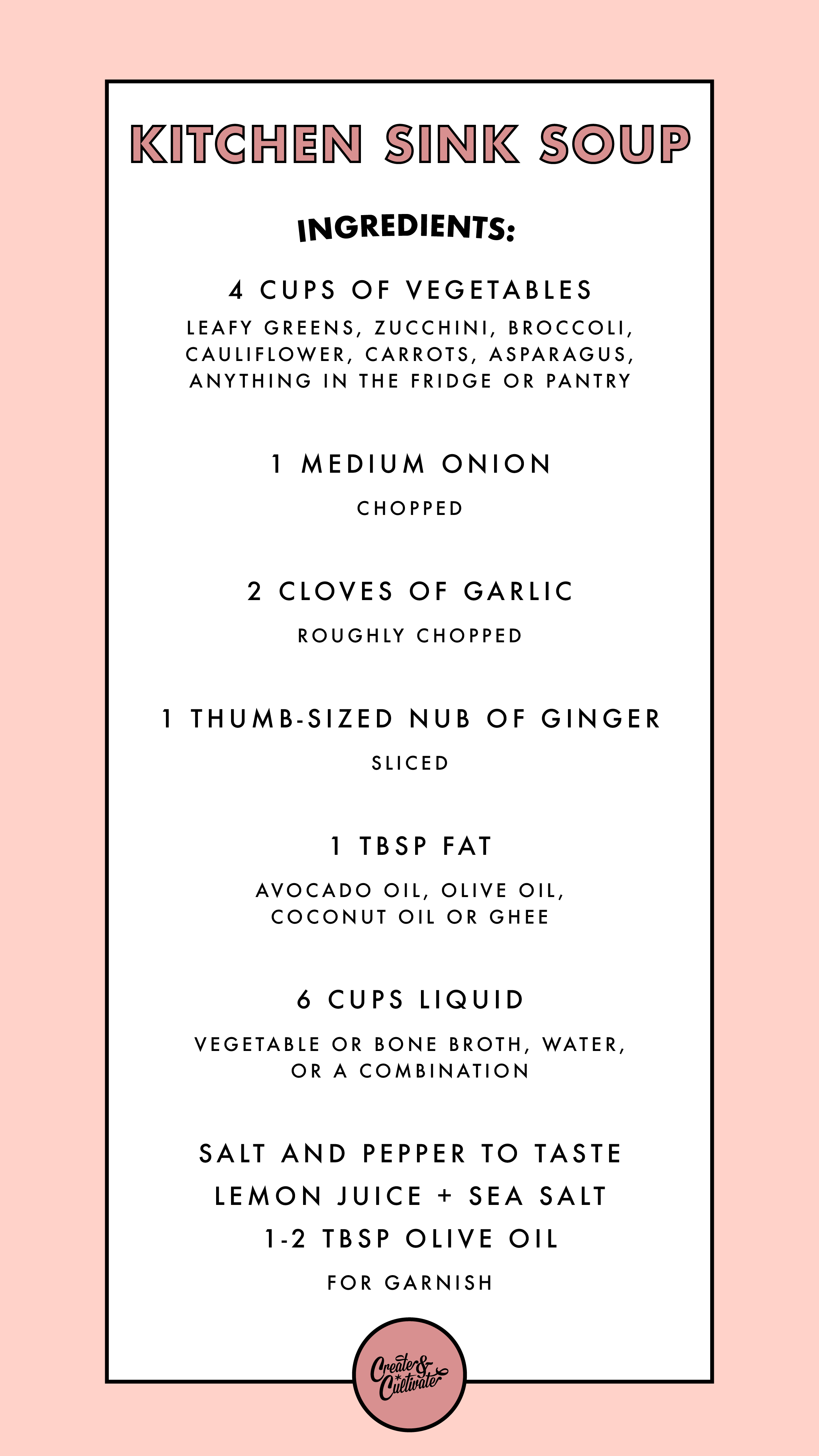
An excellent way to make the most of unused produced that’s sitting in your crisper drawer, this soup, courtesy of Mia Rigden, a nutritionist and the founder of RASA, is nutritious, flavorful, and a perfect way to reset. Make a big batch and freeze leftovers so you’ll always have a healthy meal on hand.
Instructions:
Heat coconut oil or ghee in a Dutch oven.
Add onions and garlic, stirring until fragrant, then add vegetables and stir for a minute or two longer.
Add broth then enough water to cover the vegetables (about two cups). Let simmer for 20-30 minutes and puree in a high-speed blender (or with a hand blender) until smooth.
Season as desired and serve with a squeeze of lemon, a splash of olive oil, and some sea salt
For a step-by-step tutorial, watch the Ask an Expert Live segment via Create & Cultivate’s Instagram here.

Nutritionist and founder of RASA
Turmeric Vegetable Fried Rice

This recipe puts a colorful spin on traditional fried rice with extra anti-inflammatory power! Wendy Lopez and Jessica Jones, registered dietitians, certified diabetes educators, and the founders of Food Heaven, bring us this easy and delicious way to make the most of super-spice turmeric!
When cooking your brown rice, add 1/2 tablespoon of turmeric to the boiling water, and cook as per package instructions. Set aside once done.
In a large pan, heat the sesame oil, and add the onions. Sauté for 1-2 minutes over medium heat.
Add in the eggs, and cook for 1-2 minutes.
Then add in the mixed vegetables, 2 cups of cooked turmeric rice, and the soy/tamari/aminos.
Cook over low heat for 4-5 minutes.
Turn off the heat, and mix in the cabbage and sprouts. Add salt, to taste, and top with scallions. Enjoy!
Recipe Note: The vegetables in this recipe are totally flexible and you can use whatever frozen/raw veggies you have stocked in the fridge.

Registered dietitians, certified diabetes educators, and founders of Food Heaven
Calabrian Chili Pasta

Pasta, our fave go-to for easy dining, doesn’t have to be boring! Gaby Dalkin is a trained chef, recipe developer, entrepreneur, and the founder of What’s Gaby Cooking, shows us how to spice up the pasta you are probably eating for the millionth day in a row.
Fill a large pot with water and bring to a boil. Cook the Cassarecce according to the package directions. Once al dente, drain the pasta, reserving 1 cup of pasta water for future use and set aside.
In a large sauté pan, add the olive oil and heat over medium heat. Add the garlic and sauté for 30 seconds until fragrant. Add the lemon zest (saving the lemon juice for later) and sauté for 15 seconds. Add the Calabrian hot pepper paste and stir until everything is evenly incorporated.
Add the cooked pasta and stir to combine. If you need to add a few tablespoons of the reserved pasta water to thin it out, go ahead. Add the lemon juice and toss to combine. Season with salt to taste.
Sprinkle the pecorino over the pasta if desired and toss to coat and serve immediately.

Founder of What’s Gaby Cooking
This story was originally published on April 13, 2020, and has since been updated.
MORE ON THE BLOG

4 Organization Hacks to Help You Take Control of Your Life
We call it self-care.

Photo: Teona Swift from Pexels
When your home is cluttered and chaotic, it can be difficult to muster up the energy needed to tackle even the smallest of chores. The worse it gets, the harder it is to find both the time and strength to put things right. But all that disorder is actually doing you harm.
Research has shown that living and working in a clean, orderly environment is beneficial to both mental and physical health. Well-organized spaces lower stress levels, increase motivation, improve sleep, and even encourage healthier decision-making.
Organizing and cleaning a cluttered house may seem like a colossal task, but if you break it into smaller pieces, you’ll be amazed at what you can achieve. Here are four small(ish) organization hacks and decluttering tips to help you get started today.
Get Your Closets in Order
When your household closets are well organized, everything is so much easier to find. (In other words, you’ll never be late for an early morning meeting again!) No matter what kind of closet you’re looking to tackle, the following six steps should help you straighten things out:
Gather your materials. You’ll need some basic cleaning supplies and boxes for sorting. Empty the closet of all contents.
Wipe down the shelves and sweep/vacuum the closet floor.
Sort the contents of the closet into three piles: keep, donate, and trash/recycle. If you’re having trouble deciding whether something is worth keeping, ask yourself, “Have I worn/used this in the last year? If my home burned down and I lost everything, would I replace this?”
Assess your storage needs and make any adjustments necessary, such as installing shelves or making use of baskets and bins.
Organize the closet contents by grouping similar items together. Place the items you use most often in the most accessible area and seldom-used items toward the back of the closet or on a high shelf.
Once your closet is properly organized, keep it that way by maintaining it throughout the year.
Organize Your Files and Records
Whether you use your home office for work or for managing your household's most important documents, you can't get much done if your files are a cluttered mess. Fortunately, putting things in order isn’t difficult!
Tools you’ll need: A shredder, a scanner, and a recycle bin.
Start by coming up with a system to organize your files. It can be alphabetical, numerical, or whatever makes sense to you. Then, set up folders for each type of document being filed. For instance, you might have one folder for medical forms, one for tax documents, and one for household manuals. By constructing a clear and straightforward filing system, you’ll always know where to look for important documents.
Next, gather up everything in the house that needs to be filed. Make sure to grab any mail tucked away in various nooks and crannies, documents or manuals that were randomly pigeonholed, and odd papers strewn about on tables and counters. Sort the documents into four piles: urgent, file, shred and recycle.
Once your papers have been sorted:
Place your “urgent” documents (like high-priority bills) in an obvious spot on your desk. It may help to have a tray specifically for this purpose.
Digitize all documents you plan on keeping. There are many reasons to scan your records, but chief among them is that it’s far easier to back things up. Name the files appropriately and then move them to the applicable folder.
For physical copies, you need to hang onto (i.e. birth certificates), place documents in a flood/fireproof safe.
Collect all items for disposal. Shred anything containing account numbers, birth dates, maiden names, passwords, pins, signatures, or Social Security numbers. Recycle what’s left.
It’s paramount you back up all of your important files. Natural disasters and computer crashes seem to happen when we least expect them, and you don't want to lose anything you need. Backups can be kept on an external drive, in cloud storage, or in a safe.
Catalog Your Photos
Like your household documents, organizing your photos begins with gathering them all up into one central digital or physical location. As you do this, be sure to preserve any existing organizational structures—such as digital folders, paper envelopes, or albums—as these often provide information about a group of photographs. Then you can get to work!
For digital photos:
Review and edit: Delete duplicate, repetitive, and poor-quality shots. Edit what’s left by cropping and rotating, removing red-eye, and touching up exposure and contrast where needed.
Create folders: Choose a method for organizing your photos on your computer. You can do it chronologically, by theme, or even by person/pet.
Rename and file: Rename each photo and place it into the folders you created.
Backup: Back up each batch of photos as soon as they’ve been organized into folders using at least two of the following methods: an external drive, the cloud, an online storage service, or physical copies.
Delete: Erase the photos from your camera or phone to avoid accidentally downloading duplicates and to create space for your next photo opportunities.
Keep it up: At least once a month, download photos from your camera/phone to your computer to avoid them being lost.
For physical photos:
Be prepared: In order to properly organize your pictures, you will need to invest in a large set of photo albums as well as some photo boxes.
Sort: Arrange your prints into groups by year, event, or subject.
Record details: As you sort, write an identifying description on the back of each photo with an acid-free, photo-safe pen. You can record details such as the date or who's in the photo.
Cull: Throw away photos that are blurry, poorly exposed, or are of something you don’t feel the need to keep.
Digitize: Scan your prints and sort them into your digital folders. This will serve as a backup should anything tragic happen.
Display: Put your favorites into an album or frame!
Photographs need special care to survive the passing of time. Storing your photos properly is incredibly important to their longevity. Albums with acid-free plastic sleeves and specially designed photo boxes are the best way to keep them safe. Since temperature, humidity, and light can negatively affect photos, keep them stored in a cool, dry area—and avoid storing them in basements or attics.
Whip Your Garage Into Shape
If you've accumulated a gargantuan amount of clutter in your garage, you are not alone. Garages often become a dumping ground for all those items that we don’t know where to stash. If you’re ready to take on the giant project that is your garage, here’s how to go about it.
Tools you’ll need: Some heavy-duty trash bags, broom, shop vac, and plenty of storage bins.
As with your closets, you’ll need to start by purging the garage of its contents before you can start to organize. Arrange your bins, baskets, and trash bags beforehand. Lay everything out on your driveway and being to sort it into categories (e.g. car supplies, tools, sports equipment, lawn, and garden). Once you’ve done that, you can separate the items you wish to donate, sell, or throw away.
Clean your garage well, making sure to dust shelves, sweep out cobwebs, and wash the floor. Assess your garage storage needs and decide how you’d like to utilize your vertical space (pegboards, cabinets, shelving, etc.). Once everything is properly installed, you can move items back into the garage and store them in their proper homes. Place frequently used items closest to the garage door. If you have children in the house, make sure household chemicals and other dangerous items are stored in a locked cabinet.
Take It to the Next Level
As you get better at organizing, you can start creating “centers” around your home, such as a homework center or a recycling center. Sectioning your home in such a way can help you to keep clutter at bay and use your space to its fullest potential.
Organizing your house doesn’t have to be an overwhelming operation. By breaking big jobs into smaller tasks, you can squeeze a little bit of organization into a few hours of your time. And believe it or not, finishing even the smallest of these projects in a weekend will put you in a good mood for the rest of the week.
About the Author: Liz Greene is a feminist, makeup enthusiast, and anxiety-ridden realist from the beautiful city of trees, Boise, Idaho. When she’s not writing, she enjoys eating fancy cheeses, fantasizing about what life would be like if she had an Iron Man suit, and re-watching Venture Bros. episodes for the 100th time.
Love this story? Pin the below graphic to your Pinterest board.

This post was published on November 15, 2018, and has since been updated.
MORE ON THE BLOG

How Being Overdressed for an Interview Can Negatively Affect Your Chances of Landing the Job
Make a great first impression.

Photo: Create & Cultivate
Once you schedule an interview, these are just a few of the questions that might be swimming in your head: What if I show up and I’m overdressed? What if I’m underdressed? Will it even make that much of a difference? How bad is it really to be overdressed for an interview?
According to data released in the Job Interview Anxiety Survey, 92% of employed Americans get stressed out about job interviews, but it’s not just the actual interview that stresses people out. Figuring out what to wear for an interview can often become just as stress-inducing as wondering what questions they will ask you.
With the rise of startups and tech companies with laid-back company cultures, figuring out what to wear for your next interview has become more confusing than ever, but these tips will help you navigate the process with ease.
How bad is it to be overdressed for an interview?
Really bad.
If you’re interviewing at a company known for its laid-back dress code and company culture, showing up to your interview in a suit will show that you haven’t done your research on the company and the environment.
Even worse, showing up in a suit could mean that you did research the company and didn’t care about the dress code and rules.
What can you do to ensure that you’re properly dressed?
Research the company to figure out what the company culture is like. Company culture often dictates the dress code and how formal or casual people will dress. Use websites like Glassdoor to your advantage. These platforms allow users to rate and comment on companies, giving you inside knowledge about the company culture, and what it’s really like to work there. Often people will discuss dress code and the general vibe of the office.
Another option is to search for employees on LinkedIn. Observe what employees are wearing in their LinkedIn profile photos to get a better sense of the daily dress code.
Finally, if all else fails, pick up the phone and ask someone about the company’s dress code. This is something so simple, yet almost no one does this. If you want to make sure that you won’t be overdressed for an interview, simply pick up the phone and call the front desk or a recruiter that you’re working with.
If the dress code is really casual, stick with the guidelines, but ensure that you look put together and ready for work.
This is the most important thing to remember when you’re figuring out what to wear for an interview. I always suggest being a step above the dress code, but if you do decide that it would be in your best interest to come completely casual, just make sure that you look put together. Regardless of whether or not the dress code is super casual, you do not want to look like you just rolled out of bed. You’re still interviewing for a job.
If you do decide to go with jeans, make sure they are dark wash jeans without any rips or tears. Similarly, if you opt for a T-shirt, make sure that it is clean, plain without graphics or logos, and wrinkle-free. If you don’t like to iron, (I hate ironing!) invest in a mini steamer. It will change your life and make it super simple to get the wrinkles out of any of your clothes.
How bad is it to be overdressed for an interview? Depending on the company it could be detrimental and could be the reason why you don’t get the job. Showing up completely overdressed suggests that you didn’t research the company and have not paid any attention to the company culture.
Employers want to ensure that they hire employees who will fit in with the general office vibe, and showing up to an interview overdressed can be a major red flag. When you’re determining what to wear for your next interview, do some research on the company dress code and company culture, and dress accordingly. With the rise of business casual and completely casual dress codes, figuring out what to wear for your next interview can be tricky, however, if you follow these simple steps, you’ll be good to go.
Good luck!
About the author: A native San Franciscan, Michele Lando is a certified professional résumé writer and the founder of writestylesonline.com. She has a passion for helping others present the best version of themselves, both on paper and in person, and works to polish an individual’s application package and personal style. Aiming to help create a perfect personal branding package, Write Styles presents tips to enhance your résumé, style, and boost your confidence.
Love this story? Pin the below graphic to your Pinterest board.

This story was originally published on September 21, 2018, and has since been updated.
MORE ON THE BLOG

Everyday Humans Founder on WFH (From Hong Kong!) and Making It Work 12 Hours Ahead of EST
Asana is key.


Photo: Courtesy of Charlotte C. Pienaar
Welcome to our monthly editorial series A Day in the Life where we ask women we admire to share the daily minutiae of their professional lives, from the morning rituals that set them up for success to their evening wind-down routines. This month, we caught up with Charlotte C. Pienaar, the founder of Everyday Humans, to chat about what inspired her to launch an SPF-led skincare brand, why she’s working toward the goal of no screens before 8 a.m., and how she manages her time while working 12 hours ahead of EST.
Tell us a bit about Everyday Humans and what inspired you to launch your business. What whitespace did you see in the market, and what need did you want to fill?
We’re a newly launched DTC skincare brand that makes comfy, planet-friendly sunscreens for all. As a conscious founder who cares about the planet and cultural diversity, I’m passionate about sustainability and inclusivity and created Everyday Humans with the belief that sunscreen should be for all humans and the foundation of all skincare routines. I saw a whitespace in the market for SPF-led skincare products that combined multi-tasking formulas, good for the planet packaging at everyday prices.
Now, let’s talk about your workday routine! First, are you a night owl or a morning person? When do you do your most important work and why?
I’m physically a morning person so I schedule calls with the team and external parties and review my to-do list in the morning, then I do reactive work throughout the day, like approving things, responding to emails and requests, and general ops and coordination work. My brain only fully activates and the real magic happens in the after-hours when my creative side kicks in—deep-dive research, product ideas, campaigns concepts, marketing strategy—comes through at night.
What time does your alarm go off, and what’s the first thing you do upon waking?
I have two children so my alarm is my youngest who is one and a half years old and I get up before 6 a.m. on most days. The first thing I do is to get to the kitchen to make a bottle of milk for him. Nothing fun or glamorous, just good ol’ parenting.
What does your morning, pre-work routine look like?
This is the time when the entire family sits together for breakfast before work or school. I try to be as present as possible to spend quality time with my husband and kids. Sometimes, urgent emails and requests get in the way but I’m working towards no screens before 8 a.m.!
Take us through your morning skincare routine. How do you prepare your skin for the day?
I’m a really lazy skincare person so I like products that are multi-purpose and can combine steps. The first thing in the morning is to wash my face to get rid of excess oils that developed overnight. I’ve been really into face cleansers with a gentle exfoliant as it brightens and resurfaces my skin before I apply any skincare on so everything absorbs better. We’re in the midst of developing one so it’s extra awesome to try many brands and to test drive what works for me.
After that, it’s toning. I've recently been obsessed with Hada Labo’s lotion as it’s a toner, serum, lotion combo that helps my skin feel prepped and ready to go. My last and most important step is a multi-tasking serum and sunscreen, and of course, it would be my Resting Beach Face SPF30 sunscreen serum, which is a super lightweight organic SPF30 and hydrating serum all rolled up in one. It doubles up as skincare as it has moisture-boosting hyaluronic acid and pentavitin, antioxidant-rich spinach and green tea extract, and kopara extract that wards off urban pollutants and pollution. I rarely wear make-up so the bonus is it leaves a gorgeous lit-from-within finish that makes my skin look healthy, glowy, and well-rested.
Mark Twain said, “Eat a live frog first thing in the morning and nothing worse will happen to you the rest of the day.” What’s the first thing you do when you get to your desk?
The first thing I do in the morning is also the most important. I update my to-do list to make sure I have a bird’s eye view of what I have to work on for the day and schedule and prioritize accordingly.
What are you working on this week?
It’s been an interesting week as I’m on a 21-day quarantine and trying to balance work with two small children! We’ve just done a one-year review of the brand, putting together what we’ve achieved so far, what we’ve missed the mark, and how we’re going to improve in the future. It’s been challenging to work with kids in the background but I love doing big-picture and strategy work to align with all stakeholders so this has been a great week.
What’s been the most rewarding part of running your business? The most challenging?
Seeing customers happy and calling our sunscreens their holy grail. We have a Slack channel where we share mentions, reviews, and customer feedback to the entire team and it always makes me smile from the inside when we receive a positive note from a total stranger. The most challenging part is to always be one step ahead of the game. We’ve just celebrated our one-year anniversary and the landscape has changed so much since the inception of Everyday Humans. To be able to not lose sight of your mission while being able to innovate, plan ahead and execute flawlessly are all super hard but when you overcome obstacles and come out stronger and wiser, it’s incredibly rewarding.
Do you ever reach inbox zero? What tips can you share for handling the constant influx of inquiries and communication founders are so familiar with?
TBH I don’t think it was ever a goal, and friends are freaked out by the amount of unread messages I have! I love subscribing to newsletters so perhaps that doesn’t count?
What is your go-to work lunch?
I try to limit my carb and protein intake to keep my energy up. My go-to’s are a healthy helping of vegetables in various forms—steamed, stir-fried, grilled, raw—just as it is or as a warm or cold salad, my other go-to is brothy and vegetable-heavy soups that keep me full without feeling like I’ve overeaten (or else I’ll get sleepy!). I’ve always made my own lunches—even before the pandemic—so it’s extra awesome to see how other people put together theirs and take inspiration from them.
What advice do you have for balancing the minutiae of day-to-day tasks with big-picture planning?
By making it compulsory. We schedule monthly huddles, quarterly check-ins, bi-annual re-alignment, and annual planning.
What are some work habits that help you stay healthy, productive, and on track to reach your goals?
Taking time off every month to focus on your hobbies is compulsory at Everyday Humans. I try to encourage our team to share what we do outside of work and it’s been fun to learn about everyone’s interests. There’s something about sharing your intentions with a close group that encourages you to act on them. I’ve picked up some new hobbies that I never thought I would get into, like journaling, virtual workouts, and pottery because I spoke about it to my co-workers!
Any favorite apps you use regularly?
We run our entire company off project management software Asana so that’s my #1 favorite app.
What are you reading, watching, or listening to right now to help you wind down at the end of the day?
“Pop Culture Happy Hour” to keep me up to date as I’m so behind with gossip, lol. “Stuff You Should Know” is amazing and the good ol’ “How I Built This with Guy Raz.”
When do you go to bed? What’s your “optimal” number of sleep hours?
As I’m 12 hours ahead of EST, it’s hard to not stay up late for calls and emails till midnight or 1 a.m. The ideal is to be in bed before 10:30 p.m. and my optimal is 8 hours of uninterrupted sleep.
What’s the most rewarding part of your day?
Besides happy customers, seeing my team members grow makes me super happy. My job is to empower and equip my frontline staff to make better decisions than myself, so witnessing the fruits of my labor is incredibly rewarding.
MORE ON THE BLOG

Is Upstate New York the New Silicon Beach? 3 Founders on How Moving From the City to the Country Benefited Their Biz
Entrepreneurs are flocking to this incubator haven.
Upstate New York has always been a haven for creatives, and when COVID hit in 2020, many founders relocated from New York City to upstate out of necessity, desire, or both. Below are profiles of three entrepreneurs—Trinity Mouzon Wofford, the founder of Golde, Eliza Blank, the founder The Sill, and Hillary France, the founder of The Wylde—who made the move from the city to the country last year. Read on to discover how the change impacted these founders and their businesses.

Trinity Mouzon Wofford, Founder of Golde
Saratoga Springs, New York
During the summer of 2020, when COVID was surging, Trinity and her fiancé Issey, the cofounder of Golde, spent the summer in Saratoga Springs to gain some relief and safety from the intense situation in N.Y.C. They were going back and forth from Saratoga to Brooklyn, a three-and-a-half-hour ride each way, when Trinity had the realization that, for the time being, it made sense to return full-time to upstate New York to live and run their business.
On one ride down from Saratoga during late summer, she remembers thinking to herself that she needed to go back; that perhaps running her superfood health and beauty startup, Golde, and paying rent in Brooklyn for too little space was not benefiting the growth of her business nor her own personal growth. On top of these challenges, Trinity and Issey are in an interracial relationship and, in the city, tensions were becoming palpable during the summer of 2020 in response to the BLM movement and the upcoming election. In a way, she felt as though the systems of the city were starting to fail her and she needed to actively change her surroundings for the benefit of herself, her family, and her business.
Trinity grew up in Saratoga Springs. In fact, four generations of Trinity’s family have lived in the same house that she returned to, where her mother still lives. Returning to the house that her ancestors had lived in for generations felt very natural and provided a safe space to gain a fresh perspective. It’s allowed her to go deeper into outlets such as gardening and plant care, which, in her own words, have allowed for more creativity. Not surprisingly Golde has benefited from this positive energy and change.
During this past year, Golde has been lucky. The business hasn’t been negatively affected, and has, in fact, thrived. In January, Golde launched in Target, and one of the brand’s two new products scheduled for release in 2021, Shroom Shield, has launched. The team has always been remote so no adjustments were needed in order to keep the business running smoothly. The lack of pressure to be everywhere and do everything, something that anyone who lives in a big city can relate to, has allowed her to realize that she can’t predict the future. She can only think a few steps ahead, and for the first time, she is living in the moment and is fully enjoying it and the lack of pressure this brings.

Eliza Blank, Founder The Sill
Stone Ridge, New York
It’s a similar story for Eliza. Coincidentally, both she and her husband Steve grew up in more rural areas of Massachusetts, so the desire to feel the grass under their feet has always been there. She found herself at NYU for university, and although she loved the city, she always missed nature. It’s this love of nature that inspired her to start The Sill, an online plant nursery that delivers botanicals right to your doorstep. It also inspired her to buy her first home in Stone Ridge, situated in the Catskills, in 2015.
The paths to starting The Sill—as well as finding a house in upstate New York—were not straightforward ones. Eliza found raising money for The Sill to be challenging. Venture capitalists often want fast growth at all costs, and Eliza was committed to making sure her foundational economics worked, which, for her, meant slower growth with her eye on profitability from day one. After an arduous raise, she is confident they found the right investors for The Sill, and these investors have been by her side navigating the most difficult year yet. As was the case for most businesses, March 2020 was a very dark time. All five of The Sill’s stores were closed and the distribution center in California was forced to shut down. The bright spot is that sales didn’t suffer. As it turns out, people look to plants for emotional support, and since people could not be together, they found connection in giving small gifts of kindness in the form of plants to each other.
In 2015, when buying their house upstate, Eliza realized that their mortgage would be less expensive than their rent in the city. Little did they know that five years later this house would become their permanent residence, sanctuary, and office for over a year. The past 18 months have led her to question if the social convention of the office is necessary. Does the team even need a five-day workweek? Eliza has started to hire permanently remote team members as far away as Hawaii and the business’s headquarters are now fully remote. For Eliza, she firmly believes that the space and closeness to nature their home provided them mitigated the extreme pressure and stress she experienced during COVID as a leader and also as an Asian American woman. Her home upstate became an oasis from what the world had become, or perhaps further revealed, that we live during a time of extreme unrest and racism.
When asked what’s next for her and her business, Eliza responds that she wants to live a life well-lived. She wants her two-and-a-half-year-old daughter to have the space to play and become independent. For the business, she wants to further realize the broad ways in which nature can be infused into our homes and what the brand essence of The Sill is, and how it can evolve to fit into this new space that we have all found ourselves living in. For Eliza’s family, they will go back to the city for a year in the fall and see how it feels. For right now, the country has allowed her to have creative breakthroughs and reimagine how The Sill can further help us maintain our well-being within our home as we spend more time there than ever before.

Hillary France, Founder of The Wylde
Hudson, New York
Hillary had always thought she would make the gradual move from spending weekends in Hudson, New York to living there full time. What she could not have predicted was that this move would happen as abruptly as it did in March 2020. For seven years, through her company Brand Assembly, Hillary had been running trade events for some of the most enviable fashion brands. Her business had been thriving, and then, within the first month of COVID, the Brand Assembly’s trade show business was almost obliterated.
She saw an 80% drop in activity and she soon found herself in the position of having to reimagine her whole business model. She immediately gave up her office, attempted to pivot but was unable to make it work, and slowly drained her resources. She had to accept that perhaps this almost fully offline and in-person event business was not an operation that could survive a pandemic. Not surprisingly, for the last year, her trade show business has been on hiatus (and the good news is that they are set to return in October of 2021), however, the backend operations piece called The Faculty is still fully functioning. This situation could have fully devastated Hillary, but instead, it pushed her to finally pursue a dream she had always had: to create a space for brands and community to convene in one place in Hudson. At that point, she had nothing to lose so she packed her bags, gave up her N.Y.C. apartment, and moved to her weekend house in Hudson to create what is now called The Wylde.
Hillary had spent nine years going back and forth to Hudson and saw an opportunity for a retail annex in this quickly growing city. In fact, Hudson was recently ranked the #1 metro area in terms of the biggest change in net migration. With the influx of people to the area, she figured there was more of an opportunity than ever to create a space where people could feel a sense of community and continue to be inspired by fashion and conversation. On April 17, 2021, Hillary launched the Wylde’s first outdoor market Summer Saturdays with a selection of handpicked vendors across apparel, accessories, vintage, and apothecary. Local N.Y. brands like M.Patmos, Hudson Hemp, and Lail Design are featured within the market while the permanent retail store that opened on April 30th launched brands like Rachel Comey, Dôen, Mondo Mondo, and more.
Is The Wylde solely an upstate dream? In Hillary’s mind, it’s not. When taking the Amtrak train down to the city she has daydreams of opening The Wylde up in another emerging market if she finds success in Hudson. Rather than feeling consumed by the fashion space she feels excited about how fashion, culture and even coffee (a Wylde cafe is slated to open in August 2021) can bring people together to create community and meaning. This evolution of the business more truly reflects the changes she has felt personally this past year and the community that she had always sought to be a more permanent member of.

Melissa Grillo Aruz, Founder of Aruz Ventures
About the author: Melissa Grillo Aruz has been an active part of the New York startup ecosystem for the past 20 years having senior roles at Forerunner Ventures, Gilt Groupe, and more. She currently runs her own marketing and talent consulting business under www.aruzventures.net where she helps commerce companies scale their business. She currently splits her time between upstate New York and Brooklyn. Instagram and Twitter @melgrilloaruz.
MORE ON THE BLOG